Private Key vs Public Key in Crypto: Differences, Examples and Safety Tips
Quick answer: A private key is the secret that gives control over crypto funds. A public key is derived from the private key and helps the blockchain verify that a transaction was signed by the rightful owner. A wallet address is usually a shorter, shareable form derived from public-key information and is what you normally give someone to receive crypto.
Important safety rule: Share your wallet address, be careful with public keys, and never share your private key, seed phrase or recovery phrase with anyone.
1. What Beginners Need to Know First
Crypto does not work like a bank account with a password reset button. In self-custody crypto wallets, ownership is proven with cryptographic keys. These keys are not physical keys; they are pieces of data that your wallet uses to receive funds, prove ownership and approve transactions.
The confusing part is that people often mix up four related terms: private key, public key, wallet address and seed phrase. They are connected, but they are not the same thing. Understanding the difference can prevent costly mistakes.
| Term | Simple meaning | Can you share it? | What it is used for |
|---|---|---|---|
| Private key | A secret number that controls a specific crypto account or address | No | Signing transactions and proving ownership |
| Public key | A key mathematically derived from the private key | Usually not needed to share directly | Verifying digital signatures |
| Wallet address | A shorter public receiving destination, often derived from public-key data | Yes, for receiving funds | Receiving crypto and identifying destination accounts |
| Seed phrase / recovery phrase | A backup phrase that can recreate many private keys in a wallet | No | Recovering your wallet if your device is lost or damaged |
2. Private Key vs Public Key: The Core Difference
The easiest way to understand the difference is to think of a locked mailbox or vault:
- Your wallet address is like the mailbox location. People can use it to send you something.
- Your public key is like information that lets others verify you are the person connected to that mailbox without seeing your secret key.
- Your private key is like the only key that can open the mailbox and authorize moving what is inside.
In crypto, your wallet signs a transaction with the private key. The network then uses the related public key or signature data to check that the transaction is valid. The private key does not need to be revealed for this verification to happen.
3. How Crypto Keys Work Step by Step
Most beginner wallets hide the technical details, but the basic flow looks like this:
- The wallet creates a very large random private key, or derives it from your seed phrase.
- A public key is mathematically generated from that private key using one-way cryptography.
- A wallet address is created from public-key information, usually by hashing and formatting it for a specific blockchain.
- Someone sends crypto to your wallet address.
- When you want to spend or transfer the crypto, your wallet signs the transaction with your private key.
- The blockchain network verifies the signature and records the transaction if it is valid.
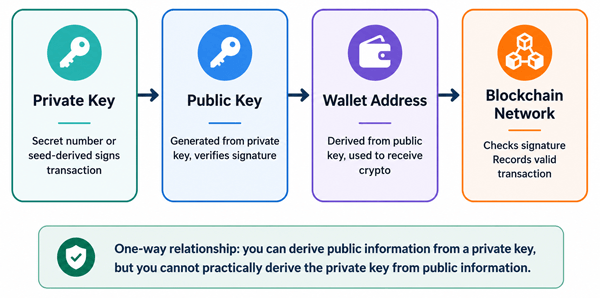
Diagram: Simplified relationship between a private key, public key, wallet address and blockchain verification.
| Feature | Private key | Public key |
|---|---|---|
| Visibility | Must remain secret | Can be public, although most users share addresses instead |
| Main purpose | Signs transactions and controls spending | Helps verify signatures |
| Direction of derivation | Starting secret | Derived from the private key |
| Can it receive funds? | Not directly; never paste a private key as a receiving address | Usually not what you share; use the wallet address |
| If exposed | Funds can be stolen | Usually not enough to steal funds with today’s cryptography, but it may reduce privacy |
| If lost | Funds may be permanently inaccessible unless backed up | Usually can be regenerated from the private key or wallet data |
4. What Is a Private Key in Crypto?
A private key is a secret value that gives control over crypto linked to the matching public key or address. In many systems, it is a 256-bit number, which means it is chosen from an enormous range of possible values. Good wallets generate private keys using secure randomness so they are not guessable.
You normally do not need to view or type your raw private key. In modern wallets, you usually interact with a seed phrase or recovery phrase instead. The wallet uses that phrase to recreate the private keys behind the scenes.
4.1 What a Private Key Does
- It proves control of funds without asking a bank or exchange for permission.
- It signs transactions when you send crypto or interact with a smart contract.
- It allows wallet recovery if it can be recreated from a properly backed-up seed phrase.
- It makes self-custody possible, but it also makes you responsible for safe storage.
4.2 Private Key Example
A raw private key can look like a long string of letters and numbers. For safety, never use an example key found online and never show your real key to anyone. A simplified example might look like this:
b8f4...9a21
Real private keys are much longer. The important point is not the format; it is the role. Whoever can use the private key can approve transactions from the related account.
5. What Is a Public Key in Crypto?
A public key is created from the private key through one-way mathematics. The public key can be used by the network to verify that a transaction signature came from the related private key, without exposing that private key.
In everyday wallet use, you usually do not copy or share the full public key. Most of the time, you share a wallet address instead. The wallet address is easier to handle and is designed for receiving funds.
5.1 Public Key Example
A public key is often a long hexadecimal string. A shortened example might look like this:
03a34b...e7c9
The exact length and format depend on the blockchain. Bitcoin and Ethereum both use public-key cryptography, but their address formats and transaction models differ.
6. What Is a Wallet Address?
A wallet address is the public destination you normally share when you want to receive crypto. It is not the same as your private key. It is also usually not the same as the full public key, although it is derived from public-key information in many crypto systems.
Examples of common address formats:
- Bitcoin legacy addresses may start with 1, while SegWit addresses may start with bc1.
- Ethereum addresses start with 0x and are 42 characters long including the prefix.
- Different blockchains use different formats, so an address that works on one network may not work on another.
7. Private Key, Public Key and Address: Real-World Scenario
Imagine Sara wants to receive ETH from Ali.
- Sara opens her Ethereum wallet and copies her public Ethereum address, such as 0xA1...B9.
- Sara sends that address to Ali. This is safe because it is only a receiving address.
- Ali pastes the address into his wallet, checks the network and sends ETH.
- Later, Sara wants to move some ETH. Her wallet uses her private key to sign the transaction.
- The Ethereum network verifies the signature and accepts the transaction if it is valid.
Sara never sends Ali her private key or seed phrase. If she did, Ali or anyone else who saw it could potentially move her funds.
| Action | Use private key? | Use public key? | Use wallet address? |
|---|---|---|---|
| Receive crypto | No | Usually hidden in the background | Yes |
| Send crypto | Yes, to sign | Yes or signature data is used for verification | Yes, for the recipient destination |
| Check balance on a block explorer | No | No, usually address is enough | Yes |
| Recover a wallet | Maybe, but seed phrase is more common | No | No |
| Prove a message came from you | Yes, to sign | Yes, to verify | Sometimes used as identity |
8. What Is a Seed Phrase and How Is It Different?
A seed phrase, also called a recovery phrase or mnemonic phrase, is a human-readable backup for your wallet. It often contains 12 or 24 words. It is not the same as one private key, but it can recreate the wallet and generate many private keys and addresses.
This is why a seed phrase must be protected as seriously as the private keys themselves. If someone gets your seed phrase, they may be able to restore your wallet on another device and move your funds.
| Item | Controls one address or many? | Beginner-friendly backup? | Risk if exposed |
|---|---|---|---|
| Raw private key | Often one key/account, depending on wallet type | No | Attacker may control the related funds |
| Seed phrase | Often many accounts/addresses in an HD wallet | Yes | Attacker may control the whole wallet |
| Wallet address | Receives funds only | Not a backup | Others may view transaction history or send funds, but cannot spend from it |
9. Benefits of Public-Key Cryptography in Crypto
- No central password database is needed to prove ownership.
- You can receive funds using a public address without revealing the secret that spends them.
- Transactions can be verified by the network without exposing private keys.
- Self-custody is possible for users who want direct control over their assets.
- More advanced setups, such as hardware wallets and multisig wallets, can improve security.
10. Risks and Limitations Beginners Should Understand
- There is usually no simple recovery if you lose your private key or seed phrase.
- Anyone with your private key or seed phrase may be able to steal your funds.
- Blockchain transactions are generally irreversible after confirmation.
- Fake support agents, phishing websites and malicious wallet apps often target seed phrases.
- Sharing wallet addresses can reveal balances and transaction history on public blockchains.
- Copy-paste malware can replace a recipient address with an attacker’s address.
11. Common Misconceptions About Private and Public Keys
| Misconception | Reality |
|---|---|
| “My wallet app stores my coins.” | The blockchain records balances and transactions. The wallet stores or manages the keys needed to control them. |
| “My public key and wallet address are the same thing.” | They are related, but not always identical. Most users share wallet addresses, not full public keys. |
| “If I forget my wallet password, the company can reset it.” | With self-custody wallets, the password may protect the app, but the recovery phrase is what restores the wallet. Without it, recovery may be impossible. |
| “It is safe to type my seed phrase into any wallet website.” | Only enter a recovery phrase into a trusted wallet recovery process you intentionally started. Never enter it because a pop-up, support agent or email asks for it. |
| “A screenshot is a good backup.” | Screenshots can sync to cloud services or be stolen by malware. Offline written or metal backups are safer. |
| “Sending a small test transaction is unnecessary.” | A test transaction can help catch wrong networks, wrong addresses and copy-paste attacks before sending a large amount. |
12. Private Key Safety Tips: Best Practices for Beginners
- Never share your private key, seed phrase or recovery phrase. No legitimate support team needs it.
- Write your seed phrase offline on paper or a metal backup. Store it somewhere private, dry and secure.
- Do not save seed phrases in screenshots, email drafts, cloud notes, chat apps or unencrypted documents.
- Use a hardware wallet for meaningful long-term holdings. It keeps signing keys isolated from your everyday computer or phone.
- Verify the full recipient address and network before sending. At minimum, check the beginning, middle and end; for large transfers, verify on the hardware wallet screen.
- Send a small test transaction before moving a large amount to a new address or network.
- Keep wallet apps, browsers and operating systems updated to reduce malware risk.
- Download wallets only from official sources and beware of sponsored search ads that imitate real wallet sites.
- Use strong device passwords and two-factor authentication for exchange accounts, but remember that 2FA does not protect a leaked self-custody seed phrase.
- Consider multisig for large funds, business treasuries or shared custody, where multiple approvals are required to move assets.
13. What to Do If Your Private Key or Seed Phrase Is Exposed
Treat an exposed private key or seed phrase as an emergency. Do not assume it is safe because “only one person saw it” or “it was only online for a minute.”
- Create a new wallet with a fresh seed phrase on a trusted device.
- Move funds from the exposed wallet to the new wallet as soon as possible, starting with the most valuable assets.
- Do not reuse the compromised wallet for future deposits.
- Revoke risky smart contract approvals if the wallet was used with DeFi apps, NFT marketplaces or token approvals.
- Check your devices for malware before entering any new wallet information.
- If funds were stolen, save transaction IDs and report the incident to the relevant platform or law-enforcement channel where appropriate.
14. Public Key and Address Privacy Tips
Public does not always mean private-safe. A wallet address cannot normally spend your funds, but it can reveal information on public blockchains.
- Use a new receiving address when your wallet supports it, especially for Bitcoin, to reduce address reuse and improve privacy.
- Avoid posting your main wallet address publicly unless you are comfortable with people seeing balances and transaction history.
- Keep personal identity separate from wallets where possible. A public donation address, NFT profile or social handle can link your identity to on-chain activity.
- Be careful with dusting attacks, where tiny unwanted deposits are sent to wallets in an attempt to track behavior.
15. Self-Custody vs Exchange Custody
When crypto is held on an exchange, the exchange often controls the private keys and you access your account with a username, password and security checks. When you use a self-custody wallet, you control the keys directly.
| Custody type | Who controls the keys? | Main benefit | Main risk |
|---|---|---|---|
| Exchange custody | The exchange or custodian | Convenience, account recovery, easier trading | Platform risk, withdrawal limits, account freezes, hacking risk |
| Self-custody wallet | You | Direct control, no need to trust a custodian to release funds | You are responsible for backups, scams, device security and mistakes |
| Multisig / shared custody | Multiple keys or parties | Reduces single-point failure | More setup complexity and recovery planning needed |
16. Pros and Cons of Self-Custody Keys
| Pros | Cons |
|---|---|
| You control your crypto directly | Losing the backup can mean permanent loss |
| No bank-style approval needed to transact | Scams and phishing can be irreversible |
| Can use hardware wallets, multisig and cold storage | More responsibility and learning required |
| Useful for long-term holding and censorship resistance | Wrong network or wrong address mistakes can be costly |
17. Beginner Checklist Before Sending Crypto
- Am I using the correct blockchain network?
- Did I copy the recipient address from a trusted source?
- Did I compare the pasted address with the original address?
- Is the amount correct, including fees?
- Is this a new address or large amount? If yes, send a test transaction first.
- Did any website, support agent or message ask for my seed phrase? If yes, stop immediately.
18. Summary
A private key is the secret cryptographic key that signs crypto transactions and controls funds. A public key is derived from the private key and allows the blockchain network to verify signatures. A wallet address is the public destination used to receive crypto. You can share your wallet address, but you should never share your private key or seed phrase.
19. FAQs About Private Keys and Public Keys in Crypto
19.1 Is a wallet address the same as a public key?
Not usually. A wallet address is often derived from public-key information, but it is normally shorter and formatted for receiving crypto. Beginners should share wallet addresses, not private keys or seed phrases.
19.2 Can someone steal my crypto with only my public key?
With current mainstream cryptography, a public key alone is not normally enough to steal funds. However, public addresses and public keys can reduce privacy because they may be linked to balances and transaction history.
19.3 Can someone steal my crypto with my wallet address?
No, a wallet address is meant to be shared for receiving crypto. The bigger risk is privacy: someone may be able to view transactions and balances associated with that address.
19.4 What happens if I lose my private key?
If you lose the private key and have no seed phrase or backup that can recreate it, the related funds may be permanently inaccessible.
19.5 What happens if someone gets my seed phrase?
They may be able to restore your wallet and move your funds. Create a new wallet and transfer funds away from the compromised wallet as quickly as possible.
19.6 Should I store my private key in a password manager?
For small amounts, some people use encrypted password managers, but for meaningful holdings, offline seed backups and hardware wallets are usually safer. Never store seed phrases in plain text or screenshots.
19.7 Why does my wallet create many addresses?
Many modern wallets are hierarchical deterministic wallets. One seed phrase can generate many private keys and addresses. This improves backup convenience and can improve privacy when addresses are not reused.
19.8 What is a hardware wallet?
A hardware wallet is a dedicated device that stores keys and signs transactions without exposing the private key to your everyday computer or phone. You still need to protect the recovery phrase.
19.9 Do I need to understand cryptography to use crypto safely?
No. But you should understand the basic rule: public addresses are for receiving, private keys and seed phrases are for control and recovery, and anyone who gets your secret keys may get your funds.
19.10 Can I change my private key?
You cannot change the private key for an existing address in the way you change a password. Instead, create a new wallet or address with a new key and move funds there.
20. Final Takeaway
Private keys and public keys are the foundation of crypto ownership. The private key is the secret that controls funds. The public key helps prove that a transaction is valid. The wallet address is the shareable destination used to receive crypto. The seed phrase is the backup that can recreate your wallet.
For beginners, the safest habit is simple: share only your receiving address, verify every transaction carefully, and protect your private key or seed phrase like the keys to a real vault.
Sources Consulted and Checked
The following sources were consulted and checked while preparing this article to support its clarity and accuracy.
- Bitcoin Developer Guide: Wallets - explains how wallet programs create public keys to receive satoshis and use corresponding private keys to spend them.
- Ethereum.org: Accounts - explains Ethereum accounts, addresses and cryptographic ownership.
- Coinbase Help: Wallet recovery phrase - explains recovery phrase responsibility in self-custody wallets.
- Ledger Academy: Public keys and private keys - beginner educational guide to crypto key pairs.
Reader Advice
This article is provided for educational and informational purposes only and is not financial, legal, tax, investment, cybersecurity, or other personalized professional advice or a recommendation to buy, sell, hold, transfer, or store any crypto asset. Crypto transactions, self-custody, wallet recovery, smart-contract use, and key management can involve significant risks, including scams, irreversible transfers, technical errors, loss of access, theft, price volatility, and regulatory or tax consequences. Rules, policies, laws, technical standards, product features, and statistics can change over time and vary by country, region, blockchain, wallet, and service provider. Before making a decision, verify current information through official sources, carefully assess the risks, and seek qualified professional advice where appropriate.