Crypto Terminology for Beginners: A-Z Glossary of Common Crypto Terms
Beginner takeaway: Crypto has its own vocabulary, but most terms describe a few core ideas: digital ownership, wallets, transactions, networks, security, trading, and risk. Learn the foundations first, then use the A-Z glossary as a reference when you see unfamiliar words.
1. Introduction: Why Crypto Terminology Feels Confusing
Crypto is full of unfamiliar words: blockchain, private key, gas fee, seed phrase, liquidity, staking, tokenomics, rug pull, and many more. Beginners often feel lost not because the ideas are impossible, but because the language is compressed. A single term can mix technology, finance, security, and online culture.
This guide explains crypto terminology in plain English. It is designed for readers who are new to cryptocurrency and want a practical, trustworthy glossary they can bookmark. You will learn what common crypto terms mean, how they fit together, and what mistakes to avoid before buying, sending, storing, or researching digital assets.
2. What Is Crypto in Simple Terms?
Crypto, short for cryptocurrency or crypto assets, refers to digital assets that use cryptography to secure ownership and transactions. Unlike money in a bank account, many cryptocurrencies are recorded on public networks that are not controlled by one central company or government. The most famous example is Bitcoin, introduced as a peer-to-peer electronic cash system.
Not every crypto asset is the same. Some are designed as money-like assets, some power smart contract platforms, some represent governance rights, and some are collectibles or game items. The shared theme is that ownership and transfers are handled through digital keys and network records rather than a traditional account ledger controlled by one institution.
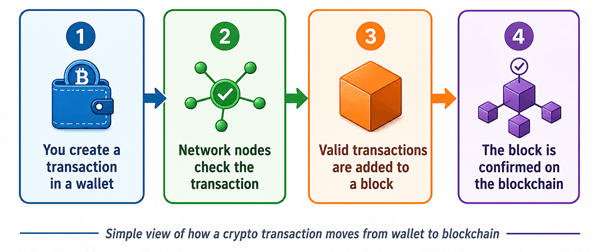
2.1 How a Crypto Transaction Works
.
- You use a wallet to create a transaction, such as sending crypto to another address.
- The wallet signs the transaction with your private key. The key is not supposed to be revealed.
- The transaction is broadcast to the network, where nodes check that it follows the rules.
- Valid transactions are included in a block and added to the blockchain through the network consensus process.
- After confirmations, the transaction becomes harder to reverse, although exact finality depends on the blockchain.
2.2 The Core Building Blocks Beginners Should Know First
| Building block | What it means | Why it matters |
|---|---|---|
| Asset | The coin, token, NFT, or other digital item. | You need to know what you actually own. |
| Network | The blockchain where the asset lives. | Sending on the wrong network can cause loss. |
| Address | The public destination for receiving crypto. | Similar to an account number, but not the same as identity. |
| Wallet | The tool that controls keys and creates transactions. | Wallet safety is personal responsibility. |
| Fees | Payments needed to process activity on many networks. | Fees can make small transfers expensive. |
| Risk | Volatility, scams, smart contract bugs, user mistakes, and changing rules. | Understanding risk prevents common beginner losses. |
3. A-Z Crypto Glossary for Beginners
Use this glossary as a quick reference. Each definition is written for beginners and includes practical context where it matters.
3.1 A
Airdrop: Free distribution of tokens to eligible wallet addresses, often used for marketing, community rewards, or protocol incentives. Beware: scam airdrops may trick users into signing malicious transactions.
Altcoin: Any cryptocurrency other than Bitcoin. Some people also exclude Ethereum from this category, but beginners can think of altcoins as the broad universe of non-Bitcoin crypto assets.
AML: Anti-money laundering rules and controls used by financial services to detect and prevent illicit finance. Crypto exchanges may require identity checks because of AML obligations.
APY: Annual percentage yield. A rate used to express yearly return, often in staking, lending, or yield products. High APY usually means higher risk or unsustainable incentives.
ATH: All-time high. The highest recorded price of an asset. Buying only because an asset is near an ATH can be risky.
3.2 B
Bagholder: A slang term for someone left holding an asset after a major price drop, often because they bought during hype.
Bear market: A period when prices are generally falling or sentiment is pessimistic. Crypto bear markets can be deep and long.
Bitcoin: The first widely adopted cryptocurrency, designed as a peer-to-peer digital cash system and now often discussed as a scarce digital asset.
Block: A batch of transactions added to a blockchain. Blocks are linked together in chronological order.
Blockchain: A shared digital ledger where transactions are grouped into blocks and secured by cryptography and network consensus.
Bridge: A tool that moves assets or messages between blockchains. Bridges are convenient but have historically been major targets for hacks.
Bull market: A period when prices are generally rising and sentiment is optimistic. Bull markets often bring hype, speculation, and scams.
Burn: To permanently remove tokens from circulation, usually by sending them to an unusable address. Burns may reduce supply but do not guarantee higher price.
3.3 C
CEX: Centralized exchange. A company-run platform where users can buy, sell, and trade crypto. Users typically have accounts and may need identity verification.
Cold wallet: A wallet setup kept offline or mostly offline, often using a hardware wallet. It helps reduce online hacking risk.
Confirmation: An indication that a transaction has been included in a block and then followed by additional blocks. More confirmations usually mean more confidence.
Consensus mechanism: The method a blockchain uses to agree on valid transactions and blocks. Common examples include proof of work and proof of stake.
Custodial wallet: A wallet or account where a third party controls the private keys for you. Convenient, but you depend on the custodian.
3.4 D
DAO: Decentralized autonomous organization. A community or protocol structure where token holders may vote on proposals. Actual decentralization varies widely.
DApp: Decentralized application. An app that uses smart contracts or blockchain infrastructure, such as a decentralized exchange or NFT marketplace.
DeFi: Decentralized finance. Crypto-based financial services such as trading, lending, borrowing, and earning yield without traditional intermediaries.
DEX: Decentralized exchange. A protocol that lets users trade from their own wallets, usually through smart contracts.
Diamond hands: Slang for holding an asset despite volatility. It can show conviction, but it can also become stubborn risk-taking.
DYOR: Do your own research. A reminder not to rely only on influencers, hype, or social media posts.
3.5 E
EIP: Ethereum Improvement Proposal. A formal proposal for changes to Ethereum. Other networks have similar improvement processes.
ERC-20: A common Ethereum token standard for fungible tokens, meaning each unit is interchangeable with another unit of the same token.
ERC-721: A common Ethereum standard for non-fungible tokens, often used for NFTs where each token is unique.
Exchange: A marketplace for buying, selling, or trading crypto. Exchanges can be centralized or decentralized.
3.6 F
Fiat currency: Government-issued money such as USD, EUR, GBP, or PKR. Crypto prices are often quoted in fiat terms.
Finality: The point at which a transaction is considered practically or formally irreversible. Finality differs by blockchain design.
FOMO: Fear of missing out. The emotional pressure to buy because prices are rising or others seem to be profiting.
Fork: A change or split in blockchain rules. A soft fork is backward-compatible; a hard fork can create an incompatible chain.
FUD: Fear, uncertainty, and doubt. Sometimes used for false negativity, but beginners should not dismiss legitimate warnings as FUD.
3.7 G
Gas fee: A fee paid to execute transactions or smart contracts on networks such as Ethereum. Fees can rise when the network is busy.
Genesis block: The first block in a blockchain.
Governance token: A token that may give holders voting power over protocol decisions. It does not automatically mean ownership of a company.
Gwei: A small unit of ether used to price Ethereum gas. One gwei is one billionth of an ETH.
3.8 H
Halving: A scheduled reduction in block rewards on some proof-of-work networks, most famously Bitcoin. It reduces new supply issuance.
Hard fork: A non-backward-compatible rule change that can split a blockchain if participants do not all upgrade.
Hardware wallet: A physical device designed to store private keys offline and sign transactions securely.
Hash: A fixed-length digital fingerprint created from data. Hashes help secure blocks and verify data integrity.
HODL: Crypto slang for holding an asset long term despite volatility. Often interpreted as “hold on for dear life,” although it began as a typo.
Hot wallet: A wallet connected to the internet, such as a browser extension or mobile wallet. Convenient but more exposed to online threats.
3.9 I
ICO: Initial coin offering. A fundraising method where new tokens are sold to early buyers. ICOs can be high risk and may face regulatory scrutiny.
Impermanent loss: A DeFi liquidity provider risk where the value of deposited assets may underperform simply holding them, especially when prices move sharply.
3.10 K
KYC: Know your customer. Identity verification used by many exchanges and financial platforms.
3.11 L
Layer 1: A base blockchain network such as Bitcoin, Ethereum, or Solana.
Layer 2: A network or system built on top of a base blockchain to improve speed, cost, or scalability.
Liquidity: How easily an asset can be bought or sold without causing a large price change. Low liquidity can lead to slippage.
Liquidity pool: A smart-contract pool of tokens used to enable decentralized trading, lending, or yield strategies.
3.12 M
Market cap: Market capitalization: token price multiplied by circulating supply. It is a rough size measure, not the same as money invested.
Mempool: A waiting area for valid transactions before they are included in a block.
Mining: The process used in proof-of-work systems where miners expend computing power to propose blocks and secure the network.
Minting: Creating a new token or NFT on a blockchain.
Moon: Slang for a dramatic price increase. Treat “to the moon” language as hype, not analysis.
Multisig: Multi-signature wallet. A wallet that requires more than one key or approval to move funds.
3.13 N
Node: A computer that participates in a blockchain network by storing, verifying, and relaying data.
Non-custodial wallet: A wallet where you control the private keys. Greater control comes with greater responsibility.
NFT: Non-fungible token. A unique token that can represent digital art, collectibles, memberships, tickets, or other unique rights.
3.14 O
On-chain: Activity recorded directly on a blockchain. On-chain data can often be publicly viewed.
Oracle: A service that provides external data to smart contracts, such as prices or event outcomes.
3.15 P
Paper wallet: A printed or written record of a private key or seed phrase. It is simple but easy to damage, lose, or expose.
Private key: A secret cryptographic key that controls crypto at an address. Never share it.
Proof of stake: A consensus method where validators lock up capital and can be rewarded for honest behavior or penalized for dishonest behavior.
Proof of work: A consensus method where miners use computing power to secure the network and propose blocks.
Public key: Cryptographic information derived from a private key, used to help create addresses and verify signatures.
Pump and dump: A manipulation scheme where promoters hype an asset, push up price, then sell into buyers.
3.16 R
Recovery phrase: A set of words that can restore access to a wallet. Also called a seed phrase. Anyone with it can control the wallet.
Rug pull: A scam where project insiders abandon the project, drain funds, or manipulate token mechanics after attracting buyers.
3.17 S
Satoshi: The smallest unit of Bitcoin. One bitcoin equals 100,000,000 satoshis.
Seed phrase: A human-readable backup phrase for a wallet. Store it offline and never type it into random websites.
Self-custody: Holding your own private keys instead of relying on a third party.
Slippage: The difference between expected trade price and actual execution price. Common in low-liquidity markets.
Smart contract: Code deployed on a blockchain that can automatically execute rules, such as swaps or lending terms.
Stablecoin: A token designed to track another asset, often a fiat currency such as the U.S. dollar. Stability depends on design, reserves, and market confidence.
Staking: Locking or delegating crypto to help secure a proof-of-stake network or earn rewards. Staking risks include slashing, lockups, and price volatility.
3.18 T
Token: A digital asset built on an existing blockchain. Tokens can represent utility, governance, stable value, collectibles, or other rights.
Tokenomics: The economic design of a token: supply, distribution, incentives, emissions, utility, and governance.
Transaction hash: A unique identifier for a blockchain transaction. It can be used to look up transaction details in a block explorer.
TVL: Total value locked. A DeFi metric estimating the value deposited in a protocol. It can be useful but can also be inflated or misleading.
3.19 V
Validator: A participant in proof-of-stake systems that checks transactions and helps create blocks.
Volatility: Large and frequent price movement. Crypto markets can move sharply in both directions.
3.20 W
Wallet address: A public string used to receive crypto. It is safe to share for receiving funds but should still be handled carefully for privacy.
Whale: A person or entity holding a large amount of a crypto asset. Whale trades can move markets.
Whitepaper: A document explaining a project’s purpose, technology, design, and economics. It is useful but not a guarantee of quality.
Wrapped token: A token representing another asset on a different blockchain, such as wrapped BTC on Ethereum.
3.21 Y
Yield farming: Moving assets between DeFi protocols to earn rewards. It can involve high smart contract, liquidity, and market risk.
3.22 Z
Zero-knowledge proof: A cryptographic method that can prove something is true without revealing all underlying information. Used in privacy and scaling systems.
4. Crypto Wallet Terms Explained
Wallet vocabulary matters because many beginner losses happen when people confuse accounts, addresses, wallets, private keys, and seed phrases.
| Concept | Beginner-friendly comparison | Main risk |
|---|---|---|
| Wallet app | Like a banking app interface, but it manages crypto keys instead of a bank balance. | Fake apps and phishing links. |
| Address | Like a receiving account number. | Sending to the wrong address or wrong network. |
| Private key | Like the master key to a vault. | Anyone who gets it can move the funds. |
| Seed phrase | Like a backup master key written as words. | Screenshots, cloud backups, and fake “support” requests. |
| Hardware wallet | Like keeping the master key in a secure physical device. | Still unsafe if you approve malicious transactions or expose the seed phrase. |
4.1 Custodial vs Non-Custodial Wallets
| Type | Who controls the keys? | Pros | Cons | Best for |
|---|---|---|---|---|
| Custodial | A third party, such as an exchange. | Easy to use; password recovery; familiar account experience. | Platform risk; withdrawals may be delayed or restricted; less direct control. | Beginners buying small amounts and learning basics. |
| Non-custodial | You control the keys. | Direct control; no need to trust a custodian with keys. | No traditional password reset; mistakes can be permanent. | Users ready to learn wallet safety and self-custody. |
5. Trading and Market Terms Beginners Should Understand
Many crypto terms come from trading culture. Understanding them helps you recognize risk and avoid emotional decisions.
- Market cap is not the same as how much money is inside a project. It is price multiplied by circulating supply.
- Volume shows how much trading occurred during a period, but fake or inflated volume can exist on some markets.
- Liquidity matters because it affects whether you can enter or exit a position near the quoted price.
- Slippage becomes more likely when trading large amounts or low-liquidity tokens.
- Leverage can multiply gains and losses. Beginners should be extremely careful with leveraged crypto trading.
6. Blockchain Network Terms: Layer 1, Layer 2, Gas, and Finality
A common beginner mistake is thinking all crypto moves on one universal network. In reality, each blockchain has its own rules, addresses, fees, wallets, and transaction finality. A token can even exist on multiple networks, which is convenient but confusing.
| Question | Beginner answer |
|---|---|
| Why do gas fees change? | Fees often rise when many people compete to use the network at the same time. |
| Why does network choice matter? | Sending an asset on an unsupported network may make it hard or impossible to recover. |
| Why do confirmations matter? | They provide more confidence that the transaction is accepted by the network. |
| Why use Layer 2? | Layer 2 networks aim to make transactions faster or cheaper while relying in some way on a base chain. |
7. Benefits and Limitations of Crypto
| Potential benefit | Important limitation |
|---|---|
| Open access to digital assets and blockchain applications. | Access does not remove responsibility; mistakes can be costly. |
| Fast global transfers on some networks. | Fees, congestion, compliance checks, and exchange limits can still slow things down. |
| Self-custody gives users direct control. | Lost keys or seed phrases usually cannot be reset by customer support. |
| Transparent on-chain records can be audited. | Public records can reduce privacy and may reveal transaction patterns. |
| Smart contracts can automate financial activity. | Code bugs, oracle failures, and governance problems can cause losses. |
8. Common Beginner Mistakes and How to Avoid Them
| Mistake | Why it is risky | Better practice |
|---|---|---|
| Sending crypto without checking the network. | The address may look valid but be on the wrong chain. | Confirm asset, network, address, and memo/tag before sending. |
| Sharing a seed phrase with “support.” | Real support should not need your recovery phrase. | Never share seed phrases or private keys. |
| Clicking airdrop or giveaway links. | Phishing sites can drain wallets. | Use official sources and separate wallets for testing. |
| Buying because of FOMO. | Hype often peaks near short-term tops. | Research fundamentals, risks, liquidity, and your own plan. |
| Ignoring taxes and records. | Many countries require reporting taxable crypto events. | Keep transaction records and consult qualified tax help when needed. |
| Keeping everything on one wallet or exchange. | One failure can affect all funds. | Use risk-based separation: spending wallet, long-term storage, and exchange account. |
9. Practical Crypto Safety Checklist
- Start with small test transactions before sending a large amount.
- Write seed phrases offline and store them somewhere private and durable.
- Use hardware wallets for larger long-term holdings when you understand self-custody.
- Turn on strong account security for exchange accounts, including app-based two-factor authentication.
- Bookmark official websites instead of clicking search ads or social links.
- Read transaction approvals carefully before signing in a wallet.
- Do not chase unusually high yields without understanding the source of the return.
- Keep records of purchases, sales, swaps, transfers, fees, staking rewards, and airdrops.
10. Real-World Scenarios Using Crypto Terms
10.1 Scenario 1: Sending Crypto to a Friend
You want to send a stablecoin to a friend. Before sending, you confirm the exact token, blockchain network, wallet address, and whether a memo or tag is required. You send a small test amount first, check the transaction hash on a block explorer, and then send the rest after confirmation.
10.2 Scenario 2: Buying a New Token
You see a token trending on social media. Instead of buying immediately, you check liquidity, tokenomics, contract address, holder concentration, project documentation, team transparency, and whether the token has suspicious permissions. This helps reduce the chance of buying into a pump and dump or rug pull.
10.3 Scenario 3: Using DeFi for Yield
A DeFi protocol advertises very high APY. You ask where the yield comes from, whether rewards are paid in an inflationary token, how much TVL the protocol has, whether smart contracts are audited, and what happens if token prices move sharply. You understand that high yield is never risk-free.
11. Common Crypto Misconceptions
| Misconception | Reality |
|---|---|
| Crypto is completely anonymous. | Many public blockchains are pseudonymous, not anonymous. Transactions may be traced to addresses and sometimes linked to identities. |
| A low token price means it is cheap. | Supply matters. A token priced at $0.01 can still have a huge market cap. |
| A project with a whitepaper is safe. | A whitepaper is only a document. Execution, security, transparency, and incentives matter. |
| Stablecoins cannot lose value. | Stablecoins can depeg if reserves, design, liquidity, or confidence fail. |
| Self-custody removes all risk. | It removes some counterparty risk but adds key management and transaction-signing risk. |
12. Quick Reference: Most Important Crypto Terms for Beginners
If you only remember ten terms at first, start with these: blockchain, cryptocurrency, wallet, address, private key, seed phrase, exchange, gas fee, stablecoin, and smart contract. These words appear constantly because they describe the basic actions of crypto: owning, sending, paying fees, trading, and interacting with blockchain applications.
13. FAQs About Crypto Terminology
13.1 What is the easiest way to learn crypto terms?
Start with wallet, address, private key, seed phrase, blockchain, exchange, gas fee, and stablecoin. These terms appear in almost every beginner task. Then learn trading, DeFi, and security terms as you encounter them.
13.2 What is the difference between a coin and a token?
A coin usually belongs to its own blockchain, such as BTC on Bitcoin or ETH on Ethereum. A token is usually created on an existing blockchain, such as an ERC-20 token on Ethereum.
13.3 Is a crypto wallet the same as a bank account?
No. A wallet does not store coins like a physical wallet stores cash. It manages keys that control crypto recorded on a blockchain. With self-custody, there may be no customer support reset if keys are lost.
13.4 What does “not your keys, not your coins” mean?
It means that if another company controls the private keys, you depend on that company to let you access or withdraw your crypto. The phrase supports self-custody, but self-custody also requires careful security.
13.5 What is gas in crypto?
Gas is a transaction or computation fee on some blockchain networks. It pays for network resources used to process transfers and smart contract actions.
13.6 Are all crypto transactions reversible?
Usually no. Many blockchain transactions are difficult or impossible to reverse once confirmed. This is why checking addresses, networks, and amounts is essential.
13.7 What does DYOR mean in crypto?
DYOR means do your own research. It reminds users to verify claims, read project materials, understand risks, and avoid relying only on influencers or hype.
13.8 What is the safest crypto wallet for beginners?
There is no single safest wallet for everyone. Small learning amounts may be fine on reputable platforms, while larger long-term holdings often justify a hardware wallet and stronger self-custody practices.
13.9 Do crypto terms change over time?
Yes. Crypto culture and technology evolve quickly. Core terms such as blockchain, wallet, private key, and exchange are stable, but newer areas such as scaling, account abstraction, restaking, and zero-knowledge systems continue to develop.
13.10 Do I need to understand every term before buying crypto?
No, but you should understand the basics of wallets, fees, volatility, scams, taxes, and exchange risk before using real money. Learn with small amounts and avoid pressure to rush.
Sources Consulted and Checked
These sources were consulted and checked while preparing this document to support accuracy and reader trust. Regulations and tax rules vary by location and can change, so readers should verify applicable requirements through official sources.
- Bitcoin whitepaper
- Ethereum.org: consensus mechanisms and proof of stake
- Ethereum.org: proof of stake
- IRS: Digital assets
- IRS: Digital asset transaction FAQs
- SEC: crypto assets and investor education
Reader Advice
This article is educational only. Crypto assets are volatile, regulations vary by country, and scams are common. Do not treat glossary definitions as investment advice, legal advice, or tax advice.
This glossary is provided for educational and informational purposes and is not personalized investment, financial, legal, tax, or professional advice or a recommendation to buy, sell, hold, transfer, or use any crypto asset or service. Crypto markets and products can involve substantial risks, including price volatility, scams, fraud, loss of private keys or seed phrases, irreversible transactions, smart-contract failures, exchange or custodian problems, liquidity limits, and possible loss of some or all funds. Rules, policies, laws, tax treatment, technical standards, and statistics may change over time and vary by country or region. Before making a decision, verify current information through relevant official sources, carefully assess the risks, and seek advice from an appropriately qualified professional where needed.