Bitcoin vs Cryptocurrency: What Is the Difference for Beginners?
Quick answer: Bitcoin is a cryptocurrency, but not all cryptocurrencies are Bitcoin. Cryptocurrency is the broad category of digital assets that use cryptography and usually blockchain technology. Bitcoin is one specific cryptocurrency, launched as a peer-to-peer electronic cash system and often described today as a decentralized digital asset with a fixed supply limit.
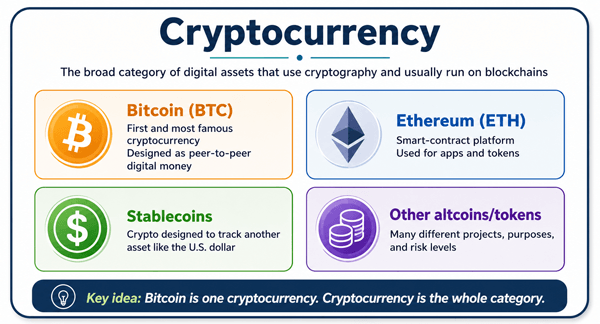
Diagram: Bitcoin is one part of the wider cryptocurrency category.
1. Quick Comparison: Bitcoin vs Cryptocurrency
The easiest way to understand the difference is to think of cryptocurrency as the category and Bitcoin as one member of that category. It is like saying “car vs vehicle.” A car is a vehicle, but vehicles also include buses, trucks, motorcycles, and vans. In the same way, Bitcoin is crypto, but crypto also includes Ethereum, stablecoins, utility tokens, governance tokens, meme coins, and many other digital assets.
| Question | Bitcoin | Cryptocurrency |
|---|---|---|
| What is it? | One specific cryptocurrency: BTC. | The broad category of digital currencies and tokens. |
| Main purpose | Originally designed for peer-to-peer digital payments without a bank. | Varies by project: payments, smart contracts, apps, stable value, gaming, governance, or speculation. |
| Launch history | Introduced in the 2008 Bitcoin white paper and launched in 2009. | Became a wider market after Bitcoin, with thousands of different projects. |
| Supply | Bitcoin has a programmed supply limit of 21 million BTC. | Supply rules differ. Some have fixed supply, some change supply, and some are issued by companies or protocols. |
| Network | Runs on the Bitcoin network. | May run on its own blockchain or on another blockchain such as Ethereum. |
| Risk level | Still risky and volatile, but generally more established than most smaller crypto assets. | Ranges from relatively established assets to highly experimental or fraudulent projects. |
| Beginner takeaway | Bitcoin is the best-known example of cryptocurrency. | Cryptocurrency is the whole universe of digital assets, not one single coin. |
2. What Is Cryptocurrency?
Cryptocurrency is digital value that uses cryptography to help secure transactions and control ownership. Most cryptocurrencies run on blockchains: shared ledgers that record transactions across many computers instead of one central database. NIST describes blockchain as a ledger where transaction records are grouped into blocks and cryptographically linked together, making the history tamper-evident.
A simple definition for beginners: cryptocurrency is internet-native money or tokens that can be sent, received, stored, and sometimes used inside digital applications without relying only on traditional banks or card networks.
2.1 A practical example
Imagine Ali wants to send digital value to Sara. With a normal bank transfer, the bank checks Ali’s balance, updates its records, and sends the money through the banking system. With a cryptocurrency transaction, Ali signs a transaction with his private key, the network checks whether the transaction follows the rules, and the blockchain records the result. The exact process differs by cryptocurrency, but the basic idea is that a network verifies the transaction instead of one traditional financial institution.
2.2 Important terms beginners should know
| Term | Plain-English meaning |
|---|---|
| Blockchain | A shared digital ledger that records transactions in linked blocks. |
| Coin | A crypto asset that usually belongs to its own blockchain, such as BTC on Bitcoin. |
| Token | A crypto asset built on an existing blockchain, such as many tokens on Ethereum. |
| Wallet | Software or hardware used to store keys and interact with crypto networks. |
| Private key | A secret code that authorizes transactions. Losing it can mean losing access. |
| Public address | An address others can use to send crypto to you. |
| Exchange | A platform where people buy, sell, and trade crypto. |
| Stablecoin | A crypto asset designed to track the value of another asset, commonly the U.S. dollar. |
| Altcoin | Any cryptocurrency other than Bitcoin. |
3. What Is Bitcoin?
Bitcoin is the first widely adopted cryptocurrency. It was described in Satoshi Nakamoto’s 2008 paper, “Bitcoin: A Peer-to-Peer Electronic Cash System,” as a way for online payments to be sent directly from one party to another without going through a financial institution. Bitcoin.org also explains that Bitcoin uses peer-to-peer technology and has no central authority or bank managing transactions or issuing coins; the network manages this collectively.
Bitcoin’s native unit is BTC. People use BTC for different reasons: as a speculative investment, as a long-term store-of-value idea, as a way to transfer value globally, or as a way to learn about decentralized networks. None of those uses removes the risks. Bitcoin’s price can move sharply, transactions can be irreversible, and users must understand custody and security.
3.1 What makes Bitcoin different?
- It is the oldest and most recognized cryptocurrency.
- It has a simple main function: send, receive, and hold BTC on the Bitcoin network.
- It has a programmed supply limit of 21 million BTC, according to Bitcoin.org.
- It does not have a company CEO, customer support desk, or central issuer.
- Its rules change slowly because broad network agreement is needed.
4. How Bitcoin and Other Cryptocurrencies Work
You do not need to understand advanced cryptography to use beginner-level crypto safely, but you should understand the basic moving parts.
4.1 A transaction is created
A user decides to send crypto from one address to another. The wallet prepares the transaction details: the asset, amount, receiving address, and network fee.
4.2 The transaction is signed
The wallet uses the private key to prove the user has permission to spend the funds. The private key should not be shared. The SEC’s investor guidance explains that losing a private key can permanently remove access to crypto assets, and a compromised key can allow theft.
4.3 The network checks the transaction
Computers on the network verify that the transaction follows the rules. For example, the sender must have enough balance, the signature must be valid, and the transaction must not try to spend the same coins twice.
4.4 The transaction is added to the blockchain
Valid transactions are grouped into blocks. Once blocks are added and confirmed, changing the history becomes difficult because later blocks depend on earlier ones through cryptographic links.
4.5 The receiver sees the balance
After the transaction is confirmed, the receiver’s wallet shows the updated balance. The funds are controlled by whoever controls the relevant private keys.
5. Main Differences Between Bitcoin and Cryptocurrency
5.1 Bitcoin is one asset; cryptocurrency is the category
This is the core difference. Bitcoin is a specific network and asset. Cryptocurrency is the umbrella term for many digital assets. Saying “I bought cryptocurrency” could mean Bitcoin, Ether, a stablecoin, or a risky token you found on social media.
5.2 Bitcoin has a narrower purpose than many crypto projects
Bitcoin mainly focuses on decentralized value transfer and monetary scarcity. Other cryptocurrencies may support smart contracts, decentralized finance, gaming items, file storage, identity systems, supply-chain tracking, governance voting, or dollar-like payments through stablecoins.
5.3 Bitcoin has a fixed supply limit; other coins may not
Bitcoin’s supply schedule is one of its most discussed features. Bitcoin.org states that only 21 million bitcoins will ever be created. Other cryptocurrencies use different supply models. Some have caps, some inflate over time, some burn tokens, and some are issued by an organization.
5.4 Bitcoin is not the same as blockchain
Bitcoin uses a blockchain, but blockchain is the underlying record-keeping technology. Many other cryptocurrencies also use blockchains, and some blockchain systems are used for non-crypto business records.
5.5 Bitcoin is usually simpler for beginners to understand
Bitcoin’s basic story is easier: a decentralized network, BTC as the asset, and a limited supply. Many other cryptocurrencies require understanding smart contracts, tokenomics, validators, bridges, governance, stablecoin reserves, or app-specific risks.
6. Types of Cryptocurrencies Besides Bitcoin
| Type | What it does | Beginner example |
|---|---|---|
| Smart-contract platforms | Provide networks where developers build decentralized apps. | Ethereum is a well-known example. |
| Stablecoins | Aim to track another asset such as the U.S. dollar. | A person might use a dollar stablecoin to move value between exchanges. |
| Utility tokens | Provide access or functions inside a specific project. | A token used to pay network fees or access app features. |
| Governance tokens | May allow holders to vote on protocol decisions. | A DeFi protocol token used in governance proposals. |
| Meme coins | Often driven by internet culture and speculation. | A coin that rises mainly because of hype or community attention. |
| NFT-related tokens | May connect to digital collectibles, games, or creator platforms. | A token used in a blockchain game or marketplace. |
The key beginner lesson is that different cryptocurrencies can have completely different purposes and risk profiles. Do not assume that because Bitcoin is well known, every crypto asset is equally established or trustworthy.
7. Pros and Cons: Bitcoin vs the Wider Crypto Market
| Option | Potential benefits | Main limitations and risks |
|---|---|---|
| Bitcoin | Most recognized crypto asset; simple thesis; fixed supply limit; large global network; widely supported by exchanges and wallets. | Volatile price; transaction fees can rise; no chargebacks; self-custody mistakes can be permanent; regulatory and tax issues still matter. |
| Other cryptocurrencies | May offer smart contracts, faster settlement, app ecosystems, stablecoins, lower fees, or specialized use cases. | Higher project failure risk; scams and hype are common; complex tokenomics; smart-contract bugs; lower liquidity; unclear regulation for some assets. |
8. Real-World Scenarios: Which One Are People Usually Talking About?
| Scenario | Usually means Bitcoin? | Usually means broader cryptocurrency? |
|---|---|---|
| “I want to buy my first crypto and hold it long term.” | Often yes, many beginners start by researching BTC. | Could include other assets, but needs more research. |
| “I want to use decentralized apps.” | Usually no. | Yes. This often involves smart-contract platforms and tokens. |
| “I want a crypto asset that tracks the dollar.” | No. | Yes. This points to stablecoins, not Bitcoin. |
| “I heard crypto can 100x quickly.” | Not specifically. | Usually risky speculation in smaller tokens. |
| “I want digital money not controlled by one bank.” | Often Bitcoin is part of that discussion. | Some other cryptocurrencies also aim for this, but designs vary. |
9. Benefits Beginners Should Understand
9.1 Potential benefits of Bitcoin
- Open access: anyone with an internet connection can use the network where legal and available.
- No central issuer: Bitcoin is not created by a company in the way company shares or app points are issued.
- Predictable supply rule: Bitcoin’s supply limit is part of its design.
- Global transfer: BTC can be sent across borders, although fees, timing, and local rules still matter.
- Educational value: learning Bitcoin helps beginners understand wallets, keys, and blockchains.
9.2 Potential benefits of broader cryptocurrency
- More use cases: smart contracts, stablecoins, apps, gaming, NFTs, and decentralized finance.
- Experimentation: developers can build new financial and digital ownership tools.
- Different design choices: some networks aim for faster transactions, lower fees, or programmable features.
- Access to crypto-native services: some apps require non-Bitcoin networks or tokens.
10. Risks, Limitations, and Misconceptions
Crypto can be useful and innovative, but beginners should approach it carefully. FINRA warns that crypto assets are risky and often extremely volatile, and that the risk of losing all of an investment can be significant. That warning applies even more strongly to small, unproven tokens.
10.1 Common risks
- Price volatility: crypto prices can rise or fall dramatically in short periods.
- Scams and fraud: fake exchanges, fake support agents, phishing links, giveaway scams, and “guaranteed profit” schemes are common.
- Custody mistakes: if you self-custody and lose your private key or recovery phrase, access may be gone permanently.
- Exchange risk: leaving funds on an exchange means you depend on that platform’s security, solvency, and rules.
- Regulatory uncertainty: laws and rules can differ by country and change over time.
- Tax obligations: in the United States, the IRS treats virtual currency as property for federal income tax purposes, so selling, exchanging, or using crypto may create taxable events.
- Technology risk: smart contracts, bridges, apps, and wallets can have bugs or be exploited.
10.2 Beginner misconceptions
| Misconception | Reality |
|---|---|
| “Bitcoin and cryptocurrency are the same thing.” | Bitcoin is one cryptocurrency. Cryptocurrency is the larger category. |
| “All crypto works like Bitcoin.” | Many crypto assets use different rules, purposes, and security models. |
| “Blockchain transactions are always anonymous.” | Many public blockchains are transparent. Addresses may be pseudonymous, but activity can often be traced. |
| “Crypto is risk-free because it is decentralized.” | Decentralization can reduce some risks but does not remove price, scam, custody, or technology risks. |
| “If I send crypto to the wrong address, support can reverse it.” | Most crypto transactions are not reversible like credit card chargebacks. |
| “A low coin price means it is cheap.” | Price per coin is not enough. Supply, market value, liquidity, and fundamentals matter. |
11. Bitcoin vs Cryptocurrency: Which Is Better for Beginners?
There is no single best answer because “better” depends on what the beginner wants to do. For learning the basics, Bitcoin is often the simplest starting point because the concept is narrower. For learning crypto apps, smart contracts, or stablecoins, the wider cryptocurrency market matters more.
| Beginner goal | Better starting point | Why |
|---|---|---|
| Understand the basic idea of decentralized digital money | Bitcoin | It has a simpler purpose and long public history. |
| Learn blockchain apps and smart contracts | Broader cryptocurrency | You will likely need networks such as Ethereum or other smart-contract platforms. |
| Avoid extreme complexity at first | Bitcoin | Fewer moving parts than many token ecosystems. |
| Use a dollar-like crypto asset | Stablecoins, not Bitcoin | Stablecoins are designed to track another asset; Bitcoin is not price-stable. |
| Speculate on high-risk small tokens | Neither as a default beginner choice | This is risky and requires research, position sizing, and scam awareness. |
12. How to Research Any Cryptocurrency Before You Buy
Beginners often ask, “Should I buy Bitcoin or another cryptocurrency?” A safer first step is learning how to evaluate claims.
- Identify the asset clearly. Check the ticker, network, contract address if it is a token, and official website. Many scam tokens copy names.
- Understand the purpose. Can you explain in one sentence what the asset is used for? If not, keep researching.
- Check supply and issuance. Is there a maximum supply? Who receives new tokens? Can insiders sell large amounts?
- Look at decentralization. Is the network run by many independent participants or controlled by a small group?
- Review security history. Has the project suffered major hacks, outages, or failed promises?
- Check liquidity and exchange support. Thinly traded assets can be hard to sell at the displayed price.
- Read risk warnings, not just promotional content. Regulators and investor-education sources are useful counterweights to hype.
- Start small if you participate. Never use money needed for rent, debt payments, emergency savings, or essential expenses.
13. Best Practices for Beginners
- Learn before buying. Understand wallets, addresses, fees, private keys, and taxes first.
- Use reputable platforms. Be careful with unknown exchanges, direct messages, and social media links.
- Turn on strong security. Use unique passwords and two-factor authentication that is not SMS-based where possible.
- Test with a small transaction. Before sending a large amount, send a tiny amount to confirm the address and network.
- Protect your recovery phrase. Store it offline. Do not type it into websites, cloud notes, screenshots, or messages.
- Do not chase hype. If the main argument is “everyone is buying,” that is not research.
- Keep records. Track dates, amounts, fees, transaction IDs, and exchange reports for tax and accounting purposes.
- Know your exit plan. Decide in advance why you are buying, how much you can lose, and when you would sell or stop.
14. Simple Analogy: Bitcoin, Crypto, and Blockchain
Think of blockchain as the road system, cryptocurrency as the vehicles that travel on those roads, and Bitcoin as one specific vehicle model. Bitcoin has its own road, rules, and vehicle design. Other cryptocurrencies may use different roads, share roads, or serve different purposes entirely.
15. Summary: The Difference in One Minute
- Cryptocurrency is the broad category of digital assets that use cryptography and usually blockchain networks.
- Bitcoin is one specific cryptocurrency: the first widely adopted one and still the most recognized.
- Bitcoin mainly focuses on decentralized value transfer and a fixed supply rule.
- Other cryptocurrencies may focus on smart contracts, stablecoins, gaming, governance, or other specialized uses.
- Bitcoin may be easier for beginners to understand, but it is still risky and volatile.
- The wider crypto market offers more use cases but also more complexity, scams, and project-specific risks.
16. FAQs: Bitcoin vs Cryptocurrency
16.1 Is Bitcoin the same as cryptocurrency?
No. Bitcoin is a cryptocurrency, but cryptocurrency is the larger category. Bitcoin is one asset and one network; crypto includes Bitcoin plus many other coins and tokens.
16.2 Is Bitcoin better than other cryptocurrencies?
It depends on the goal. Bitcoin is more established and easier to understand than many crypto assets, but other cryptocurrencies may offer features Bitcoin does not, such as smart contracts or stablecoin payments.
16.3 What is the biggest difference between Bitcoin and crypto?
The biggest difference is category versus example. Cryptocurrency is the full category. Bitcoin is one specific cryptocurrency within that category.
16.4 Can cryptocurrency exist without Bitcoin?
Yes. Other cryptocurrencies can and do exist without being Bitcoin. However, Bitcoin played a major role in proving the idea of decentralized digital money.
16.5 Can Bitcoin exist without blockchain?
Bitcoin relies on its blockchain to record transactions and prevent double-spending. Without that ledger and network rules, Bitcoin as we know it would not function.
16.6 Are all cryptocurrencies decentralized?
No. Some are highly decentralized; others depend on companies, foundations, small validator groups, or centralized infrastructure. Decentralization exists on a spectrum.
16.7 Is crypto real money?
Crypto can be used as a medium of exchange in some situations, but it is not the same as government-issued money. Acceptance, legal status, price stability, and tax treatment vary by country and asset.
16.8 Is Bitcoin safe for beginners?
Bitcoin is easier to research than many smaller assets, but it is not “safe” in the ordinary sense. The price is volatile, transactions are hard to reverse, and custody mistakes can be costly.
16.9 What is an altcoin?
An altcoin is any cryptocurrency other than Bitcoin. Ether, Solana, XRP, and many smaller tokens are commonly called altcoins.
16.10 Do I need a wallet to buy Bitcoin?
You need some way to hold or access BTC. An exchange account may provide custodial holding, while a self-custody wallet lets you control your private keys. Each option has trade-offs.
16.11 What happens if I lose my private key?
If you self-custody and lose the private key or recovery phrase, you may permanently lose access to the crypto. There is usually no password reset for self-custody wallets.
16.12 Do I owe taxes on cryptocurrency?
Tax rules depend on your country. In the United States, the IRS treats virtual currency as property for federal income tax purposes, and selling, exchanging, or using crypto can create taxable gains or losses.
17. Final Beginner Takeaway
Bitcoin vs cryptocurrency is not really a competition between two separate things. Bitcoin is part of cryptocurrency. The useful beginner question is not only “Bitcoin or crypto?” but “Which digital asset, if any, matches my goal, risk tolerance, knowledge level, and security habits?” Start with the basics, be skeptical of hype, protect your keys, understand taxes, and never risk money you cannot afford to lose.
Sources Consulted and Checked
These sources were consulted and checked while preparing this article to support accuracy and provide reliable background information.
- Satoshi Nakamoto, “Bitcoin: A Peer-to-Peer Electronic Cash System.”
- Bitcoin.org FAQ and overview pages, including peer-to-peer network and 21 million supply explanations.
- NIST, “Blockchain Technology Overview,” NISTIR 8202, and NIST blockchain overview page.
- SEC Investor.gov, “Crypto Asset Custody Basics for Retail Investors,” Dec. 12, 2025.
- FINRA, “Crypto Assets - Risks.”
- IRS, “Digital assets” and “Frequently asked questions on virtual currency transactions.”
Reader Advice
This article is provided for educational and informational purposes only. It is not personalized legal, financial, tax, investment, or regulatory advice, and it does not recommend buying, selling, or holding Bitcoin or any other cryptocurrency. Crypto assets can be highly volatile, transactions may be irreversible, scams and technology failures can cause losses, and you may lose some or all of the money involved. Rules, policies, laws, tax treatment, market data, and statistics can change over time and vary by country or region, so verify important details through current official sources and consider advice from an appropriately qualified professional before making a decision. Use only money you can afford to lose and protect your accounts, private keys, and recovery phrases carefully.