Why Does Crypto Have Value?
Scarcity, Utility, Demand and Network EffectsCrypto has value for the same broad reason anything has value: people believe it is useful, scarce, exchangeable, or worth holding. The difference is that crypto is digital, programmable, and usually runs on open blockchain networks rather than inside one company or one country’s banking system.
That can make crypto confusing. A coin is not a physical object. It may not produce cash flow like a business. Some tokens are useful, some are mostly speculative, and many fail. So the better question is not simply, “Why does crypto have value?” It is: “What specific forces make a crypto asset valuable, and how can I judge whether that value is real or fragile?”
The clearest answer comes down to four ideas: scarcity, utility, demand, and network effects. When these work together, a crypto asset may develop meaningful market value. When they are weak or fake, the price can collapse even if the marketing looks impressive.
Quick answer: Crypto has value when people are willing to use, hold, or exchange it because it offers something they value - such as limited supply, fast settlement, censorship-resistant payments, access to decentralized applications, collateral, governance rights, or membership in a strong network. Scarcity alone is not enough. A crypto asset also needs credible demand, security, liquidity, and a reason to exist.
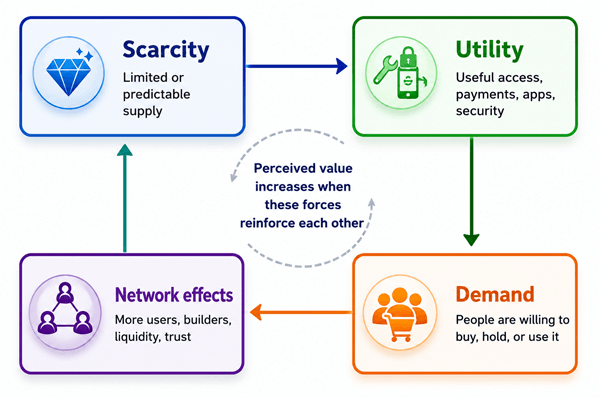
Diagram: A simple value flywheel for crypto assets.
1. What Gives Any Asset Value?
Before looking at crypto, it helps to compare it with things people already understand. Gold has value partly because it is scarce, durable, recognizable, and widely trusted. A company stock has value because investors expect the business to generate future profits. A national currency has value because people use it to pay taxes, settle debts, and buy goods inside an economy.
Crypto does not fit neatly into just one of those categories. Some crypto assets behave more like digital commodities. Some are closer to software access tokens. Some are stablecoins designed to track the value of a traditional currency. Some are governance tokens, meme tokens, or experimental assets. That is why there is no single explanation that applies equally to every cryptocurrency.
| Asset type | Main source of value | Simple example |
|---|---|---|
| Gold | Scarcity, durability, cultural trust, industrial uses | People hold gold because it is hard to produce and has a long history as a store of value. |
| Stocks | Ownership claim on a business and expected future earnings | A profitable company can distribute or reinvest earnings. |
| Fiat currency | Government backing, legal/tax use, network acceptance | People accept dollars because others accept dollars and governments require taxes in dollars. |
| Crypto | Scarcity, utility, demand, security, liquidity, and network effects | People may use ETH to pay for transactions and smart contracts on Ethereum. |
2. The Four Main Drivers of Crypto Value
2.1 Scarcity: Is the Supply Limited or Predictable?
Scarcity means an asset is limited in supply or difficult to create. Bitcoin is the clearest example: its protocol is designed so that only 21 million bitcoins will ever be created, and transactions can be divided into very small units. Bitcoin.org explains that bitcoins can be divided to eight decimal places, which allows small transactions even with a fixed total supply.
Scarcity matters because unlimited supply can dilute holders. If a token can be printed endlessly, each existing unit may become less valuable unless demand grows even faster. But scarcity by itself does not create value. A rock in your backyard may be unique, but that does not mean people will pay for it.
- Good scarcity is transparent, verifiable, and difficult to change.
- Weak scarcity exists only in marketing claims, not in code or governance.
- Fake scarcity can appear when insiders hold huge token allocations while public supply looks small.
2.2 Utility: What Can People Actually Do With It?
Utility means the asset has a practical use. On Ethereum, for example, ETH is used to pay transaction fees and interact with decentralized applications. Ethereum describes itself as a global decentralized platform for money and applications, where users can control digital assets, data, and identity.
Crypto utility can include payments, settlement, smart contract execution, collateral in decentralized finance, access to services, staking, governance participation, or use inside games and digital communities. The stronger and more repeated the use case, the stronger the case for value.
| Type of utility | What it means | Example |
|---|---|---|
| Payment utility | The token can transfer value across a network. | Using BTC or a stablecoin to send funds to another wallet. |
| Gas or fee utility | The token pays for computation or transaction processing. | Using ETH to pay gas fees on Ethereum. |
| Collateral utility | The asset can be locked to borrow, lend, or secure activity. | Depositing crypto in a DeFi protocol. |
| Governance utility | Token holders can vote on protocol decisions. | Voting on fee changes or treasury spending. |
| Membership or access utility | The token unlocks a digital product, game, community, or service. | Using a token to access premium features. |
2.3 Demand: Do People Want It Enough to Pay for It?
Demand is the willingness of buyers, users, investors, institutions, developers, and communities to acquire or use a crypto asset. Demand can come from genuine use, long-term conviction, speculation, portfolio diversification, fear of inflation, cross-border transfer needs, or participation in a network.
Demand is also the reason prices move. If more people want to buy a crypto asset than sell it at current prices, the price tends to rise. If sellers overwhelm buyers, the price tends to fall. This is why a useful network can still have a falling token price during a bear market, and why a nearly useless token can temporarily rise during a hype cycle.
2.4 Network Effects: Does the Network Become More Useful as More People Join?
A network effect happens when a product or system becomes more valuable as more people use it. Telephones, social media, credit card networks, and online marketplaces all depend on network effects. Crypto can work the same way.
A blockchain with more users can attract more developers. More developers can create more wallets, apps, tools, and integrations. More apps can attract more users and liquidity. More liquidity can make the network more practical for trading, payments, and investment. Over time, this can become a reinforcing cycle.
- Bitcoin benefits from brand recognition, liquidity, miners, nodes, wallets, exchanges, and institutional products.
- Ethereum benefits from developers, smart contracts, stablecoins, DeFi, NFTs, tooling, wallets, and layer-2 networks.
- A smaller crypto project may struggle if few people use it, few developers build on it, and liquidity is thin.
3. How Crypto Value Works in Practice
Imagine a new crypto network that lets people send money internationally in minutes at low cost. At launch, the token has little value because few people trust it and few exchanges list it. Over time, more wallets support it, merchants accept it, developers build tools, and users discover it is reliable. Demand increases because the network solves a real problem. If supply is limited or grows slowly, more demand can push price upward.
Now imagine another token with a fixed supply but no real users, no active development, no security, and no reason to hold it except the hope that someone else will buy it later. Even if it is scarce, the value is fragile because demand is based mostly on speculation. This is the difference between scarcity plus utility and scarcity without substance.
4. Why Bitcoin Has Value
Bitcoin’s value case is usually built around digital scarcity, decentralization, security, liquidity, and its role as a non-sovereign monetary asset. Bitcoin is not backed by a company or government. Instead, its supporters value it because the rules are transparent, the supply schedule is predictable, and the network is difficult for one party to control.
Bitcoin.org describes Bitcoin as an innovative payment network and a new kind of money. Blockchain.com also summarizes that Bitcoin’s total supply is limited and predefined in the protocol at 21 million, with issuance decreasing over time through mining rewards. These features support the “digital gold” argument: Bitcoin may be valued because people trust its scarcity and settlement network.
However, Bitcoin is not risk-free. Its price is volatile, transaction fees can rise during congestion, regulation can affect access, and its long-term security model depends on miners being adequately compensated through block rewards and transaction fees. Beginners should understand both the appeal and the limitations.
5. Why Ethereum and Smart Contract Tokens Have Value
Ethereum’s value case is different from Bitcoin’s. While Bitcoin is often discussed as digital money or digital gold, Ethereum is commonly described as a programmable blockchain. It supports smart contracts, which are pieces of code that can run applications without a traditional middleman.
ETH has utility because users need it to pay transaction fees on Ethereum. Developers also build decentralized exchanges, lending markets, stablecoin systems, NFT platforms, games, and other applications on Ethereum and related scaling networks. In simple terms, ETH can be thought of as the asset needed to use and secure the Ethereum economy.
The risk is that utility does not automatically guarantee price appreciation. If competing networks offer better speed, lower costs, or stronger user experience, demand can shift. If applications are hacked or regulation restricts activity, demand can weaken. Smart contract platforms are valuable only if people continue to trust and use the ecosystem.
6. Stablecoins: A Different Kind of Crypto Value
Stablecoins are crypto assets designed to track another asset, usually the U.S. dollar. Their value comes less from scarcity and more from redeemability, reserves, trust in the issuer, and usefulness in digital markets. Stablecoins are commonly used for trading, payments, remittances, and moving value between exchanges or blockchain applications.
A stablecoin is valuable only if users believe it is properly backed and redeemable. This is why reserve quality, transparency, regulation, audits, issuer reputation, and liquidity matter. A poorly backed stablecoin can lose its peg, which means it may trade below the value it claims to represent.
7. What Does “Backing” Mean in Crypto?
Many beginners ask whether crypto is “backed by anything.” The honest answer depends on the asset. Bitcoin is not backed by physical gold, government guarantees, or company profits. Its value is market-based and comes from people’s willingness to hold, use, mine, validate, and accept it under a shared set of rules.
Some stablecoins are backed by reserves such as cash or short-term government securities. Some tokenized assets represent claims on real-world assets. Some governance tokens may be connected to protocol revenue, but many do not provide legal ownership of that revenue. This is why investors should read the project documentation carefully instead of assuming all tokens work the same way.
8. Market Cap, Price, and Value Are Not the Same Thing
Crypto beginners often confuse token price with value. A token priced at $0.01 is not automatically “cheap,” and a token priced at $60,000 is not automatically “expensive.” You need to look at supply.
Market capitalization is calculated as: price per coin multiplied by circulating supply. For example, a coin priced at $1 with 10 billion tokens has a $10 billion market cap. A coin priced at $100 with 1 million tokens has a $100 million market cap. The $1 coin is much larger by market value despite having a lower unit price.
Market data changes constantly. As a recent snapshot, CoinGecko reported the global cryptocurrency market capitalization around the low trillions of U.S. dollars, while CoinMarketCap listed more than 50 million tracked crypto assets and exchanges in its market overview. Treat these figures as moving estimates, not permanent facts.
| Metric | What it tells you | Common beginner mistake |
|---|---|---|
| Token price | The current price of one unit. | Thinking low price means cheap. |
| Circulating supply | How many tokens are currently available in the market. | Ignoring future token unlocks. |
| Fully diluted valuation | Price multiplied by maximum or total possible supply. | Buying without checking future dilution. |
| Trading volume | How much is being traded over a period. | Assuming high volume always means healthy demand. |
| Liquidity | How easily you can buy or sell without moving price. | Buying illiquid tokens that are hard to exit. |
9. Benefits of Crypto Value Systems
- Open access: Many crypto networks can be used by anyone with an internet connection and a wallet.
- Programmability: Smart contracts allow financial and digital services to be built directly on blockchains.
- Transparent rules: Supply schedules and transactions can often be verified publicly.
- Global settlement: Crypto can move across borders without relying on traditional banking hours.
- User ownership: Users can hold assets in self-custody, though this also creates responsibility.
10. Risks and Limitations Beginners Must Understand
Crypto value can be real, but it can also be fragile. Prices are volatile because markets trade around the clock, regulation is still developing, narratives change quickly, and many tokens have uncertain long-term demand.
- Price volatility: Crypto prices can rise or fall sharply in short periods.
- Regulatory risk: Laws can affect exchanges, issuers, taxes, stablecoins, and token classification.
- Technology risk: Bugs, hacks, bridge failures, smart contract exploits, and wallet mistakes can cause losses.
- Centralization risk: Some projects are controlled by founders, insiders, validators, or companies despite using decentralized language.
- Liquidity risk: Small tokens can be hard to sell at a fair price.
- Tokenomics risk: Large unlocks, inflation, or insider allocations can dilute public holders.
- Narrative risk: Some assets depend more on hype than durable use.
11. Common Misconceptions About Crypto Value
| Misconception | Reality |
|---|---|
| “Crypto has no value because it is not physical.” | Many valuable things are not physical, including software, domain names, brand equity, and payment networks. The real question is whether the asset is useful, trusted, and demanded. |
| “Scarcity alone makes a coin valuable.” | Scarcity helps only when people also want the asset. A scarce token with no demand can still be worthless. |
| “A low token price means it can easily reach $1.” | The supply matters. A huge supply can make a $1 price unrealistic because it would imply an enormous market cap. |
| “All crypto is the same.” | Bitcoin, Ethereum, stablecoins, governance tokens, meme coins, and tokenized assets have different value drivers and risks. |
| “Utility guarantees profits.” | A useful network can still have an overvalued token, poor token economics, or falling demand. |
| “Decentralized means nobody controls it.” | Some projects use decentralized branding while insiders or a small group still control key decisions. |
12. How to Evaluate Whether a Crypto Asset Has Real Value
A beginner does not need to become a developer to ask better questions. Use this checklist before taking any project seriously.
- What problem does it solve, and who actually uses it?
- Is the supply limited, predictable, or inflationary?
- Who controls upgrades, treasury funds, validator sets, or admin keys?
- Is demand coming from real usage, speculation, incentives, or a mix?
- Are developers still active and shipping improvements?
- Is the network secure, battle-tested, and transparent?
- How liquid is the asset across reputable exchanges?
- What percentage of supply is held by insiders, foundations, or early investors?
- Are there major token unlocks or emissions coming?
- What would make the token unnecessary or obsolete?
The last question is especially useful. If a token can be removed from the product without affecting the user experience, the token may not have strong value capture. In other words, a good project and a good token investment are not always the same thing.
13. Practical Examples: Stronger vs Weaker Value Cases
| Scenario | Value case | Main concern |
|---|---|---|
| A major blockchain with high liquidity, active developers, and real fee-paying users. | Stronger: utility, network effects, and demand are visible. | It may still be overvalued, congested, or challenged by competitors. |
| A fixed-supply token with no working product or active users. | Weak: scarcity exists, but demand is mostly speculative. | Price depends on hype and may collapse when attention fades. |
| A stablecoin backed by high-quality reserves and widely used for payments/trading. | Different: value depends on peg stability, reserves, and trust. | Reserve, regulatory, issuer, and redemption risks remain. |
| A meme coin with a large community and no practical utility. | Possible short-term demand from culture and speculation. | Network effects can be fragile if attention shifts. |
| A governance token for a protocol with real revenue but unclear holder rights. | Potential value if governance or fee capture is credible. | Holders may not legally own cash flows or may face dilution. |
14. Best Practices for Beginners
- Start by learning, not by chasing price. Understand wallets, exchanges, fees, private keys, and scams before buying.
- Use market cap and fully diluted valuation, not only token price.
- Separate the technology from the investment. A useful blockchain can still have an overpriced token.
- Be skeptical of guaranteed returns, celebrity promotions, secret trading groups, and “limited time” pressure.
- Check whether a project has real users, real fees, real liquidity, and transparent tokenomics.
- Never invest money you cannot afford to lose. Crypto can be highly volatile.
- Use reputable exchanges and enable strong account security, including two-factor authentication.
- For self-custody, protect seed phrases offline and never share them with anyone.
- Diversify and avoid putting your entire portfolio into one speculative asset.
- Keep tax records because crypto trades, staking rewards, and sales may have tax consequences depending on your jurisdiction.
15. A Simple Mental Model: Value Must Be Earned
The most useful way to think about crypto value is this: a crypto asset has to earn demand. Scarcity can support value, but it cannot replace usefulness. Utility can create demand, but it does not remove risk. Network effects can strengthen a project, but they can also reverse if users, developers, or liquidity leave.
A strong crypto asset usually has several things working together: credible scarcity, real utility, growing or durable demand, deep liquidity, secure infrastructure, and a community or developer ecosystem that makes the network more useful over time. A weak crypto asset usually relies on one thing: the hope that someone else will buy it at a higher price.
16. FAQs About Why Crypto Has Value
16.1 Why does Bitcoin have value if it is just digital?
Bitcoin has value because people trust and use its open network, fixed supply rules, security model, liquidity, and settlement properties. It is digital, but digital scarcity can matter when the rules are verifiable and widely accepted.
16.2 Is crypto backed by anything?
Some crypto assets are backed by reserves or real-world assets, but many are not. Bitcoin is not backed by a government or company. Its value is market-based. Stablecoins, by contrast, are designed to be backed by assets that support their peg.
16.3 Can a cryptocurrency become worthless?
Yes. A token can lose most or all of its value if demand disappears, the project fails, supply is inflated, security breaks, regulation cuts off access, or users lose trust.
16.4 Does limited supply guarantee a higher price?
No. Limited supply can help only when demand exists. A scarce asset with no buyers has little or no market value.
16.5 Why do crypto prices change so much?
Crypto prices move quickly because markets trade constantly, liquidity varies, sentiment changes fast, leverage is common, regulation evolves, and many assets have uncertain fundamentals.
16.6 What is the difference between utility and speculation?
Utility means people use the asset or network for a practical purpose. Speculation means people buy mainly because they expect the price to rise. Most crypto demand includes some mix of both, but projects with only speculation are usually riskier.
16.7 Are meme coins valuable?
Meme coins can have market value if a community creates demand and liquidity. However, that value is often more fragile because it may depend on attention, culture, and momentum rather than durable utility.
16.8 How can I tell if a crypto project is overhyped?
Warning signs include vague use cases, anonymous or unaccountable teams, unrealistic returns, low liquidity, huge insider allocations, no working product, fake partnerships, aggressive marketing, and a token that seems unnecessary to the product.
16.9 Can governments destroy crypto value?
Governments can affect access, taxation, exchange listings, stablecoin rules, and institutional adoption. They may not be able to shut down a sufficiently decentralized global network easily, but regulation can still strongly affect price and usage.
16.10 What is the safest way to think about crypto as a beginner?
Treat crypto as a high-risk digital asset class. Learn first, start small if you participate, avoid leverage, protect your keys, verify claims, and remember that a rising price does not prove lasting value.
17. Conclusion
Crypto has value when enough people believe a digital asset is useful, scarce, secure, liquid, and worth participating in. The strongest value cases combine scarcity, utility, demand, and network effects. The weakest rely mostly on hype and the hope of resale.
For beginners, the best approach is not to ask, “Will this coin go up?” Start with better questions: What does it do? Who uses it? Why is the token needed? How is supply controlled? Where does demand come from? What could go wrong? Those questions will help you separate durable value from temporary excitement.
Sources Consulted and Checked
The following sources were consulted and checked while preparing this article and supporting its accuracy:
- Bitcoin.org FAQ - finite supply and divisibility
- Bitcoin.org - Bitcoin overview
- Blockchain.com chart explanation - total circulating Bitcoin
- Ethereum.org - Ethereum guide and platform overview
- CoinGecko - global cryptocurrency market cap charts
- CoinMarketCap - cryptocurrency market overview
Reader Advice
This article is provided for educational and informational purposes only. It explains general ideas about why crypto assets may have value, but it is not personalized financial, investment, tax, legal, or regulatory advice and should not be treated as a recommendation to buy, sell, hold, or use any crypto asset. Crypto can be highly volatile and may involve loss of capital, fraud, cybersecurity, liquidity, custody, technology, and regulatory risks. Laws, policies, market statistics, tax treatment, and platform rules can change over time and may differ by country or region, so please verify important details through current official sources and, where appropriate, seek advice from a qualified professional before making a decision.