Crypto for Beginners: Complete Starter Guide to Buying, Storing and Using Crypto
Cryptocurrency can feel confusing at first because it mixes money, technology, security, investing, and internet culture. The good news is that you do not need to understand every technical detail before you understand the basics. You do, however, need to move slowly, protect your accounts, and know what can go wrong.
This beginner guide explains what crypto is, how it works, how to buy your first crypto safely, how wallets work, how to store crypto, and how people actually use it. It also covers risks, scams, taxes, common misconceptions, and practical rules that can save beginners from expensive mistakes.
1. What Is Crypto?
Crypto, short for cryptocurrency or crypto assets, is a broad term for digital assets that are created, transferred, or recorded using blockchain or similar distributed ledger technology. Some crypto assets are designed to work like digital money. Others represent access to software networks, governance rights, collectibles, or investment exposure.
Bitcoin is the best-known cryptocurrency. Ethereum is another major network, widely used for smart contracts and decentralized applications. There are also stablecoins, meme coins, utility tokens, governance tokens, non-fungible tokens, and many small experimental projects. They are not all the same, and beginners should not treat every token as “the next Bitcoin.”
1.1 A simple example
Imagine you want to send value to a friend online without using a bank transfer. With crypto, you can send a transaction from your wallet address to your friend’s wallet address. The blockchain network checks that you have the funds, records the transfer, and updates the public ledger. Depending on the network, the transaction may settle in seconds, minutes, or longer.
2. How Cryptocurrency Works in Simple Terms
Most cryptocurrencies run on a blockchain. A blockchain is a shared digital record of transactions. Instead of one company privately controlling the database, many computers in the network keep copies of the ledger and follow rules that decide which transactions are valid.
Here are the core ideas beginners need to know:
- Blockchain: a public or shared record of transactions grouped into blocks.
- Wallet: software or hardware that helps you manage crypto addresses and private keys.
- Public address: similar to an email address for receiving crypto, but tied to a blockchain.
- Private key: a secret cryptographic key that proves control over crypto. Anyone with the private key can move the funds.
- Seed phrase: a set of words that can restore many wallets. It must be kept offline and private.
- Network fee: a fee paid to process a transaction. Fees vary by blockchain and network demand.
- Confirmation: the point at which a transaction has been accepted by the network and becomes harder to reverse.
The most important beginner lesson is this: crypto transactions are usually irreversible. If you send money to the wrong address, approve a malicious transaction, or give away your seed phrase, there may be no bank, card company, or support desk that can reverse the loss.
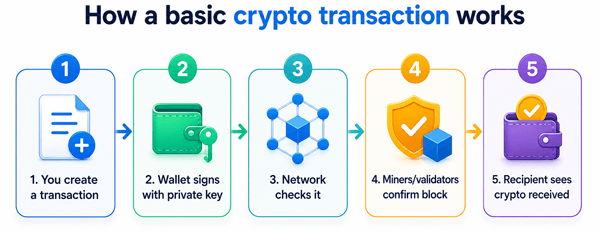
Diagram: A simplified crypto transaction flow for beginners.
3. Main Types of Crypto Assets Beginners Should Know
The word crypto covers many different things. Before buying anything, know what category it belongs to and what risk you are taking.
| Type | Beginner explanation | Example use | Main risk |
|---|---|---|---|
| Bitcoin-like cryptocurrencies | Digital assets designed mainly as scarce, transferable value. | Holding or transferring value. | Price volatility; loss of keys; regulatory and market risk. |
| Smart contract platform tokens | Tokens used to pay fees or participate in programmable blockchain networks. | Using apps, NFTs, DeFi, or network services. | Smart contract bugs, high fees, complex user experience. |
| Stablecoins | Tokens designed to track a currency such as the U.S. dollar. | Moving money between exchanges or making payments. | Issuer, reserve, de-pegging, regulatory, and platform risks. |
| Meme coins | Tokens driven mostly by internet culture and speculation. | Community trading or entertainment. | Extreme volatility, thin liquidity, hype cycles, scams. |
| Governance or utility tokens | Tokens that may provide voting rights, access, discounts, or network functions. | Participating in a project ecosystem. | Unclear value, project failure, legal uncertainty. |
| NFTs | Unique tokens often linked to digital art, collectibles, or access rights. | Collecting, gaming, memberships, digital identity. | Illiquidity, copyright confusion, scams, broken links. |
4. Crypto vs Traditional Money: What Is Different?
Crypto is sometimes described as digital money, but it does not behave like a normal bank account. A bank account is controlled by a regulated financial institution. If you forget your password, a bank can help you recover access. If someone steals your debit card, you may have protections. With self-custodied crypto, you control the keys, and that control comes with responsibility.
| Feature | Bank account | Self-custodied crypto wallet |
|---|---|---|
| Who controls access? | The bank controls the account system; you authenticate to use it. | You control the private keys or seed phrase. |
| Can mistakes be reversed? | Sometimes, depending on rules and fraud protections. | Usually no; confirmed blockchain transactions are difficult or impossible to reverse. |
| Customer support | Available from the bank. | Wallet software may have support, but it cannot recover lost seed phrases. |
| Privacy | Private to the institution and regulators, but not public. | Many blockchains are public; addresses may be pseudonymous, not fully anonymous. |
| Availability | Depends on bank hours, systems, and location. | Networks may run 24/7, but fees and congestion vary. |
5. Why Do People Use Crypto?
People use crypto for different reasons. Some buy it as a speculative investment. Some use stablecoins for fast digital payments. Some use blockchain applications, NFTs, games, or decentralized finance. Some like the idea of controlling assets without relying fully on a bank or broker.
5.1 Potential benefits
- 24/7 transfers on many blockchain networks.
- Direct ownership when you self-custody correctly.
- Access to global blockchain applications and communities.
- Programmable money through smart contracts.
- Portfolio diversification for investors who understand the risks.
5.2 Important limitations
- Prices can rise or fall sharply.
- The user experience is still unforgiving for beginners.
- Scams, fake websites, phishing, and social engineering are common.
- Some projects have little real use, weak disclosure, or poor security.
- Rules, taxes, and regulatory treatment vary by country and can change.
6. Should Beginners Buy Crypto?
A beginner should not buy crypto just because friends, influencers, or social media are excited about it. Crypto may be suitable only for money you can afford to risk. It should not replace an emergency fund, debt payoff plan, rent money, tuition, or retirement contributions without careful thought.
A practical beginner rule is: learn first, buy small if you choose to buy, and never invest money you cannot afford to lose. If you feel rushed, pressured, or promised guaranteed returns, stop.
7. How to Buy Crypto Safely: Step-by-Step
7.1 Step 1: Decide your purpose
Before choosing a coin or platform, ask why you want crypto. Your purpose affects what you buy and how you store it.
- Learning: buy a very small amount to understand wallets and transactions.
- Long-term investing: focus on risk management, position size, and recordkeeping.
- Payments: consider fees, speed, acceptance, and tax consequences.
- Using blockchain apps: learn network fees, wallet approvals, and smart contract risks first.
7.2 Step 2: Choose a reputable platform
Most beginners buy through a centralized crypto exchange or brokerage because it is simpler than buying directly on-chain. Look for a platform with clear fees, identity verification, account security tools, withdrawal options, transparent legal information, and a track record of operating in your country.
Do not choose a platform because a stranger sent you a link. Type the website address yourself, use bookmarks, and avoid ads that may lead to fake login pages.
7.3 Step 3: Secure your account before depositing money
Before you buy anything, set up account security. Use a unique password from a password manager. Turn on two-factor authentication, ideally with an authenticator app or hardware security key rather than SMS. Add withdrawal address controls if the platform offers them. Keep your email account secure too, because email is often the recovery point for exchange accounts.
7.4 Step 4: Start small
Your first purchase should be small enough that a mistake would be annoying, not life-changing. Many beginners buy a small amount, learn how the platform works, and only later decide whether to buy more.
7.5 Step 5: Understand fees and spreads
The displayed price is not the only cost. You may pay a trading fee, a spread between buy and sell prices, deposit fees, withdrawal fees, blockchain network fees, or foreign exchange fees. Beginners often overlook spreads because they are built into the price.
7.6 Step 6: Keep records
Save trade confirmations, wallet addresses, transaction IDs, cost basis, fees, and dates. Tax rules vary by country, but many jurisdictions require reporting when you sell, trade, spend, or earn crypto. In the United States, the IRS says income from digital assets is taxable and that taxpayers may need to report digital asset transactions.
8. Centralized Exchange vs Crypto Wallet
Buying crypto and storing crypto are related but different. An exchange is a platform where you buy, sell, and sometimes hold crypto. A wallet is a tool for controlling crypto addresses and keys. Beginners often leave crypto on an exchange because it is convenient, but that creates platform risk. Moving crypto to your own wallet gives more control but also more responsibility.
| Option | Best for | Pros | Cons |
|---|---|---|---|
| Keeping crypto on an exchange | Small balances, active trading, beginners still learning. | Easy login, simple buying/selling, customer support, password recovery may exist. | Platform could freeze withdrawals, be hacked, fail, or limit access. You may not control private keys. |
| Hot wallet | Using apps, small spending amounts, frequent transactions. | Easy to use, direct on-chain access, often free. | Connected to internet; phishing and malware risks. |
| Hardware/cold wallet | Longer-term storage and larger balances. | Private keys stay offline; stronger protection from online attacks. | Costs money; setup mistakes can still cause loss; seed phrase must be protected. |
| Multi-signature wallet | Businesses, families, larger balances, advanced users. | Requires multiple approvals; reduces single-point failure. | More complex; recovery planning is essential. |
9. How Crypto Wallets Work
A crypto wallet does not usually “hold coins” the way a leather wallet holds cash. Instead, the blockchain records which addresses control funds, and your wallet helps you manage the private keys needed to authorize transactions from those addresses.
9.1 Public address vs private key
Your public address can be shared to receive funds. Your private key or seed phrase must never be shared. Think of the public address like a mailbox and the private key like the only key that opens it. Sharing the mailbox address is normal. Giving away the key is dangerous.
9.2 Seed phrase safety rules
- Write the seed phrase offline, preferably on paper or a durable backup material.
- Do not store it in cloud notes, screenshots, email, or messaging apps.
- Do not type it into websites, forms, support chats, or “verification” pages.
- Store backups where they are safe from theft, fire, water, and accidental disposal.
- Test your recovery process with small amounts before trusting a wallet with significant value.
10. Hot Wallets vs Cold Wallets
A hot wallet is connected to the internet through your phone, browser, or computer. It is convenient for small amounts and frequent use. A cold wallet keeps private keys offline, often through a hardware device. It is better for long-term storage, but it requires careful setup and backup.
| Question | Hot wallet | Cold/hardware wallet |
|---|---|---|
| Is it easy for beginners? | Usually easier. | Moderate learning curve. |
| Best use | Small balances and regular activity. | Long-term storage and larger balances. |
| Main risk | Phishing, malware, fake apps, malicious approvals. | Losing seed phrase, buying tampered device, poor backup. |
| Cost | Often free. | Usually a paid device. |
| Security level | Good only with careful habits. | Stronger if set up correctly. |
11. How to Send and Receive Crypto Safely
Sending crypto is simple, but mistakes can be permanent. Use this checklist before every transfer:
- Confirm the network. Sending a token on the wrong network may cause loss or require difficult recovery.
- Copy and paste the exact address, then compare the first and last characters.
- Watch for address-poisoning scams, where a fake similar address appears in your history.
- Send a small test transaction first when moving a larger amount.
- Check fees before confirming. Some networks become expensive during congestion.
- Do not rush. A scammer’s favorite tool is urgency.
11.1 Real-world scenario: moving crypto from an exchange to your wallet
Suppose you buy a small amount of Bitcoin on an exchange and want to move it to your own wallet. You would open your wallet, copy your Bitcoin receive address, paste it into the exchange withdrawal page, confirm that the asset and network are correct, send a small test amount, wait for confirmation, and then send the remaining amount only after the test arrives.
12. How People Use Crypto in Real Life
Crypto is not only for trading, but trading is the use case many beginners see first. Practical uses depend on your country, the coin, fees, and whether merchants or apps support it.
12.1 Common uses
- Buying and holding: Some people treat crypto as a speculative long-term asset.
- Trading: Some people trade price movements, but this is risky and difficult.
- Payments: Some merchants accept crypto directly or through payment processors.
- Stablecoin transfers: Stablecoins may be used to move dollar-like value on blockchain networks.
- Decentralized applications: Users may lend, borrow, swap, play games, buy NFTs, or join communities.
- Donations and cross-border transfers: Crypto can be useful where traditional payment rails are slow or unavailable, though fees and laws still matter.
12.2 Using crypto to pay for something
If a legitimate merchant accepts crypto, you typically scan a QR code or paste a payment address, confirm the amount, and send the transaction. However, be careful: the FTC warns that scammers often ask for payment methods that are hard to reverse, including cryptocurrency. A government agency, utility company, recruiter, or support agent demanding payment in crypto is a major red flag.
13. Crypto Fees Explained
Fees vary widely and can surprise beginners. There are two big categories: platform fees and network fees. Platform fees are charged by exchanges or brokers. Network fees go to the blockchain network participants who process transactions.
| Fee type | Where it appears | Beginner tip |
|---|---|---|
| Trading fee | When buying or selling on an exchange. | Compare fee schedules before choosing a platform. |
| Spread | Built into the quoted buy/sell price. | Preview trades before confirming; spreads can be larger on simple-buy screens. |
| Withdrawal fee | When moving crypto off a platform. | Check the fee before buying if you plan to self-custody. |
| Network fee | When sending an on-chain transaction. | Fees rise when networks are busy; timing and network choice matter. |
| Conversion/FX fee | When paying with local currency or card. | Bank transfer may be cheaper than card purchase, depending on platform. |
14. Risks Every Beginner Must Understand
Crypto can be useful and interesting, but it is risky. The SEC has warned that some crypto asset investments can be exceptionally volatile and speculative, and FINRA reminds investors that crypto assets carry investment risks. The CFTC has also warned that virtual currencies are targets for hackers and fraudsters and that recourse may be limited if assets are stolen.
14.1 Market risk
Crypto prices can move sharply in both directions. A coin can lose half its value quickly. Small tokens can collapse to near zero. Do not assume a past price increase will continue.
14.2 Custody risk
If you keep funds on an exchange, you rely on that platform’s security and solvency. If you self-custody, you are responsible for protecting your keys. Both choices involve risk.
14.3 Technology risk
Smart contracts can have bugs. Wallet software can be fake or compromised. Bridges between blockchains have historically been targets. Even legitimate projects can fail.
14.4 Liquidity risk
Some tokens are easy to buy but hard to sell at a fair price. Low liquidity means your sale may move the price or fail during market stress.
14.5 Regulatory and tax risk
Rules for crypto exchanges, stablecoins, securities, taxes, and reporting vary by jurisdiction and may change. A product available today may be restricted later.
15. Common Crypto Scams and Red Flags
Many beginners lose money not because the technology failed, but because a scammer manipulated them. Treat unsolicited messages, guaranteed returns, and pressure tactics as danger signs.
| Scam type | How it works | How to protect yourself |
|---|---|---|
| Fake investment platform | A scammer shows fake profits and then blocks withdrawals unless you pay more. | Do not trust links from strangers; verify platforms independently. |
| Romance or friendship scam | Someone builds trust online and then introduces a crypto investment opportunity. | Never mix online dating or new friendships with investing. |
| Recovery scam | After a loss, someone claims they can recover your crypto for an upfront fee. | Real recovery is difficult; upfront-fee recovery offers are usually scams. |
| Phishing site or fake wallet | A fake website asks for your seed phrase or login. | Never enter a seed phrase online; use bookmarks and official app stores cautiously. |
| Impersonation scam | Someone pretends to be support, an exchange, a regulator, celebrity, or government agent. | Contact companies through official channels; government agencies do not demand crypto payments. |
| Pump-and-dump | Promoters hype a small token, sell into buyers, and disappear. | Avoid social-media hype and anonymous “guaranteed” calls. |
16. Crypto Taxes: Beginner Basics
Tax treatment depends on where you live. In the United States, the IRS treats convertible virtual currency as property for federal income tax purposes and says income from digital assets is taxable. Selling, trading, spending, receiving, mining, staking, or earning crypto may create reporting obligations.
Beginners should track:
- Date and time of every purchase, sale, trade, transfer, reward, or payment.
- Amount of crypto and local-currency value at the time.
- Fees paid.
- Wallet addresses and transaction IDs.
- Which assets were sold or transferred.
Moving crypto between wallets you own may not be a sale in many tax systems, but fees, trades, rewards, and spending can still matter. Use reputable tax software or consult a qualified tax professional if your activity is more than a few simple purchases.
17. Beginner Portfolio Rules of Thumb
The following risk-management habits are useful for beginners:
- Do not borrow money to buy crypto.
- Do not put emergency savings into crypto.
- Avoid coins you cannot explain in plain language.
- Diversify; do not let one speculative asset control your financial future.
- Use dollar-cost averaging only if you already understand the risks and have a plan.
- Write down your buy thesis and sell rules before emotion takes over.
- Review your security setup before increasing your balance.
18. Common Beginner Mistakes
- Buying because of FOMO instead of research.
- Leaving large balances on an exchange without understanding platform risk.
- Sending crypto on the wrong network.
- Ignoring network fees.
- Entering a seed phrase into a website.
- Believing “guaranteed return” promises.
- Not keeping tax records.
- Using the same password across accounts.
- Buying obscure tokens without checking liquidity, supply, team, and purpose.
- Thinking crypto is anonymous when many blockchains are publicly traceable.
19. A Safe First-Week Learning Plan
If you are completely new, use this simple plan before risking meaningful money.
| Day | What to do | Goal |
|---|---|---|
| Day 1 | Learn the difference between Bitcoin, Ethereum, stablecoins, exchanges, and wallets. | Understand the map before buying. |
| Day 2 | Compare two or three reputable platforms available in your country. | Know fees, security tools, and withdrawal rules. |
| Day 3 | Set up strong email and exchange account security. | Protect the account before funding it. |
| Day 4 | Buy a tiny amount, if you choose to buy. | Practice without major risk. |
| Day 5 | Install a beginner-friendly wallet and learn receive addresses. | Understand self-custody basics. |
| Day 6 | Send a small test transaction. | Learn fees, confirmations, and address checks. |
| Day 7 | Record the transaction and review what could go wrong. | Build good habits before increasing exposure. |
20. Quick Beginner Checklist
- I understand that crypto can lose value quickly.
- I have secured my email and exchange account with strong 2FA.
- I know the difference between an exchange account and a self-custody wallet.
- I know never to share my seed phrase or private key.
- I can explain the coin or token I am buying.
- I have checked fees, withdrawal rules, and supported networks.
- I will send a test transaction before moving a large amount.
- I will keep records for taxes.
- I will ignore guaranteed returns, pressure tactics, and unsolicited investment messages.
21. FAQs About Crypto for Beginners
21.1 What is the best crypto for beginners?
There is no single best crypto for every beginner. Bitcoin and Ethereum are the most widely recognized starting points for learning, but they still carry risk. Beginners should first learn how the asset works, why it has value, how it is stored, and what could cause losses.
21.2 How much money do I need to start with crypto?
You can often start with a small amount, depending on the platform and asset. The smarter question is how much you can afford to lose while learning. For a first transaction, many beginners should use a very small test amount.
21.3 Is crypto safe?
Crypto can be used safely, but it is not automatically safe. The main dangers are price volatility, scams, phishing, platform failure, lost keys, and user mistakes. Security habits matter as much as the asset you choose.
21.4 Can I lose more than I invest?
If you simply buy crypto with cash and do not borrow, use margin, or trade derivatives, your loss is generally limited to the amount invested. You can lose more than your deposit if you borrow, use leverage, short, trade futures, or owe taxes without planning for them.
21.5 Should I keep crypto on an exchange or in a wallet?
For small amounts and beginners, an exchange may be convenient. For larger or long-term holdings, many users prefer self-custody with a hardware wallet. The right choice depends on your technical comfort, amount held, and ability to protect recovery information.
21.6 What happens if I lose my seed phrase?
If you lose your seed phrase and lose access to the wallet, you may permanently lose the crypto. If someone else finds the seed phrase, they may be able to steal the crypto. Backups are critical.
21.7 Are crypto transactions anonymous?
Not usually. Many blockchains are pseudonymous, meaning addresses are public but do not automatically show your real name. However, transactions can often be traced, and exchange accounts may connect addresses to verified identities.
21.8 Do I have to pay taxes on crypto?
Possibly. Tax rules depend on your country and activity. In many places, selling, trading, spending, earning, mining, or staking crypto can have tax consequences. Keep records from the beginning.
21.9 What is the safest way to avoid crypto scams?
Ignore unsolicited investment messages, never share your seed phrase, avoid guaranteed returns, verify websites independently, and never send crypto because someone is pressuring you. When in doubt, stop and research before acting.
22. Final Thoughts
Crypto is powerful, interesting, and risky. For beginners, the goal is not to become an expert overnight. The goal is to understand the basics, protect yourself, start small if you choose to participate, and avoid irreversible mistakes. The best crypto users are usually patient, skeptical, organized, and security-conscious.
Learn before buying. Secure before depositing. Test before transferring. Record before tax season. And never let hype, fear, or pressure make decisions for you.
Sources Consulted and Checked
These sources were consulted and checked while preparing this document to support its accuracy and reliability.
- SEC Investor.gov - Crypto Asset Custody Basics for Retail Investors
- SEC Investor.gov - Exercise Caution with Crypto Asset Securities
- FINRA - Crypto Assets: Risks
- FTC - What To Know About Cryptocurrency and Scams
- FTC - Did someone insist you pay them with cryptocurrency?
- CFTC - Understand the Risks of Virtual Currency Trading
- IRS - Digital assets
- IRS - Frequently asked questions on virtual currency transactions
- NIST - Blockchain Technology Overview
Reader Advice
This article is provided for educational and informational purposes only. It is not personalized financial, investment, tax, legal, cybersecurity, or other professional advice, and it does not recommend any cryptocurrency, token, exchange, wallet, or transaction. Crypto assets can be highly volatile and may involve the loss of some or all funds, scams, irreversible transfers, platform failure, lost keys, technology defects, liquidity limits, and tax or regulatory consequences. Rules, policies, laws, fees, market conditions, and statistics change over time and vary by country or region, so please verify important information through official sources and, where appropriate, consult a qualified professional before acting. Never invest money you cannot afford to lose, never share a private key or seed phrase, and independently check addresses, networks, platforms, and security steps.