Beginner Crypto Mistakes to Avoid When Buying, Trading and Storing Cryptocurrency
Quick answer The biggest beginner crypto mistakes are moving too fast, buying because of hype, risking money needed for everyday life, using an unsuitable platform, ignoring total costs, trading without a written plan, using leverage too early, mishandling wallet credentials, sending funds on the wrong network and trusting scammers. A safer approach is to learn first, start small, verify every detail, secure every account and only take risks you can explain in plain language.
Cryptocurrency can be useful and innovative, but it is not beginner-proof. Unlike many traditional financial transactions, a crypto transfer may be final, customer-service recovery may be limited, and possession of a private key or recovery phrase can determine who controls the funds. That makes preparation more important than speed.
This guide separates the risks of buying, trading and storing cryptocurrency, because a person can make a sensible purchase and still lose money through poor trading discipline, unsafe custody or a scam. It is written for education, not to promote any coin, exchange, wallet or trading strategy.
The safer beginner crypto process
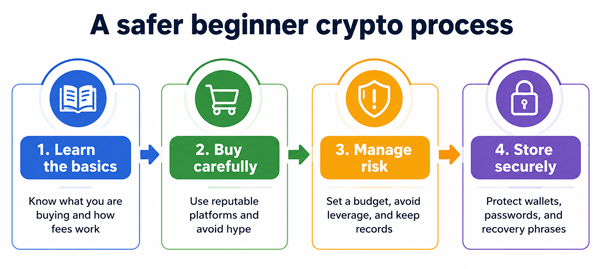
| 1. Learn | 2. Buy carefully | 3. Manage risk | 4. Store securely |
|---|---|---|---|
| Understand the asset, volatility, fees and local rules. | Use a reputable platform, secure the account and start small. | Use a written plan, avoid leverage and keep records. | Protect keys, verify networks and test transfers. |
1. Understand What Buying, Trading and Storing Mean
Cryptocurrency is a digital asset recorded and transferred using blockchain or similar distributed-ledger technology. A wallet does not normally hold coins in the way a physical wallet holds cash; it manages the credentials used to authorize transactions. Those credentials may include a private key and a recovery phrase.
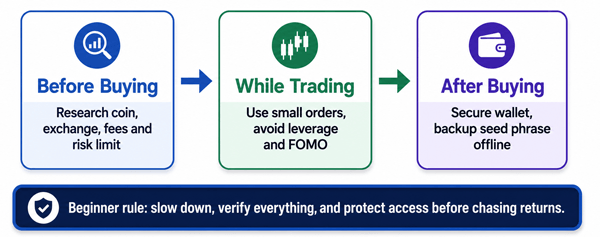
Buying means converting cash or another asset into cryptocurrency. Trading means buying and selling more actively to profit from price changes. Storing, or custody, means deciding where the access credentials sit and who controls them. These activities overlap, but their main risks are different.
| Activity | Main beginner risk | Safer habit |
|---|---|---|
| Buying | Hype, fake tokens, unsuitable platforms, hidden costs or an asset you do not understand. | Research first, start small and verify the exact asset and platform. |
| Trading | Emotional decisions, oversized positions, leverage, poor liquidity and overtrading. | Use a written plan, limit risk and treat “no trade” as a valid decision. |
| Storing | Account takeover, platform failure, phishing, lost recovery phrase or wrong-network transfer. | Use strong security, offline backups and a tested custody plan. |
2. Mistakes to Avoid Before Buying Cryptocurrency
Mistake 1: Buying because of hype or fear of missing out
A coin trends on social media, its price rises quickly and comments make it appear that everyone is getting rich. A beginner buys near the top without understanding the project, then panic-sells when the price falls. Hype is not research. Ask yourself: “Would I still consider this asset if nobody online were talking about it?”
Mistake 2: Investing money you cannot afford to lose
Crypto prices can fall sharply and platforms or projects can fail. Do not use rent, school fees, emergency savings, debt payments, medical money or borrowed funds for speculative crypto purchases. Decide in advance on an amount that could fall to zero without damaging your essential finances or peace of mind.
Mistake 3: Buying before understanding the asset
Bitcoin, smart-contract platform assets, stablecoins, meme coins and small tokens have different purposes and risks. A low unit price does not automatically mean an asset is cheap. Supply, market capitalization, liquidity, token unlocks, governance, concentration of ownership and the ability to sell all matter.
| Question to ask | Why it matters |
|---|---|
| What does the asset do, and who uses it? | Helps separate an actual use case from marketing or pure speculation. |
| Who can change supply, rules or governance? | Centralized control or large insider holdings can create additional risk. |
| How much liquidity and trading volume exist? | Low liquidity can produce slippage and make an exit difficult. |
| Are future token unlocks or emissions significant? | New supply can dilute existing holders and increase selling pressure. |
| Where did I verify the contract address? | Names, tickers and logos can be copied by fake tokens. |
| What could make this investment fail? | A source that presents only upside is not giving a balanced picture. |
Mistake 4: Assuming every cryptocurrency is like Bitcoin
Do not transfer the reputation, liquidity or design of one major asset to every token. Stablecoins can de-peg and carry issuer, reserve, liquidity and regulatory risks. Meme coins can depend heavily on attention. New small-cap tokens may have thin markets, concentrated ownership, unaudited code or anonymous teams.
Mistake 5: Ignoring local laws, restrictions and taxes
Crypto rules differ by country and can change. Exchanges, derivatives, staking, stablecoins or particular tokens may be restricted. Selling, swapping, spending or earning crypto can also create reporting or tax consequences depending on your jurisdiction. Keep complete records from the first transaction and check current official guidance where you live.
3. Mistakes to Avoid When Choosing a Crypto Platform
Mistake 6: Using the first exchange or app you see
A polished app is not proof of safety. Compare regulatory status where relevant, operating history, security controls, withdrawal rules, supported networks, liquidity, fee disclosures, customer support and whether users can transfer crypto to an external wallet. Be cautious when a platform pressures you toward futures, leverage or unusually high yields.
Platform due-diligence checklist
- Confirm that the platform is genuinely available and permitted in your location.
- Use the official app store listing or type the official web address yourself; avoid sponsored search links.
- Check whether app-based two-factor authentication, security keys and withdrawal allowlists are supported.
- Read the full fee schedule, including spreads and withdrawal charges.
- Confirm whether the exact asset and network you need are supported for deposits and withdrawals.
- Download account statements and transaction history regularly.
- Never use a platform recommended only by a stranger, romantic contact or private investment group.
Mistake 7: Ignoring the total cost
The displayed coin price is only part of the cost. You may pay a deposit or card fee, trading fee, conversion spread, blockchain network fee and withdrawal fee. A market order can also suffer slippage, especially in an illiquid market. Compare the amount you spend with the amount of crypto you actually receive, and check the expected cash-out cost before buying.
Mistake 8: Using weak account security
Use a unique password generated and stored securely. Enable app-based two-factor authentication or a hardware security key where available; SMS codes are generally more vulnerable to SIM-swap and interception risks. Secure the email account connected to the exchange, enable login and withdrawal alerts, and never approve an unexpected authentication request.
4. Mistakes to Avoid When Placing Your First Crypto Order
Mistake 9: Buying a fake or look-alike token
Scammers can copy a project name, ticker, logo and website. On decentralized exchanges, a token name alone is not a reliable identifier. Verify the contract address through the project’s official channels and cross-check it with a reputable independent data source. Be especially careful with newly launched tokens and links sent in direct messages.
Mistake 10: Using a market order in an illiquid token
A market order prioritizes execution, not price. In a thin order book, part of the order may fill much higher than the quoted price. A limit order lets you set the maximum price you will pay, although it may not execute. Learn the difference between market and limit orders before trading smaller assets.
Mistake 11: Going all in at once
Putting the full planned amount into one asset at one price creates concentration and timing risk. Some beginners use dollar-cost averaging—buying smaller fixed amounts over time—to reduce the pressure of choosing one perfect entry. It does not guarantee profit or protect against a long-term decline, but it may make behavior more disciplined.
Mistake 12: Failing to decide the purpose of the purchase
Before buying, decide whether you plan to hold, trade, transfer, use the asset on-chain or simply learn with a small amount. The purpose affects the platform, order type, records, custody method and acceptable fees. Without a purpose, beginners often drift between long-term investing and short-term speculation whenever the price moves.
5. Mistakes to Avoid When Trading Cryptocurrency
Active trading is normally harder than buying and holding because it adds execution, behavioral, fee and record-keeping risks. A profitable first trade can be luck rather than evidence of skill.
Mistake 13: Trading without a written plan
Before entering, write down why the trade exists, what would prove the idea wrong, where you may take profit, how long the thesis should take and how much you can lose. If you cannot state the invalidation point, you do not have a complete plan.
Mistake 14: Using leverage, futures or margin too early
Leverage increases the size of a position relative to your capital. It can magnify gains, but it also magnifies losses and can trigger liquidation after a relatively small adverse move. Funding rates, maintenance margin and sudden price gaps add complexity. Beginners should learn spot orders, fees, custody and position sizing before considering leveraged products.
Mistake 15: Chasing pumps and panic-selling dumps
Buying after a rapid rise because the move feels unstoppable, then selling after a sharp fall because the loss feels unbearable, is a common cycle. The antidote is not a prediction—it is a predefined rule. Slow down when urgency is highest, reduce size and do not let a social-media countdown become your trading plan.
Mistake 16: Overtrading and revenge trading
Crypto markets operate around the clock, but you do not need to participate around the clock. More trades can mean more fees, taxable events, mistakes, stress and lost sleep. After a loss, do not increase position size to “win it back.” Stop, document what happened and return only when calm.
Mistake 17: Ignoring position size and concentration
Risk depends not only on which coin you buy but also on how much of your portfolio is exposed. A small speculative position may be survivable; an oversized position in the same asset can be financially destructive. Set a maximum allocation for crypto and a smaller maximum for any single high-risk token.
Mistake 18: Copying influencers or private groups blindly
Promoters may be paid, may hold an undisclosed position or may sell into their followers’ buying. “Signals,” secret groups and claims of insider information are not substitutes for independent evidence. Verify the asset, liquidity, conflicts of interest and downside. Never send money to an account or platform merely because a public figure appears in a video or advertisement; impersonation and deepfakes are common scam tools.
| Bad habit | What it sounds like | Better replacement |
|---|---|---|
| FOMO buying | “It is already up 40%; I must buy now.” | Pause, research and enter only if the risk still makes sense. |
| Revenge trading | “I lost money, so I need a bigger trade today.” | Stop trading and review the process before returning. |
| No invalidation point | “I will sell when it feels right.” | Decide in advance what would prove the idea wrong. |
| Oversized position | “This one coin will change everything.” | Limit exposure so one mistake cannot ruin your finances. |
| Blind copy trading | “A famous account posted it.” | Verify the thesis, liquidity and conflicts independently. |
Mistake 19: Failing to keep records
Record dates, asset quantities, fiat values, fees, transaction IDs, wallet addresses and the purpose of each transfer. Exchanges can close, histories can become difficult to export and one token swap may be treated differently from a simple purchase in your jurisdiction. Good records support taxes, security investigations and honest performance review.
6. Mistakes to Avoid When Storing Cryptocurrency
Custody is the area where crypto differs most sharply from ordinary online banking. In self-custody, a lost or stolen recovery phrase may result in permanent loss, and there may be no central institution able to reset access.
Custodial vs self-custody, in plain English
Custodial storage means a platform controls the private keys and lets you access the account through its login and recovery process. Self-custody means you control the private keys or recovery phrase. Custody can be convenient but adds platform risk. Self-custody offers more control but adds personal responsibility.
| Storage option | Advantages | Main risks | Typical use |
|---|---|---|---|
| Exchange account | Easy buying, selling and account recovery in many cases. | Platform failure, account freeze, hacking, withdrawal limits and less direct control. | Small learning balances or active trading funds. |
| Software wallet | More control and easy access to transfers and decentralized apps. | Malware, phishing, malicious approvals and recovery-phrase mistakes. | Moderate amounts and careful on-chain use. |
| Hardware wallet | Private keys remain isolated from ordinary internet-connected devices. | Setup mistakes, supply-chain scams, device loss and unsafe backup practices. | Larger long-term holdings after the user understands recovery. |
| Offline paper/metal backup | Keeps recovery information away from online accounts. | Theft, fire, water, loss, photography or poor inheritance planning. | Recovery backup, not routine transaction use. |
Mistake 20: Leaving more on an exchange than your plan requires
An exchange balance is convenient, but the platform controls the keys. A hack, insolvency, withdrawal suspension or account dispute can affect access. This does not mean every beginner must immediately self-custody everything. It means the custody method should match the amount, purpose and user’s ability to protect backups.
Mistake 21: Photographing, cloud-storing or sharing a recovery phrase
A recovery phrase—often 12 or 24 words—can restore a wallet. Anyone who obtains it may be able to control the funds. Do not send it to support, type it into an unsolicited website, photograph it or store it casually in email, cloud notes or messaging apps. Keep an accurate offline backup in a secure place, and consider separate protected locations for meaningful holdings.
Mistake 22: Losing the recovery phrase or failing to test the backup
A backup is useful only if it is complete, readable and in the correct order. Check it carefully during setup. For a new self-custody process, practice with a small wallet and a small amount before storing meaningful value. Do not perform a recovery test while screen-sharing or following instructions from a stranger.
Mistake 23: Keeping everything in one place—or creating too many wallets
One exchange, one device or one wallet can be a single point of failure. Yet splitting small balances across many wallets can create confusion and lost backups. Use the simplest arrangement that meets your security needs, document it privately and review it as holdings or skills change.
Mistake 24: Connecting a main wallet to random websites
Fake airdrops, copied decentralized-app sites and malicious token approvals can drain a wallet without asking for the recovery phrase. Bookmark official sites, read approval messages, avoid unlimited permissions where possible, revoke unused approvals and use a separate low-value wallet for experiments.
Mistake 25: Forgetting estate and emergency planning
If nobody can locate or understand your access plan after death or incapacity, the assets may be permanently inaccessible. Create a secure inheritance process that tells trusted people that instructions exist without casually exposing the recovery phrase. For significant holdings, seek qualified legal and security advice appropriate to your country.
7. Mistakes to Avoid When Transferring Crypto
Mistake 26: Sending on the wrong network
The same token name can exist on multiple networks. The sender and recipient must support the same asset on the same network. A correct-looking address is not enough. Confirm the network, address and any memo or destination tag required by the receiving platform.
Mistake 27: Skipping a small test transaction
For a new address or route, send a small amount first. Confirm that it arrives and is credited correctly before sending the rest. The test adds time and a second fee, but it can prevent a much larger irreversible mistake.
Mistake 28: Copying an address without checking it
Clipboard malware can replace a copied address. Check the first and last characters and, for meaningful transfers, compare the complete address through a second trusted channel. Never rush because a caller or message claims your account is in danger.
Transfer rule Before pressing Send, verify five things: the asset, the full destination address, the network, any memo/tag and the amount. Then test with a small transaction when the route is new.
8. Crypto Scams Every Beginner Should Recognize
Scams often look professional and create urgency. The FBI’s 2025 IC3 Annual Report states that cryptocurrency investment fraud was the largest source of reported financial losses to Americans that year, with $7.2 billion in reported losses. Reported figures capture only complaints received and should not be treated as a complete measure of all harm.
| Scam type | How it works | Major warning sign |
|---|---|---|
| Fake investment platform | A site displays fake profits, then blocks withdrawals and demands more deposits, taxes or fees. | Guaranteed returns, a stranger-selected platform or payment required to unlock funds. |
| Relationship investment scam | A new online friend or romantic contact builds trust and gradually pushes crypto investing. | Pressure to use a specific app, site or private investment group. |
| Phishing or fake wallet site | A copied site asks for login credentials, a wallet connection or recovery phrase. | Unusual domain, urgent security claim or request for seed words. |
| Impersonation/deepfake scam | A scammer pretends to be support, a regulator, celebrity, executive or family member. | Demand for crypto payment, remote access or secrecy. |
| Pump-and-dump group | Promoters coordinate hype, then sell into followers’ purchases. | A precise “buy time,” secret signal or guaranteed short-term move. |
| Malicious wallet approval | A transaction grants permission to move tokens from the wallet. | Unlimited spending approval or a signature unrelated to the stated action. |
| Recovery scam | Someone contacts a previous victim and promises to retrieve lost crypto for an upfront fee. | Payment in advance, guaranteed recovery or request for private credentials. |
| Bitcoin ATM/kiosk scam | An impersonator orders the victim to buy crypto at a kiosk and send it to a QR-code address. | Claim that a government agency, bank or business requires crypto payment. |
Scam rule of thumb Treat it as a serious warning when someone promises guaranteed profits, pressures you to act immediately, asks for a recovery phrase or one-time code, requires crypto to “protect” money, or demands another payment to release a withdrawal.
9. A Practical Beginner Risk-Management Framework
You do not need to predict the market perfectly to avoid many expensive mistakes. You need rules that stop one bad decision from becoming a disaster.
- Protect essential finances first. Keep bills, emergency savings and debt obligations separate from crypto.
- Set a maximum crypto allocation before exposure to market hype, and use a smaller limit for speculative tokens.
- Start with a small amount while learning orders, fees, withdrawals, networks and wallet backups.
- Avoid leverage and borrowed money. Complexity should increase only after competence increases.
- Use independent research and write down the downside, not only the possible upside.
- Secure the email account, exchange account and wallet—not just one of them.
- Keep transaction and tax records from day one.
- Review the process periodically; do not react to every price candle or social-media post.
When to pause immediately
- You feel rushed, euphoric, frightened or desperate to recover a loss.
- You cannot explain the asset, fees, network or custody method in simple language.
- Someone promises a guaranteed or risk-free return.
- You are using borrowed money or money needed within the next few months.
- You are being asked to install remote-access software, reveal a code or enter a seed phrase.
- You are about to connect a valuable wallet to an unfamiliar site.
- The platform blocks withdrawals and asks for another payment.
10. Beginner Checklists
Before you buy
- I know what asset I am buying, what it is designed to do and what could make it fail.
- I can afford a total loss without affecting essential expenses.
- I verified the exact token or contract address.
- I checked the platform, fees, spread, liquidity and withdrawal rules.
- I am not reacting to hype, pressure or a guaranteed-return claim.
- I secured the platform and connected email account with strong authentication.
- I know whether I intend to hold, trade, transfer or use the asset.
- I have a custody and record-keeping plan.
Before you trade
- I have written the entry reason, invalidation point, possible exit and maximum loss.
- I understand the order type, liquidity, slippage and all fees.
- I am not using leverage, borrowed money or an oversized position.
- I am calm and not trying to recover a recent loss.
- I will record the trade and review whether I followed the plan.
Before you store or transfer
- I understand who controls the private keys.
- My recovery phrase is accurate, offline, private and protected from loss or damage.
- I obtained wallet software or hardware through an official source.
- I verified the asset, address, network and any memo/tag.
- I will make a small test transaction for a new route.
- I am not screen-sharing, following unsolicited support instructions or connecting to a random site.
- I have a secure emergency or inheritance plan for meaningful holdings.
11. Common Crypto Misconceptions
| Misconception | Reality |
|---|---|
| “Crypto is anonymous.” | Many blockchains are public and transactions can often be traced, even when names are not displayed directly. |
| “A low coin price means it is cheap.” | Supply, market capitalization, liquidity and token economics matter more than unit price alone. |
| “If an exchange lists it, it must be safe.” | A listing does not remove project, market, legal, liquidity or security risks. |
| “Stablecoins are the same as insured bank deposits.” | Stablecoins may face issuer, reserve, de-pegging, liquidity, technical and regulatory risks. |
| “Self-custody removes all risk.” | It reduces some platform risk but adds responsibility for keys, backups, devices and inheritance. |
| “More trades mean more profit.” | More trades can mean more fees, taxes, stress and opportunities for mistakes. |
| “Stolen crypto can always be recovered.” | Recovery can be difficult or impossible, and recovery scammers often target victims again. |
12. A Simple 30-Day Beginner Learning Plan
| Time | Focus | Practical action |
|---|---|---|
| Days 1–7 | Core concepts | Learn blockchain basics, volatility, major asset categories, exchanges, wallets, private keys and recovery phrases. |
| Days 8–14 | Security | Secure email and exchange accounts, identify phishing, learn backup practices and understand custodial vs self-custody. |
| Days 15–21 | Small purchase | Use a very small amount, compare order types and fees, and record the transaction accurately. |
| Days 22–30 | Transfer and review | Practice a small test transfer, document the network and address checks, then review every step for weaknesses. |
13. Frequently Asked Questions
13.1 What is the biggest mistake beginners make with crypto?
Moving too fast. Speed encourages buying without research, skipping security, following hype and trusting people or platforms that have not been verified.
13.2 What is the safest way for a beginner to buy cryptocurrency?
There is no risk-free method. A more careful approach is to use a reputable platform available in your location, secure the account, understand the fees, start with a small amount and avoid guaranteed-profit offers.
13.3 Should beginners trade crypto or buy and hold?
Active trading adds execution, emotional and record-keeping risks. Many beginners benefit from learning slowly before trading frequently. Buying and holding still carries substantial price and custody risk.
13.4 Is it bad to keep crypto on an exchange?
A small balance can be convenient, but exchange custody adds platform and account risk. Self-custody adds personal key-management risk. The choice should match the amount, purpose and user’s security competence.
13.5 Do I need a hardware wallet?
Not immediately in every case. A hardware wallet may reduce online key exposure for larger long-term holdings, but it does not protect against every mistake. Users still need safe setup, recovery and transaction-verification habits.
13.6 What happens if I lose my recovery phrase?
If you also lose access to the wallet, there may be no way to recover the funds. This is why accurate offline backups and a tested recovery process are critical.
13.7 Can crypto transactions be reversed?
Usually not after confirmation. A platform or recipient may sometimes help in limited circumstances, but users should assume a mistaken transfer could be permanent.
13.8 How much should a beginner invest?
There is no universal amount. Use only money that can be lost without affecting essentials, emergency savings, debt obligations or near-term goals. Starting very small is sensible while learning.
13.9 Are stablecoins risk-free?
No. They are designed to track another asset, but may face de-pegging, issuer, reserve, liquidity, technical, platform and regulatory risks.
13.10 How can I identify a crypto scam?
Look for guaranteed returns, urgency, fake support, unsolicited investment groups, romance-based advice, blocked withdrawals, requests for more fees, remote-access requests and any demand for a private key or recovery phrase.
13.11 What is the single most important wallet security rule?
Never share your private key or recovery phrase. Anyone who has it may be able to control the funds.
13.12 Do crypto trades create tax obligations?
They may. Rules depend on jurisdiction and can apply to sales, swaps, spending, staking, rewards or other transactions. Keep records and consult current official guidance or a qualified professional.
14. Final Takeaway
Beginners often search for the next winning coin, but the first objective should be avoiding preventable loss. Learn before buying, risk only non-essential money, choose platforms carefully, understand total costs, avoid leverage, protect every credential, verify every transfer and treat urgency as a warning sign. In crypto, patience and verification are not delays—they are security tools.
The goal is not to become fearless. It is to become careful enough that one mistake does not wipe you out.
Sources Consulted
- Investor.gov — Crypto Asset Custody Basics for Retail Investors
- FINRA — Crypto Assets: Risks
- FINRA — Relationship Investment Scams
- FTC Consumer Advice — What To Know About Cryptocurrency and Scams
- FBI IC3 — 2025 Annual Report
- IRS — Digital Assets
Reader Advice
This article provides general educational information and is not personalized financial, investment, legal, tax or security advice, and it is not a recommendation to buy, sell, trade or hold any cryptocurrency. Crypto assets can be highly volatile; platforms, projects and stablecoins can fail; scams and technical errors are possible; and transactions may be irreversible. Laws, regulations, taxes, fees and platform policies vary by location and change over time. Verify important details through current official sources and consult qualified professionals when appropriate.