How Does Cryptocurrency Work?
Blockchain, Wallets and Transactions Explained1. Quick Answer: How Cryptocurrency Works
Cryptocurrency is digital money or a digital asset recorded on a shared database called a blockchain. Instead of one bank updating everyone’s balances, many computers on a network follow the same rules, check transactions and agree on the latest version of the ledger. A crypto wallet does not actually store coins like a leather wallet stores cash. It stores private keys, which are secret codes that let you sign and authorize transactions from your address.
In simple terms: your wallet creates and signs a transaction, the network checks it, miners or validators add it to a block, and the blockchain updates so the receiver can spend the funds. The system is powerful, but it also has risks: transactions are usually irreversible, prices can be volatile, fees can change, scams are common, and losing a seed phrase can mean losing access permanently.
- Blockchain = a shared, tamper-resistant ledger of transactions.
- Wallet = software or hardware that manages keys and shows balances.
- Private key or seed phrase = the secret that controls access. Never share it.
- Public address = the destination you share to receive crypto.
- Transaction fee = payment to the network participants who process transactions.
- Confirmation = evidence that a transaction has been included in the blockchain and is harder to reverse.
2. What Is Cryptocurrency?
Cryptocurrency is a digital asset that uses cryptography and network rules to control ownership and transfers. Bitcoin was designed as a peer-to-peer electronic cash system, meaning people can send value directly without relying on a central payment company for every transaction. Other cryptocurrencies, such as ether on Ethereum, can also be used to pay for activity on programmable networks that run smart contracts and decentralized applications.
A helpful comparison is email. You can send an email without printing a letter or asking a post office to approve the message. Crypto aims to do something similar for value: a wallet can send a signed message to a network saying, in effect, “I authorize this amount to move from my address to that address.” The network checks whether the message follows the rules.
| Term | Plain-English meaning | Beginner example |
|---|---|---|
| Coin or token | A digital asset recorded on a blockchain. | Bitcoin is a coin on the Bitcoin network; USDC is a token used on several networks. |
| Blockchain | A shared transaction history maintained by many computers. | Like a public spreadsheet that many independent computers verify. |
| Wallet | An app or device that manages your keys and lets you send or receive crypto. | A mobile wallet, browser wallet or hardware wallet. |
| Address | A public receiving destination derived from cryptographic keys. | Similar to an email address for payments, but mistakes are harder to fix. |
| Private key | A secret used to authorize spending. | Like the master password to funds at an address. |
| Seed phrase | A set of words that can recover many wallet keys. | Often 12 or 24 words written down during wallet setup. |
3. What Is a Blockchain?
A blockchain is a ledger made of batches of data called blocks. Each block contains transactions and a reference to the previous block. Linking blocks this way creates a timeline. If someone tries to change an old transaction, the change would break the chain’s history unless the attacker can also overcome the network’s consensus rules.
Blockchains are often described as “decentralized,” but decentralization is not all-or-nothing. A network may have many independent validators, or it may rely on a smaller group. Beginners should look at the actual network, not just the marketing word.
3.1 Why Blocks Are Linked Together
Every block includes a cryptographic fingerprint of the block before it. This fingerprint is called a hash. A hash is easy to check but practically impossible to reverse into the original data. If one detail changes, the hash changes. That is why blockchains are useful for creating an auditable history.
3.2 How Networks Agree: Mining, Staking and Consensus
A blockchain needs a way for independent computers to agree on which transactions are valid and which block comes next. This process is called consensus.
| Consensus method | How it works | Common trade-offs |
|---|---|---|
| Proof of work | Miners compete to solve computational puzzles and propose blocks. Bitcoin uses proof of work. | Strong battle-tested security, but energy use can be high and throughput is limited. |
| Proof of stake | Validators lock up, or stake, the network asset and are selected to propose and attest to blocks. Ethereum moved to proof of stake in 2022. | Much lower energy use than proof of work, but design complexity and validator concentration are concerns to watch. |
| Permissioned consensus | Approved participants validate transactions, often in business or institutional settings. | Can be fast and controlled, but less open and usually less censorship-resistant. |
4. How Crypto Wallets Work
A crypto wallet is the beginner’s main interface with a blockchain. It creates or imports keys, shows balances, prepares transactions and asks you to approve actions. The blockchain stores the actual ownership record. The wallet helps you control the keys that prove you are allowed to spend from an address.
4.1 Public Address vs Private Key
Your public address is safe to share when you want to receive funds. Your private key is never safe to share. Anyone with the private key or seed phrase can usually move the funds. No legitimate support agent, exchange, wallet provider, government office or investment adviser needs your seed phrase.
| Wallet type | Best for | Main advantage | Main risk |
|---|---|---|---|
| Custodial exchange account | Beginners buying small amounts and trading often. | Password recovery and familiar app experience. | You trust the company to hold the assets and stay solvent, secure and compliant. |
| Hot wallet | Using apps, NFTs, DeFi or frequent transactions. | Convenient and quick. | Connected devices are exposed to malware, phishing and mistaken approvals. |
| Hardware wallet / cold wallet | Long-term storage and larger balances. | Private keys stay offline during normal use. | You must protect the device, seed phrase and backups. |
| Paper or metal backup | Seed phrase backup, not daily spending. | Offline and simple when stored securely. | Loss, theft, fire, water damage or poor backup habits. |
5. What Happens in a Cryptocurrency Transaction?
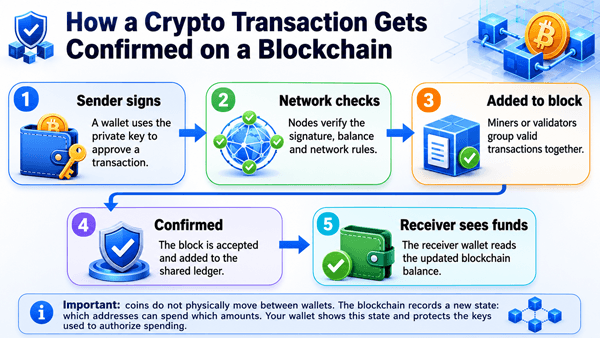
Here is the process in more detail:
- You enter the receiver’s address, amount and network fee in your wallet.
- Your wallet uses your private key to create a digital signature. This proves authorization without revealing the private key.
- The signed transaction is broadcast to the network.
- Nodes check the transaction against network rules, such as whether the signature is valid and whether the funds are available.
- A miner or validator includes the transaction in a new block.
- Once the block is accepted, wallets and block explorers show the transaction as confirmed.
- Additional blocks after it usually make reversal increasingly difficult.
5.1 A Simple Real-World Example
Imagine Aisha wants to send 0.01 BTC to Bilal. Bilal sends Aisha a Bitcoin address. Aisha pastes it into her wallet, enters 0.01 BTC, reviews the fee, and confirms. Her wallet signs the transaction and broadcasts it. The Bitcoin network checks that her address can spend the funds. A miner includes the transaction in a block. Bilal’s wallet sees the payment. After enough confirmations for the amount involved, Bilal treats it as final.
6. Fees, Confirmations and Finality
Crypto networks usually charge a transaction fee. Fees are not a tip to the wallet company; they are part of how the network prioritizes limited block space and rewards the participants who process transactions. When a network is busy, fees can rise. Sending the same amount can cost very little at one time and much more later.
A confirmation means a transaction has been included in a block. One confirmation is often enough for small, low-risk payments, while exchanges and merchants may require more for larger transfers. The right number depends on the network, the amount and the risk tolerance of the receiver.
| Concept | What it means | Practical tip |
|---|---|---|
| Network fee | Cost paid to process the transaction. | Check the fee before approving, especially on busy networks. |
| Mempool / pending queue | Transactions waiting to be included in blocks. | A low fee may make a transaction slow. |
| Confirmation | A block has included the transaction. | Wait for more confirmations for higher-value transfers. |
| Finality | How hard it is to reverse or reorganize the transaction. | Different chains have different finality assumptions. |
7. Blockchain vs Traditional Banking: What Is Different?
| Feature | Cryptocurrency blockchain | Traditional banking |
|---|---|---|
| Control | You may control funds directly through private keys. | Banks control account access and can reverse or block transactions. |
| Availability | Many networks operate 24/7 globally. | Transfers may depend on banking hours, rails and jurisdictions. |
| Mistake recovery | Often difficult or impossible after confirmation. | Chargebacks, reversals or support may be possible. |
| Identity | Addresses can be pseudonymous but activity is often publicly visible. | Accounts are tied to verified identities and private bank records. |
| Fees | Fees depend on network congestion and chain design. | Fees depend on banks, card networks and payment providers. |
| Responsibility | Users must secure keys and avoid scams. | Institutions provide custody, fraud controls and recovery processes. |
8. What Are Smart Contracts?
A smart contract is code stored and executed on a blockchain. Instead of only sending coins from one address to another, a transaction can interact with a program. For example, a decentralized exchange can use smart contracts to let users swap tokens, or a lending protocol can use smart contracts to manage deposits and borrowing rules.
Smart contracts are not automatically safe just because they are on a blockchain. Bugs, poor design, admin privileges, oracle failures and user-interface scams can all lead to losses. Beginners should be careful when connecting wallets to unfamiliar websites.
9. Benefits of Cryptocurrency
- Direct ownership: With a non-custodial wallet, users can hold assets without depending on a bank account.
- Open access: Many networks are available to anyone with an internet connection and compatible wallet.
- Fast global transfers: Some networks can move value across borders quickly compared with legacy rails.
- Programmability: Smart contracts make new financial and digital ownership models possible.
- Transparency: Public blockchains let anyone inspect transaction history, balances and contract activity.
10. Risks, Limitations and Misconceptions
| Issue | What beginners often think | Reality |
|---|---|---|
| “Crypto is anonymous.” | Nobody can see anything. | Most public blockchains are pseudonymous. Addresses are visible, and activity can often be analyzed. |
| “A wallet stores my coins.” | Coins sit inside the wallet app. | The blockchain records balances. The wallet stores keys and reads the ledger. |
| “Transactions can always be reversed.” | Support can undo mistakes. | Many confirmed transactions are irreversible unless the receiver voluntarily returns funds. |
| “All crypto is the same.” | Every coin works like Bitcoin. | Networks vary widely in consensus, security, fees, use cases and decentralization. |
| “High returns are guaranteed.” | Crypto always goes up over time. | Prices are volatile. Projects can fail, get hacked or become illiquid. |
The biggest practical risks for beginners are sending funds on the wrong network, typing or pasting the wrong address, losing the seed phrase, approving a malicious smart contract, keeping too much on an exchange, and believing investment promises from strangers.
11. Beginner Best Practices Before Using Crypto
- Start small. Test with a tiny amount before sending a large transfer.
- Confirm the network. USDT on Ethereum is not the same as USDT on Tron, Solana or another chain.
- Check the address carefully. Use copy-and-paste cautiously and compare the first and last characters.
- Protect your seed phrase offline. Do not screenshot it, email it, upload it or type it into websites.
- Use two-factor authentication on exchange accounts, preferably an authenticator app or hardware security key.
- Separate wallets by purpose. Keep a small “daily use” wallet and a safer long-term storage wallet.
- Be skeptical of urgency. Scammers push quick action, guaranteed profits, recovery services and secret opportunities.
- Keep records. Track buys, sells, swaps, income, fees and transfers for tax and accounting purposes.
- Update software from official sources only. Fake wallet apps and browser extensions are common traps.
- Do not invest money you cannot afford to lose.
12. How to Read a Blockchain Transaction
A block explorer is a search engine for a blockchain. You can paste a transaction ID, address or block number to see public details. Beginners should learn the basic fields before panicking over a pending transfer.
| Explorer field | Meaning | What to check |
|---|---|---|
| Transaction hash / ID | The unique identifier for a transaction. | Use it to track status or share proof of payment. |
| Status | Pending, failed or confirmed. | A failed transaction may still cost a fee on some networks. |
| From / To | Sending and receiving addresses, or smart contract interactions. | Make sure the destination matches the intended address. |
| Amount | Value transferred. | Check token decimals and ticker carefully. |
| Fee / gas | Cost paid to the network. | High fees may indicate congestion or complex contract activity. |
| Confirmations / block | How deeply the transaction is included in the chain. | More confirmations usually means greater settlement confidence. |
13. Common Mistakes to Avoid
- Sending crypto to an address on the wrong blockchain network.
- Sharing a seed phrase with “support” or entering it into a website.
- Approving unlimited token spending for unknown smart contracts.
- Using public Wi-Fi and an unprotected device for high-value transfers.
- Keeping all assets in one hot wallet.
- Ignoring tax obligations because the asset is “digital.”
- Trusting screenshots of profits, celebrity endorsements or private investment groups.
- Forgetting that stablecoins can have issuer, reserve, regulatory and depegging risks.
14. Pros and Cons Summary
| Pros | Cons |
|---|---|
| Open, global access to digital assets. | User mistakes can be permanent. |
| Potentially fast 24/7 settlement. | Fees and speeds vary by network congestion. |
| Self-custody is possible. | Self-custody requires serious security habits. |
| Transparent public records. | Public records can reduce privacy. |
| Programmable financial tools through smart contracts. | Smart contract bugs and scams can cause losses. |
| Useful for some cross-border, digital and experimental applications. | Volatility and regulation can create uncertainty. |
15. Frequently Asked Questions
15.1 Is cryptocurrency real money?
It depends on the context. Some people use cryptocurrencies as money, some as investments, and some as access tokens for blockchain applications. Many countries do not treat most cryptocurrencies as legal tender. A practical way to think about crypto is “digital value recorded on a blockchain,” not automatically the same as cash in a bank.
15.2 Where is cryptocurrency stored?
The coins or tokens are recorded on the blockchain. Your wallet stores or manages the private keys that let you control addresses on that blockchain.
15.3 Can a crypto transaction be canceled?
Usually not after it is confirmed. If a transaction is still pending, some networks and wallets may allow replacement or fee adjustment, but beginners should assume that confirmed transactions are final.
15.4 What happens if I lose my seed phrase?
If you use a non-custodial wallet and lose the seed phrase or private key, there may be no recovery option. That is why offline backups are essential.
15.5 Can someone steal my crypto with my public address?
No. A public address lets people view or send funds to that address, but it should not let them spend. The danger is sharing your private key, seed phrase, device access or malicious approvals.
15.6 Why do transaction fees change?
Block space is limited. When many people want transactions processed, they may offer higher fees to be prioritized. Smart contract interactions can also require more computation and therefore more fee.
15.7 What is the difference between a coin and a token?
A coin is usually native to its own blockchain, such as BTC on Bitcoin or ETH on Ethereum. A token is created on top of an existing blockchain, such as many stablecoins and app tokens.
15.8 Is Bitcoin the same as blockchain?
No. Bitcoin is one cryptocurrency and one blockchain network. Blockchain is the broader technology model used by many networks.
15.9 Is crypto safe for beginners?
Crypto can be used safely only with caution, education and risk limits. The technology removes some middlemen but also removes many consumer protections. Beginners should start small, avoid hype and learn wallet security first.
15.10 Do I need to pay taxes on cryptocurrency?
Tax rules vary by country, but many jurisdictions treat sales, swaps, payments, mining, staking or other crypto activity as reportable. Keep records and consult a qualified tax professional for your location.
16. Final Takeaway
Cryptocurrency works by combining cryptography, wallets, network rules and a shared blockchain ledger. A wallet signs a transaction, the network verifies it, and miners or validators add it to the chain. The main beginner lesson is simple: crypto gives users more direct control, but that control comes with more responsibility. Learn the difference between addresses and private keys, test transfers before sending large amounts, protect your seed phrase, watch fees, avoid scams and keep good records.
Sources Consulted and Checked
The following sources were consulted and checked while preparing this article to support clarity and accuracy.
- Bitcoin.org, “Bitcoin: A Peer-to-Peer Electronic Cash System” (Satoshi Nakamoto)
- Bitcoin.org, “Securing your wallet”
- Bitcoin.org, “Some things you need to know”
- Ethereum.org, “Proof-of-stake (PoS)”
- Ethereum.org, “Ethereum wallets”
- Ethereum.org, “Ethereum accounts”
- Federal Trade Commission, “What To Know About Cryptocurrency and Scams”
- FBI Internet Crime Complaint Center, “Cryptocurrency”
- IRS, Digital assets information
Reader Advice
This article is provided for general educational and informational purposes only. It explains how cryptocurrency, blockchains, wallets and transactions commonly work, but it is not personalized legal, financial, investment, tax, cybersecurity or regulatory advice, and it should not be treated as a recommendation to buy, sell, hold or use any digital asset. Cryptocurrency involves significant risks, including price volatility, scams, hacking, loss of private keys or seed phrases, irreversible transfers, smart-contract failures, exchange or stablecoin failure, and possible loss of the entire amount involved. Laws, rules, policies, fees, technical standards and statistics can change and may differ by country, region, platform and blockchain network. Before acting, verify current information through official sources, review the terms and security guidance of the relevant service, consider your circumstances and risk tolerance, and seek advice from a suitably qualified professional where appropriate.