Crypto Coins vs Tokens: Key Differences, Examples and Use Cases
1. Quick Answer: Coin vs Token in Plain English
A crypto coin is the native digital asset of its own blockchain. Bitcoin (BTC) is the native coin of the Bitcoin blockchain. Ether (ETH) is the native coin of Ethereum and is used to pay for computation and transaction fees on that network.
A crypto token is a digital asset created on top of an existing blockchain, usually through a smart contract. For example, many tokens run on Ethereum using standards such as ERC-20. Tokens can represent stablecoins, governance rights, rewards, real-world assets, game items, or NFTs.
The easiest rule: if the asset belongs to the base blockchain itself, it is usually a coin. If it is issued by an app, project, company, DAO, or smart contract on another blockchain, it is usually a token.
1.1 At-a-Glance Comparison
| Feature | Crypto Coin | Crypto Token |
|---|---|---|
| Basic meaning | Native asset of a blockchain. | Asset built on an existing blockchain. |
| Examples | BTC, ETH, SOL, ADA, DOGE | USDT, USDC, UNI, LINK, AAVE, NFTs |
| Where it lives | On its own blockchain or base network. | On another blockchain such as Ethereum, Solana, BNB Chain, Polygon, or Arbitrum. |
| How it is created | Usually through the blockchain protocol, mining, staking, or network rules. | Usually through a smart contract or token program. |
| Main uses | Transaction fees, network security, payments, store of value, staking. | Stable payments, governance, DeFi, rewards, access, NFTs, tokenized assets. |
| Typical fee paid in | The network coin. For example, ETH on Ethereum. | Still usually paid in the network coin, not the token itself. |
| Beginner mistake | Thinking every crypto asset is a coin. | Thinking tokens have their own blockchain. |
2. What Is a Crypto Coin?
A crypto coin is a blockchain’s native asset. It is part of the core network design, not an extra asset added later by a separate app. Coins help the network operate because users often need them to pay transaction fees, validators or miners may receive them as rewards, and the coin may be used to secure the blockchain.
Bitcoin is the simplest example. BTC exists on the Bitcoin network and was designed for peer-to-peer electronic payments without relying on a traditional financial intermediary. Ethereum is broader: ETH is the native asset of Ethereum and is used to pay for computation, smart contract activity, and network fees.
2.1 Common Examples of Coins
| Coin | Blockchain | Common use case |
|---|---|---|
| BTC | Bitcoin | Peer-to-peer value transfer, long-term holding, settlement asset. |
| ETH | Ethereum | Gas fees, staking, DeFi activity, NFT transactions, smart contract execution. |
| SOL | Solana | Transaction fees, staking, applications on Solana. |
| ADA | Cardano | Fees, staking, governance-related ecosystem activity. |
| DOGE | Dogecoin | Payments, tipping, community-driven use. |
2.2 How Crypto Coins Work
Coins are created and moved according to the rules of their own blockchain. Those rules define things such as supply, transaction validation, fees, rewards, and consensus. For example, a proof-of-work chain may reward miners, while a proof-of-stake chain may reward validators who lock coins to help secure the network.
When you send a coin, the blockchain records that transaction. Wallets do not literally store coins like files. Instead, wallets store private keys that allow you to control addresses on the blockchain.
2.3 Main Benefits of Coins
- They are usually essential to the network they belong to.
- They may have stronger liquidity and exchange support than smaller tokens.
- They are often used to pay fees and secure the network.
- Some coins, such as BTC and ETH, have long operating histories compared with many newer assets.
2.4 Main Limitations and Risks of Coins
- Prices can be highly volatile.
- A coin can still fail if its network loses users, developers, validators, or economic demand.
- Network fees may rise during congestion.
- Some coins have unclear utility, weak security, or concentrated ownership.
3. What Is a Crypto Token?
A crypto token is a digital asset issued on top of an existing blockchain. The token does not normally need its own blockchain. Instead, it follows a token standard or program that tells wallets, exchanges, and apps how to read balances and transfer the asset.
On Ethereum, one of the best-known token standards is ERC-20. It defines common functions such as transferring tokens, checking balances, checking total supply, and approving a third party to spend tokens. This standardization is why many wallets and decentralized exchanges can support thousands of tokens without custom code for every project.
3.1 Common Examples of Tokens
| Token type | Examples | What it can be used for |
|---|---|---|
| Stablecoins | USDT, USDC, DAI | Digital dollar-like payments, trading pairs, DeFi collateral. |
| Governance tokens | UNI, AAVE, COMP | Voting on protocol changes or treasury decisions. |
| Utility/access tokens | BAT, some game or platform tokens | Access, rewards, platform usage, in-app economies. |
| Oracle and infrastructure tokens | LINK | Paying or incentivizing services that support blockchain apps. |
| NFTs | ERC-721 or similar collectibles | Digital art, game items, memberships, tickets, identity-like assets. |
| Tokenized real-world assets | Tokenized treasuries, property shares, commodities | Representing claims or exposure to off-chain assets, subject to legal structure. |
3.2 How Crypto Tokens Work
- A project chooses a blockchain, such as Ethereum or Solana.
- It creates a smart contract or token program that defines the token rules.
- The contract tracks balances, transfers, supply, and permissions.
- Users interact with the token through wallets, exchanges, dApps, or smart contracts.
- Transaction fees are paid in the blockchain’s native coin, such as ETH on Ethereum.
This is why a beginner can hold USDC on Ethereum but still need ETH to move it. The token is USDC, but the network fee is paid in ETH because Ethereum is the blockchain processing the transaction.
4. Visual Diagram: Coins vs Tokens
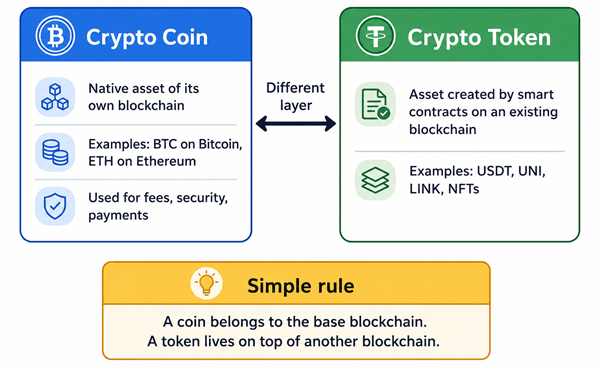
Figure: Coins are native to a blockchain; tokens are issued on top of an existing blockchain.
5. The Key Differences Between Crypto Coins and Tokens
5.1 Blockchain Layer
Coins live at the base layer of a blockchain. Tokens live at the application or smart contract layer. This is the most important difference.
5.2 Creation and Issuance
Coins are created by the network protocol. Tokens are created by a project or developer using a token contract. A token can often be launched faster because the project does not need to build and secure a brand-new blockchain.
5.3 Security Model
A coin depends on the security of its own blockchain. A token depends on the security of the host blockchain plus the security of its own smart contract. This means tokens can inherit strong blockchain security, but they can also introduce extra smart contract risk.
5.4 Fees
Coins are commonly used to pay transaction fees on their own network. Tokens usually cannot pay their own transfer fees unless the app adds special account abstraction or sponsorship features. In most normal cases, the native coin is still needed for gas.
5.5 Flexibility
Tokens are often more flexible for businesses and communities. A project can design a token for voting, rewards, access, in-game assets, or stable-value payments without launching a new blockchain.
5.6 Regulation and Legal Meaning
The words coin and token are technical categories, not legal guarantees. A token can be a utility token, governance token, stablecoin, security-like asset, or something else depending on its design, sale, marketing, rights, and jurisdiction. Regulators have repeatedly warned that crypto assets can be speculative and may lack investor protections found in traditional markets.
6. Real-World Use Cases
6.1 Coin Use Cases
- Paying blockchain fees: ETH pays gas on Ethereum; SOL pays fees on Solana.
- Securing networks: proof-of-stake coins may be staked by validators.
- Payments and settlement: BTC and some other coins are used for peer-to-peer transfer.
- Store-of-value speculation: some people hold coins because they believe the network will become more valuable.
- Collateral: major coins are often used as collateral in DeFi, though this adds liquidation risk.
6.2 Token Use Cases
- Stablecoins: tokens such as USDC and USDT are used for dollar-like transfers and trading pairs.
- DeFi: lending, borrowing, liquidity pools, yield strategies, and governance often use tokens.
- Governance: token holders may vote on protocol upgrades or treasury spending.
- Gaming: tokens can represent in-game currencies, items, characters, or rewards.
- NFTs and collectibles: tokens can represent unique digital items.
- Tokenized real-world assets: tokens may represent claims on off-chain assets, but the legal rights depend on the issuer and documents.
7. Pros and Cons: Coins vs Tokens
| Category | Coins - Pros | Coins - Cons | Tokens - Pros | Tokens - Cons |
|---|---|---|---|---|
| Launch and infrastructure | Native to a network; core to blockchain operation. | Hard to launch because a new chain needs security and adoption. | Faster and cheaper to launch on an existing chain. | Depends on host chain and contract quality. |
| Security | Can be secured by the whole network. | Weak chains can be attacked or abandoned. | Can inherit strong host-chain security. | Smart contract bugs, admin keys, bridges, and approvals add risk. |
| Utility | Often needed for fees, staking, and network activity. | Some coins have limited real demand beyond speculation. | Can be designed for specific app, community, or asset needs. | Utility may be vague, exaggerated, or unnecessary. |
| User experience | Major coins are widely supported. | Fees and addresses can confuse beginners. | Tokens can support many use cases. | Users may need the native coin for gas even when moving a token. |
8. Beginner Scenarios That Make the Difference Clear
8.1 Scenario 1: Sending USDC on Ethereum
You want to send USDC to a friend. USDC is the token. Ethereum is the blockchain. ETH is the coin you need to pay gas. If your wallet has USDC but no ETH, the transfer may fail because you cannot pay the network fee.
8.2 Scenario 2: Buying Bitcoin
You buy BTC and withdraw it to a Bitcoin address. BTC is not an ERC-20 token and does not live on Ethereum. It moves on the Bitcoin network, and fees are paid in BTC.
8.3 Scenario 3: Receiving a Token on the Wrong Network
Someone sends you USDT on Tron, but your exchange deposit address was for USDT on Ethereum. Both assets may be called USDT, but they are on different networks. Sending tokens to the wrong network or address can cause loss or require difficult recovery.
8.4 Scenario 4: Buying a Governance Token
You buy UNI because you use Uniswap. UNI is not the native coin of Ethereum. It is a token used for governance around the Uniswap protocol. Its value depends on market demand, governance expectations, token design, and broader crypto conditions.
9. Common Misconceptions
| Misconception | Reality |
|---|---|
| All cryptocurrencies are coins. | Crypto asset is the broad category. Coins and tokens are subcategories. |
| Tokens are less valuable than coins. | Value depends on demand, utility, supply, liquidity, trust, legal rights, and risk. Some tokens are large; many coins are small. |
| A token always gives ownership in a company. | Usually it does not. Token rights depend on the issuer, contract, and legal documents. |
| Stablecoins are risk-free. | Stablecoins can have issuer, reserve, regulatory, depeg, smart contract, and platform risks. |
| If it is listed on an exchange, it is safe. | Listings are not guarantees. Exchanges can list risky, illiquid, or speculative assets. |
| A token with a low price is cheap. | Price per unit is meaningless without supply. Market capitalization and tokenomics matter more. |
10. How to Evaluate a Coin or Token Before Using or Buying It
- Identify the asset type. Is it a coin, fungible token, NFT, stablecoin, governance token, or tokenized asset?
- Check the network. Which blockchain does it use? Are you using the correct deposit and withdrawal network?
- Read the official documentation. Understand the asset’s purpose, supply, issuance, rights, and limitations.
- Review tokenomics. Look at total supply, circulating supply, unlock schedules, allocation to insiders, and inflation.
- Check real utility. Ask what problem the asset solves and whether people need it beyond speculation.
- Assess liquidity. Thinly traded assets can be hard to sell without large price impact.
- Look for security audits, but do not treat audits as guarantees.
- Understand custody. Decide whether you are using an exchange wallet, hardware wallet, mobile wallet, or smart contract wallet.
- Avoid approvals you do not understand. Token approvals can let apps spend tokens from your wallet.
- Never invest money you cannot afford to lose. Crypto assets can be extremely volatile and speculative.
11. Practical Wallet and Safety Tips
- Always match the asset and network before sending funds.
- Send a small test transaction first when moving a meaningful amount.
- Keep some native coin in your wallet for gas.
- Use official contract addresses from reputable sources, not random social media links.
- Revoke unused token approvals when appropriate.
- Be careful with airdrops, fake tokens, phishing sites, and wallet signature requests.
- Understand that blockchain transactions are usually irreversible.
- For larger holdings, consider a hardware wallet and a clear backup plan for seed phrases.
12. Which Is Better: Coins or Tokens?
Neither is automatically better. Coins and tokens are tools for different jobs.
Coins are better when the goal is to use or secure a blockchain network. Tokens are better when the goal is to represent a specific asset, right, reward, membership, governance function, or app-level feature on an existing blockchain.
A beginner should focus less on the label and more on the real questions: What does this asset do? Who controls it? What rights do holders have? What risks exist? How liquid is it? What network is it on? What happens if the project fails?
13. Summary
Crypto coins are native assets of their own blockchains, such as BTC on Bitcoin or ETH on Ethereum. Crypto tokens are assets created on existing blockchains through smart contracts or token programs, such as USDC, UNI, LINK, or NFTs on Ethereum and other networks. Coins usually pay network fees and help secure blockchains, while tokens are used for stablecoins, DeFi, governance, rewards, gaming, collectibles, and tokenized assets.
14. Frequently Asked Questions
14.1 Is Bitcoin a coin or a token?
Bitcoin is a coin because BTC is the native asset of the Bitcoin blockchain.
14.2 Is Ethereum a coin or a token?
ETH is a coin because it is the native asset of the Ethereum blockchain. Many tokens also run on Ethereum, but ETH itself is the native coin.
14.3 Is USDT a coin or a token?
USDT is usually a token. It exists on multiple blockchains, including Ethereum, Tron, Solana, and others. You must choose the correct network when sending it.
14.4 Can a token become a coin?
Yes. A project may launch as a token on one chain and later move to its own blockchain. This is often called a mainnet migration or token swap.
14.5 Do tokens have their own blockchain?
Usually no. A token normally uses an existing blockchain. Some projects use the word token loosely, so always check the technical details.
14.6 Do I need ETH to send ERC-20 tokens?
In normal Ethereum transactions, yes. ERC-20 token transfers require ETH for gas because Ethereum processes the transaction.
14.7 Are NFTs coins or tokens?
NFTs are tokens. They are non-fungible tokens, meaning each one is unique or individually identifiable.
14.8 Are tokens riskier than coins?
Not always, but tokens can add extra risks such as smart contract bugs, admin control, weak tokenomics, low liquidity, and unclear legal rights.
14.9 What is the difference between a utility token and a governance token?
A utility token is designed for access, usage, rewards, or functions inside an ecosystem. A governance token is designed to let holders vote on protocol decisions, though actual influence depends on the governance design and token distribution.
14.10 What is the safest way to learn?
Start with small amounts, use reputable wallets, verify networks and addresses, read official documentation, and avoid assets you do not understand.
15. Final Takeaway
The coin-versus-token difference is simple once you think in layers. A coin is native to the blockchain. A token is built on top of a blockchain. That one distinction explains why ETH pays Ethereum gas, why USDC can exist on several networks, why NFTs are tokens, and why sending assets on the wrong network can be costly.
For beginners, the best habit is to pause before every transaction and ask: What asset is this? What network is it on? What fee coin do I need? What rights or risks come with it? That mindset will prevent many common crypto mistakes.
Sources Consulted and Checked
The following sources were consulted and checked while preparing this document and supporting its accuracy.
- Ethereum.org, “Technical intro to Ethereum” — explains ETH as Ethereum’s native cryptocurrency and its role in computation and transaction execution.
- Ethereum.org, “ERC-20 Token Standard” — explains ERC-20 as a standard API for tokens in smart contracts.
- Bitcoin.org, “Bitcoin: A Peer-to-Peer Electronic Cash System” — original Bitcoin whitepaper describing peer-to-peer electronic cash.
- SEC Investor.gov, “Exercise Caution with Crypto Asset Securities” — investor alert on volatility, speculation, and investor protection concerns.
- FINRA, “Crypto Assets” — overview of crypto asset risks for investors.
Reader Advice
This article is provided for educational and informational purposes only and is not personalized legal, financial, investment, tax, or regulatory advice or a recommendation to buy, sell, or use any crypto asset. Crypto coins and tokens can involve significant risks, including volatility, loss of funds, scams, smart-contract failures, custody problems, network errors, and changing legal or regulatory treatment. Rules, policies, laws, technical standards, and statistics may change over time and vary by region, so verify important details through current official sources and consider qualified professional advice before making decisions. Never risk money you cannot afford to lose.