Best Semiconductor ETFs to Buy in 2026
Quick answer: the best semiconductor ETFs for 2026
For most beginners, the “best” semiconductor ETF is not simply the one that performed best last year. A better choice is the fund that matches your purpose: low cost, liquidity, diversification, lower single-stock concentration, or higher conviction exposure to AI chip leaders. Semiconductor ETFs are sector funds, so they should usually be used as a satellite position around a diversified core portfolio, not as the entire portfolio.
| ETF | Best for | Expense ratio | Holdings | What to know before buying |
|---|---|---|---|---|
| SOXQ - Invesco PHLX Semiconductor ETF | Lowest-cost broad chip exposure | 0.19% | 31 | Good cost advantage; still concentrated in chip names and affected by valuation cycles. |
| SOXX - iShares Semiconductor ETF | Mainstream, liquid, long-running semiconductor exposure | 0.23% | 30 | Large asset base and tight trading spreads; can be heavily exposed to the biggest winners. |
| SMH - VanEck Semiconductor ETF | High-conviction exposure to leading global chip makers | 0.35% | 26 | Very strong AI-chip exposure, but top holdings can dominate returns. |
| XSD - SPDR S&P Semiconductor ETF | More balanced / modified equal-weight exposure | 0.35% | 47 | Less dependent on one mega-cap name, but may lag when the largest AI winners dominate. |
| PSI - Invesco Semiconductors ETF | Smart-beta / momentum-style chip exposure | 0.56% | 31 | Can tilt toward stronger trends, but costs are higher and factor performance can rotate. |
| FTXL - First Trust Nasdaq Semiconductor ETF | Rules-based quality/value/momentum mix | 0.60% | 34 | More selective than plain indexes; highest fee among the major funds in this list. |
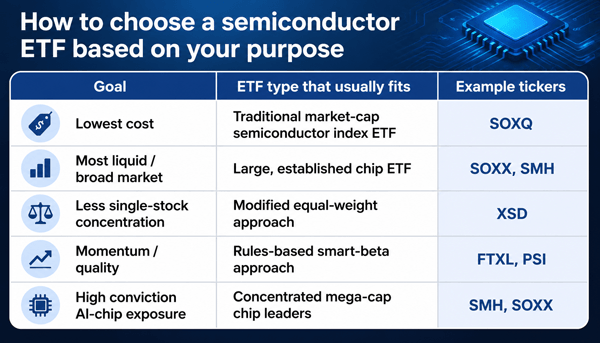
Practical take: SOXQ is attractive for cost-focused investors, SOXX is a strong “default comparison” because of liquidity and history, SMH suits investors who deliberately want concentrated exposure to dominant chip leaders, and XSD is useful for investors who dislike a portfolio where one or two stocks drive everything.
1. What is a semiconductor ETF?
A semiconductor ETF is an exchange-traded fund that owns a basket of semiconductor-related stocks. Instead of buying one chip company, you buy one fund that may hold companies involved in chip design, manufacturing, foundries, memory chips, equipment, testing, packaging, and related technology.
A simple example: buying one share of SOXX, SMH, SOXQ or XSD gives you exposure to many chip companies at once. You still own a risky investment, but you are not depending on only one company’s earnings report, product launch, factory issue, or management decision.
A semiconductor ETF trades like a stock during market hours. You can buy it through a brokerage account, place a market or limit order, see its price move during the day, and sell it when the market is open. The ETF itself holds the underlying stocks and charges an annual expense ratio.
- ETF: a fund that trades on an exchange like a stock.
- Semiconductor: the chip industry that powers AI servers, smartphones, cars, cloud computing, gaming, data centers, industrial equipment and consumer electronics.
- Expense ratio: the annual fund cost, automatically reflected in fund returns.
- Holdings: the stocks inside the ETF.
- Weighting: how much of the fund is allocated to each stock.
2. Why semiconductor ETFs are popular in 2026
Semiconductors sit at the center of several long-term themes: artificial intelligence, cloud data centers, electric vehicles, advanced manufacturing, defense electronics, robotics, smartphones and high-performance computing. When investors talk about “AI infrastructure,” they are often talking about chips, networking, memory, advanced packaging and the equipment needed to build all of it.
This popularity also creates a problem: many beginners buy chip ETFs after a big rally, assuming the trend can only continue. That is not how cyclical sectors work. Semiconductor companies can grow quickly, but their stocks can also fall hard when demand slows, inventories rise, export rules change, valuations get too high, or investors rotate into cheaper sectors.
The practical lesson is simple: semiconductor ETFs can be excellent long-term tools, but they are not magic. They are concentrated technology-sector investments. Use them with position sizing, patience, and a clear reason.
3. How semiconductor ETFs work behind the scenes
Most semiconductor ETFs track an index. The index provider decides which companies qualify, how often the list is refreshed, and how each stock is weighted. The ETF manager then tries to track that index before fees and expenses. This is why two semiconductor ETFs can own many of the same companies but still perform differently.
| Feature | What it means for a beginner | Why it matters |
|---|---|---|
| Market-cap weighting | Bigger companies get bigger weights. | Great when the largest winners keep winning; risky when one stock becomes too dominant. |
| Modified weighting | The index may cap large positions or adjust weights. | Can reduce concentration without fully equal-weighting the portfolio. |
| Equal or modified equal weighting | Smaller companies get more influence than in market-cap funds. | Can diversify single-stock risk but may lag mega-cap rallies. |
| Rebalancing | The ETF periodically resets holdings and weights. | Affects turnover, tax distributions, and exposure to recent winners or laggards. |
| Expense ratio | The annual cost of owning the ETF. | A lower fee is a reliable advantage, but not the only factor. |
| Bid-ask spread | The gap between what buyers bid and sellers ask. | Tighter spreads usually reduce trading costs, especially for frequent investors. |
4. Comparison table: semiconductor ETFs to watch in 2026
Data points below are based on issuer pages and fund fact sheets reviewed on July 15, 2026. Because ETF holdings, assets and prices change frequently, refresh this table before publishing or updating the article.
| Ticker | Issuer | Index / approach | Expense ratio | # holdings | Best use case |
|---|---|---|---|---|---|
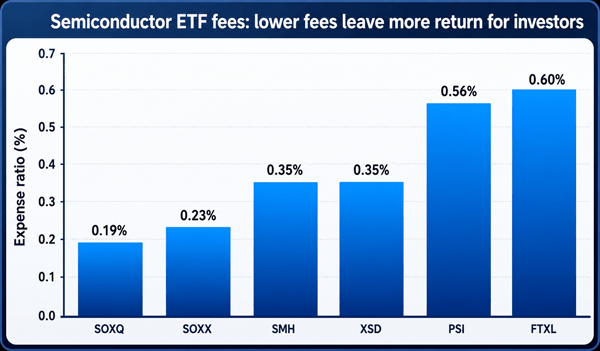
| SOXQ | Invesco | PHLX Semiconductor Index exposure | 0.19% | 31 | Lowest-cost broad semiconductor ETF candidate. |
| SOXX | iShares / BlackRock | NYSE Semiconductor Index | 0.23% | 30 | Mainstream, liquid semiconductor ETF with a long record. |
| SMH | VanEck | MVIS US Listed Semiconductor 25 Index | 0.35% | 26 | Concentrated leader exposure, including global chip giants. |
| XSD | State Street SPDR | S&P Semiconductor Select Industry Index, modified equal weighted | 0.35% | 47 | Less concentrated, more balanced semiconductor sleeve. |
| PSI | Invesco | Dynamic Semiconductors Intellidex Index | 0.56% | 31 | Factor/smart-beta chip exposure. |
| FTXL | First Trust | Nasdaq US Smart Semiconductor Index | 0.60% | 34 | Quality, value and momentum style semiconductor approach. |
5. ETF-by-ETF breakdown
5.1 SOXQ - Invesco PHLX Semiconductor ETF
SOXQ is the most cost-efficient major semiconductor ETF in this comparison, with a 0.19% expense ratio. That fee advantage matters because investors cannot control next year’s returns, but they can control recurring fund costs. SOXQ is useful for investors who want simple, low-cost exposure to the chip industry without paying a higher smart-beta fee.
Best fit: beginner investors who already have a diversified core portfolio and want a low-cost satellite position in semiconductors.
Watch out for: concentration in the same major chip leaders that dominate the sector. Low cost does not mean low risk.
5.2 SOXX - iShares Semiconductor ETF
SOXX is one of the most recognized semiconductor ETFs. It has a long operating history, large assets, high trading volume, and a 0.23% expense ratio. For many investors, SOXX is the fund to compare others against because it is liquid, transparent and widely followed.
Best fit: investors who want a mainstream semiconductor ETF with strong liquidity and a simple industry index approach.
Watch out for: valuation risk and top-heavy exposure. If the largest chip stocks become expensive, SOXX can still be vulnerable to a broad sector correction.
5.3 SMH - VanEck Semiconductor ETF
SMH is a concentrated semiconductor ETF with exposure to major global chip companies. Its fact sheet showed a 0.35% expense ratio and 26 holdings. Because it often gives large weights to dominant names such as NVIDIA, Taiwan Semiconductor Manufacturing, Micron, AMD, Intel and Broadcom, SMH can be powerful in an AI-led chip rally.
Best fit: investors who intentionally want high-conviction exposure to leading semiconductor companies and can tolerate bigger swings.
Watch out for: concentration. When a few giant holdings drive performance, returns can look excellent during bull markets and painful during reversals.
5.4 XSD - SPDR S&P Semiconductor ETF
XSD tracks a modified equal-weight semiconductor index. This makes it different from funds that lean heavily on the biggest chip companies. In simple terms, XSD gives smaller and mid-sized semiconductor stocks more room to matter. Its issuer page showed a 0.35% gross expense ratio and 47 holdings.
Best fit: investors who want semiconductor exposure but do not want one or two mega-cap companies to control most of the outcome.
Watch out for: when mega-cap AI leaders dominate the market, a more balanced fund can underperform concentrated funds like SMH.
5.5 PSI - Invesco Semiconductors ETF
PSI uses a dynamic, rules-based index rather than a plain market-cap approach. It can tilt toward companies with stronger quantitative characteristics, but it charges more than the cheapest funds. Invesco’s page showed a 0.56% total expense ratio and 31 holdings.
Best fit: investors who want a factor-style semiconductor ETF and are comfortable paying a higher fee for that approach.
Watch out for: smart-beta strategies can shine in one market environment and lag in another. Higher fees make the hurdle for outperformance higher.
5.6 FTXL - First Trust Nasdaq Semiconductor ETF
FTXL tracks a smart semiconductor index and uses a rules-based process rather than simply owning every company by size. Its issuer page showed a 0.60% total expense ratio and 34 holdings. FTXL can be useful for investors who want a more selective semiconductor ETF, but the higher fee should be justified by the strategy.
Best fit: investors who understand factor investing and want a quality/value/momentum screen inside the semiconductor universe.
Watch out for: the highest expense ratio in this comparison and potential underperformance if its factor model is out of favor.
6. How beginners should choose a semiconductor ETF
A beginner should not start by asking, “Which ETF will go up the most?” Nobody can know that in advance. A better question is: “Which fund gives me the exposure I want at a cost and risk level I can live with?”
6.1 Decide your role for the ETF
Semiconductor ETFs are best used as satellite holdings. For example, an investor may keep 80% to 95% of their stock allocation in broad funds such as total-market or S&P 500 ETFs, then use a 5% to 10% semiconductor ETF position for extra exposure to AI and chip growth. Aggressive investors may use more, but beginners should be careful with concentrated sector bets.
6.2 Check overlap with what you already own
Many broad market ETFs already own NVIDIA, Broadcom, AMD, Qualcomm, Intel, Texas Instruments and other chip companies. If your portfolio already has a Nasdaq 100 ETF, a technology ETF, and an S&P 500 ETF, adding a semiconductor ETF may increase exposure to the same winners rather than truly diversify your portfolio.
6.3 Compare cost, liquidity and concentration
Cost is easy to compare, but it is not the whole story. A 0.19% fund may be attractive, but a slightly more expensive fund may have better liquidity, longer history, or a weighting method you prefer. For ETFs, the practical comparison is expense ratio + bid-ask spread + holdings quality + concentration risk.
6.4 Read the top 10 holdings
Do not buy a semiconductor ETF by ticker name alone. Open the holdings page and ask: Which stocks are the biggest weights? Does one stock exceed 15% or 20%? Are the top 10 holdings more than half of the fund? Does it own foundries, equipment makers, memory companies and designers, or mostly one category?
6.5 Create a buying plan before the market gets emotional
The worst time to design an investment plan is during a market panic or hype cycle. Decide in advance whether you will invest a lump sum, dollar-cost average monthly, rebalance once or twice per year, and trim the position if it grows too large.
7. Practical examples for real-life investors
| Investor profile | Possible ETF approach | Practical reasoning |
|---|---|---|
| New investor with a simple portfolio | Start with broad-market ETFs first; add a small SOXQ, SOXX or SMH position only after the core is built. | A beginner needs diversification before sector exposure. Semiconductor ETFs should not replace a core portfolio. |
| AI believer but risk-aware | Use SMH or SOXX as a 5%-10% satellite and rebalance yearly. | Gets AI-chip exposure but limits the damage if the sector corrects. |
| Cost-focused long-term investor | Compare SOXQ first because of the 0.19% expense ratio. | Lower costs are one of the few investing variables an investor can control. |
| Investor worried about NVIDIA concentration | Compare XSD because of its modified equal-weight approach. | More balanced exposure may reduce single-stock dependence. |
| Active sector-rotation investor | Compare PSI or FTXL, but only with a clear factor strategy. | Higher fees require stronger conviction and monitoring. |
8. Semiconductor ETF risks beginners must understand
Semiconductor ETFs can be exciting, but they are not safe simply because they own many companies. They are diversified inside one industry, not across the whole economy.
- Cyclicality risk: chip demand often moves in cycles. Strong demand can lead to overproduction, then price pressure.
- Valuation risk: great companies can still be bad short-term investments if bought at extreme prices.
- Concentration risk: some ETFs rely heavily on a handful of stocks.
- Geopolitical risk: the semiconductor supply chain touches the U.S., Taiwan, China, South Korea, Japan, the Netherlands and other regions. Trade restrictions, tariffs or conflicts can affect returns.
- Currency and global supply-chain risk: several important chip companies earn revenue globally and manufacture across borders.
- Technology shift risk: today’s leader can lose advantage if the next architecture, foundry process or customer demand changes.
- Liquidity and trading risk: large ETFs usually trade efficiently, but smaller funds or volatile days can widen spreads.
A good beginner rule: if a 30% drop in your semiconductor ETF would make you sell in panic, your position is probably too large.
9. How much should you invest in semiconductor ETFs?
There is no universal answer, but for beginner portfolios, semiconductor ETFs usually make more sense as a 3% to 10% satellite position than a 30% to 50% bet. The exact number depends on your age, risk tolerance, income stability, time horizon, and existing tech exposure.
| Risk level | Possible semiconductor ETF allocation | Who it may fit |
|---|---|---|
| Conservative | 0%-3% | Investors who prefer broad index funds and have low tolerance for volatility. |
| Moderate | 3%-7% | Investors who want targeted AI/chip exposure without letting it dominate the portfolio. |
| Growth-oriented | 7%-12% | Investors with long time horizons and willingness to accept sharp drawdowns. |
| Aggressive / tactical | 12%+ | Experienced investors who understand sector cycles and actively monitor exposure. |
Example: If a beginner has a $10,000 portfolio and wants 5% exposure, that means $500 in a semiconductor ETF. If the ETF doubles and becomes $1,000 while the portfolio is $12,000, the position is now above 8%. Rebalancing would mean trimming some gains or directing new contributions to other parts of the portfolio.
10. Lump sum vs dollar-cost averaging
For volatile sector ETFs, dollar-cost averaging can help beginners avoid the emotional pressure of picking the perfect entry point. Instead of investing $3,000 at once, a beginner might invest $500 per month for six months. This does not guarantee better returns, but it can reduce regret and help build discipline.
Lump-sum investing may work better when markets rise quickly, but it requires stronger emotional control. If you buy all at once and the ETF drops 20% in the next month, you need to know whether you are still comfortable holding it. The right method is the one you can stick with without panic.
11. SOXX vs SMH vs SOXQ vs XSD: which is better?
| Question | Likely answer |
|---|---|
| Which is cheapest? | SOXQ, based on the 0.19% expense ratio reviewed. |
| Which is most mainstream? | SOXX and SMH are widely followed, large, liquid semiconductor ETFs. |
| Which is more concentrated? | SMH is typically more concentrated in leading chip names. |
| Which may reduce single-stock dominance? | XSD, because of its modified equal-weight approach. |
| Which is best for AI-chip exposure? | SMH and SOXX often have strong exposure to AI chip leaders, but check current holdings before buying. |
| Which is best for beginners? | Often SOXQ, SOXX or XSD depending on whether the beginner values low cost, liquidity or less concentration. |
The honest answer is that there is no permanent winner. In an AI mega-cap rally, SMH or SOXX may shine. In a broad semiconductor recovery where smaller companies rebound, XSD may look better. In a cost-sensitive long-term portfolio, SOXQ’s lower expense ratio can be compelling. The best fund is the one whose behavior you understand before buying.
12. What people often learn after buying semiconductor ETFs
Experienced investors often say the same thing in different words: semiconductor ETFs are easier to buy than to hold. They can move sharply in both directions. A beginner may buy because AI headlines look exciting, then discover that the ETF can drop on interest-rate fears, export restrictions, weaker smartphone demand, inventory corrections or one large company’s guidance.
Common real-world lessons include:
- A semiconductor ETF is not automatically diversified enough for an entire portfolio.
- The top holdings matter more than the ETF name.
- Buying after a huge rally can still work long term, but it increases short-term regret risk.
- Low fees matter, but fund structure and concentration matter too.
- Rebalancing is not boring; it is how investors prevent one hot sector from taking over the portfolio.
- Dividend yield is usually not the main reason to own semiconductor ETFs; growth exposure is the main reason.
13. Beginner checklist before buying a semiconductor ETF
- Do I already have a diversified core portfolio?
- What percentage of my total portfolio will this ETF represent?
- Do I understand the top 10 holdings?
- Is the ETF concentrated in one or two companies?
- What is the expense ratio and bid-ask spread?
- Does the ETF overlap with my Nasdaq 100, S&P 500 or technology ETF holdings?
- Will I buy all at once or dollar-cost average?
- When will I rebalance?
- Would I still hold this ETF if it fell 25%-40%?
- Have I read the current fund page or prospectus summary?
14. How to buy a semiconductor ETF step by step
The mechanics are simple, but the decision should be thoughtful.
- 1. Choose a brokerage account: use a reputable broker with low commissions, good ETF screeners and transparent order execution.
- 2. Search the ticker: type SOXX, SMH, SOXQ, XSD, PSI or FTXL into the trading screen.
- 3. Review the quote: check price, bid, ask, volume and whether the market is open.
- 4. Use a limit order: a limit order helps control the maximum price you pay, especially during volatile markets.
- 5. Start small: beginners can start with a small allocation and add over time.
- 6. Track allocation, not daily noise: review quarterly or semiannually rather than reacting to every headline.
15. Tax notes and account placement
Semiconductor ETFs are equity ETFs, so taxes may include dividends, capital gains distributions, and capital gains or losses when you sell. In many cases, broad equity ETFs are tax-efficient, but sector ETFs can still produce taxable events. Investors using retirement accounts may avoid yearly taxable brokerage reporting, while taxable account investors should consider holding periods and tax-loss harvesting rules. Tax rules vary by country and personal situation, so consult a qualified tax professional for personalized guidance.
16. Conclusion: best semiconductor ETF for 2026
The best semiconductor ETF to buy in 2026 depends on what you are trying to accomplish. If you want low fees, SOXQ deserves a close look. If you want a large, liquid, established fund, SOXX is a strong benchmark choice. If you want concentrated exposure to the biggest AI-chip leaders, SMH may fit. If you want less dependence on the biggest stocks, XSD is worth comparing. If you want a factor-based strategy and accept higher costs, PSI and FTXL are more specialized options.
For beginners, the most responsible approach is to first build a diversified core, then add a semiconductor ETF only as a measured satellite position. Buy it because it fits your plan, not because headlines are exciting. Check the holdings, understand the risks, keep the position size reasonable, and rebalance when the fund becomes too large. That is how semiconductor ETFs can be used as practical tools instead of emotional bets.
17. FAQ: Best semiconductor ETFs to buy in 2026
17.1 What is the best semiconductor ETF for beginners?
For many beginners, SOXQ, SOXX and XSD are good starting comparisons. SOXQ is low cost, SOXX is large and liquid, and XSD may reduce single-stock concentration. The right choice depends on your portfolio and risk tolerance.
17.2 Are semiconductor ETFs safe?
No investment in stocks is guaranteed. Semiconductor ETFs reduce single-company risk compared with buying one chip stock, but they still carry sector, valuation, geopolitical and market risk.
17.3 Is SMH better than SOXX?
SMH may be better for investors who want more concentrated exposure to dominant chip leaders. SOXX may be better for investors who prefer a large, mainstream semiconductor ETF with broad industry exposure. Neither is always better.
17.4 Is SOXQ a good ETF?
SOXQ is attractive because of its low expense ratio, but investors should still review its holdings, liquidity, index approach and concentration before buying.
17.5 How much of my portfolio should be in semiconductor ETFs?
Many beginners may keep semiconductor ETFs around 3% to 10% of a portfolio. Higher allocations require higher risk tolerance and stronger conviction.
17.6 Can I hold semiconductor ETFs long term?
Yes, if you understand the volatility and keep the allocation reasonable. The chip industry has long-term growth drivers, but it also moves through painful cycles.
17.7 Do semiconductor ETFs pay dividends?
Some do, but yields are often low because many semiconductor companies reinvest for growth. Investors usually buy these ETFs for growth exposure, not income.
17.8 Should I buy a semiconductor ETF or individual chip stocks?
Beginners usually benefit from ETFs because they reduce single-stock risk. Individual stocks require deeper research and more monitoring.
Sources Consulted and Checked
These sources were consulted and checked while preparing this article and verifying its accuracy. Because ETF holdings, assets, prices, yields, fees, and applicable rules can change, readers should confirm current information with official sources.
- VanEck SMH fact sheet: Expense ratio, holdings, fund details and performance disclaimers. URL: https://www.vaneck.com/us/en/investments/semiconductor-etf-smh-fact-sheet.pdf
- iShares SOXX fund page: Expense ratio, assets, holdings count, benchmark and fund description. URL: https://www.ishares.com/us/products/239705/ishares-phlx-semiconductor-etf
- Invesco SOXQ fund page: Expense ratio, holdings count and fund details. URL: https://www.invesco.com/us/en/financial-products/etfs/invesco-phlx-semiconductor-etf.html
- State Street XSD fund page: Expense ratio, modified equal-weight approach, holdings and risk language. URL: https://www.ssga.com/us/en/intermediary/etfs/state-street-spdr-sp-semiconductor-etf-xsd
- Invesco PSI fund page: Expense ratio, holdings count and dynamic index approach. URL: https://www.invesco.com/us/en/financial-products/etfs/invesco-semiconductors-etf.html
- First Trust FTXL fund page: Expense ratio, holdings, index and fund data. URL: https://www.ftportfolios.com/retail/etf/etfsummary.aspx?Ticker=ftxl
- FINRA ETF investor education: ETF structure, risks, fees and comparison guidance. URL: https://www.finra.org/investors/investing/investment-products/exchange-traded-funds-and-products
- SEC Investor.gov ETF education: ETF risk and investor protection basics. URL: https://www.investor.gov/introduction-investing/investing-basics/investment-products/mutual-funds-and-exchange-traded-2
Reader Advice
This article is provided solely for educational and informational purposes and does not constitute personalized investment, financial, tax, legal, or accounting advice. Any use of terms such as “best” or “to buy,” and any rankings, comparisons, or assessments of semiconductor ETFs presented in this article, reflect the criteria, assumptions, and methodology used for this analysis and should not be interpreted as definitive rankings, personalized investment recommendations, or predictions of future performance. Other analyses using different criteria, assumptions, or methodologies may reach different conclusions.
Semiconductor ETFs and other market investments can be volatile, may decline substantially, and can result in loss of principal. Semiconductor-focused ETFs may also involve sector concentration and exposure to industry-specific risks, and diversification within a single sector does not eliminate investment risk. Before making any decision, readers should consider their objectives, financial circumstances, time horizon, risk tolerance, existing portfolio exposure, and the possible need for advice from appropriately qualified professionals.
ETF fees, holdings, index methodologies, assets, prices, yields, tax treatment, eligibility rules, regulations, and market conditions may change without notice and may differ by country, account type, broker, and individual circumstances. Readers should verify all facts and figures directly through current issuer documents, prospectuses, regulatory publications, and other official sources. Past performance does not guarantee future results, and no ETF mentioned in this article is presented as suitable for every investor.