Best Monthly Dividend ETFs for Reliable Passive Income
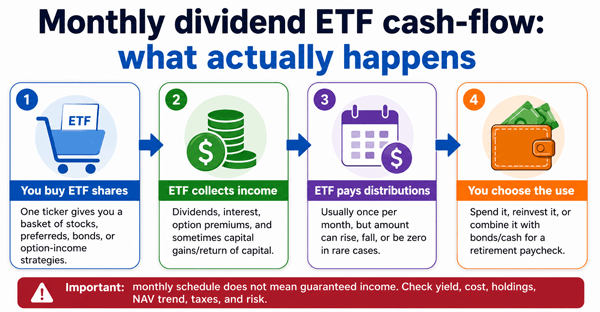
Figure: Monthly ETF cash-flow process.
Monthly dividend ETFs are popular because they sound simple: buy one fund, receive cash every month, and use that cash as passive income. The real story is a little more nuanced. A monthly ETF can be a useful income tool, but the word “monthly” describes the payment schedule, not the safety of the payment. The income can change, the share price can fall, and some high-yield funds may pay partly from option premiums, capital gains, or return of capital rather than only from company dividends.
The goal of this guide is to help a beginner understand the whole picture before buying. We will cover what monthly dividend ETFs are, how they work, which ETFs are commonly used for income, how to compare them, what real investors often like and dislike about them, and how to build a sensible monthly cash-flow plan without blindly chasing the highest yield.
1. Quick answer: What is the best monthly dividend ETF?
There is no single best monthly dividend ETF for everyone. A retired investor who wants smoother income may prefer a diversified equity-income or preferred-stock ETF. A younger investor may prefer dividend growth and reinvestment. A yield-focused investor may like covered-call ETFs, but must accept capped upside and variable distributions. A conservative investor may choose not to use monthly equity-income ETFs at all and may combine broad-market ETFs, bond ETFs, Treasury bills, and cash instead.
A practical shortlist for U.S. investors often includes JEPI for broad equity premium income, JEPQ for higher Nasdaq-linked income, DIVO for dividend stocks plus selective covered calls, SPHD for high-dividend low-volatility U.S. stocks, PFF for preferred securities, SDIV for global high-dividend exposure, and SPYI/QYLD for option-income strategies. These are not recommendations to buy; they are examples of different monthly-income categories.
| Ticker | Strategy type | Cost / yield context | Common use case | Key risk to understand |
|---|---|---|---|---|
| JEPI | Equity premium income | 0.35% / issuer materials recently showed about an 8% rolling yield | Core monthly equity-income candidate | Covered-call/ELN strategy may lag in strong bull markets. |
| JEPQ | Nasdaq equity premium income | 0.35% / often higher income than JEPI | Higher income with Nasdaq exposure | More technology concentration and growth-stock volatility. |
| DIVO | Dividend stocks + tactical calls | 0.56% / mid-single-digit yield context | Quality dividend income with active overlay | Active fee; lower yield than aggressive option-income funds. |
| SPHD | High-dividend, lower-volatility S&P 500 stocks | about 0.30% / roughly 4%-5% recent context | Simple dividend-stock monthly payer | Sector concentration and value-stock risk. |
| PFF | Preferred securities | 0.45% / about 5%-6% SEC/trailing yield context | Preferred-stock income sleeve | Interest-rate, credit, call, and financial-sector risks. |
| SDIV | Global high-dividend stocks | 0.58% / high single-digit trailing distribution context | High-yield global dividend exposure | Dividend traps, weak price trends, and country/currency risks. |
| SPYI | S&P 500 option-income strategy | 0.68% / double-digit distribution rate shown by issuer | Aggressive monthly income from options | Return of capital, capped upside, and variable distributions. |
| QYLD | Nasdaq-100 covered-call strategy | 0.60% / high but variable distribution history | Popular covered-call income ETF | Upside limited when Nasdaq rallies strongly. |
2. What “monthly dividend ETF” really means
A monthly dividend ETF is an exchange-traded fund that usually sends cash distributions to shareholders every month. It trades on an exchange like a stock, but inside the ETF there may be dozens, hundreds, or even thousands of holdings. The ETF collects income from those holdings and passes some or all of it to investors.
The important beginner point is this: many investors use the phrase “monthly dividend ETF,” but the ETF may not be paying only dividends. Depending on the fund, the monthly cash can come from stock dividends, bond interest, preferred-stock payments, option premiums, realized capital gains, or return of capital. For a beginner, “monthly income ETF” is often the more accurate phrase.
3. How monthly dividend ETFs work step by step
Imagine you buy $10,000 of a monthly income ETF. The fund owns income-producing assets. During the month, the fund receives income or generates option premiums. Near the distribution date, the fund declares how much it will pay per share. On the ex-dividend date, new buyers are no longer entitled to that upcoming distribution. On the pay date, cash arrives in your brokerage account. You can spend it or reinvest it.
The share price often drops by roughly the amount of the distribution on the ex-dividend date. That does not mean you got free money. Part of your investment value moved from the ETF price into your cash balance. This is why serious income investors look at total return, NAV trend, and distribution quality, not yield alone.
4. Why people like monthly dividend ETFs
The appeal is emotional and practical. Monthly income feels like rent, salary, or a paycheck. Retirees may use it to match monthly bills. New investors may find it motivating because they can see cash arrive regularly. Some investors also prefer ETFs because they provide diversification in one trade, publish holdings, and can be bought or sold during market hours.
Based on common investor experiences, the biggest positives are simplicity, regular cash flow, easy reinvestment, and less work than building a portfolio of individual dividend stocks. The biggest complaints are variable payouts, confusing tax forms, price declines in high-yield funds, and disappointment when a fund with a very high yield underperforms a simple broad-market ETF on total return.
5. What beginners must know before buying
First, monthly does not mean safe. A fund can pay monthly and still lose money. Second, yield is not return. A fund yielding 10% can still have a poor total return if its price falls by more than the income paid. Third, expense ratios matter because fees reduce the fund’s return every year. Fourth, taxes can reduce spendable income. Fifth, ETF strategies are different: a dividend-stock ETF is not the same as a covered-call ETF, and a preferred-stock ETF is not the same as a bond ETF.
A good beginner rule is to ask five questions before buying: What does the ETF own? Where does the distribution come from? Has the share price/NAV been stable or shrinking? What is the expense ratio? What role does this ETF play in my portfolio? If the answer is only “it pays a high yield,” that is not enough.
6. Monthly dividend ETF categories explained simply
Traditional dividend-stock ETFs own companies that pay dividends. Their income depends on company dividends and portfolio turnover. They can offer growth if the companies grow earnings over time, but the yield is usually lower than option-income funds.
Covered-call ETFs own stocks or index exposure and sell call options to generate extra income. They can produce attractive monthly cash flow, especially when option premiums are rich. The tradeoff is that upside can be capped when the market rises strongly. Distributions may vary, and part of the payment may be tax-characterized differently than ordinary dividends.
Preferred-stock ETFs own preferred securities, which sit between bonds and common stocks in the capital structure. They often pay higher income than common stocks, but they can be sensitive to interest rates, credit conditions, and call risk.
High-dividend global ETFs screen for high-yielding stocks around the world. The yield can look attractive, but high yields may reflect weak share prices or struggling businesses. Currency, country, sector, and dividend sustainability risks matter.
7. Practical example: how much monthly income could you receive?
The simple formula is: investment amount x annual distribution yield / 12. For example, a $100,000 portfolio with a 5% annual distribution yield would produce about $416 per month before taxes. At 8%, it would produce about $667 per month. At 12%, it would produce about $1,000 per month. But the higher number usually comes with higher risk, more variable distributions, or less price growth potential.
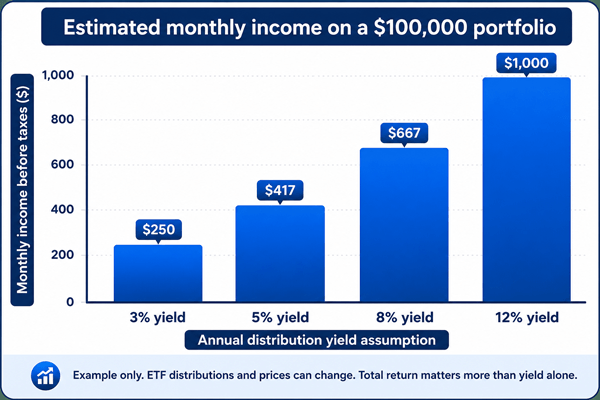
Example chart for education only; not a forecast.
| Investment | 3% yield | 5% yield | 8% yield | 12% yield |
|---|---|---|---|---|
| $10,000 | $25/mo | $42/mo | $67/mo | $100/mo |
| $50,000 | $125/mo | $208/mo | $333/mo | $500/mo |
| $100,000 | $250/mo | $417/mo | $667/mo | $1,000/mo |
| $250,000 | $625/mo | $1,042/mo | $1,667/mo | $2,500/mo |
8. How to choose the best monthly dividend ETF
Start with your goal. If you need spending cash soon, focus on distribution stability, lower volatility, liquidity, and tax impact. If you are still building wealth, total return and dividend growth may matter more than monthly cash. If you are attracted to very high yields, slow down and study the fund’s NAV history and distribution source.
Next, compare funds within the same category. JEPI and JEPQ are closer relatives than JEPI and PFF. DIVO and SPHD both involve dividend-paying stocks, but DIVO uses an active covered-call overlay while SPHD follows an index methodology. PFF is preferred-stock exposure, which behaves differently from common-stock dividend funds. SPYI and QYLD are option-income strategies, so their yields should not be compared directly with ordinary dividend yields.
8.1 A practical ETF checklist
Use this checklist before putting money into any monthly income ETF: 1) expense ratio below what seems reasonable for the strategy, 2) enough assets and trading volume, 3) clear holdings and strategy, 4) distribution history, 5) NAV trend, 6) sector and top-holding concentration, 7) tax character of distributions, 8) performance in down markets, 9) role in portfolio, and 10) whether you would still own it if the distribution dropped.
9. The biggest mistake: chasing the highest yield
High yield is attractive because it gives the impression of faster passive income. But a very high yield can be a warning sign. Sometimes the yield is high because the fund’s holdings have fallen in price. Sometimes the strategy pays a lot of cash but gives up too much upside. Sometimes distributions include return of capital, which may be fine in some option strategies but should be understood rather than ignored.
A healthier way to compare income ETFs is to ask: What was the total return after distributions? Did the NAV hold up? Was the income repeatable? Did the fund protect capital during stress? Would a lower-yield fund with stronger price growth have left the investor wealthier?
10. How retirees may use monthly dividend ETFs
A retiree may use monthly ETFs as one layer of a retirement income plan. For example, cash covers the next 6 to 12 months of spending, short-term bonds or Treasury bills cover near-term needs, and monthly dividend ETFs provide a variable income layer. This approach reduces the pressure to sell shares during a market decline. However, it does not remove investment risk.
A common practical approach is to avoid relying on one ETF. A retiree might combine a broad-market ETF for growth, a dividend-income ETF, a preferred or bond ETF, and a cash reserve. The exact mix depends on risk tolerance, spending rate, tax situation, and investment horizon.
11. How younger investors may use monthly dividend ETFs
Younger investors usually do not need monthly cash. For them, the best use may be dividend reinvestment. Reinvesting distributions can buy more shares over time. But younger investors should be careful not to sacrifice long-term growth just to see monthly payments. A lower-yield broad-market ETF may outperform a high-yield monthly ETF over long periods if the high-yield fund gives up too much growth.
A practical beginner approach is to keep monthly dividend ETFs as a smaller satellite position while using broad-market index funds as the core. This lets the investor learn income investing without making the whole portfolio dependent on one income strategy.
12. Taxes: what beginners need to understand
ETF distributions may be taxed differently depending on their source and your account type. Ordinary dividends are generally taxed as ordinary income. Qualified dividends may receive lower long-term capital gains tax rates if IRS rules are met. Capital gain distributions and return of capital are treated differently. Covered-call and option-income ETFs may have distributions with tax character that surprises beginners.
In a taxable brokerage account, after-tax income matters more than headline yield. In a retirement account, current taxes may be deferred or avoided depending on the account type. Investors should review the fund’s tax documents and consult a qualified tax professional for personal advice.
13. A simple monthly income portfolio example
This is not a recommendation, but it shows how an investor might think. Suppose someone has $100,000 and wants income but does not want to depend on one ETF. A moderate income sleeve might use 40% broad dividend/equity income, 25% covered-call income, 20% preferred or bond income, and 15% cash or Treasury bills. The goal is not to maximize yield; the goal is to balance cash flow, liquidity, risk, and long-term capital preservation.
Another investor with a longer time horizon may use only 10%-20% in monthly income ETFs and keep the rest in broad-market growth or dividend-growth funds. The right allocation depends on whether the investor wants today’s income or future wealth.
| Investor type | Possible use | What to avoid |
|---|---|---|
| Beginner building wealth | Small satellite position; reinvest distributions; learn ETF mechanics. | Putting the whole portfolio into the highest-yield fund. |
| Income-focused worker | Use monthly ETFs to supplement salary or build a future income stream. | Ignoring taxes and total return. |
| Retiree | Combine income ETFs with cash, bonds, and broad-market exposure. | Depending on variable distributions for fixed essential bills. |
| High-yield seeker | Study option-income ETFs and return of capital carefully. | Assuming double-digit distribution rates are guaranteed returns. |
14. Best monthly dividend ETFs by use case
14.1 Best for balanced equity income: JEPI
JEPI is often used by investors who want monthly income from a large, liquid ETF with an active equity-income and option-premium approach. It aims for current income while maintaining some prospects for capital appreciation. The investor experience is usually positive when expectations are realistic: income can be attractive, but upside may lag during powerful bull markets.
14.2 Best for higher Nasdaq-linked income: JEPQ
JEPQ is more growth-stock and Nasdaq-oriented than JEPI. Investors may choose it for higher income potential, but they should understand that Nasdaq exposure can be more volatile and more concentrated in technology-related companies. It may fit aggressive income investors better than conservative retirees.
14.3 Best for quality dividend stocks plus income overlay: DIVO
DIVO owns large-cap dividend-oriented companies and uses a tactical covered-call strategy on individual stocks. It may appeal to investors who want income but do not want an extremely high-yield product. The tradeoff is a higher active-management fee than many plain index ETFs.
14.4 Best simple high-dividend stock screen: SPHD
SPHD tracks an index of high-dividend, lower-volatility S&P 500 stocks. It is easy to understand compared with option-heavy funds. The risk is that high-dividend low-volatility screens can become concentrated in sectors such as utilities, real estate, consumer staples, financials, or energy depending on the market cycle.
14.5 Best preferred-stock exposure: PFF
PFF is one of the largest preferred-security ETFs and pays monthly. It may be useful for investors seeking income that behaves differently from common-stock dividends. But preferreds carry interest-rate risk, credit risk, call risk, and sector concentration, especially financial-sector exposure.
14.6 Best high-yield global dividend exposure: SDIV
SDIV has a high trailing distribution yield and a long monthly distribution history. It may interest investors who want global high-dividend exposure, but it should be researched carefully because high-dividend global screens can include companies with weak price trends or unsustainable dividends.
14.7 Best for aggressive option income: SPYI or QYLD
SPYI and QYLD are better described as option-income ETFs than traditional dividend ETFs. They can produce high monthly cash flow, but investors must understand upside caps, option strategy design, tax treatment, and whether NAV is holding up. They are not substitutes for a guaranteed annuity, bank CD, or Treasury bill.
15. Red flags that a monthly dividend ETF may not be reliable
Be careful if the ETF has a very high distribution rate, a long-term declining price chart, unclear distribution sources, low assets, thin trading volume, a high expense ratio, heavy concentration in one risky sector, or marketing that makes income sound guaranteed. Also be careful if you cannot explain the strategy in plain English.
16. How to buy and manage monthly dividend ETFs
Open a reputable brokerage account, search the ticker, review the fund page and prospectus, check expense ratio and holdings, and decide whether to place a market or limit order. For ETFs with wider spreads, limit orders are often safer. Avoid trading at the market open or close if spreads are unstable. After buying, track total return, distributions, tax forms, and whether the ETF still fits your plan.
Rebalance at least once or twice a year. If one high-yield ETF grows too large in your portfolio, reduce concentration. If distributions fall, do not automatically sell; first understand why. If NAV steadily erodes and total return disappoints, reconsider the position.
17. Frequently asked questions
17.1 Are monthly dividend ETFs good for passive income?
They can be useful for passive income, but they are not risk-free. They are best used as part of a diversified plan rather than as a single source of income.
17.2 Can you live off monthly dividend ETFs?
Some investors can, but only with enough capital, realistic spending, tax planning, and risk control. A $100,000 portfolio will not safely produce a full living income for most people. A $1 million portfolio at a 4%-6% distribution rate may produce meaningful income, but market risk remains.
17.3 Do monthly dividend ETFs pay the same amount every month?
Usually no. Many distributions vary based on dividends received, interest rates, option premiums, realized gains, and fund policy.
17.4 Is a 10% ETF yield safe?
Not automatically. A 10% distribution rate may come from an option strategy or may reflect higher risk. Always check total return, NAV trend, and distribution source.
17.5 Should beginners buy JEPI, JEPQ, or SCHD?
SCHD does not pay monthly, but many beginners compare it with monthly income ETFs because it is a popular dividend ETF. JEPI and JEPQ focus on monthly income with options exposure. SCHD focuses more on dividend quality and growth. The right choice depends on whether the investor wants current income or long-term dividend growth.
18. Bottom line
The best monthly dividend ETF is not the one with the highest yield. It is the one that fits your goal, risk tolerance, tax situation, and time horizon. For beginners, the safest mindset is to treat monthly distributions as one tool, not a magic paycheck. Compare strategy, cost, holdings, liquidity, NAV trend, tax character, and total return. Build income gradually, diversify across sources, and never buy a fund only because the yield looks exciting.
Sources Consulted and Checked
The following sources were consulted and checked while preparing this article and reviewing its accuracy. Because fund data, distributions, holdings, fees, tax rules, and regulatory guidance can change, readers should confirm current information directly with the relevant official source.
- Data points can change. Verify all yields, distribution rates, holdings, expense ratios, and related figures on the issuer’s official website. Source review date: June 22, 2026.
- SEC Investor.gov: ETF basics: ETFs pool investor money, hold portfolios, trade on exchanges, and are registered investment products. https://www.investor.gov/introduction-investing/investing-basics/investment-products/mutual-funds-and-exchange-traded-2
- J.P. Morgan Asset Management: JEPI/JEPQ issuer pages and JEPI materials used for strategy, expense ratio, distribution context, and monthly distribution calendar. https://am.jpmorgan.com/us/en/asset-management/adv/products/jpmorgan-equity-premium-income-etf-etf-shares-46641q332
- Global X ETFs: SDIV and QYLD pages/fact sheets used for distribution frequency, expense ratios, strategy descriptions, and distribution history notes. https://www.globalxetfs.com/funds/sdiv/
- BlackRock iShares: PFF page used for preferred ETF expense ratio, SEC yield, trailing yield, and monthly income context. https://www.ishares.com/us/products/239826/ishares-us-preferred-stock-etf
- NEOS Investments: SPYI page used for distribution frequency, expense ratio, S&P 500 option-income strategy, and distribution rate context. https://neosfunds.com/spyi/
- Invesco: SPHD page/fact sheet used for index methodology and monthly high-dividend low-volatility ETF context. https://www.invesco.com/us/en/financial-products/etfs/invesco-sp-500-high-dividend-low-volatility-etf.html
- IRS: Dividend tax definitions: ordinary dividends and qualified dividends. https://www.irs.gov/taxtopics/tc404
- Schwab: ETF distribution and tax discussion used for general tax education. https://www.schwab.com/learn/story/etfs-and-taxes-what-you-need-to-know
Reader Advice
This article is provided solely for educational and informational purposes. It does not constitute personalized investment, financial, tax, legal, or accounting advice, and it should not be treated as a recommendation to buy, sell, or hold any ETF or other security. Any use of terms such as “best” or “reliable,” and any rankings, comparisons, or assessments of monthly dividend ETFs presented in this article, reflect the criteria and methodology used for this analysis and should not be interpreted as definitive, universally applicable, or as a guarantee of future results. Other analyses using different criteria, assumptions, or methodologies may reach different conclusions. References to “reliable” or “passive income” do not imply that any ETF's distributions, dividends, yields, payment frequency, or income levels are guaranteed, fixed, or certain to continue; distributions may fluctuate, be reduced, suspended, or discontinued.
Investment objectives, risk tolerance, tax circumstances, and financial needs differ from one person to another. Before making any financial decision, readers should conduct their own research and, where appropriate, consult a qualified financial adviser, tax professional, or other licensed expert. ETF prices, yields, distributions, holdings, fees, tax rules, regulations, and market conditions can change at any time and may also vary by country, account type, and investor circumstances. Readers should therefore verify all facts, figures, eligibility requirements, and current fund information directly from official fund-provider documents, regulators, tax authorities, and other authoritative sources. Past performance and historical distributions do not guarantee future results, and investing involves the risk of loss, including possible loss of principal.