Best Dividend ETFs for Passive Income in 2026
1. Quick answer: the best dividend ETFs depend on the type of passive income you want
For most beginners, a dividend ETF is simply a basket of dividend-paying companies that trades like a stock. Instead of trying to pick one “perfect” dividend stock, you buy one fund and get exposure to many companies at once.
In 2026, the strongest beginner choices are not always the ETFs with the highest yield. A high yield can be useful, but it can also signal slower growth, sector concentration, or a payout that may not be sustainable. The best dividend ETF is usually the one that balances yield, quality, cost, diversification, and your time horizon.
Best-by-use-case shortlist:
| Use case | ETF examples | Why it fits | Beginner warning |
|---|---|---|---|
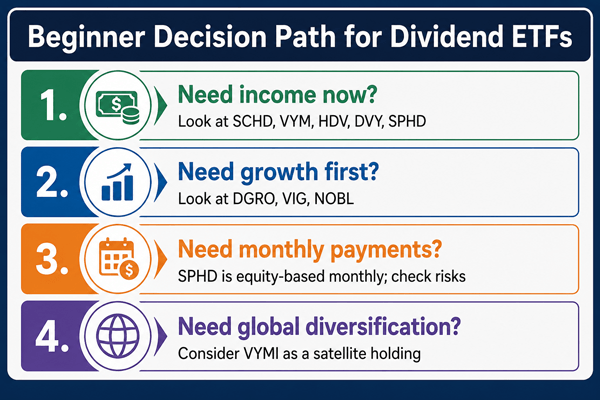
| Best overall balance | SCHD, VYM | Low cost, diversified U.S. dividend exposure, practical for core holdings | Still stock-market risk; dividends can fall |
| Best for dividend growth | DGRO, VIG, NOBL | Focus on companies with rising or durable dividends | Starting yield is often lower |
| Best for higher current yield | HDV, DVY, SPHD | More income today than growth-focused dividend ETFs | Check concentration, valuation, and payout quality |
| Best monthly equity dividend option | SPHD | Pays monthly and screens for high yield plus lower volatility | Monthly income does not mean guaranteed income |
| Best international dividend satellite | VYMI | Adds non-U.S. dividend exposure and currency diversification | Foreign withholding tax and currency risk matter |
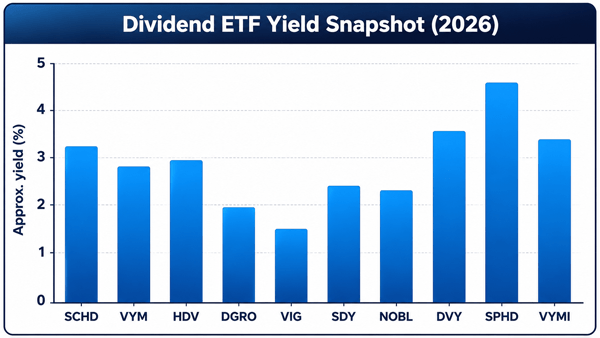
Chart uses approximate yield data available from official ETF provider pages, Morningstar quote pages, and fund factsheets checked in June 2026. Yields change with market prices and distributions.
2. What is a dividend ETF?
A dividend ETF is an exchange-traded fund that owns a portfolio of dividend-paying stocks. When those companies pay dividends to the fund, the ETF usually passes that income to shareholders as distributions, often quarterly and sometimes monthly.
Think of it like a rental-property neighborhood, but for stocks. Instead of buying one house and hoping the rent keeps coming, you buy a fund that owns many “income-producing” companies. Some companies may cut dividends, but the ETF spreads that risk across a basket.
The SEC explains that ETFs pool investor money into a fund that invests in stocks, bonds, or other assets. Each ETF share represents a proportional interest in the portfolio and the income it generates. ETFs also trade throughout the day on an exchange, unlike traditional mutual funds that price once per day.
Sources: SEC Investor.gov ETF pages and Investor Bulletin on ETFs; FINRA Exchange-Traded Funds and Products overview.
3. How dividend ETFs create passive income
A dividend ETF does not create money out of thin air. The income comes from the stocks inside the fund. If the ETF owns companies like banks, healthcare firms, energy companies, utilities, consumer staples, or mature technology businesses, those companies may distribute part of their profits as dividends.
The fund collects those dividends, subtracts fund expenses, and then distributes income to ETF shareholders. The distribution amount can change each quarter because company dividends, share prices, portfolio turnover, and tax treatment can change.
| Step | What happens | Beginner takeaway |
|---|---|---|
| 1 | Companies inside the ETF earn profits and may pay dividends. | Dividends depend on business results, not promises. |
| 2 | The ETF receives dividends from those companies. | The fund is the middle layer between you and many stocks. |
| 3 | The ETF pays distributions to shareholders on a schedule. | Income can be quarterly, monthly, or irregular depending on the fund. |
| 4 | You choose to take cash or reinvest distributions. | Reinvesting can compound wealth; taking cash can support expenses. |
4. Key terms beginners must understand before buying
| Term | Plain-English meaning | Why it matters |
|---|---|---|
| Dividend yield | Annual dividend/distribution divided by current price. | A higher yield may mean more income, but not always more safety. |
| 30-day SEC yield | A standardized yield measure based on recent income. | Useful for comparing income funds, but it is not a guarantee. |
| Distribution yield | Usually based on actual distributions paid over a period. | Can include special or unusual payments. |
| Expense ratio | The annual fund cost taken from assets. | Lower fees leave more return for investors over time. |
| Dividend growth | A company or fund’s dividend rising over time. | Often helps income keep up with inflation. |
| Yield trap | A high yield caused by a falling share price or weak business outlook. | Beginners often chase yield and ignore risk. |
| Qualified dividend | A dividend that may receive lower U.S. tax rates if rules are met. | After-tax income matters more than headline yield. |
| Ex-dividend date | The cutoff date for receiving the next dividend. | Buying right before a dividend is not free money; price often adjusts. |
Sources: SEC Investor.gov expense ratio definition and ETF investor bulletins; IRS Topic 404 and Publication 550 for ordinary/qualified dividend treatment.
5. Best dividend ETFs for passive income in 2026: detailed comparison
The table below is not a “buy list.” It is a practical comparison of widely used dividend ETFs so readers can understand trade-offs. Current yields and prices change daily, so always verify the latest factsheet before investing.
| Ticker | ETF | Strategy | Expense | Approx. yield | Pays | Best for | Main risk |
|---|---|---|---|---|---|---|---|
| SCHD | Schwab U.S. Dividend Equity ETF | Dividend quality + value | 0.06% | ~3.23% SEC / ~3.25% TTM | Quarterly | Core income + quality screen | Not the highest yield; U.S. large-cap tilt |
| VYM | Vanguard High Dividend Yield ETF | Broad high-dividend U.S. stocks | 0.04% | ~2.7-3.0% current range | Quarterly | Simple low-cost core high-dividend exposure | Yield can lag more focused funds |
| HDV | iShares Core High Dividend ETF | High dividend + financial health screen | 0.08% | ~2.98% SEC / ~2.91% trailing | Quarterly | Higher yield with quality filters | Can be concentrated in energy/healthcare |
| DGRO | iShares Core Dividend Growth ETF | Dividend growth | 0.08% | ~1.97% SEC / ~1.96% trailing | Quarterly | Long-term compounding + growing payouts | Lower starting income |
| VIG | Vanguard Dividend Appreciation ETF | Dividend appreciation | 0.04% | ~1.53% SEC | Quarterly | Quality growth-oriented dividend portfolio | Income is modest |
| SDY | SPDR S&P Dividend ETF | Long dividend history / aristocrat-style | 0.35% | ~2.46% SEC / ~2.47% TTM | Quarterly | Investors who value long dividend records | Higher fee than SCHD/VYM/DGRO/VIG |
| NOBL | ProShares S&P 500 Dividend Aristocrats ETF | S&P 500 Dividend Aristocrats | 0.35% | ~2.1-2.6% yield range | Quarterly | Pure Dividend Aristocrats exposure | Fee is higher; equal weighting can shift exposure |
| DVY | iShares Select Dividend ETF | Higher-yield U.S. dividend stocks | 0.38% | ~3.57% SEC / ~3.39% trailing | Quarterly | Higher current income | More yield trap risk; higher fee |
| SPHD | Invesco S&P 500 High Dividend Low Volatility ETF | High dividend + low volatility | 0.30% | ~4.67% SEC / ~4.54% 12-mo rate | Monthly | Monthly cash flow seekers | Sector concentration and slower growth risk |
| VYMI | Vanguard International High Dividend Yield ETF | International high dividend | 0.07% | ~3.42% distribution yield | Quarterly | Non-U.S. dividend diversification | Currency, tax withholding and country risks |
Data references include Schwab SCHD product page, Vanguard VIG/VYM/VYMI pages, iShares DGRO/HDV/DVY pages and factsheets, State Street SDY factsheet/Morningstar, ProShares NOBL page, Invesco SPHD page, and Morningstar/Yahoo Finance quote snapshots where needed. Data checked June 2026.
5.1 Schwab U.S. Dividend Equity ETF (SCHD)
SCHD is one of the most popular dividend ETFs because it tries to combine dividend yield with quality and value. It tracks the Dow Jones U.S. Dividend 100 Index and has a very low 0.06% expense ratio. It can work as a core dividend ETF for investors who want income but do not want to chase the highest yield. The practical appeal is that SCHD screens companies rather than simply buying the highest yielders. That helps reduce, but does not remove, yield-trap risk.
5.2 Vanguard High Dividend Yield ETF (VYM)
VYM is a simple, broad, low-cost way to own U.S. companies with above-average dividend yields. It is attractive for beginners because the fee is extremely low and the portfolio is diversified across many stocks. It is not designed to maximize monthly income; it is better understood as a broad high-dividend core holding.
5.3 iShares Core High Dividend ETF (HDV)
HDV focuses on relatively high dividend-paying U.S. stocks while applying financial health screens. The yield is usually higher than dividend-growth funds like DGRO and VIG, but investors should look at sector exposure. High-dividend funds can lean heavily into energy, healthcare, utilities, or defensive sectors depending on the index rules.
5.4 iShares Core Dividend Growth ETF (DGRO)
DGRO is built for investors who care about dividend growth more than maximum current income. Its lower starting yield can disappoint income seekers, but it may suit younger investors or long-term savers who want rising payouts and capital appreciation potential.
5.5 Vanguard Dividend Appreciation ETF (VIG)
VIG is a low-cost dividend appreciation ETF. It focuses more on companies with a record of increasing dividends than on high yield. For beginners, the important point is that VIG is not an income-maximizer. It is closer to a quality large-cap stock ETF with a dividend-growth discipline.
5.6 SPDR S&P Dividend ETF (SDY)
SDY gives exposure to companies with long dividend histories. It can appeal to investors who value consistency and long records. The main trade-off is cost: its expense ratio is much higher than low-cost alternatives such as VYM, SCHD, DGRO, and VIG.
5.7 ProShares S&P 500 Dividend Aristocrats ETF (NOBL)
NOBL focuses on S&P 500 Dividend Aristocrats, companies with at least 25 consecutive years of dividend increases. This is a clean story for readers: the ETF is about dividend durability and discipline, not maximum income. The fee is higher than many broad dividend ETFs, so investors should decide whether the Dividend Aristocrats approach is worth the extra cost.
5.8 iShares Select Dividend ETF (DVY)
DVY offers a higher current yield than many broad dividend ETFs by focusing on dividend-paying U.S. stocks selected for yield and related criteria. It may suit investors who want more income today, but beginners should inspect sector exposure and avoid assuming that a higher yield is automatically better.
5.9 Invesco S&P 500 High Dividend Low Volatility ETF (SPHD)
SPHD is popular with income-focused investors because it pays monthly and combines high dividend yield with low-volatility screening. It can help with cash-flow planning, but it is not a savings account. Share price can decline, distributions can change, and the strategy may lag in growth-led bull markets.
5.10 Vanguard International High Dividend Yield ETF (VYMI)
VYMI adds non-U.S. dividend exposure. It can diversify a U.S.-heavy portfolio, but it brings currency risk, country risk, and potential foreign withholding tax. It is usually better as a satellite holding than as a beginner’s only dividend ETF.
6. How to choose the right dividend ETF as a beginner
Start with your real goal. “Passive income” sounds simple, but different investors mean different things. A retiree may want cash today. A 30-year-old may want compounding and rising future income. A conservative investor may want lower volatility. A global investor may want non-U.S. exposure. The right ETF changes with the goal.
A beginner should compare dividend ETFs using five filters: yield, dividend quality, cost, diversification, and tax fit. Do not make the decision from yield alone.
| Filter | What to check | Good sign | Red flag |
|---|---|---|---|
| Yield | SEC yield, trailing yield, distribution history | Reasonable yield supported by mature businesses | Very high yield with falling price or shrinking dividends |
| Quality | Profitability, dividend growth rules, payout discipline | Screens for financial strength or dividend growth | Buys stocks only because yield is high |
| Cost | Expense ratio | Below 0.10% for broad core funds; up to 0.35% may be acceptable for specialized strategies | High fee for a simple strategy |
| Diversification | Number of holdings, sector concentration, country exposure | No single company or sector dominates too much | Large bet on one sector, country, or factor |
| Tax fit | Qualified dividends, account type, foreign withholding | ETF placed in a tax-smart account for your situation | Ignoring taxes and focusing only on gross yield |
7. Practical income examples: what could $10,000 generate?
These examples are intentionally simple. They show how yield translates into possible annual cash flow before taxes and before price changes. Actual distributions can rise, fall, or arrive unevenly.
| Investment | Example yield | Estimated annual income | Estimated monthly average |
|---|---|---|---|
| $10,000 in a 2% dividend ETF | 2.0% | $200/year | $16.67/month |
| $10,000 in a 3.25% dividend ETF | 3.25% | $325/year | $27.08/month |
| $10,000 in a 4.5% dividend ETF | 4.5% | $450/year | $37.50/month |
| $100,000 in a 3.25% dividend ETF | 3.25% | $3,250/year | $270.83/month |
The honest lesson: dividend ETFs can support passive income, but they are not magic. A small portfolio produces modest income. The real power comes from consistent saving, reinvesting dividends, keeping fees low, and letting time work.
8. Sample dividend ETF portfolio ideas
The following examples are educational frameworks, not recommendations. A real portfolio should consider age, income needs, emergency savings, taxes, risk tolerance, and whether you already own broad-market index funds.
| Investor type | Possible ETF mix | Why it may fit | What to watch |
|---|---|---|---|
| Beginner building wealth | 60% broad-market ETF + 20% DGRO/VIG + 20% SCHD/VYM | Keeps growth diversified while adding dividend discipline | Do not over-focus on income too early |
| Income-focused but cautious | 40% broad-market ETF + 30% SCHD/VYM + 20% HDV + 10% cash/bonds | Balances dividend income with broader diversification | Equity drawdowns still happen |
| Monthly cash-flow seeker | Core ETF + smaller SPHD sleeve | Uses monthly distributions without making the whole portfolio yield-driven | Monthly payouts can create false comfort |
| Global dividend investor | U.S. dividend core + 10-25% VYMI | Adds international dividend exposure | Currency, withholding tax, and country cycles |
9. Risks beginners often miss
Dividend cuts: Companies can reduce or suspend dividends during recessions, weak earnings periods, or balance-sheet stress. An ETF reduces single-company risk but cannot eliminate broad market risk.
Yield chasing: A 6% or 8% yield may look attractive, but the market may be pricing in danger. Always ask: why is the yield high?
Sector concentration: High-dividend ETFs often lean toward financials, energy, utilities, telecom, healthcare, consumer staples, or real estate-like businesses. That can help income but reduce diversification.
Price declines: A dividend ETF can lose more in share price than it pays in income. A 3% yield does not protect you from a 20% bear-market decline.
Tax drag: Dividends in taxable accounts may create annual taxes even if reinvested. Qualified dividends can receive lower rates, while ordinary dividends are taxed as ordinary income.
Inflation: A flat dividend loses purchasing power over time. Dividend-growth ETFs can help, but they usually start with lower yields.
Covered-call confusion: Some high-income ETFs generate distributions from option premiums, not only stock dividends. They may be useful for some investors, but they behave differently from traditional dividend ETFs.
SEC Investor.gov notes that ETFs carry risk and investors may lose some or all invested money; dividends or interest payments can change as market conditions change.
10. Tax basics: gross yield is not the same as after-tax income
For U.S. taxpayers, dividends can be ordinary or qualified. The IRS explains that ordinary dividends are included in ordinary income, while qualified dividends may be taxed at lower capital-gain rates if the requirements are met. ETF distributions can also include capital gains or return of capital depending on the fund and year.
This is why beginners should think in after-tax income, not just headline yield. A lower-yield ETF with mostly qualified dividends may be more attractive than a higher-yield product with less favorable tax treatment, depending on your account and tax bracket.
Tax rules vary by country and by account type. Retirement accounts, taxable brokerage accounts, and international investors can all face different outcomes. Readers should consult a qualified tax professional for personal tax advice.
Sources: IRS Topic No. 404, IRS Publication 550, and IRS federal tax rate pages accessed June 2026.
11. How beginners can actually use dividend ETFs
- Build an emergency fund first. Dividend ETFs are investments, not cash reserves. If the market falls when you need money, you may be forced to sell at a loss.
- Decide cash vs reinvestment. If you need spending income, take distributions as cash. If you are still building wealth, automatic dividend reinvestment can buy more shares over time.
- Use dollar-cost averaging. Investing a fixed amount monthly can reduce the pressure of trying to time the market.
- Review once or twice a year. Check expense ratio, yield, holdings, sector exposure, distribution history, and whether the ETF still matches your goal.
- Avoid constant switching. Chasing last year’s highest-yield ETF can create taxes, trading costs, and worse behavior. A good income plan should survive boring years.
12. Dividend ETF due-diligence checklist
- What index or strategy does the ETF follow?
- Does it focus on high yield, dividend growth, quality, low volatility, or international dividends?
- What is the expense ratio?
- How many holdings does it own?
- What are the top 10 holdings and top sectors?
- Is the yield SEC yield, trailing yield, or distribution rate?
- How often does it pay?
- Has the dividend grown, stayed flat, or been volatile?
- How did the ETF behave in down markets?
- Will distributions be taxable in my account?
- Is this replacing growth exposure I still need?
- Would I still hold this ETF if its yield fell by 1 percentage point?
13. Dividend ETFs vs alternatives
| Option | Income source | Pros | Cons |
|---|---|---|---|
| Dividend ETFs | Company dividends | Diversified, easy to buy, usually tax-efficient vs high-turnover funds | Income not guaranteed; equity volatility |
| Individual dividend stocks | Single-company dividends | Higher control and possible higher yield | More research, more concentration risk |
| Bond ETFs | Bond interest | Can provide more predictable income role | Interest-rate and credit risk; different tax treatment |
| REIT ETFs | Real estate income | High income potential | Rate sensitivity; distributions often less tax-favorable |
| Covered-call ETFs | Option premiums + possible dividends | High monthly distributions | May cap upside and distributions can be tax-complex |
| Savings accounts/CDs | Bank interest | Principal stability if insured and within limits | Lower long-term growth potential; reinvestment risk |
14. FAQ: Best Dividend ETFs for Passive Income in 2026
14.1 What is the best dividend ETF for beginners in 2026?
For many beginners, SCHD, VYM, DGRO, and VIG are reasonable starting points to research because they are large, diversified, and relatively low cost. SCHD and VYM lean more toward current income, while DGRO and VIG lean more toward dividend growth.
14.2 Are monthly dividend ETFs better than quarterly dividend ETFs?
Not automatically. Monthly payments can help with budgeting, but total return, risk, fees, and dividend quality matter more than payment frequency. A quarterly ETF can still be a better long-term investment than a weaker monthly ETF.
14.3 Can I live off dividend ETFs?
Yes, some investors do, but it usually requires a large portfolio and realistic expectations. For example, a $500,000 portfolio at a 3.5% yield produces about $17,500 per year before taxes. Dividends can also change.
14.4 Should I choose the highest-yield dividend ETF?
Usually not as the only filter. High yield can signal value, but it can also signal risk. Compare quality screens, holdings, sector exposure, fees, and dividend history.
14.5 Are dividend ETFs safe?
They are generally diversified, but they are not risk-free. ETF share prices can fall, dividends can be cut, and income can fluctuate. The SEC warns that ETF investors can lose money because the securities inside the fund can decline in value.
14.6 Do dividend ETFs pay qualified dividends?
Many stock dividend ETFs distribute qualified dividends, but not every distribution is qualified. Tax treatment depends on the fund, the holdings, holding periods, and the investor’s situation. Check Form 1099-DIV and consult a tax professional.
14.7 Is SCHD better than VYM?
SCHD uses a quality/value dividend screen and has a higher recent yield than some broad dividend funds. VYM is broader and extremely low cost. SCHD may suit investors who want a rules-based quality income strategy; VYM may suit investors who want broad high-dividend exposure.
14.8 Is dividend investing good for young investors?
It can be, especially if dividends are reinvested. But young investors should not ignore growth. A balanced portfolio may include broad-market index funds plus a dividend-growth or dividend-quality ETF.
Sources Consulted and Checked
The following sources were consulted and checked while preparing this article to support accuracy, clarity, and responsible presentation of the information.
- SEC Investor.gov: Exchange-Traded Funds (ETFs), ETF glossary, ETF investor bulletins, and mutual fund/ETF fees investor bulletin.
- FINRA: Exchange-Traded Funds and Products overview and fund expense guidance.
- IRS: Topic No. 404, Publication 550, and federal tax rate resources for dividend tax concepts.
- Schwab Asset Management: SCHD product page and Schwab quote/research pages.
- Vanguard: VYM, VIG, and VYMI product pages and advisor product pages.
- iShares/BlackRock: DGRO, HDV, and DVY product pages and factsheets.
- State Street Global Advisors: SPDR S&P Dividend ETF (SDY) factsheet/product information.
- ProShares: NOBL product/index information.
- Invesco: SPHD product page and factsheet.
- Morningstar/Yahoo Finance quote snapshots used as secondary checks for yield/expense data where official pages were not fully accessible in search snippets.
Reader Advice
This article is provided solely for educational and informational purposes. It does not constitute personalized investment, financial, tax, legal, or accounting advice, and it should not be treated as a recommendation to buy, sell, or hold any ETF or other security. Any use of terms such as “best,” and any rankings, comparisons, or assessments of dividend ETFs presented in this article, reflect the criteria and methodology used for this analysis and should not be considered definitive or universally applicable; other analyses using different criteria or assumptions may reach different conclusions. References to “passive income” are descriptive and do not imply that dividends, distributions, yields, or income levels are guaranteed, fixed, or suitable for every investor, as they may fluctuate, be reduced, or be discontinued.
Investment objectives, risk tolerance, tax circumstances, and financial needs differ from one person to another. Before making any financial decision, readers should conduct their own research and, where appropriate, consult a qualified financial adviser, tax professional, or other licensed expert. ETF prices, yields, distributions, holdings, fees, tax rules, regulations, and market conditions can change at any time and may also vary by country, account type, and investor circumstances. Readers should therefore verify all facts, figures, eligibility requirements, and current fund information directly from official fund-provider documents, regulators, tax authorities, and other authoritative sources. Past performance and historical distributions do not guarantee future results, and investing involves the risk of loss, including possible loss of principal.