Best AI ETFs to Buy in 2026
Artificial intelligence is no longer just a futuristic story. It is already inside cloud computing, chips, search engines, business software, cybersecurity, robotics, advertising, drug discovery, logistics and even the data centers that power everyday apps. That is why many investors are searching for the best AI ETFs to buy in 2026 instead of trying to pick one “winner” stock.
An AI ETF is an exchange-traded fund that owns a basket of companies connected to artificial intelligence. Instead of buying only Nvidia, Microsoft, Palantir, Micron or a robotics company, you buy one fund that spreads your money across many AI-related businesses. That can make AI investing easier, but it does not remove risk. AI ETFs can still fall sharply, become expensive, overlap with your existing portfolio, or chase a theme after prices have already run up.
This guide explains AI ETFs in plain English, compares leading funds, shows how beginners can use them, and gives practical rules to avoid common mistakes. The goal is not to hype AI. The goal is to help readers make a more informed, honest and disciplined decision.
Quick answer: the best AI ETFs for different investors
| Best for | ETF examples | Why it may fit | Main caution |
|---|---|---|---|
| Broad AI exposure | AIQ, BAI | Large funds with exposure across chips, data, software and AI infrastructure. AIQ is rules-based; BAI is active. | Can be heavily exposed to big tech and high valuations. |
| Lower-cost focused AI | ARTY, WTAI | Expense ratios around the mid-0.40% range based on current issuer data; targeted AI and innovation exposure. | Smaller or more concentrated than broad market index funds. |
| Robotics and automation | BOTZ, ROBO, IRBO | Useful for investors who want AI plus real-world automation, industrial robotics or robotics supply chain exposure. | Robotics cycles can lag software/chip hype and fees can be higher. |
| Generative AI theme | CHAT, IVES | Designed around companies expected to benefit from generative AI platforms, AI software, chips and infrastructure. | Active/high-conviction funds can have higher fees and manager risk. |
| Beginner satellite position | AIQ, ARTY, IRBO | Easier to understand than leveraged or narrow single-stock products. | Still best used as a small part of a diversified portfolio, not the whole plan. |
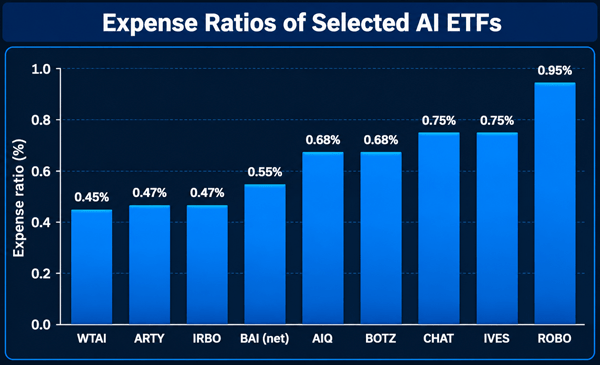
Figure 1. Expense ratio comparison of selected AI ETFs (issuer data checked in July 2026).
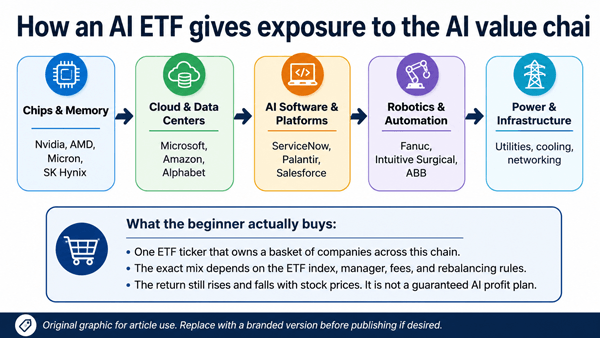
Figure 2. How an AI ETF gives exposure to the AI value chain
1. What is an AI ETF?
An AI ETF is a stock-market fund that trades on an exchange like a normal stock but holds many companies linked to artificial intelligence. Some AI ETFs track an index. Others are actively managed by a portfolio team. The fund may own chipmakers, memory companies, cloud platforms, software firms, robotics manufacturers, cybersecurity companies, data-center suppliers or companies using AI to improve their products.
Simple example: Imagine you have $1,000 and want AI exposure. Buying one AI stock can be risky because one bad earnings report or product delay can hurt you badly. Buying an AI ETF may spread that $1,000 across 30, 50, 75 or even 100 companies. You still face market risk, but you are not depending on one company only.
The important point is that “AI ETF” is a broad label. Two funds can both use the AI keyword but invest very differently. One may be mostly semiconductors. Another may hold robotics companies. Another may hold software and cloud stocks. Another may own pre-IPO or active positions. Beginners should always look under the hood before buying.
2. How AI ETFs work in real life
When you buy an ETF, you are buying shares of the fund. The ETF manager uses the fund’s assets to own underlying stocks. The ETF price moves during the trading day, and its value generally follows the value of the holdings after fees and trading costs.
A passive AI ETF usually follows a published index. For example, a fund may track an artificial intelligence and big data index or a robotics and automation index. The index rules decide which companies qualify, how much weight each company receives, and when the holdings are rebalanced.
An active AI ETF gives the manager more freedom. The team can increase or reduce positions based on research, valuation, industry trends, earnings quality or new AI developments. Active management can help if the manager is right, but it can hurt if the manager makes poor choices. It also often costs more.
The ETF charges an expense ratio. A 0.50% expense ratio means about $5 per year for every $1,000 invested, before considering trading spreads and taxes. Fees seem small, but they matter over time because they reduce your return every year.
3. Current AI ETF comparison for 2026
The table below uses publicly available issuer and fund data checked in July 2026. Always verify before investing because ETF assets, performance, holdings and fees can change quickly.
| Ticker | Fund name | Style | Expense ratio | Approx. current scale / notes | Best use case |
|---|---|---|---|---|---|
| AIQ | Global X Artificial Intelligence & Technology ETF | Passive thematic | 0.68% | Global X reported about $11.08B in net assets as of Jun. 18, 2026. | Broad AI and big-data exposure for investors wanting a large, established thematic ETF. |
| BAI | iShares A.I. Innovation and Tech Active ETF | Active | 0.65% gross / 0.55% net | BlackRock listed about $16.64B net assets as of Jun. 18, 2026. | Investors who want active AI stock selection and can accept manager risk. |
| ARTY | iShares Future AI & Tech ETF | Passive thematic | 0.47% | BlackRock listed 49 holdings as of Jun. 19, 2026 and a high technology-sector tilt. | Focused AI/tech exposure with a lower fee than many thematic peers. |
| WTAI | WisdomTree Artificial Intelligence and Innovation Fund | Passive thematic | 0.45% | WisdomTree listed about $669.5M total assets as of Jun. 18, 2026. | Cost-conscious AI theme exposure with global innovation holdings. |
| BOTZ | Global X Robotics & Artificial Intelligence ETF | Passive robotics/AI | 0.68% | Targets robotics, automation, autonomous vehicles and AI adoption. | Investors who want applied robotics, automation and AI hardware exposure. |
| IRBO | iShares Robotics and Artificial Intelligence Multisector ETF | Passive robotics/AI | 0.47% | Yahoo Finance showed about $788M net assets and 0.47% net expense ratio in June 2026. | Broader robotics and AI exposure with lower fee than several robotics peers. |
| ROBO | ROBO Global Robotics and Automation Index ETF | Passive robotics | 0.95% | Fund factsheet listed 77 holdings and $1.48B AUM; higher fee. | Investors wanting a long-running, specialized robotics index approach. |
| CHAT | Roundhill Generative AI & Technology ETF | Active generative AI | 0.75% | Roundhill states CHAT launched May 18, 2023 and is actively managed. | Investors specifically targeting generative AI beneficiaries. |
| IVES | Dan IVES Wedbush AI Revolution ETF | Thematic / research-driven | 0.75% | Schwab holdings page showed 31 holdings, about $1.2B total assets and 0.75% expense ratio. | High-conviction AI revolution exposure; suitable only after checking concentration. |
4. Best AI ETFs to buy in 2026: focused analyst picks
4.1 Global X Artificial Intelligence & Technology ETF (AIQ) - best broad rules-based AI ETF
AIQ is one of the most established artificial intelligence ETFs. It targets companies involved in artificial intelligence, big data and related technologies. Based on Global X data, the fund had a 0.68% expense ratio and about $10.11 billion in net assets as of July 2026. That scale can matter because larger ETFs often have better liquidity, more investor attention and lower closure risk than tiny thematic funds.
Why beginners may like it: AIQ gives broad AI exposure without forcing the reader to pick one AI stock. It can work as a satellite holding for someone who already owns a core S&P 500 or total-market index fund but wants more AI exposure.
What to watch: The fee is higher than plain vanilla index ETFs. AIQ can also overlap with mega-cap technology holdings already inside a broad U.S. stock index fund. Before buying, compare the top holdings with what you already own.
4.2 iShares A.I. Innovation and Tech Active ETF (BAI) - best active AI ETF for investors who want manager judgment
BAI is an actively managed iShares AI ETF. BlackRock listed net assets of about $14.47 billion as of July 9, 2026, and showed a gross expense ratio of 0.65% with a net expense ratio of 0.55% in current materials. Recent reporting also noted that BAI has exposure to private AI leaders such as Anthropic and OpenAI preferred shares, although those positions were a small part of assets.
Why beginners may like it: Active management can adapt faster than a rigid index when the AI market changes. In 2026, AI leadership is not only about apps. It also includes memory chips, data centers, power needs, software monetization and private AI companies.
What to watch: Active funds depend on manager skill. The fund can look very attractive after strong performance, but beginners should avoid buying only because a chart has gone up. Read the fact sheet, holdings, turnover and fee waiver details.
4.3 iShares Future AI & Tech ETF (ARTY) - best lower-cost focused AI ETF
ARTY is a focused iShares AI and technology ETF. BlackRock listed a 0.47% expense ratio, 49 holdings as of July 13, 2026, and a technology-heavy portfolio. It may appeal to investors who want AI exposure but prefer a fee below many competing thematic ETFs.
Why beginners may like it: The fund is easier to understand than a complex leveraged product. It offers focused exposure while still spreading risk across multiple holdings.
What to watch: ARTY can be volatile. BlackRock data in July 2026 showed a high equity beta and a high P/E ratio, which tells beginners that this is not a conservative income fund. It is a growth-oriented thematic ETF.
4.4 WisdomTree Artificial Intelligence and Innovation Fund (WTAI) - best cost-conscious AI innovation ETF
WTAI had an expense ratio of 0.45% and about $629.0 million in total assets as of July 9, 2026, according to WisdomTree. It tracks an AI and innovation theme and may include global companies across chips, hardware, software and related AI infrastructure.
Why beginners may like it: The 0.45% fee is competitive for a specialized AI ETF. This can matter for long-term investors because lower fees leave more of the return in the investor’s pocket.
What to watch: Lower fee does not mean lower risk. The holdings may still be concentrated in fast-moving technology names. Review country exposure, top holdings and whether it duplicates your other funds.
4.5 Global X Robotics & Artificial Intelligence ETF (BOTZ) - best AI ETF for robotics exposure
BOTZ focuses on companies that may benefit from robotics, automation, autonomous vehicles and AI adoption. It is not only a “chatbot” or software AI fund. It is more about AI meeting machines, factories, surgery, industrial automation and real-world productivity.
Why beginners may like it: Robotics is a practical part of the AI story. A warehouse robot, surgical robot or factory automation system can create visible business value. BOTZ can suit readers who believe AI will increasingly move from screens into physical operations.
What to watch: Robotics adoption can be slower than software adoption. Industrial cycles, capital spending and global manufacturing demand can affect returns. The fund’s 0.68% fee is also higher than broad market ETFs.
4.6 iShares Robotics and Artificial Intelligence Multisector ETF (IRBO) - best broader robotics/AI blend for fee-sensitive investors
IRBO offers robotics and AI exposure across sectors and regions. publicly available fund data checked in July 2026 showed about $788 million in net assets and a 0.47% net expense ratio. It can be a useful alternative for readers who want robotics/AI exposure but are uncomfortable with higher-fee specialty funds.
Why beginners may like it: It spreads exposure across more companies than a very concentrated fund and costs less than some well-known robotics ETFs.
What to watch: Equal-weighted or broader approaches can underperform when a few mega-cap AI winners dominate the market. Broad exposure is safer in one sense, but it may not keep up with narrow AI winners during momentum-driven periods.
4.7 ROBO Global Robotics and Automation Index ETF (ROBO) - best long-running specialized robotics ETF
ROBO has a long operating history and a specialized robotics-and-automation focus. A recent factsheet listed 77 equity holdings, quarterly rebalancing and a 0.95% expense ratio. This is a serious robotics fund, but the fee is high compared with many alternatives.
Why beginners may like it: ROBO is useful for investors who want a specialized robotics index rather than a general AI software ETF.
What to watch: The 0.95% expense ratio is a major hurdle. A fund with a higher fee must deliver enough value through exposure, diversification or performance to justify the cost.
4.8 Roundhill Generative AI & Technology ETF (CHAT) - best generative AI ETF for high-conviction investors
CHAT is an actively managed ETF focused on generative AI and related technologies. Roundhill says the fund launched on May 18, 2023, is actively managed and has a 0.75% gross expense ratio. It is designed for investors who want direct thematic exposure to generative AI companies.
Why beginners may like it: The theme is easy to understand. Generative AI is the part of AI many people see in daily life through chatbots, copilots, image generation, coding tools and productivity software.
What to watch: Easy-to-understand themes can become crowded. A hot theme can attract buyers after prices are already expensive. Beginners should treat CHAT as a satellite idea, not a full portfolio replacement.
5. How beginners should choose an AI ETF
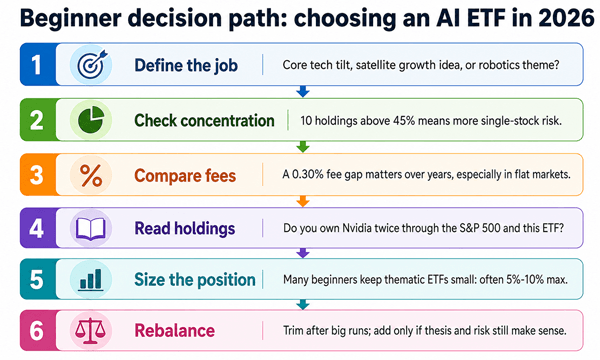
Figure 3. Beginner decision path: choosing an AI ETF in 2026
A good AI ETF choice starts with the job you want it to do. Do you want broad AI exposure? Robotics exposure? Generative AI exposure? Or do you simply want a small growth satellite next to your core index funds? The right answer changes depending on that purpose.
Here is a practical checklist:
| Question to ask | Why it matters | Beginner-friendly rule |
|---|---|---|
| What does the ETF actually own? | The name may say AI, but holdings may be chips, software, robotics, cloud or infrastructure. | Read the top 10 holdings before buying. |
| How concentrated is it? | A fund with 45%-60% in the top 10 holdings can behave like a few big stocks. | Be more careful if one stock is above 8%-10%. |
| What is the expense ratio? | Fees reduce returns every year. | Compare similar ETFs; do not pay more unless the strategy is clearly different. |
| How liquid is it? | Thin ETFs can have wider bid-ask spreads. | Prefer larger funds with healthy daily volume for beginner portfolios. |
| Does it overlap with your current funds? | Many investors already own AI leaders through the S&P 500 or Nasdaq 100. | Check overlap before adding more tech risk. |
| Can you hold through a 30%-50% drop? | Thematic technology ETFs can be very volatile. | Size the position small enough that you will not panic sell. |
6. Practical portfolio examples
These examples are educational only. They show how a beginner might think about position sizing, not what any specific person should buy.
| Investor type | Possible AI ETF role | Example allocation idea | Reasoning |
|---|---|---|---|
| Very cautious beginner | No AI ETF or tiny satellite | 0%-3% of portfolio | They may already own AI companies through broad index funds. |
| Balanced long-term investor | Small satellite | 5% of portfolio | Enough to participate in the theme without letting it dominate results. |
| Growth-oriented investor | Meaningful satellite | 5%-10% of portfolio | Can tolerate more volatility, but still keeps the core diversified. |
| Aggressive thematic investor | High-conviction satellite | 10%-15% max for many people | Requires strong risk tolerance, rebalancing discipline and acceptance of big drawdowns. |
Example: A reader has $10,000 and already owns a broad S&P 500 ETF. They want AI exposure but do not want to gamble. A practical approach could be to place $500 in one AI ETF and keep $9,500 in diversified core funds. If AI runs up and the AI ETF grows to $900 while the rest of the portfolio grows slowly, the investor can rebalance instead of letting one theme take over.
Another example: A reader wants robotics, not just chip stocks. They might compare BOTZ, IRBO and ROBO. BOTZ may offer focused robotics exposure, IRBO may offer a lower-cost broader robotics/AI blend, and ROBO may offer a specialized long-running robotics index but with a higher fee. The best choice depends on whether they value cost, focus or index methodology most.
7. Common beginner mistakes with AI ETFs
- Mistake 1: Buying the best recent performer. A fund that is up sharply may be strong, but it may also be expensive. Beginners should ask what changed in the business outlook, not just what changed in the price.
- Mistake 2: Owning the same stocks twice without realizing it. Many broad index funds already own large positions in Nvidia, Microsoft, Apple, Alphabet, Amazon, Meta and other AI-linked companies. An AI ETF can increase exposure to names you already own.
- Mistake 3: Ignoring the expense ratio. Thematic ETFs often cost more than broad index ETFs. A higher fee can be worth it only if the exposure is genuinely useful and the investor understands why they are paying it.
- Mistake 4: Confusing ETFs with guaranteed safety. Diversification helps, but a basket of expensive technology stocks can still drop together during a market selloff.
- Mistake 5: Using leveraged AI or single-stock ETFs as long-term investments. FINRA and SEC investor guidance warns that leveraged and inverse ETFs are generally designed for daily objectives and can behave very differently over longer periods, especially in volatile markets.
8. What risks should readers know before buying?
- Valuation risk: AI companies can be excellent businesses and still be poor investments if the purchase price is too high. High P/E ratios and high expectations leave less room for disappointment.
- Concentration risk: Some AI ETFs hold many companies, but the top holdings can still drive most of the return. Read the holdings instead of trusting the fund name.
- Theme risk: A popular theme can attract too much money. When everyone wants AI exposure at the same time, prices can move ahead of fundamentals.
- Technology-cycle risk: AI spending may shift from chips to software, then to infrastructure, then to power, then to robotics. A fund that was positioned perfectly last year may be less attractive next year.
- Regulatory and fraud risk: AI is also being used in investment scams. The SEC, NASAA and FINRA have warned that bad actors use AI hype and complexity to lure victims into fraudulent investments. Real ETFs listed on major exchanges are regulated products, but that does not mean every AI-related pitch is legitimate.
- Currency and tax risk: U.S.-listed AI ETFs may not be ideal for every international investor. Taxes, withholding, estate rules and brokerage access vary by country. Readers outside the U.S. should check local rules or consider locally listed UCITS or other regional ETF options where appropriate.
9. AI ETF vs AI stocks: which is better?
| Choice | Pros | Cons | Best for |
|---|---|---|---|
| AI ETF | Diversified, easier, less single-company risk, simple to buy through a brokerage account. | Fees, possible overlap, may include weak companies, still volatile. | Beginners and long-term investors who want theme exposure without stock picking. |
| Individual AI stocks | Higher upside if the company wins, no ETF fee, more control. | Higher risk, requires research, one company mistake can hurt badly. | Experienced investors who can analyze businesses and tolerate volatility. |
| Broad market ETF | Low cost, diversified, already includes many AI leaders. | Less pure AI exposure, may feel too slow for thematic investors. | Core portfolio building and retirement investing. |
For most beginners, the honest answer is not “AI ETF or AI stock.” It is usually “core diversified portfolio first, AI ETF second, individual AI stocks only if you truly understand them.”
10. How to buy an AI ETF step by step
- Open or use a reputable brokerage account. Choose a regulated broker, understand fees, and avoid social-media links promising guaranteed AI profits.
- Search the ticker. Type the ETF ticker, such as AIQ, ARTY, BAI, BOTZ, IRBO, WTAI, ROBO or CHAT. Confirm the full fund name before placing an order.
- Read the issuer page. Check expense ratio, assets, holdings, strategy, performance history, premium/discount and distributions.
- Decide position size before buying. A beginner may start small, such as 2%-5% of the portfolio, then add only after understanding the fund better.
- Use a limit order when possible. ETFs trade during the day, and a limit order can help avoid paying more than intended, especially with less liquid funds.
- Review quarterly or semiannually. Do not check every hour. Instead, review holdings, valuation, overlap and whether the fund still matches your goal.
11. Our practical ranking for 2026
| Rank | ETF | Reasonable label | Why it ranks here |
|---|---|---|---|
| 1 | AIQ | Best broad passive AI ETF | Large asset base, clear AI/big-data theme and broad exposure. |
| 2 | BAI | Best active AI ETF | Large iShares active fund with flexibility to adapt to changing AI leadership. |
| 3 | ARTY | Best lower-cost focused AI ETF | Focused AI/tech exposure with a competitive 0.47% fee. |
| 4 | WTAI | Best value-fee AI innovation ETF | Competitive 0.45% fee and clear AI innovation mandate. |
| 5 | IRBO | Best lower-cost robotics/AI blend | Robotics and AI exposure at a lower fee than many robotics funds. |
| 6 | BOTZ | Best robotics specialist for applied AI | Strong fit for investors who believe robotics and automation are the next phase of AI. |
| 7 | CHAT | Best generative AI satellite | Focused and active, but higher fee and theme-crowding risk. |
| 8 | ROBO | Best specialized legacy robotics ETF | Long-running specialist, but high 0.95% expense ratio. |
This ranking is not a prediction that the first fund will outperform. It is a practical assessment based on factors such as clarity, cost, scale, use case, diversification, and beginner suitability. Rankings and assessments may vary depending on the criteria, methodology, market conditions, and individual investment objectives considered.
12. FAQs about AI ETFs
12.1 Are AI ETFs good for beginners?
They can be, if used carefully. A beginner should treat an AI ETF as a satellite holding, not as a complete investment plan. The core of a portfolio should usually be diversified across sectors, countries and asset classes.
12.2 What is the safest AI ETF?
No AI ETF is truly “safe” in the way a bank deposit or Treasury bill may be safer. A larger, more diversified, lower-cost AI ETF may be more beginner-friendly, but it can still lose money.
12.3 Should I buy an AI ETF in 2026 after AI stocks already went up?
Only if the position size fits your plan and you can hold through volatility. AI may be a long-term trend, but long-term trends can still have painful corrections.
12.4 Is Nvidia already inside AI ETFs?
Often yes, but not always at the same weight. Many AI ETFs own Nvidia or other semiconductor leaders because chips are central to AI computing. Check the latest holdings because weights change.
12.5 Can I use AI ETFs for retirement investing?
Possibly, but usually as a small growth tilt inside a broader retirement portfolio. Retirement money should be managed with extra attention to time horizon, taxes, risk and diversification.
12.6 Do AI ETFs pay dividends?
Some pay small distributions, but most AI ETFs are growth-oriented and should not be bought mainly for income. Check the 30-day SEC yield and distribution history.
13. Final verdict: what is the best AI ETF to buy in 2026?
For a beginner who wants one broad AI ETF, AIQ is a strong starting point because it is large, established and focused on artificial intelligence and big data. For investors who prefer active management and are comfortable with manager risk, BAI deserves serious attention. For cost-conscious investors, ARTY and WTAI stand out. For robotics believers, BOTZ, IRBO and ROBO are the main comparison set. For high-conviction generative AI exposure, CHAT can be useful, but it should be sized carefully.
The best AI ETF is not simply the one with the highest return last year. It is the fund that matches your goal, costs a reasonable fee, owns companies you understand, avoids excessive overlap, and fits inside a disciplined portfolio. AI may change the economy, but good investing still depends on old-fashioned habits: diversification, patience, valuation awareness, fee control and risk management.
Sources Consulted and Checked
The following sources were consulted and checked while preparing this article and reviewing its accuracy. Fund data can change, so readers should confirm the latest information directly with the issuer before acting.
- Global X AIQ fund page, checked July 2026: expense ratio 0.68% and net assets about $10.11B. https://www.globalxetfs.com/funds/aiq/
- BlackRock/iShares ARTY fund page, checked July 2026: expense ratio 0.47%, 49 holdings and current portfolio characteristics. https://www.ishares.com/us/products/297905/ishares-future-ai-tech-etf
- BlackRock/iShares BAI fund page, checked July 2026: net assets, gross and net expense ratios, and active AI strategy. https://www.ishares.com/us/products/339081/ishares-a-i-innovation-and-tech-active-etf
- WisdomTree WTAI fund page, checked July 2026: expense ratio 0.45% and total assets about $629.0M. https://www.wisdomtree.com/us/products/megatrends/wtai
- Global X BOTZ fund page, checked July 2026: robotics and AI strategy, expense ratio, holdings and net assets. https://www.globalxetfs.com/funds/botz/
- ROBO ETF factsheet, 2026: holdings, AUM, expense ratio and rebalancing. https://www.roboglobaletfs.com/robo
- Roundhill CHAT fund page, checked July 2026: launch date, active management and 0.75% expense ratio. https://www.roundhillinvestments.com/etf/chat/
- ETF.com AI ETF category page: AI ETF market size and average expense ratio snapshot. https://www.etf.com/topics/artificial-intelligence
- FINRA ETF investor education: ETF/ETP structure and risk considerations. https://www.finra.org/investors/investing/investment-products/exchange-traded-funds-and-products
- SEC/NASAA/FINRA Investor Alert on AI investment fraud, January 25, 2024. https://www.investor.gov/introduction-investing/general-resources/news-alerts/alerts-bulletins/investor-alerts/artificial-intelligence-fraud
- SEC Investor Bulletin on leveraged and inverse ETFs, August 29, 2023. https://www.investor.gov/introduction-investing/general-resources/news-alerts/alerts-bulletins/investor-alerts/sec
- Wedbush Funds IVES fund page, checked July 2026: objective, expense ratio, assets and trading details. https://wedbushfunds.com/funds/ives/
Reader Advice
This article is provided solely for educational and informational purposes and does not constitute personalized investment, legal, tax or financial advice. Any use of terms such as “best” or “to buy,” and any rankings, comparisons or assessments of AI ETFs presented in this article, reflect the criteria and methodology used for this analysis and should not be interpreted as definitive rankings, personalized investment recommendations or predictions of future performance; other analyses using different criteria, assumptions or methodologies may reach different conclusions. No ETF discussed is presented as suitable or appropriate for every investor.
AI-focused ETFs may involve thematic or sector concentration, exposure to rapidly evolving technologies and companies, and heightened market volatility. The classification of a fund or company as related to artificial intelligence may also vary depending on the definitions and methodologies used by fund providers, index providers and other market participants. ETF fees, holdings, assets, performance, availability, regulations and tax treatment may change because of market conditions, issuer decisions, jurisdiction and other factors.
Before making any decision, readers should verify current facts and figures through official fund issuer pages, prospectuses, regulatory sources and their brokerage platform, and should consider their own objectives, time horizon, financial circumstances and risk tolerance. Where appropriate, consult a qualified and properly regulated financial, tax or legal professional. Past performance does not guarantee future results, and investing involves the possible loss of principal.