Best International ETFs for Global Diversification in 2026
1. Quick answer
For most beginners, the best international ETF is usually not the most exciting one. It is the one that is broad, cheap, easy to understand, tax-reportable on your brokerage platform, and simple enough to hold through bad years. In 2026, broad “total international” funds such as VXUS and IXUS remain the simplest one-ticket choices because they include both developed and emerging markets outside the United States. Investors who want only developed markets can look at SCHF, SPDW, IDEV, or IEFA. Investors who already own developed-market funds and want a separate emerging-market sleeve can compare VWO and IEMG.
| Investor need | Best-fit ETF type | Examples | Why it works |
|---|---|---|---|
| One fund for non-U.S. stocks | Total international / global ex-U.S. | VXUS, IXUS, VEU | Broad exposure across many countries; less maintenance |
| Cheapest developed-market exposure | Developed markets ex-U.S. | SCHF, SPDW, IDEV | Very low fees; excludes emerging-market volatility |
| Emerging-market growth sleeve | Emerging markets | VWO, IEMG | Adds China, India, Taiwan, Brazil and other faster-growing but riskier markets |
| Dividend income focus | International dividend | SCHY | Screens for higher-dividend non-U.S. companies; less broad than total-market funds |
| Factor/value tilt | Rules-based active / factor | AVDE | Broader than stock picking, but higher fee and more tracking difference |
Important: “Best” depends on your existing portfolio. If you already own a U.S. total market ETF such as VTI or an S&P 500 fund, an international ETF can fill the non-U.S. stock gap. If you already own a global all-world ETF, adding another international ETF may duplicate holdings.
2. What is an international ETF?
An international ETF is a basket of stocks from countries outside your home market. For a U.S.-based investor, that usually means companies listed in Japan, the United Kingdom, France, Canada, Switzerland, Taiwan, India, South Korea, China, Brazil and many other markets. Instead of buying hundreds or thousands of foreign stocks one by one, the ETF holds them for you and trades on an exchange like a normal stock during market hours.
The SEC’s Investor.gov explains that ETFs pool money from many investors and invest in a portfolio of securities. Unlike a traditional mutual fund, an ETF can be bought and sold on an exchange during the trading day. FINRA also notes that exchange-traded products can trade at a premium or discount to estimated value and can decline in value like other investments. That is why a beginner should understand both the fund holdings and the trading mechanics before buying.
2.1 How international ETFs work in plain English
- You buy shares of the ETF through a brokerage account, retirement account or investment platform.
- The ETF provider tracks an index or follows a stated strategy, such as “developed markets outside the U.S.” or “emerging markets.”
- The fund owns many stocks. Your ETF share represents a tiny slice of that full basket.
- The ETF price moves during the day based on demand, supply and the value of the underlying holdings.
- You may receive dividends if the underlying companies pay dividends and the ETF distributes them.
- You pay an annual expense ratio, which is deducted from fund assets. You do not usually see a separate bill.
3. Why global diversification matters in 2026
Many investors naturally buy what they know: local banks, local telecoms, local real estate companies, or U.S. mega-cap technology stocks. This is called home bias. It feels comfortable, but it can leave a portfolio dependent on one economy, one currency, one political system, or one market cycle.
International ETFs help spread risk across countries and currencies. They also give access to companies that may not be well represented in a domestic portfolio: European healthcare and luxury companies, Japanese industrials, Taiwanese semiconductors, Korean electronics, Canadian financials, Indian banks, and emerging-market consumer businesses.
The practical reason to diversify is not that international stocks must beat U.S. stocks every year. They will not. The reason is that leadership changes. A portfolio that owns only one market can look brilliant for years and then become painfully concentrated. A globally diversified portfolio accepts that no one knows the next winning region in advance.
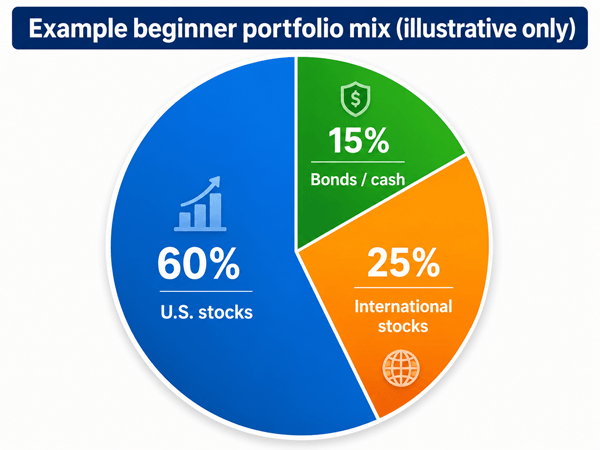
Example beginner portfolio mix (illustrative only)
4. Best international ETFs for 2026: comparison table
The table below focuses on well-known, liquid ETFs with low expense ratios and clear use cases. Fund data changes over time; reader should verify details on the issuer page.
| Ticker | ETF | Coverage | Expense ratio | Holdings | Best for | Plain-English note |
|---|---|---|---|---|---|---|
| VXUS | Vanguard Total International Stock ETF | Total international ex-U.S. | 0.05% | 8,700+ | Beginner one-fund international exposure | Includes developed + emerging markets; very broad |
| IXUS | iShares Core MSCI Total International Stock ETF | Total international ex-U.S. | 0.07% | 4,000+ | BlackRock/iShares users who want total ex-U.S. | Broad developed + emerging market coverage |
| VEU | Vanguard FTSE All-World ex-US ETF | Large/mid cap total ex-U.S. | 0.04% | 3,800+ | Low-cost broad exposure excluding most small caps | Cheaper than many broad funds but not as total-market as VXUS |
| SCHF | Schwab International Equity ETF | Developed ex-U.S. large/mid cap | 0.03% | ~1,500 | Cost-focused developed-market sleeve | Very low fee; excludes emerging markets |
| SPDW | SPDR Portfolio Developed World ex-US ETF | Developed ex-U.S. | 0.03% | Thousands | Low-cost developed-market exposure | Very cheap; useful with separate EM ETF |
| IDEV | iShares Core MSCI International Developed Markets ETF | Developed ex-U.S. IMI | 0.04% | 2,200+ | Developed-market exposure with broad coverage | Low fee and broad developed market index |
| IEFA | iShares Core MSCI EAFE ETF | Developed Europe, Australasia, Far East | 0.07% | 2,600+ | Classic developed-market ETF | No U.S. or Canada; excludes emerging markets |
| VWO | Vanguard FTSE Emerging Markets ETF | Emerging markets | 0.06% | 6,300+ | Separate emerging-market allocation | Low-cost EM exposure; higher volatility |
| IEMG | iShares Core MSCI Emerging Markets ETF | Emerging markets IMI | 0.09% | Large/mid/small EM | Emerging-market sleeve with small-cap inclusion | Broad EM fund; higher risk than developed markets |
| SCHY | Schwab International Dividend Equity ETF | International dividend | 0.08% | Dividend screen | Income-focused investors | Less diversified than total international funds |
| AVDE | Avantis International Equity ETF | Developed markets factor/value tilt | 0.23% | 3,000+ | Investors wanting systematic value/profitability tilt | Higher fee; may behave differently from index funds |
5. How to choose: a simple decision tree
| Question | Choose this path | Example |
|---|---|---|
| Do you want one simple fund for non-U.S. stocks? | Use a total international ETF. | VXUS or IXUS |
| Do you want developed markets only? | Use a developed-market ETF. | SCHF, SPDW, IDEV or IEFA |
| Do you already own a developed-market ETF and want emerging markets? | Add a separate EM ETF. | VWO or IEMG |
| Do you want dividend income from non-U.S. stocks? | Use a dividend ETF as a satellite, not the core. | SCHY |
| Do you want to tilt toward value/profitability? | Use a factor ETF only if you can accept long tracking differences. | AVDE |
Beginner rule: Start broad before getting fancy. A total international ETF is easier to manage than three regional ETFs, five country ETFs, or a trendy theme ETF. The more pieces you add, the more you must rebalance, track overlaps, and control behavior during market stress.
6. Deep-dive reviews
6.1 VXUS: Vanguard Total International Stock ETF
Verdict: Best overall for simple, broad international diversification.
Practical pros:
- Very broad exposure across developed and emerging markets
- Low 0.05% expense ratio
- Useful as the core international stock holding
Watch-outs:
- Can lag the U.S. market for long stretches
- Currency movements can add volatility
- Large market-cap weighting means it owns more of expensive or dominant markets automatically
6.2 IXUS: iShares Core MSCI Total International Stock ETF
Verdict: Best iShares alternative to VXUS.
Practical pros:
- Broad total international exposure
- 0.07% fee remains low
- Easy to pair with U.S. total-market ETFs
Watch-outs:
- Slightly higher fee than VXUS and VEU
- Overlaps with other developed and EM funds
- Still exposed to currency, country and political risk
6.3 VEU: Vanguard FTSE All-World ex-US ETF
Verdict: Best broad large/mid-cap international ETF for low fees.
Practical pros:
- 0.04% expense ratio
- Includes both developed and emerging markets
- Simple broad ex-U.S. exposure
Watch-outs:
- Less complete small-cap coverage than VXUS
- May not be ideal if you specifically want total-market exposure
- Still market-cap weighted
6.4 SCHF: Schwab International Equity ETF
Verdict: Best ultra-low-cost developed-market ETF.
Practical pros:
- 0.03% expense ratio
- Large asset base and many holdings
- Good for investors using Schwab or wanting developed-market exposure
Watch-outs:
- Excludes emerging markets
- Large/mid-cap focus means less small-cap exposure
- Needs VWO/IEMG if you want full international coverage
6.5 SPDW: SPDR Portfolio Developed World ex-US ETF
Verdict: Best low-cost developed-market alternative.
Practical pros:
- 0.03% expense ratio
- Broad developed-market exposure outside the U.S.
- Useful for building a two-fund developed + emerging international sleeve
Watch-outs:
- No emerging markets
- Requires separate EM ETF for full coverage
- Index differences versus SCHF/IDEV can affect returns
6.6 IDEV: iShares Core MSCI International Developed Markets ETF
Verdict: Best low-cost iShares developed-market fund.
Practical pros:
- 0.04% expense ratio
- Broad MSCI developed ex-U.S. exposure
- Good alternative to IEFA for lower fee seekers
Watch-outs:
- No emerging-market exposure
- Still has currency risk
- May overlap heavily with IEFA or SCHF
6.7 VWO: Vanguard FTSE Emerging Markets ETF
Verdict: Best low-cost emerging-market ETF for a separate EM sleeve.
Practical pros:
- 0.06% expense ratio
- Very broad emerging-market exposure
- Can be paired with SCHF, SPDW, IDEV or IEFA
Watch-outs:
- Emerging markets can be volatile
- Country weights may change with index rules
- Political, currency and liquidity risks are higher
6.8 IEMG: iShares Core MSCI Emerging Markets ETF
Verdict: Best broad iShares emerging-market ETF.
Practical pros:
- Large, liquid fund
- Includes large-, mid- and small-cap emerging-market stocks
- Useful for long-term EM allocation
Watch-outs:
- 0.09% fee is higher than VWO
- Can suffer large drawdowns
- Needs discipline because EM returns can be uneven
6.9 SCHY: Schwab International Dividend Equity ETF
Verdict: Best satellite for international dividend exposure.
Practical pros:
- 0.08% fee is low for a dividend strategy
- Focuses on non-U.S. high-dividend companies
- May appeal to income-focused investors
Watch-outs:
- Not a total international market fund
- Dividend screens can reduce diversification
- High yield is not the same as low risk
6.10 AVDE: Avantis International Equity ETF
Verdict: Best for investors who understand factor tilts.
Practical pros:
- Rules-based active approach with value/profitability orientation
- Broad developed-market holdings
- Potential long-term factor premium exposure
Watch-outs:
- 0.23% fee is much higher than basic index ETFs
- Can underperform plain indexes for years
- Not ideal as a first ETF unless investor understands the strategy
7. Fees: why a tiny expense ratio matters
Expense ratio is the yearly cost of owning the ETF, shown as a percentage of assets. A 0.05% expense ratio means about $5 per year on every $10,000 invested. A 0.23% expense ratio means about $23 per year on every $10,000. That difference sounds small, but over decades it compounds.
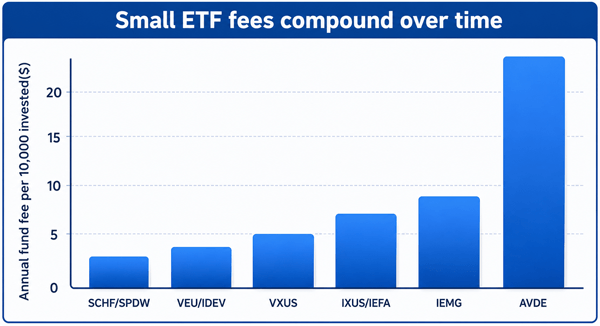
Small ETF fees compound over time
Beginner takeaway: Do not choose an ETF only because it is cheap, but treat cost as a permanent headwind. A broad fund charging 0.03% to 0.09% usually sets a high bar for any higher-fee international strategy.
8. Practical portfolio examples
These are educational examples, not recommendations. The right allocation depends on age, country, tax situation, time horizon, risk tolerance, debts, income stability and existing investments.
| Example investor | Possible ETF structure | Why it may fit | Main risk |
|---|---|---|---|
| New investor with U.S. stock ETF already | 75% U.S. stock ETF + 25% VXUS | Simple global diversification with one international fund | May feel frustrating when U.S. stocks outperform |
| Investor wanting market-like global stocks | 60% U.S. stock ETF + 40% VXUS/IXUS | Closer to global equity market split than home-biased portfolios | Higher exposure to currency and foreign-market cycles |
| Cost-focused investor building pieces | 75% U.S. ETF + 20% SCHF/SPDW + 5% VWO/IEMG | Separates developed and emerging markets with low fees | Requires rebalancing |
| Income-oriented investor | Core broad ETFs + small SCHY satellite | Keeps diversification while adding dividend tilt | Dividend ETF may underperform growth-led markets |
| Factor-aware investor | Core broad ETFs + small AVDE satellite | Adds value/profitability tilt without individual stock picking | Can lag plain indexes for long periods |
8.1 How much international exposure should a beginner consider?
There is no single correct number. Many U.S.-based model portfolios use somewhere around 20% to 40% of the stock allocation in international stocks. Conservative investors may start lower simply to build confidence. More globally neutral investors may go higher. The key is to choose a percentage you can keep during years when international stocks disappoint.
Example: If you have $10,000 for stocks and choose a 70/30 U.S./international split, $7,000 goes to your U.S. ETF and $3,000 goes to VXUS or IXUS. If the U.S. grows faster and the split becomes 78/22 later, you can rebalance by adding new money to the international ETF or selling some of the overweight fund if appropriate.
9. Common beginner mistakes
| Mistake | Why it hurts | Better habit |
|---|---|---|
| Buying many ETFs with the same holdings | Creates fake diversification and extra complexity | Check overlap before adding a fund |
| Chasing last year’s best country ETF | Performance leadership rotates | Use broad exposure for the core |
| Ignoring expense ratios | Fees reduce returns every year | Prefer low-cost funds unless there is a clear reason |
| Using market orders in volatile hours | May get a worse price than expected | Use limit orders and avoid the market open/close |
| Confusing dividend yield with safety | High dividends can come from troubled sectors | Look at total return, quality and diversification |
| Selling after a bad year | Locks in losses and breaks the plan | Write an allocation plan before investing |
10. Trading tips for ETFs
- Use limit orders, especially for international ETFs, because underlying foreign markets may be closed while the U.S. market is open.
- Avoid trading in the first 15-30 minutes and final 15 minutes of the trading day when spreads can widen.
- Check bid-ask spread. A low expense ratio is less useful if you repeatedly trade with wide spreads.
- Do not buy solely from a social-media list. Read the issuer page, prospectus summary, index methodology and holdings.
- Understand your tax forms. U.S. investors may receive ordinary dividends, qualified dividends and possible foreign tax credit information. Non-U.S. investors may face withholding tax and estate-tax issues depending on fund domicile and local rules.
11. Risks you should explain honestly
International ETFs should not be presented as guaranteed or risk-free merely because they are diversified. They can reduce single-country concentration, but they still carry real risks.
| Risk | Plain-English meaning | How to handle it |
|---|---|---|
| Market risk | The ETF can fall when global stocks fall. | Invest only long-term money and keep emergency cash separate. |
| Currency risk | Foreign currencies can move against your home currency. | Accept it as part of global diversification; avoid overreacting. |
| Country/political risk | Local rules, wars, sanctions or policy changes can hurt markets. | Use broad funds instead of large single-country bets. |
| Emerging-market risk | EM stocks can be more volatile and less liquid. | Keep EM allocation at a size you can tolerate. |
| Tracking difference | ETF return may differ from the index after fees and trading costs. | Compare fund history and costs. |
| Premium/discount risk | ETF market price can trade above or below NAV. | Use limit orders and check spreads. |
| Tax risk | Foreign withholding taxes and local tax rules can affect returns. | Consult a qualified tax professional for your country. |
12. FAQs
12.1 What is the best international ETF for beginners in 2026?
For many beginners, a broad total international ETF such as VXUS or IXUS is the easiest starting point because it includes both developed and emerging markets outside the U.S. The best choice still depends on your existing holdings and tax situation.
12.2 Is VXUS better than IXUS?
They are very similar in purpose. VXUS has a lower listed expense ratio in current Vanguard data, while IXUS is the comparable iShares total international option. For most long-term investors, behavior and allocation discipline matter more than tiny differences between two broad, low-cost funds.
12.3 Should I buy developed markets and emerging markets separately?
You can, but it adds maintenance. A total international ETF handles the mix for you. Separate funds are useful if you want to control the emerging-market percentage yourself.
12.4 Are international ETFs risky?
Yes. They are diversified, but they can still lose money. They carry stock-market risk, currency risk, political risk, tax complexity and, in emerging markets, higher volatility.
12.5 How much should I invest internationally?
Many investors use 20% to 40% of their stock allocation internationally, but there is no universal rule. Choose an allocation you can hold through long periods of underperformance.
12.6 Do international ETFs pay dividends?
Many do, because non-U.S. markets often include dividend-paying banks, industrials, energy, healthcare and consumer companies. Dividend payments are not guaranteed and can be affected by withholding taxes.
12.7 Can I use only one global ETF instead?
Yes, some investors use a total world ETF that includes both U.S. and non-U.S. stocks. That is simpler, but it gives you less control over the U.S. versus international split.
12.8 What is the safest international ETF?
No stock ETF is truly safe. A broad developed-market ETF may be less volatile than a concentrated country or emerging-market ETF, but it can still decline sharply in a bear market.
13. Final verdict
The best international ETF in 2026 is the one that gives you broad exposure, low cost, clear rules and a role you understand in your portfolio. For a simple core, VXUS and IXUS are the cleanest total international choices. For developed markets only, SCHF, SPDW and IDEV stand out on cost. For emerging markets, VWO and IEMG are the main low-cost building blocks. For income or factor tilts, SCHY and AVDE can be useful satellites, but they should not replace a diversified core for most beginners.
The central takeaway is straightforward: international ETFs are not a shortcut to guaranteed returns. They are a practical tool for reducing home bias, spreading risk, and owning more of the world’s companies through a simple, low-cost structure.
Sources Consulted and Checked
The following official and professional sources were consulted when preparing this article and checking its general accuracy. Fund details, fees, holdings, yields, tax treatment and rules may change, so readers should confirm current information directly with the relevant issuer or authority.
- Investor.gov / SEC ETF overview: https://www.investor.gov/introduction-investing/investing-basics/investment-products/mutual-funds-and-exchange-traded-2
- SEC Investor Bulletin: Exchange-Traded Funds: https://www.sec.gov/investor/alerts/etfs.pdf
- FINRA: Exchange-Traded Funds and Products: https://www.finra.org/investors/investing/investment-products/exchange-traded-funds-and-products
- Vanguard VXUS official fund page: https://investor.vanguard.com/investment-products/etfs/profile/vxus
- Vanguard VEU official fund page: https://investor.vanguard.com/investment-products/etfs/profile/veu
- Vanguard VWO official fund page: https://investor.vanguard.com/investment-products/etfs/profile/vwo
- iShares IXUS official fund page: https://www.ishares.com/us/products/244048/ishares-core-msci-total-international-stock-etf
- iShares IEFA official fund page: https://www.ishares.com/us/products/244049/ishares-core-msci-eafe-etf
- iShares IDEV official fund page: https://www.ishares.com/us/products/286762/ishares-core-msci-international-developed-markets-etf
- iShares IEMG official fund page: https://www.ishares.com/us/products/244050/ishares-core-msci-emerging-markets-etf
- Schwab SCHF official fund page: https://www.schwabassetmanagement.com/products/schf
- Schwab SCHY official fund page: https://www.schwabassetmanagement.com/products/schy
- State Street SPDW official fund page: https://www.ssga.com/us/en/intermediary/etfs/state-street-spdr-portfolio-developed-world-ex-us-etf-spdw
- Avantis AVDE official fund page: https://www.avantisinvestors.com/avantis-investments/avantis-international-equity-etf/
- Vanguard: Why invest internationally?: https://investor.vanguard.com/investor-resources-education/understanding-investment-types/why-invest-internationally
- CFA Institute: ETF mechanics and applications: https://www.cfainstitute.org/insights/professional-learning/refresher-readings/2026/exchange-traded-funds-mechanics-applications
Reader Advice
This article is provided solely for educational and general informational purposes. It does not constitute individualized investment, financial, legal, accounting or tax advice, and it is not an offer, recommendation or solicitation to buy or sell any security. Any use of terms such as “best,” and any rankings, comparisons or assessments of international ETFs presented in this article, reflect the criteria and methodology used for this analysis and should not be considered definitive or universally applicable; other analyses using different criteria, assumptions or methodologies may reach different conclusions. References to “global diversification” or “diversification” do not imply that any ETF or combination of investments provides complete diversification, eliminates investment risk, or is appropriate for every investor.
ETF values can rise or fall, investors may lose money, and past performance does not predict future results. International investing may also involve additional risks, including currency fluctuations, geopolitical developments, differences in regulation and accounting standards, and country- or region-specific risks.
Before making any decision, review the latest fund prospectus, issuer disclosures, expense ratio, holdings, index methodology, trading costs, tax consequences and regulatory requirements. These details may change because of market conditions, issuer decisions, index revisions, law, taxation, jurisdiction, brokerage practices and other factors. Verify facts and figures through official sources and consider consulting a qualified financial adviser and tax professional who understands your personal circumstances and country of residence.
Any affiliate relationship, sponsorship or brokerage compensation connected with links or products mentioned on the publishing website should be disclosed clearly and prominently. Rankings and editorial judgments should remain independent of compensation.