Best Growth ETFs to Buy in 2026
Growth ETFs are popular because they give everyday investors a simple way to own companies that may grow faster than the overall market. Instead of trying to pick the next winning stock, a growth ETF lets you buy a basket of businesses in areas such as technology, communication services, e-commerce, software, semiconductors, healthcare innovation, and other high-earnings-growth industries.
The key is to understand what you are buying. A growth ETF is not automatically safe just because it is diversified. Many growth ETFs are heavily concentrated in large technology stocks. That can be powerful in strong markets, but painful during corrections. The best growth ETF for a beginner is usually not the flashiest one. It is the one that fits your goal, cost tolerance, time horizon, and risk level.
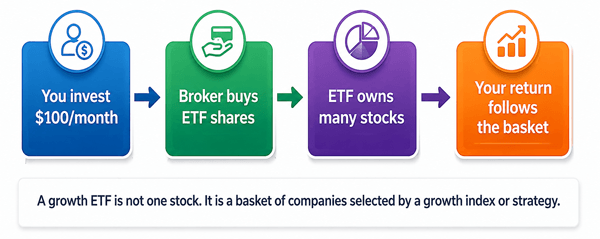
Plain-English definition
A growth ETF is an exchange-traded fund that owns companies expected to grow sales, earnings, cash flow, or market value faster than average. You buy and sell it like a stock, but inside it are many companies selected by an index or active manager.
1. Quick answer: the best growth ETFs to watch in 2026
For most long-term beginners, the strongest starting point is a broad, low-cost large-cap growth ETF. These funds spread money across many established growth companies instead of betting everything on one theme. More concentrated funds can be useful, but they should usually be smaller satellite positions.
| Ticker | ETF | Expense ratio | Focus | Why it stands out | Best fit |
|---|---|---|---|---|---|
| VUG | Vanguard Growth ETF | 0.03% | Broad U.S. large-cap growth | Low-cost core growth holding | Investors who want simple, diversified growth exposure |
| SCHG | Schwab U.S. Large-Cap Growth ETF | 0.04% | Large-cap U.S. growth | Very low fee and strong broad-growth exposure | Cost-focused beginners and long-term investors |
| QQQM | Invesco NASDAQ 100 ETF | 0.15% | Nasdaq-100, non-financial large companies | Tech-heavy growth with lower fee than QQQ | Investors who want Nasdaq exposure for long-term holding |
| SPYG | SPDR Portfolio S&P 500 Growth ETF | 0.04% | S&P 500 growth stocks | Cheap S&P 500 growth tilt | Investors who already like S&P 500-based funds |
| IWF | iShares Russell 1000 Growth ETF | 0.18% | Russell 1000 growth | Large and diversified growth benchmark | Investors who want Russell-style large growth exposure |
| VOOG | Vanguard S&P 500 Growth ETF | 0.07% | S&P 500 growth stocks | Vanguard option for S&P 500 growth | Investors who prefer Vanguard and want S&P methodology |
| MGK | Vanguard Mega Cap Growth ETF | 0.05% | Mega-cap growth | Concentrated mega-cap growth leaders | Investors comfortable with higher concentration |
| VGT | Vanguard Information Technology ETF | 0.09% | Technology sector | Pureer technology exposure | Satellite position for tech believers, not a full portfolio |
2. How a growth ETF works
An ETF is a fund that trades on an exchange. When you buy one share of a growth ETF, you are buying a slice of the ETF. The ETF itself owns shares of many companies. The fund manager or index provider decides which companies belong in the fund based on rules such as earnings growth, sales growth, momentum, profitability, market capitalization, or membership in an index like the Nasdaq-100, Russell 1000 Growth Index, CRSP U.S. Large Cap Growth Index, or S&P 500 Growth Index.
You make money if the ETF price rises and, in some cases, when the ETF pays dividends. Growth ETFs usually pay lower dividends because many growth companies reinvest profits into expansion. That is why growth ETFs are mainly used for capital appreciation, not income.
| Term | Easy explanation | Why it matters |
|---|---|---|
| Expense ratio | The annual fund fee deducted inside the ETF price. | Lower fees leave more of the return for the investor over time. |
| Holdings | The stocks owned inside the ETF. | Two ETFs can sound similar but hold different companies and weights. |
| Index | The rulebook the ETF follows. | The index decides what gets added, removed, and weighted. |
| AUM | Assets under management. | Larger funds often have better liquidity, but size alone does not make a fund better. |
| Bid-ask spread | The gap between the buying price and selling price. | A wider spread can quietly increase trading cost. |
| Rebalancing | The scheduled reset of holdings and weights. | This keeps the ETF aligned with its strategy. |
3. Why growth ETFs matter in 2026
Growth investing remains closely tied to powerful trends: artificial intelligence, cloud computing, semiconductors, digital advertising, enterprise software, cybersecurity, automation, healthcare innovation, and consumer platforms. Many of the largest growth ETFs now have meaningful exposure to mega-cap companies such as Nvidia, Microsoft, Apple, Amazon, Alphabet, Meta Platforms, Broadcom, and other firms that dominate major indexes.
That opportunity comes with a trade-off. When a small group of companies drives market returns, a growth ETF can become less diversified than it appears. A fund may own 100, 200, or 400 stocks, but the top 10 holdings can still control a large part of the return. A smart investor does not only ask, “Which ETF performed best?” They ask, “What risks am I accepting to get that performance?”
4. Best Growth ETFs for 2026: detailed review
4.1 Vanguard Growth ETF (VUG)
VUG is one of the cleanest choices for investors who want a low-cost, broad U.S. large-cap growth ETF. Its biggest strength is simplicity: it owns a diversified basket of growth companies at an extremely low cost. This makes it a strong candidate for a long-term growth sleeve in a brokerage account, Roth IRA, or retirement portfolio.
Practical takeaway
Best for: investors who want a core growth ETF with very low fees. Watch out for: heavy exposure to large technology and communication-services companies.
4.2 Schwab U.S. Large-Cap Growth ETF (SCHG)
SCHG is another strong low-cost growth ETF. It tracks a broad large-cap growth index and is attractive for investors who care about keeping expenses minimal. It may overlap heavily with VUG, so most beginners do not need both. Choose one based on brokerage preference, holdings, and index methodology.
Practical takeaway
Best for: cost-sensitive investors and Schwab users. Watch out for: similar concentration risks as other large-cap growth funds.
4.3 Invesco NASDAQ 100 ETF (QQQM)
QQQM gives exposure to the Nasdaq-100, which includes many of the most profitable and innovative non-financial companies listed on Nasdaq. It is similar in exposure to QQQ but has a lower expense ratio, making it more suitable for buy-and-hold investors. The trade-off is concentration: Nasdaq-100 exposure is not the same as the total market.
Practical takeaway
Best for: long-term investors who want Nasdaq growth exposure. Watch out for: technology concentration and valuation risk.
4.4 SPDR Portfolio S&P 500 Growth ETF (SPYG)
SPYG is a low-cost way to tilt toward growth stocks inside the S&P 500. It can be useful for investors who already understand the S&P 500 and want the growth half of that universe. Its very low fee makes it competitive against other broad growth ETFs.
Practical takeaway
Best for: investors who want S&P 500 growth exposure at a low cost. Watch out for: top-heavy exposure to the largest S&P 500 growth names.
4.5 iShares Russell 1000 Growth ETF (IWF)
IWF is one of the most established large-cap growth ETFs and tracks the Russell 1000 Growth Index. It is broad and liquid, but its expense ratio is higher than some close competitors. That does not make it bad, but fee-conscious beginners should compare it with VUG, SCHG, and SPYG.
Practical takeaway
Best for: investors who specifically want Russell 1000 Growth exposure. Watch out for: higher cost than some alternatives.
4.6 Vanguard S&P 500 Growth ETF (VOOG)
VOOG follows the S&P 500 Growth Index. It is a solid fund, especially for Vanguard-oriented investors, but it costs more than SPYG while offering a similar S&P 500 growth concept. The better choice depends on account platform, bid-ask spread, and personal preference.
Practical takeaway
Best for: Vanguard investors who want an S&P 500 growth tilt. Watch out for: cheaper alternatives may exist.
4.7 Vanguard Mega Cap Growth ETF (MGK)
MGK focuses on the largest growth companies. It can perform very well when mega-cap leaders dominate the market, but it is more concentrated than broader growth ETFs. For beginners, MGK is better used as a smaller satellite position rather than the only equity fund.
Practical takeaway
Best for: investors who intentionally want mega-cap growth leaders. Watch out for: high dependence on a few giant companies.
4.8 Vanguard Information Technology ETF (VGT)
VGT is not a general growth ETF; it is a technology sector ETF. It can fit investors who want a deliberate technology tilt, but it should not be confused with diversified growth exposure. A sector ETF can rise sharply, but it can also fall sharply when sentiment changes.
Practical takeaway
Best for: a satellite technology allocation. Watch out for: sector concentration and higher volatility.
5. Growth ETF comparison: which one should a beginner choose?
| Investor situation | Better ETF type | Why |
|---|---|---|
| I want one simple growth ETF | VUG, SCHG, or SPYG | They are broad, low-cost, and easier to understand than thematic funds. |
| I want Nasdaq-style growth | QQQM | It gives Nasdaq-100 exposure with a lower fee than QQQ for long-term holders. |
| I already own an S&P 500 ETF | Small allocation to SPYG or VOOG | This tilts the portfolio toward growth without replacing the core. |
| I want maximum tech exposure | VGT or another tech ETF as a satellite | Technology funds can be powerful but should not be mistaken for a balanced portfolio. |
| I am investing for retirement over 20+ years | Broad market core plus modest growth ETF tilt | A core-satellite structure avoids betting the entire retirement plan on one style. |
| I panic when markets fall 20% | Use less growth exposure | Growth ETFs can have deeper drawdowns than broad-market funds. |
5.1 Practical example: how a beginner might use growth ETFs
Imagine Sara is 28 years old and wants long-term growth. She has no need for the money for at least 15 years. Instead of putting all her savings into a technology ETF, she uses a core-satellite approach:
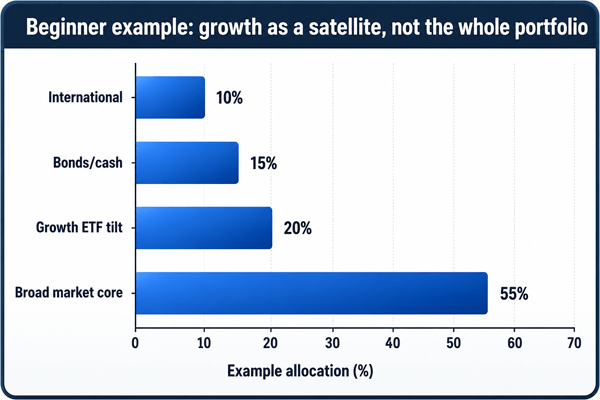
- 55% in a broad total U.S. stock market or S&P 500 ETF as the core.
- 20% in a broad growth ETF such as VUG, SCHG, or SPYG.
- 10% in international stocks for geographic diversification.
- 15% in bonds or cash depending on her risk tolerance and emergency-fund needs.
A younger investor with stable income may choose more stocks, while a retiree may need less growth exposure and more income stability.
6. A simple 7-step checklist before buying a growth ETF
6.1 Read the fund objective
Do not buy based on the name alone. Confirm whether the ETF tracks large-cap growth, Nasdaq-100, S&P 500 growth, technology, semiconductors, or an active innovation strategy.
6.2 Compare the expense ratio
For broad passive growth ETFs, lower is usually better when exposure is similar. A 0.03% fund costs about $3 per year per $10,000 invested, while a 0.75% fund costs about $75 per year per $10,000.
6.3 Check the top 10 holdings
If the top holdings are the same across funds, owning multiple ETFs may not add real diversification.
6.4 Look at sector concentration
Many growth ETFs are technology-heavy. Decide whether that is intentional or accidental.
6.5 Review valuation and volatility
High price-to-earnings ratios are common in growth funds. They can be justified by earnings growth, but they also increase disappointment risk.
6.6 Decide account type
A Roth IRA may be attractive for long-term growth if eligible. A taxable brokerage account offers flexibility but may involve taxes on dividends and sales.
6.7 Write your sell rule before buying
For example: rebalance once or twice a year, sell only if the fund changes strategy, or trim if growth exposure becomes too large.
6.8 Expense ratio example: why small fee differences matter
| ETF fee | Annual cost on $10,000 | Annual cost on $100,000 | Plain-English meaning |
|---|---|---|---|
| 0.03% | $3 | $30 | Very low-cost broad ETF level |
| 0.04% | $4 | $40 | Still extremely low |
| 0.15% | $15 | $150 | Reasonable for Nasdaq-100 exposure |
| 0.34% | $34 | $340 | Common for more specialized sector funds |
| 0.75% | $75 | $750 | High compared with passive index ETFs |
Fees are not the only factor, but they are one of the few things an investor can control. A higher-fee ETF must deliver enough extra value to justify the cost, and many active or thematic ETFs fail to do that consistently over long periods.
7. Biggest risks of growth ETFs
| Risk | What it means |
|---|---|
| Concentration risk | A growth ETF can own hundreds of stocks but still depend heavily on a few mega-cap companies. If those companies fall, the ETF can fall too. |
| Valuation risk | Growth stocks often trade at higher prices relative to earnings. If earnings growth slows, prices can adjust quickly. |
| Interest-rate sensitivity | Higher interest rates can hurt growth stocks because future profits become less valuable in today’s dollars. |
| Style cycles | Growth does not outperform value every year. There can be long periods when value, dividends, or small caps do better. |
| Thematic hype risk | AI, semiconductors, robotics, crypto-related equities, and innovation funds can attract investors after big gains. Buying after a dramatic run-up can lead to disappointment. |
| Behavior risk | The biggest mistake is not choosing the wrong ETF; it is buying high, panicking during a decline, and selling low. |
8. How to buy a growth ETF step by step
- Open a reputable brokerage account that offers ETF trading and clear fee disclosures.
- Search the ticker symbol, such as VUG, SCHG, QQQM, SPYG, IWF, VOOG, MGK, or VGT.
- Check the ETF name carefully so you do not buy the wrong security.
- Review the latest expense ratio, holdings, bid-ask spread, and prospectus.
- Choose a dollar amount or number of shares. Many brokers now allow fractional ETF shares.
- Use a limit order if the ETF is less liquid or if the bid-ask spread is wide.
- Track your allocation quarterly or semiannually, not every hour.
9. Three educational portfolio examples
| Profile | Example growth ETF use | Reasoning |
|---|---|---|
| Conservative beginner | 5%-10% growth ETF tilt | Keeps growth exposure modest while learning market volatility. |
| Long-term balanced investor | 10%-25% growth ETF tilt | Adds growth potential while broad-market ETFs remain the foundation. |
| Aggressive young investor | 25%-40% growth tilt, only if risk tolerance is high | Can work for a long horizon, but drawdowns may be uncomfortable. |
The best portfolio is the one a person can actually hold through bad markets. A theoretically perfect allocation is useless if it causes panic selling.
10. Where growth ETFs can fit: brokerage, Roth IRA, traditional IRA, and 401(k)
Growth ETFs can be used in taxable brokerage accounts, Roth IRAs, traditional IRAs, and some 401(k) plans if the platform offers them. In taxable accounts, ETFs are often tax-efficient compared with many mutual funds, but investors can still owe taxes when they sell at a gain or receive dividends. In retirement accounts, taxes depend on the account type and local rules.
| Account type | Why investors use it | Growth ETF consideration |
|---|---|---|
| Taxable brokerage | Flexible access to money | Watch capital gains taxes and avoid unnecessary trading. |
| Roth IRA | Potential tax-free qualified withdrawals | Useful for long-term growth if eligible. |
| Traditional IRA | Tax-deferred growth | Withdrawals are generally taxable later. |
| 401(k) | Payroll investing and possible employer match | ETF choices may be limited; index mutual funds may be similar. |
11. FAQ: Growth ETFs for beginners
11.1 Are growth ETFs good for beginners?
They can be, if the investor understands risk and uses them as part of a diversified plan. A broad growth ETF is usually easier for beginners than a narrow thematic ETF.
11.2 Is QQQM better than QQQ?
QQQM is designed for long-term Nasdaq-100 exposure and has a lower expense ratio than QQQ. QQQ may be more popular with active traders because of liquidity and options activity. Long-term investors often compare QQQM first.
11.3 Should I buy VUG and SCHG together?
Usually not necessary. They overlap heavily because both focus on U.S. large-cap growth. Owning both may make the portfolio look more diversified without changing the underlying exposure much.
11.4 What is the safest growth ETF?
No growth ETF is truly safe. Broad, low-cost funds such as VUG, SCHG, or SPYG are generally less risky than narrow sector or thematic funds, but they can still decline sharply.
11.5 How much of my portfolio should be in growth ETFs?
There is no universal number. Beginners often start small, such as 5%-20%, and increase only if they understand the volatility and already have a diversified core.
11.6 Do growth ETFs pay dividends?
Yes, many pay dividends, but yields are usually low because growth companies often reinvest profits instead of paying large dividends.
11.7 Can I lose money in a growth ETF?
Yes. Growth ETFs can fall during recessions, rising-rate periods, valuation resets, or tech sell-offs. Long-term investing reduces timing pressure but does not remove risk.
11.8 What is better: a growth ETF or an S&P 500 ETF?
An S&P 500 ETF is broader and often better as a core holding. A growth ETF is a tilt toward faster-growing companies. Many investors use both, with the S&P 500 or total market fund as the foundation.
12. Final verdict: best growth ETF choices in 2026
For a beginner who wants a simple long-term growth ETF, VUG, SCHG, and SPYG are the most practical starting points because they combine broad exposure with very low expense ratios. QQQM is a strong choice for investors who specifically want Nasdaq-100 growth exposure. IWF and VOOG are solid but should be compared against lower-cost alternatives. MGK and VGT can be useful for investors who intentionally want more concentration, but they are better treated as satellite positions.
The smartest approach is not to chase the ETF with the hottest recent return. It is to build a portfolio that can survive different market environments. Use low costs, diversification, clear goals, and patient behavior as your edge.
Sources Consulted and Checked
The following official fund pages and investor-education sources were consulted and checked while preparing this article and reviewing its accuracy. Fund data can change, so readers should verify current details directly with the fund sponsor and the latest prospectus.
| Source | URL |
|---|---|
| Vanguard Growth ETF (VUG) | https://investor.vanguard.com/investment-products/etfs/profile/vug |
| Schwab U.S. Large-Cap Growth ETF (SCHG) | https://www.schwabassetmanagement.com/products/schg |
| Invesco NASDAQ 100 ETF (QQQM) | https://www.invesco.com/us/en/financial-products/etfs/invesco-nasdaq-100-etf.html |
| SPDR Portfolio S&P 500 Growth ETF (SPYG) | https://www.ssga.com/us/en/intermediary/etfs/state-street-spdr-portfolio-sp-500-growth-etf-spyg |
| iShares Russell 1000 Growth ETF (IWF) | https://www.ishares.com/us/products/239706/ishares-russell-1000-growth-etf |
| Vanguard S&P 500 Growth ETF (VOOG) | https://investor.vanguard.com/investment-products/etfs/profile/voog |
| Vanguard Mega Cap Growth ETF (MGK) | https://advisors.vanguard.com/investments/products/mgk/vanguard-mega-cap-growth-etf |
| Vanguard Information Technology ETF (VGT) | https://investor.vanguard.com/investment-products/etfs/profile/vgt |
| SEC Investor.gov investing basics | https://www.investor.gov/introduction-investing/investing-basics |
| Kiplinger ETF coverage, 2026 context | https://www.kiplinger.com/investing/etfs/best-growth-etfs |
Reader Advice
This article is provided solely for educational and informational purposes. It does not constitute personalized investment, financial, tax, legal, or brokerage advice, and it does not guarantee returns or recommend any ETF for every investor. Any use of terms such as “best” or “to buy,” and any rankings, comparisons, or assessments of growth ETFs presented in this article, reflect the criteria, assumptions, and methodology used for this analysis and should not be interpreted as definitive rankings, personalized recommendations, or predictions of future performance. Other analyses using different criteria, assumptions, or methodologies may reach different conclusions.
Growth ETFs and the securities they hold can lose value, sometimes substantially. The portfolio allocations and examples in this article are illustrations only and should not be treated as model portfolios or recommendations for any particular investor. Expense ratios, holdings, prices, yields, tax rules, account eligibility requirements, regulations, and other facts may change over time or differ according to location and individual circumstances. Before making any decision, readers should assess their goals, time horizon, financial position, and risk tolerance; read the latest official fund page and prospectus; verify figures through current official sources; and consult appropriately qualified financial, tax, or legal professionals when personal guidance is needed.