Best Financial Stocks to Buy in 2026
Financial stocks are companies that help money move, grow, get insured, get invested, or get borrowed. A bank takes deposits and makes loans. An insurer prices risk. A payment network connects merchants, banks and consumers. An asset manager earns fees for managing money. A brokerage gives investors access to markets. These businesses can be powerful long-term investments because money is always moving through the economy.
But financial stocks are not all the same. A large bank can be sensitive to interest rates and credit losses. An insurer can benefit from higher investment income but can be hurt by storms and claims inflation. A payment network can grow even without lending money, but it can trade at a higher valuation. A beginner should not buy a stock only because it is famous, cheap, or mentioned online. The better approach is to understand how the company makes money, what can go wrong, and whether the valuation makes sense for your time horizon.
This guide focuses on 10 high-quality financial sector stocks for 2026. The list is built around business durability, scale, profitability, balance-sheet strength, beginner understandability, and practical portfolio use. It includes large banks, payment giants, insurers, asset managers and brokerage platforms so readers can compare different types of financial stocks instead of treating the whole sector as one single idea.
1. Quick Answer: The 10 Best Financial Stocks to Watch in 2026
| Rank | Stock | Ticker | Type | Why it stands out | Beginner fit |
|---|---|---|---|---|---|
| 1 | JPMorgan Chase | JPM | Mega-bank / diversified finance | Best all-around financial compounder | Core watchlist |
| 2 | Berkshire Hathaway | BRK.B | Insurance-led conglomerate | Best defensive financial holding | Core watchlist |
| 3 | Visa | V | Global payments network | Best cashless-payments toll road | Core watchlist |
| 4 | Mastercard | MA | Global payments network | Best premium growth payments stock | Core watchlist |
| 5 | BlackRock | BLK | Asset manager / ETFs | Best asset-management platform | Core watchlist |
| 6 | Morgan Stanley | MS | Wealth + investment banking | Best wealth-management/investment-banking mix | Satellite / value watchlist |
| 7 | Charles Schwab | SCHW | Brokerage / wealth platform | Best brokerage platform stock | Satellite / value watchlist |
| 8 | Chubb | CB | Property & casualty insurance | Best high-quality insurer | Satellite / value watchlist |
| 9 | Progressive | PGR | Auto and property insurance | Best insurance growth story | Satellite / value watchlist |
| 10 | Bank of America | BAC | Mega-bank | Best value-oriented big bank | Satellite / value watchlist |
Source note: Company filings and investor relations pages, plus market data snapshot from July 21, 2026 UTC.
2. What Is a Financial Stock?
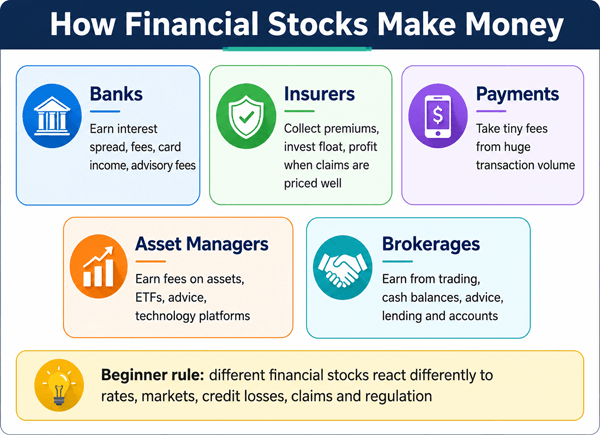
A financial stock is a share of a company whose main business is linked to money services. When you buy a financial stock, you are not buying a savings account or a bond. You are buying part ownership in a business that earns profit from financial activity.
For example, JPMorgan Chase earns from lending, credit cards, deposits, investment banking, asset management and payment processing. Visa and Mastercard do not usually lend to consumers directly; they run payment networks and collect fees as transactions move across their systems. Chubb and Progressive sell insurance and try to price policies so that premiums plus investment income exceed claims and expenses. BlackRock and Morgan Stanley earn fees from managing, advising and moving client assets. Schwab earns from brokerage accounts, client cash, advice and trading-related services.
This difference matters because the phrase 'financial stocks' covers many business models. A recession may hurt loan losses at banks. A strong travel market may help Mastercard cross-border volume. Rising stock markets may help BlackRock's fee base. Higher claim costs may hurt insurers if policy pricing lags. Beginners should always ask: what actually drives this company?
3. How Financial Stocks Work: The Beginner Framework
| Business model | How it makes money | Key metric | Main risk |
|---|---|---|---|
| Banks | Interest spread, deposit fees, card fees, investment banking | Net interest income, CET1 capital, loan losses | Recession, bad loans, deposit competition |
| Insurers | Premiums plus investment income minus claims | Combined ratio, premium growth, reserves | Catastrophes, inflation, underpricing |
| Payment networks | Tiny fee on very large transaction volume | Payment volume, cross-border volume, margins | Regulation, competition, valuation |
| Asset managers | Fees on assets under management | AUM, net inflows, fee rate | Market declines, fee pressure |
| Brokerages | Client cash, trading, advice, lending | Client assets, accounts, net interest revenue | Cash sorting, market slowdown |
Practical example: A beginner may think Visa and Bank of America are similar because both are financial stocks. They are not. Bank of America lends money and manages deposits. Visa mainly operates a payment network. That means Visa has less credit risk, while Bank of America is more exposed to interest-rate cycles and loan performance.
4. How I Chose These 10 Financial Stocks
The screen was not based on hype or short-term price targets. It focused on quality signals that matter to long-term investors: scale, recurring revenue, proven profitability, strong capital position, competitive advantage, shareholder returns, understandable risks, and 2026 relevance.
I also avoided making the article a simple list of the biggest banks. A useful financial stock portfolio should not depend on one business model. The final list includes banks, payment networks, insurers, asset managers, wealth platforms and a diversified conglomerate. That gives readers a better way to compare risk and opportunity.
The ranking is a research watchlist, not a command to buy immediately. A great company can still be a poor buy at the wrong price. Beginners should use this guide to build a shortlist, then check valuation, earnings trends, dividend policy, balance sheet, recent news and personal risk tolerance before investing.
5. Detailed Analysis: 10 Best Financial Stocks to Buy or Watch in 2026
5.1 JPMorgan Chase (JPM) - Best all-around financial compounder
Business type: Mega-bank / diversified finance. Market snapshot: Approx. price $331.48, market cap 917.4B, P/E 16.4 as of the June 22, 2026 UTC market-data snapshot. Main driver: Scale, deposits, cards, investment banking, asset management.
Why it belongs on the list: JPMorgan Chase is the most complete U.S. banking franchise in this guide. It combines consumer banking, credit cards, commercial banking, investment banking, trading, treasury services and asset management. That mix gives it more ways to earn money than a smaller regional bank.
How it works in plain English: Think of JPMorgan as a financial supermarket. Consumers deposit money, borrow, use cards and invest. Companies use it to raise capital, manage cash and handle payments. Wealth clients use it for advice and portfolios. When one activity slows, another may help offset it.
What beginners should watch: Watch deposit costs, credit-card losses, loan growth, investment-banking activity and capital ratios. If the economy weakens, loan losses can rise. If markets are active, trading and advisory fees can improve.
Best use in a portfolio: Core financial-sector holding for investors who want one high-quality bank rather than several smaller banks.
| Buy thesis | Beginner risk | Simple example |
|---|---|---|
| Best all-around financial compounder; scale, deposits, cards, investment banking, asset management | Credit cycle, regulation, lower investment-banking fees. | If loan losses stay controlled and markets remain active, multiple business lines can support earnings. |
5.2 Berkshire Hathaway (BRK.B) - Best defensive financial holding
Business type: Insurance-led conglomerate. Market snapshot: Approx. price $488.69, market cap 683.6B, P/E 14.3 as of the June 22, 2026 UTC market-data snapshot. Main driver: Insurance float, cash, operating businesses, equity portfolio.
Why it belongs on the list: Berkshire Hathaway is not a pure bank, but it is one of the most important financial holdings in the market because insurance float, cash management and capital allocation sit at the center of its model.
How it works in plain English: Berkshire owns insurers that collect premiums before claims are paid. That float can be invested. It also owns operating businesses and a large equity portfolio. The result is a diversified financial and industrial compounder.
What beginners should watch: Watch insurance underwriting, cash levels, buybacks, large acquisitions and leadership transition. Berkshire is usually less exciting than high-growth fintech names, but that is part of the appeal.
Best use in a portfolio: Defensive long-term financial holding for investors who want diversification and lower dependence on one banking cycle.
| Buy thesis | Beginner risk | Simple example |
|---|---|---|
| Best defensive financial holding; insurance float, cash, operating businesses, equity portfolio | Succession, limited dividend income, opportunity cost. | If insurance underwriting stays profitable, Berkshire can reinvest float and cash through many cycles. |
5.3 Visa (V) - Best cashless-payments toll road
Business type: Global payments network. Market snapshot: Approx. price $326.60, market cap 669.5B, P/E 19.0 as of the June 22, 2026 UTC market-data snapshot. Main driver: High-margin payment network with global acceptance.
Why it belongs on the list: Visa is a global payments network with enormous scale, strong margins and a business model tied to the long-term shift from cash to digital payments.
How it works in plain English: Visa does not need to own every card or lend every dollar. It connects banks, merchants and consumers, then earns fees when transactions move through its network.
What beginners should watch: Watch payments volume, cross-border volume, operating margin, regulation of payment fees and competition from alternative payment rails.
Best use in a portfolio: High-quality growth financial stock for investors who prefer transaction-fee economics over bank credit risk.
| Buy thesis | Beginner risk | Simple example |
|---|---|---|
| Best cashless-payments toll road; high-margin payment network with global acceptance | Regulatory fee pressure and premium valuation. | If more spending shifts from cash to cards/mobile wallets, Visa can grow without taking direct loan risk. |
5.4 Mastercard (MA) - Best premium growth payments stock
Business type: Global payments network. Market snapshot: Approx. price $484.09, market cap 432.3B, P/E 28.0 as of the June 22, 2026 UTC market-data snapshot. Main driver: Cross-border volume, switched transactions, digital payments.
Why it belongs on the list: Mastercard is similar to Visa but smaller, often with strong international and cross-border exposure. Its Q1 2026 release showed gross dollar volume growth and switched transaction growth, which are important operating drivers.
How it works in plain English: Every time a transaction is routed through the Mastercard network, the company earns a small fee. The power of the model is not the size of one transaction; it is the huge number of transactions worldwide.
What beginners should watch: Watch cross-border travel, consumer spending, currency impacts, rebates and incentives, and valuation. Mastercard can be an excellent business but may require patience if bought at a premium price.
Best use in a portfolio: Premium growth holding for investors who want global digital-payment exposure.
| Buy thesis | Beginner risk | Simple example |
|---|---|---|
| Best premium growth payments stock; cross-border volume, switched transactions, digital payments | Valuation, competition, cross-border sensitivity. | If global travel and online payments rise, Mastercard can benefit from cross-border and switched volume. |
5.5 BlackRock (BLK) - Best asset-management platform
Business type: Asset manager / ETFs. Market snapshot: Approx. price $1,051.74, market cap 157.4B, P/E 26.1 as of the June 22, 2026 UTC market-data snapshot. Main driver: iShares, Aladdin, ETFs, retirement and private markets.
Why it belongs on the list: BlackRock is the world-scale asset-management platform behind iShares ETFs and the Aladdin technology platform. Reuters reported that BlackRock reached record assets under management above $14 trillion for Q4 2025.
How it works in plain English: BlackRock earns fees for managing money. If clients add assets or markets rise, fee revenue can grow. If markets fall, assets under management and fees can decline.
What beginners should watch: Watch AUM, net inflows, ETF demand, fee pressure, private-market expansion and equity-market levels. Asset managers are linked to investor confidence.
Best use in a portfolio: Financial stock for investors who want exposure to long-term growth in ETFs, retirement assets and portfolio technology.
| Buy thesis | Beginner risk | Simple example |
|---|---|---|
| Best asset-management platform; ishares, aladdin, etfs, retirement and private markets | Market decline, fee compression, private-market execution. | If investors keep using ETFs and retirement products, BlackRock can collect fees on a growing asset base. |
5.6 Morgan Stanley (MS) - Best wealth-management/investment-banking mix
Business type: Wealth + investment banking. Market snapshot: Approx. price $227.09, market cap 357.9B, P/E 20.6 as of the June 22, 2026 UTC market-data snapshot. Main driver: Advice-led wealth franchise plus capital markets upside.
Why it belongs on the list: Morgan Stanley has transformed into a stronger wealth-management business while keeping upside from investment banking and trading. Its Q1 2026 release reported higher net revenues and net income versus the prior year period.
How it works in plain English: Morgan Stanley advises wealthy clients, manages assets, helps companies raise money, trades securities and supports workplace wealth programs. Wealth management can provide steadier fees than pure dealmaking.
What beginners should watch: Watch client assets, advisor productivity, investment-banking pipelines, trading revenue and expense discipline. The stock can be cyclical when deal activity slows.
Best use in a portfolio: Good fit for investors who want a mix of wealth-management stability and capital-markets upside.
| Buy thesis | Beginner risk | Simple example |
|---|---|---|
| Best wealth-management/investment-banking mix; advice-led wealth franchise plus capital markets upside | Capital-markets cyclicality and expense pressure. | If wealth assets grow and dealmaking improves, Morgan Stanley can benefit from both steady fees and cyclical revenue. |
5.7 Charles Schwab (SCHW) - Best brokerage platform stock
Business type: Brokerage / wealth platform. Market snapshot: Approx. price $92.03, market cap 161.2B, P/E 18.3 as of the June 22, 2026 UTC market-data snapshot. Main driver: Client assets, brokerage accounts, cash sweep recovery.
Why it belongs on the list: Charles Schwab is a leading brokerage and wealth platform. Its Q1 2026 release reported total client assets of $11.77 trillion and strong new account openings.
How it works in plain English: Schwab earns from client cash, brokerage accounts, advice, managed investing, margin lending and trading-related services. It benefits when more people invest and keep assets on the platform.
What beginners should watch: Watch client assets, net new assets, cash sorting, interest-rate sensitivity and brokerage account growth. When clients move idle cash to higher-yielding products, Schwab margins can be pressured.
Best use in a portfolio: Platform-style financial stock for investors who believe long-term retail investing participation will keep growing.
| Buy thesis | Beginner risk | Simple example |
|---|---|---|
| Best brokerage platform stock; client assets, brokerage accounts, cash sweep recovery | Cash sorting and rate sensitivity. | If clients keep opening accounts and rates normalize favorably, Schwab can rebuild earnings power. |
5.8 Chubb (CB) - Best high-quality insurer
Business type: Property & casualty insurance. Market snapshot: Approx. price $325.20, market cap 126.1B, P/E 11.5 as of the June 22, 2026 UTC market-data snapshot. Main driver: Underwriting discipline and investment income.
Why it belongs on the list: Chubb is a high-quality property and casualty insurer with a reputation for underwriting discipline. Its 2025 results highlighted strong P&C underwriting income and a record-low combined ratio.
How it works in plain English: Chubb collects premiums from individuals and businesses, pays claims, invests the float and tries to price risk better than competitors.
What beginners should watch: Watch combined ratio, premium growth, catastrophe losses, reserve development and investment income. A combined ratio below 100 generally means underwriting profit before investment income.
Best use in a portfolio: Quality insurance holding for investors who want financial exposure that is not directly a bank.
| Buy thesis | Beginner risk | Simple example |
|---|---|---|
| Best high-quality insurer; underwriting discipline and investment income | Catastrophe losses and reserve surprises. | If underwriting stays disciplined, Chubb can earn from both policy profits and investment income. |
5.9 Progressive (PGR) - Best insurance growth story
Business type: Auto and property insurance. Market snapshot: Approx. price $207.38, market cap 121.7B, P/E 10.5 as of the June 22, 2026 UTC market-data snapshot. Main driver: Pricing, telematics, policy growth, combined-ratio discipline.
Why it belongs on the list: Progressive is one of the strongest U.S. auto insurance businesses. Its 2025 annual report reported 14% growth in net premiums written and 37.4 million policies in force.
How it works in plain English: Progressive uses pricing, claims data, telematics and marketing to sell insurance policies profitably. The company aims to grow while keeping its combined ratio below its long-term target.
What beginners should watch: Watch policy growth, combined ratio, claims severity, auto repair inflation and advertising efficiency. Auto insurance can be profitable, but pricing mistakes show up quickly.
Best use in a portfolio: Growth-oriented insurance stock for investors comfortable with valuation swings and underwriting cycles.
| Buy thesis | Beginner risk | Simple example |
|---|---|---|
| Best insurance growth story; pricing, telematics, policy growth, combined-ratio discipline | Claims inflation and pricing mistakes. | If pricing remains accurate and policies grow, Progressive can compound premiums and earnings. |
5.10 Bank of America (BAC) - Best value-oriented big bank
Business type: Mega-bank. Market snapshot: Approx. price $57.37, market cap 425.5B, P/E 14.2 as of the June 22, 2026 UTC market-data snapshot. Main driver: Deposits, consumer banking, Merrill, rate sensitivity.
Why it belongs on the list: Bank of America is a massive consumer and commercial bank with Merrill wealth management and strong deposit relationships. Its Q1 2026 investor page reported $30.3 billion in revenue, $8.6 billion in net income and 16.0% return on tangible common equity.
How it works in plain English: Bank of America earns from deposits, loans, cards, Merrill wealth advice, trading and corporate banking. Because of its large deposit base, interest rates and deposit costs are especially important.
What beginners should watch: Watch net interest income, deposit beta, credit losses, expense control and capital returns. BAC may appeal more to value-oriented investors than investors seeking the highest-quality premium multiple.
Best use in a portfolio: Value-oriented big-bank exposure, best used after comparing valuation with JPMorgan and the broader bank sector.
| Buy thesis | Beginner risk | Simple example |
|---|---|---|
| Best value-oriented big bank; deposits, consumer banking, merrill, rate sensitivity | Rate sensitivity and credit losses. | If deposit costs stabilize and credit remains healthy, BAC can look attractive versus premium peers. |
6. Comparison Table: Which Financial Stock Fits Which Investor?
| Investor goal | Best candidates | Why | Main caution | Beginner takeaway |
|---|---|---|---|---|
| One core financial stock | JPM, BRK.B | Diversified and durable | Still exposed to cycles | Start with quality before chasing yield |
| Cashless payments growth | V, MA | Asset-light networks | Valuation and regulation | Great businesses can still be expensive |
| Insurance exposure | CB, PGR | Different from bank risk | Claims/catastrophe cycles | Use combined ratio as a key metric |
| Wealth and asset growth | BLK, MS, SCHW | Benefit from client assets and markets | Market declines reduce fees/assets | Good for long-term investing trends |
| Value big-bank idea | BAC | Large deposit base and lower P/E than some peers | Credit/rate sensitivity | Do not buy only because it looks cheap |
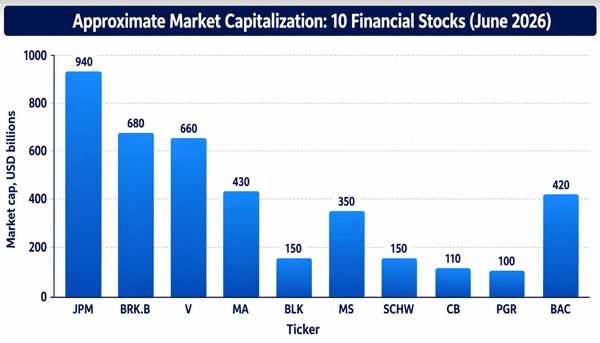
Source note: Approximate market caps from market-data snapshot as of July 21, 2026 UTC. Chart created for this article.
7. Beginner Checklist Before Buying Any Financial Stock
- Understand the business model: bank, insurer, payments, asset manager or brokerage.
- Check valuation: compare P/E, price-to-book for banks, and growth expectations.
- Read the latest quarterly release, not only the annual report.
- Look for risk concentration: loan losses, catastrophe exposure, market exposure or regulatory pressure.
- Compare the stock with an ETF such as a broad financial-sector ETF to decide whether single-stock risk is worth it.
- Decide position size before buying. Beginners should avoid putting too much money into one financial stock.
- Use a watchlist and buy gradually if valuation or market volatility is uncertain.
- Keep an emergency fund separate. Do not invest money needed for bills, rent, tuition or short-term obligations.
8. Practical Portfolio Examples
Example 1: A conservative beginner wants simple exposure to the financial sector. A possible watchlist could start with JPMorgan Chase, Berkshire Hathaway, Visa and Chubb. This mix includes banking, diversified insurance-led capital allocation, payments and underwriting. The goal is not maximum excitement; it is quality and business-model variety.
Example 2: A growth-focused investor wants financial stocks tied to digital transactions and investing participation. A possible watchlist could include Visa, Mastercard, BlackRock and Charles Schwab. The key risk is valuation: these businesses can be excellent but still underperform if bought when expectations are too high.
Example 3: A value-oriented investor wants bank exposure. A possible comparison is JPMorgan versus Bank of America. JPMorgan may deserve a quality premium because of its diversification and execution record, while Bank of America may look cheaper at times because it is more sensitive to rate and deposit cycles. The right choice depends on price, risk tolerance and the investor's view of the economy.
9. FAQ: Financial Stocks for Beginners
9.1 Are financial stocks good for beginners?
They can be, but beginners should start with simple, high-quality businesses and avoid highly leveraged or complex financial companies they do not understand.
9.2 Are bank stocks and financial stocks the same thing?
No. Banks are one part of the financial sector. Financial stocks also include insurers, payment networks, asset managers, exchanges, brokerage platforms and fintech companies.
9.3 What is the safest financial stock?
No stock is truly safe. Berkshire Hathaway, JPMorgan, Visa and Chubb may be easier for many beginners to understand because of scale and durable business models, but all can decline in price.
9.4 Do financial stocks pay dividends?
Many do, especially banks and insurers, but dividend yield should not be the only reason to buy. A high yield can signal risk if earnings or capital strength weaken.
9.5 Should I buy all 10 stocks?
Not necessarily. This article is a research list. Most beginners are better off choosing a few businesses they understand or using a diversified ETF.
9.6 What is the biggest mistake beginners make with financial stocks?
They buy based on low P/E or high dividend yield without checking credit risk, balance-sheet strength, rate sensitivity and business quality.
10. Final Verdict: Best Financial Stocks for 2026
The best financial stocks for 2026 are not only the cheapest or the most popular. They are businesses with clear earning power, strong competitive positions and risks that an investor can actually understand. JPMorgan Chase is the best all-around bank choice. Berkshire Hathaway is the strongest defensive financial holding. Visa and Mastercard are the premier payment-network stocks. BlackRock, Morgan Stanley and Charles Schwab give exposure to investing, advice and wealth platforms. Chubb and Progressive offer insurance quality and underwriting discipline. Bank of America gives value-oriented investors another large-bank option.
For most beginners, the smartest next step is to build a watchlist, read the latest earnings release for each company, compare valuations, and decide which business models match their goals. A good stock purchase begins before the buy button. It begins with understanding how the company earns money, what could hurt it, and what price you are willing to pay.
Sources Consulted and Checked
These sources were consulted and checked while preparing this document to support accuracy, clarity and factual verification. Market prices, valuation ratios, company results, regulations and other time-sensitive information may change after publication.
- JPMorgan Chase 2025 Annual Report / Investor Relations: https://www.jpmorganchase.com/ir/annual-report
- JPMorgan Chase FY 2025 Results: https://jpmorganchaseco.gcs-web.com/news-releases/news-release-details/jpmorganchase-reports-fourth-quarter-and-full-year-2025
- Berkshire Hathaway Annual and Interim Reports: https://www.berkshirehathaway.com/reports.html
- Visa Fiscal 2025 Annual Report: https://annualreport.visa.com/financials/default.aspx
- Mastercard Q1 2026 Earnings Release: https://s25.q4cdn.com/479285134/files/doc_financials/2026/q1/1Q26-Mastercard-Earnings-Release.pdf
- BlackRock Investor Relations / Annual Reports: https://ir.blackrock.com/financials/annual-reports-and-proxy/default.aspx
- Reuters: BlackRock AUM record in Q4 2025: https://www.reuters.com/business/blackrock-fourth-quarter-profit-rises-etf-inflows-index-fund-demand-2026-01-15/
- Morgan Stanley FY 2025 and Q1 2026 releases: https://www.morganstanley.com/press-releases/morgan-stanley-reports-fourth-quarter-and-full-year-2025
- Charles Schwab Q1 2026 Earnings Release: https://content.schwab.com/web/retail/public/about-schwab/schwab_q1_2026_earnings_release.pdf
- Chubb Q4/FY 2025 Results: https://news.chubb.com/2026-02-03-Chubb-Reports-Fourth-Quarter-Net-Income-of-3-21-Billion%2C-Up-24-7-%2C-and-Core-Operating-Income-of-2-98-Billion%2C-Up-21-7-Consolidated-Net-Premiums-Written-of-13-1-Billion%2C-Up-8-9-%2C-with-P-C-and-Life-Insurance-Up-7-7-and-16-9-Record-P-C-Combined-Ra
- Progressive 2025 Annual Report: https://s202.q4cdn.com/605347829/files/doc_financials/2025/q4/interactive/progressive-ir-25/pdfs/Progressive-2025-AR.pdf
- Bank of America Q1 2026 Financial Results: https://investor.bankofamerica.com/
- Market data snapshot from finance tool, June 22, 2026 UTC: Prices, market caps and P/E ratios used for comparison table
Reader Advice
This article is provided solely for educational and informational purposes and does not constitute personalized investment, financial, tax, accounting or legal advice. Investing in stocks involves risk, including the possible loss of principal. Financial-sector companies can be influenced by factors such as interest-rate changes, credit conditions, loan performance, economic cycles, capital requirements and evolving financial regulations, so these are helpful considerations to keep in mind when researching the stocks discussed.
Before making any decision, readers should conduct independent research, review the latest company filings and official announcements, compare current valuations, and consider their financial circumstances, objectives, time horizon and risk tolerance. Rules, regulations, tax treatment, market conditions, prices, earnings figures and other facts may change because of economic, legal, regulatory, company-specific or market developments. Readers should therefore verify all material facts and figures through current official sources and consult an appropriately licensed professional when needed.