10 Best REIT Stocks to Buy in 2026
1. What Is a REIT?
A REIT, or real estate investment trust, is a company that owns, operates or finances income-producing real estate. Instead of buying an apartment building, warehouse, cell tower or data center yourself, you can buy shares of a publicly traded REIT through a brokerage account. You then participate in the economics of the real estate portfolio: rent collected from tenants, property expenses, financing costs, acquisitions, development and dividends.
The simple appeal is access. A beginner with a small amount of money can own a tiny slice of thousands of buildings. A REIT also avoids the practical problems of being a landlord: finding tenants, repairing roofs, handling leases, negotiating financing and selling properties. The trade-off is that REIT shares trade on the stock market, so their price can rise or fall every day even when the buildings are still occupied.
2. How REITs Work in Plain English
Think of a REIT like a professionally managed real estate business wrapped inside a stock. The REIT raises money from shareholders and lenders, buys or builds properties, signs leases with tenants, collects rent, pays operating expenses and interest, and distributes a large portion of taxable income to shareholders. To qualify as a REIT, a company generally must distribute at least 90% of taxable income to shareholders each year, which is why many REITs are known for dividends [1][2].
However, “90% of taxable income” does not mean every REIT dividend is automatically safe. Taxable income is not the same as cash flow. Real estate depreciation can reduce taxable income, while debt maturities, interest rates and capital expenditures can still pressure cash. This is why serious REIT investors look at FFO and AFFO, not only net income.
| Term | Meaning for beginners | Why it matters |
|---|---|---|
| FFO | Funds from operations. A common REIT cash-flow measure that adds back real estate depreciation and adjusts property gains/losses. | Net income can make real estate look less profitable because buildings are depreciated for accounting purposes. |
| AFFO | Adjusted funds from operations. Often closer to recurring cash flow after maintenance-type adjustments. | Useful for judging whether the dividend is covered by cash flow. |
| NOI | Net operating income from properties before corporate overhead and financing. | Shows whether the real estate itself is performing. |
| Occupancy | Percentage of space leased or occupied. | Lower occupancy usually means weaker rent collection and pricing power. |
| Net lease | Tenant pays many property costs such as taxes, insurance and maintenance. | Can make cash flow steadier and easier to forecast. |
| Payout ratio | Dividend divided by FFO or AFFO. | A lower ratio can mean more safety and room to reinvest. |
3. Why REITs May Matter in 2026
REITs enter 2026 with a mixed setup. Higher interest rates have hurt many real estate valuations, but some sectors still have powerful demand drivers: AI and cloud computing need data centers, mobile traffic needs towers, e-commerce needs logistics space, aging populations need senior housing, and consumers still visit high-quality retail destinations. The opportunity is not “buy any REIT.” The opportunity is to choose real estate sectors with durable tenants, manageable debt and clear cash-flow visibility.
Beginner investors should also understand that REITs can underperform when rates rise quickly. Higher bond yields can make REIT dividends look less attractive. Higher borrowing costs can reduce acquisition spreads. Property values can fall when cap rates rise. This is why 2026 REIT investing should focus on balance sheet quality and dividend coverage, not yield chasing.
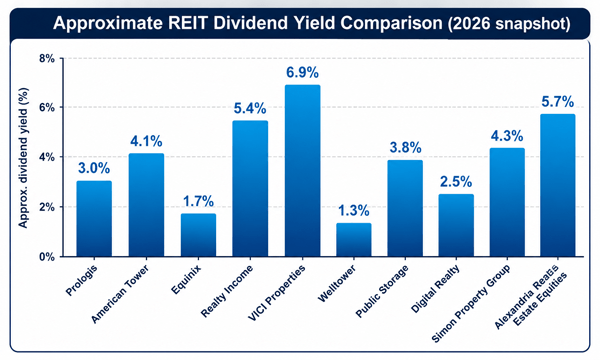
4. Comparison Table: 10 Best REIT Stocks to Buy or Watch in 2026
| REIT | Ticker | Sector | Price* | Market cap* | Approx. yield | Key 2026 metric | Best for |
|---|---|---|---|---|---|---|---|
| Prologis | PLD | Industrial/logistics | 143.83 | 137.7B | 3.05% | Core FFO guidance $6.07-$6.23/share | Best for investors who want e-commerce and supply-chain real estate exposure. |
| American Tower | AMT | Cell towers/digital infrastructure | 176.43 | 82.8B | ~4.1% | Q1 revenue +6.8%; AFFO attributable +2.6% | Best for investors who want mobile data, 5G, cloud and AI infrastructure exposure. |
| Equinix | EQIX | Data centers | 1,115.94 | 110.2B | ~1.7% | 2026 AFFO outlook $4.198-$4.278B | Best for investors who want premium data-center exposure and can accept valuation risk. |
| Realty Income | O | Net lease retail/industrial | 60.58 | 56.6B | ~5.4% | Annualized dividend $3.246/share; Q1 AFFO/share $1.13 | Best for investors who want monthly dividends and broad tenant diversification. |
| VICI Properties | VICI | Gaming/experiential net lease | 26.09 | 27.9B | ~6.9% | 2026 AFFO guidance $2.44-$2.47/share | Best for investors who want high income from contractual rent but understand tenant concentration. |
| Welltower | WELL | Senior housing/health care | 211.45 | 153.6B | ~1.3% | Senior-housing demand and 2026 growth tied to aging population | Best for investors who want health-care real estate growth, not just high yield. |
| Public Storage | PSA | Self-storage | 320.22 | 56.3B | ~3.8% | Q1 Core FFO/share $4.22; 2026 Core FFO guidance $16.35-$17.00 | Best for investors who want storage exposure with operational scale. |
| Digital Realty | DLR | Data centers | 195.54 | 69.1B | ~2.5% | 2026 Core FFO/share outlook $8.00-$8.10 | Best for investors who want AI infrastructure growth with more yield than EQIX. |
| Simon Property Group | SPG | Malls/outlets | 214.57 | 69.6B | ~4.3% | Q1 Real Estate FFO/share $3.17; occupancy 96.0% | Best for investors who believe high-quality retail real estate remains resilient. |
| Alexandria Real Estate Equities | ARE | Life-science labs/offices | 50.73 | 8.8B | ~5.7%-6.2% | Q1 FFO/share adjusted $1.73; 2026 midpoint $6.40 | Best for investors who can tolerate office/lab-cycle risk and want turnaround upside. |
* Prices and market caps are a June 2026 market-data snapshot. Yields are approximate and should be checked again before investing.
4.1 PLD: Prologis - Industrial/logistics
Prologis is one of the clearest ways to invest in logistics real estate. Its warehouses sit near major cities, ports and transportation routes, serving companies that need fast delivery and efficient supply chains.
The practical beginner point: Prologis is more of a quality growth REIT than a maximum-yield REIT. You buy it because logistics real estate is hard to replicate in the best locations, not because it offers the biggest dividend today.
What to check before buying: leasing spreads, occupancy, development pipeline, debt maturities, and whether the stock price already reflects optimistic growth. Prologis reported 2026 Core FFO guidance of $6.07-$6.23 per share in Q1 2026 [3].
| What to like | What to watch | Simple beginner verdict |
|---|---|---|
| Global warehouses near population centers | Core FFO guidance $6.07-$6.23/share | Best for investors who want e-commerce and supply-chain real estate exposure. |
4.2 O: Realty Income - Net lease retail/industrial
Realty Income is known as a monthly dividend REIT. It owns a large portfolio of single-tenant properties, often leased under net leases where tenants pay many property-level expenses.
For beginners, Realty Income is easy to understand: many leases, many tenants, monthly dividend checks and a long dividend-growth history. Its Q1 2026 supplemental report showed an annualized dividend of $3.246 per share as of March 31, 2026 and Q1 diluted AFFO per share of $1.13 [4].
The risk is that a safe-looking dividend can still be hurt by higher interest rates, tenant bankruptcies, slow acquisition spreads or overpaying for growth. Use it as an income anchor, not as a substitute for a diversified portfolio.
| What to like | What to watch | Simple beginner verdict |
|---|---|---|
| Long leases with tenants paying taxes, insurance and maintenance | Annualized dividend $3.246/share; Q1 AFFO/share $1.13 | Best for investors who want monthly dividends and broad tenant diversification. |
4.3 VICI: VICI Properties - Gaming/experiential net lease
VICI owns experiential real estate, especially casino and resort properties. Many of its leases are long-term triple-net leases, which can make rental cash flows predictable.
The attractive part is income. VICI declared quarterly dividends of $0.45 per share in 2026 and raised 2026 AFFO guidance to $2.44-$2.47 per diluted share [5]. At the June 2026 snapshot price, that implies a high yield relative to many large REITs.
The caution is tenant and sector concentration. Casino real estate can be profitable, but investors should understand exposure to major operators, travel demand, regional gaming conditions and debt financing.
| What to like | What to watch | Simple beginner verdict |
|---|---|---|
| Casino and hospitality properties under long-term leases | 2026 AFFO guidance $2.44-$2.47/share | Best for investors who want high income from contractual rent but understand tenant concentration. |
4.4 WELL: Welltower - Senior housing/health care
Welltower focuses on senior housing and wellness housing. The broad thesis is simple: as populations age, demand for senior living and health-related real estate can grow.
This is not a classic high-yield REIT. It is more of a demographic growth REIT. Welltower describes itself as focused on rental housing for aging seniors across the U.S., U.K. and Canada, with 2,500+ seniors and wellness housing communities [6].
The main beginner risk is valuation. Great themes can become poor investments if bought at too high a price. Watch same-store NOI, occupancy, development costs, operator quality and whether growth expectations are already priced in.
| What to like | What to watch | Simple beginner verdict |
|---|---|---|
| Senior housing and wellness housing in US, UK and Canada | Senior-housing demand and 2026 growth tied to aging population | Best for investors who want health-care real estate growth, not just high yield. |
4.5 EQIX: Equinix - Data centers
Equinix is a premium data-center REIT. It operates highly connected facilities where enterprises, cloud providers and networks meet.
For 2026, the growth story is tied to cloud, AI, interconnection and digital infrastructure. Equinix raised its full-year 2026 AFFO outlook to $4.198-$4.278 billion after Q1 [7].
The trade-off is valuation and capital intensity. Data centers can have powerful demand, but they require huge capital spending, power access and disciplined execution. For beginners, EQIX may fit the growth sleeve rather than the income sleeve.
| What to like | What to watch | Simple beginner verdict |
|---|---|---|
| Carrier-neutral data centers and interconnection | 2026 AFFO outlook $4.198-$4.278B | Best for investors who want premium data-center exposure and can accept valuation risk. |
4.6 DLR: Digital Realty - Data centers
Digital Realty is another large data-center REIT, with exposure to hyperscale cloud, enterprise and AI infrastructure demand.
Digital Realty reported Q1 2026 Core FFO per share of $2.04 and raised its 2026 Core FFO outlook to $8.00-$8.10 per share [8]. That makes it a direct way to invest in data-center demand with a more visible dividend profile than some pure growth tech names.
Risks include power availability, construction costs, customer concentration, competition, high capex and the lag between signing leases and collecting rent.
| What to like | What to watch | Simple beginner verdict |
|---|---|---|
| Large-scale data centers for cloud, enterprise and AI workloads | 2026 Core FFO/share outlook $8.00-$8.10 | Best for investors who want AI infrastructure growth with more yield than EQIX. |
4.7 AMT: American Tower - Cell towers/digital infrastructure
American Tower owns communications infrastructure, especially towers that wireless carriers use to support mobile networks. The long-term story is rising data consumption, 5G networks and connectivity demand.
In Q1 2026, American Tower reported total revenue growth of 6.8%, total property revenue growth of 7.3%, and AFFO attributable to common stockholders growth of 2.6% [9].
Beginners should watch tenant concentration among large telecom carriers, interest expense, international currency exposure and whether the company is improving leverage and dividend growth.
| What to like | What to watch | Simple beginner verdict |
|---|---|---|
| Towers and data infrastructure leased to wireless carriers | Q1 revenue +6.8%; AFFO attributable +2.6% | Best for investors who want mobile data, 5G, cloud and AI infrastructure exposure. |
4.8 PSA: Public Storage - Self-storage
Public Storage is a self-storage REIT with a large U.S. footprint and strong brand recognition. Self-storage can be resilient because people use it during moves, downsizing, life changes and business transitions.
Public Storage reported Q1 2026 Core FFO per share of $4.22, up 2.4% year over year, and reaffirmed 2026 Core FFO per share guidance of $16.35-$17.00 [10].
The risk is that storage pricing can soften when move-in rates fall or supply increases. The pending acquisition of National Storage Affiliates also adds integration and execution questions.
| What to like | What to watch | Simple beginner verdict |
|---|---|---|
| Self-storage facilities with strong brand and scale | Q1 Core FFO/share $4.22; 2026 Core FFO guidance $16.35-$17.00 | Best for investors who want storage exposure with operational scale. |
4.9 SPG: Simon Property Group - Malls/outlets
Simon Property Group owns high-quality malls, premium outlets and mixed-use retail properties. It is a reminder that “retail REIT” does not automatically mean bad real estate.
In Q1 2026, Simon reported Real Estate FFO of $3.17 per diluted share, up from $2.95 a year earlier. Occupancy was 96.0%, and base minimum rent per square foot rose 5.2% [11].
The practical risk is consumer weakness and retail bankruptcies. Simon can perform better than weaker mall owners because it owns stronger assets, but it is still tied to retail traffic, tenant sales and discretionary spending.
| What to like | What to watch | Simple beginner verdict |
|---|---|---|
| Class A malls, premium outlets and mixed-use retail | Q1 Real Estate FFO/share $3.17; occupancy 96.0% | Best for investors who believe high-quality retail real estate remains resilient. |
4.10 ARE: Alexandria Real Estate Equities - Life-science labs/offices
Alexandria owns life-science laboratory and innovation campuses. It serves biotech, pharma and research tenants, but the stock has been pressured by concerns around office/lab demand and higher rates.
Alexandria reported a Q1 2026 adjusted FFO per share of $1.73, a quarterly dividend of $0.72 per share, and a 6.2% dividend yield as of March 31, 2026 [12].
This is the most contrarian pick on the list. It may appeal to income investors seeking potential recovery, but beginners should be careful: life-science real estate can be cyclical, tenant funding can weaken, and a low valuation may reflect real risk.
| What to like | What to watch | Simple beginner verdict |
|---|---|---|
| Lab and innovation campuses for biotech and pharma tenants | Q1 FFO/share adjusted $1.73; 2026 midpoint $6.40 | Best for investors who can tolerate office/lab-cycle risk and want turnaround upside. |
5. How Beginners Should Choose a REIT
- Start with the property type. A warehouse REIT, cell-tower REIT, data-center REIT and mall REIT can behave very differently. Do not assume all real estate is the same.
- Next, check the dividend coverage. A 7% yield with weak AFFO coverage can be more dangerous than a 3% yield with strong growth. Look for payout ratio, AFFO trend, debt maturities, credit rating, occupancy and lease duration.
- Finally, compare valuation to growth. A great company can be a poor investment if the price is too high. A cheap REIT can also stay cheap if its properties are losing demand. The goal is not perfection; it is a fair price for durable cash flow.
6. Practical Example: How a Beginner Might Build a REIT Basket
Example only: A beginner who wants REIT exposure could build a small basket instead of betting on one stock. For example, 25% Realty Income for monthly income, 20% Prologis for logistics growth, 15% Digital Realty or Equinix for data centers, 15% Welltower for senior housing, 10% Public Storage for defensiveness, 10% VICI for higher yield and 5% Alexandria as a higher-risk recovery position.
This example is not a recommendation. It shows the thought process: combine different property sectors so one bad area does not dominate the whole portfolio.
7. REITs vs Rental Property vs Real Estate ETFs
REIT stocks are liquid, diversified and easy to buy, but their prices move with the stock market. Rental property gives more control and possible leverage benefits, but it requires large capital, local knowledge and hands-on management. REIT ETFs reduce single-stock risk, but they also include weaker REITs and may dilute your best ideas.
For many beginners, a REIT ETF can be the simplest starting point. Individual REIT stocks make more sense when you are willing to read filings, compare sectors and monitor dividend coverage.
8. Common Beginner Mistakes to Avoid
- Do not chase the highest dividend yield. A very high yield may mean the market expects a dividend cut or weaker growth.
- Do not ignore debt. REITs use leverage, and refinancing risk matters when rates are high.
- Do not compare REIT P/E ratios like normal companies. Use FFO or AFFO multiples because depreciation distorts net income.
- Do not buy only one property sector. A portfolio of only office REITs, mall REITs or data-center REITs is not diversified.
- Do not forget taxes. REIT dividends are often taxed differently from qualified dividends. Ask a qualified tax professional for personal tax guidance.
9. Best REIT Stocks by Investor Type
For monthly income: Realty Income. For high yield: VICI Properties or Alexandria, with extra risk review. For AI and cloud infrastructure: Equinix and Digital Realty. For 5G and mobile data: American Tower. For demographic growth: Welltower. For defensive real estate: Public Storage. For retail value: Simon Property Group. For logistics growth: Prologis.
The best choice depends on your goal. Income investors often care about dividend safety and payout ratio. Growth investors care more about same-store NOI, development returns and long-term demand. Conservative investors should care most about debt, occupancy and tenant quality.
10. Final Takeaway
The best REIT stocks to buy in 2026 are not magic passive-income machines. They are real businesses that own real assets, borrow real money and serve real tenants. The strongest REIT investors think like property owners, not lottery-ticket buyers.
A beginner can start by learning three questions: What real estate does this REIT own? Is the dividend covered by recurring cash flow? Is the balance sheet strong enough to survive a difficult market? If you can answer those questions, you are already ahead of many yield chasers.
11. Frequently Asked Questions
11.1 Are REITs good for beginners?
Yes, they can be, because they provide easy access to real estate. But beginners should start small, diversify, and learn FFO, AFFO, debt and payout ratios.
11.2 Can you lose money in REITs?
Yes. REIT share prices can fall, dividends can be cut, property values can decline, and debt refinancing can become more expensive.
11.3 Which REIT pays monthly dividends?
Realty Income is one of the best-known monthly dividend REITs.
11.4 Are REIT dividends guaranteed?
No. REIT dividends are paid at the board’s discretion and depend on cash flow, taxable income, leverage and capital needs.
11.5 Should I buy REIT stocks or a REIT ETF?
A REIT ETF is simpler and more diversified. Individual REITs may offer better targeted exposure but require more research.
11.6 What is the safest REIT sector?
No sector is perfectly safe. Net lease, self-storage and some health-care REITs can be defensive, while data centers and logistics may offer growth. Safety depends on balance sheet and valuation, not sector alone.
11.7 How many REITs should a beginner own?
Many beginners are better served by a REIT ETF or a basket of 5 to 10 REITs across different property types rather than one concentrated pick.
Sources Consulted and Checked
The following sources were consulted and checked while preparing this article to support accuracy and provide readers with primary or authoritative reference points.
[1] Nareit - How to Form a REIT / REIT qualification and 90% distribution rule: https://www.reit.com/what-reit/how-form-reit
[2] SEC Investor Bulletin: Real Estate Investment Trusts (REITs): https://www.sec.gov/files/reits.pdf
[3] Prologis Q1 2026 Results: https://ir.prologis.com/press-releases/detail/1036/prologis-reports-first-quarter-2026-results
[4] Realty Income Q1 2026 Supplemental Report: https://www.realtyincome.com/sites/realty-income/files/2026-05/Q1-2026-supplemental-report-final-v2.pdf
[5] VICI Properties Q1 2026 Results: https://investors.viciproperties.com/news-releases/news-release-details/vici-properties-inc-announces-first-quarter-2026-results
[6] Welltower company overview: https://welltower.com/
[7] Equinix Q1 2026 Results: https://newsroom.equinix.com/2026-04-29-Equinix-Reports-First-Quarter-Results-and-Raises-Full-Year-Financial-Outlook
[8] Digital Realty Q1 2026 Results: https://investor.digitalrealty.com/news-releases/news-release-details/digital-realty-reports-first-quarter-2026-results
[9] American Tower Q1 2026 Results: https://www.businesswire.com/news/home/20260428668321/en/American-Tower-Corporation-Reports-First-Quarter-2026-Financial-Results
[10] Public Storage Q1 2026 Results: https://s1.q4cdn.com/588671402/files/doc_financials/2026/q1/20260427-Public-Storage-Reports-Results-for-the-First-Quarter-ended-March-31-2026-FINAL.pdf
[11] Simon Property Group Q1 2026 Results: https://www.prnewswire.com/news-releases/simon-reports-first-quarter-2026-results-increases-full-year-2026-real-estate-ffo-per-share-guidance-and-raises-quarterly-dividend-302768514.html
[12] Alexandria Real Estate Equities Q1 2026 Results: https://www.prnewswire.com/news-releases/alexandria-real-estate-equities-inc-reports-1q26-net-income-per-share--diluted-of-2-10-and-1q26-ffo-per-share--diluted-as-adjusted-of-1-73--302754543.html
Reader Advice
This article is provided solely for educational and informational purposes. It does not constitute personalized financial, investment, tax, legal or accounting advice, and it is not a recommendation or solicitation to buy, sell or hold any security. REIT prices, dividend yields, distributions, company guidance, tax treatment, laws, regulations and market conditions may change at any time. REIT performance can also be influenced by interest rates, property values, occupancy levels, rental income, financing costs and conditions in specific real estate sectors, so readers may find it helpful to consider the latest company and property-market information as part of their own research.
Before making a decision, readers should verify all facts, figures, filings and current disclosures through official company investor-relations pages, regulatory filings and other authoritative sources. Consider personal objectives, risk tolerance, time horizon, diversification needs and tax circumstances, and seek advice from appropriately qualified professionals where necessary. Past performance and historical distributions do not guarantee future results, and investing can involve loss of principal.