10 Best Energy Stocks to Buy in 2026
1. What Are Energy Stocks?
Energy stocks are shares of companies that help produce, transport, sell, or enable energy. That can mean oil and natural gas producers, pipeline companies, LNG exporters, oilfield-service firms, electric utilities, solar manufacturers, and renewable-power owners. In plain English, an energy stock is a way to invest in the businesses that keep homes, cars, factories, data centers, and economies running.
The sector is not one single bet. Exxon Mobil and Chevron are different from First Solar. Enbridge is different from SLB. A beginner should avoid treating all energy stocks as the same because each business model reacts differently to oil prices, gas demand, interest rates, regulation, and electricity growth.
1.1 How Energy Stocks Work
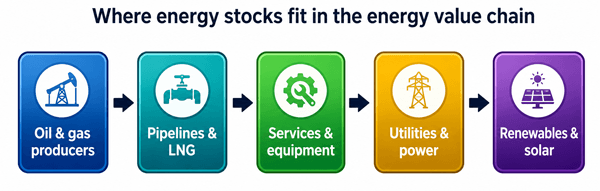
Energy companies generally make money in one of five ways:
- Selling oil, natural gas, or refined products. These companies benefit when commodity prices and production volumes are strong.
- Moving energy through pipelines, terminals, and export facilities. These businesses often earn fee-like revenue, but they still face volume, debt, and regulatory risk.
- Providing drilling, technology, and field services. Their revenue usually improves when producers increase spending.
- Generating and selling electricity. Utilities and power companies can be steadier, but interest rates and regulation matter a lot.
- Building clean-energy equipment or owning renewable assets. These companies benefit from electrification, solar demand, storage, and long-term power contracts, but they can be sensitive to policy and financing costs.
2. Why Energy Stocks Matter in 2026
The 2026 energy market has two competing stories. The first is traditional energy: oil, natural gas, refining, LNG exports, and shareholder returns. The second is electrification: data centers, artificial intelligence, EVs, grid expansion, renewables, batteries, and reliable power. A strong article should explain both, because the best energy stocks for 2026 are not only oil stocks; they also include power, LNG, pipelines, and renewable energy exposure.
The U.S. Energy Information Administration said in its Short-Term Energy Outlook that it expected global oil consumption to decrease by 1.1 million barrels per day over 2026 compared with 2025, showing why investors should not blindly assume oil demand always rises. At the same time, the International Energy Agency has highlighted that renewables and natural gas are expected to be major sources for meeting data-center electricity demand. BloombergNEF also described a longer-term electricity-led energy era driven by EVs, data centers, and electrification.
A practical takeaway: Beginners should build an energy watchlist that is diversified across oil, gas, LNG, pipelines, services, utilities, and renewables. That gives the portfolio more ways to benefit if one energy theme slows while another improves.
3. How Beginners Should Judge Energy Stocks
| What to check | Why it matters | Simple beginner rule |
|---|---|---|
| Balance sheet | Energy downturns can be brutal. Debt-heavy companies can struggle when prices fall. | Prefer companies that can fund dividends and projects without depending on perfect commodity prices. |
| Free cash flow | Free cash flow pays dividends, buybacks, debt reduction, and new projects. | Look for consistent free cash flow over a full commodity cycle, not one lucky year. |
| Dividend quality | High yield can be attractive, but an unsafe payout can be a trap. | Ask: is the payout covered by cash flow after capital spending? |
| Commodity exposure | Oil and gas producers move with prices more than pipelines or utilities. | Know whether you are buying a cyclical producer or a steadier infrastructure business. |
| Growth runway | LNG, data-center power, renewables, and grid investment can create multi-year growth. | Prefer growth that is backed by contracts, assets, or proven demand. |
| Valuation | Even a great company can be a poor investment if bought at an expensive price. | Compare P/E, cash flow yield, dividend yield, debt, and history before buying. |
| Policy and climate risk | Energy rules, emissions policy, permitting, and tariffs can change returns. | Do not rely on one political outcome. |
4. Quick Comparison: 10 Energy Stocks to Research in 2026
| Company | Ticker | Recent price | Market cap | P/E | Main exposure | Why it is on the 2026 watchlist |
|---|---|---|---|---|---|---|
| Exxon Mobil | XOM | $138.47 | $574.0B | 23.3 | Integrated oil & gas | Scale, cash flow, dividend history, Guyana and Permian exposure |
| Chevron | CVX | $175.06 | $347.7B | 30.5 | Integrated oil & gas | Dividend, Permian, LNG, and emerging data-center power angle |
| ConocoPhillips | COP | $109.70 | $134.4B | 18.6 | Oil & gas E&P | Large upstream portfolio with shareholder-return focus |
| EOG Resources | EOG | $132.83 | $71.1B | 13.1 | Oil & gas E&P | Disciplined shale operator with strong cost focus |
| SLB | SLB | $47.95 | $72.6B | 21.1 | Oilfield services | Global service and technology exposure to producer spending |
| Cheniere Energy | LNG | $230.85 | $48.6B | 39.1 | LNG export | U.S. LNG export leader with long-term contract exposure |
| Enbridge | ENB | $54.80 | $119.7B | 25.1 | Pipelines & utility-like assets | Income-focused pipeline and infrastructure exposure |
| NextEra Energy | NEE | $86.08 | $179.5B | 21.8 | Utility & renewables | Regulated utility plus major renewable-development platform |
| Shell | SHEL | $79.66 | $508.8B | N/A | Integrated global energy | Global LNG, upstream, trading, and shareholder returns |
| First Solar | FSLR | $263.11 | $28.3B | 17.0 | Solar manufacturing | U.S.-focused solar manufacturing and clean-energy growth |
Market data note: Prices, market capitalizations, and P/E ratios are recent figures retrieved on June 23, 2026, and can change quickly. Investors should verify live data before acting.
5. The 10 Best Energy Stocks to Research in 2026
5.1 Exxon Mobil (XOM)
Best for: beginners who want a large, diversified oil and gas leader.
Exxon Mobil is one of the biggest energy companies in the world. It produces oil and gas, runs refining and chemical operations, and has large long-life projects. For a beginner, the appeal is simple: Exxon is not a tiny speculative oil stock. It has scale, a global asset base, and a long history of returning cash to shareholders.
- Why it could work in 2026: Exxon gives exposure to oil, natural gas, refining, chemicals, Guyana growth, and the Permian Basin. If energy prices stay healthy, its cash flow can support dividends, buybacks, and investment in future projects. It is also a useful core holding for investors who want energy exposure without betting everything on one niche.
- What to watch: Exxon is still sensitive to oil and gas prices. If crude prices fall sharply or refining margins weaken, earnings can drop. Beginners should also watch capital spending, debt levels, and whether the company is buying back shares at sensible valuations.
- Practical example: An investor building a $1,000 educational energy basket might use Exxon as the stable “anchor” position rather than as the only holding. That reduces the temptation to chase smaller, riskier oil names.
5.2 Chevron (CVX)
Best for: dividend-focused investors who still want large-cap oil and gas exposure.
Chevron is another integrated energy major. It has oil and gas production, refining, LNG exposure, and a shareholder-return culture. Beginners often compare Chevron with Exxon because both are blue-chip energy stocks, but Chevron can be more concentrated in certain upstream assets and major projects.
- Why it could work in 2026: Chevron offers exposure to the Permian Basin, LNG, global upstream projects, and dividends. A newer angle is power for data centers: reports in June 2026 said Chevron agreed to supply power for a Microsoft AI data-center project in West Texas, showing how natural gas may become tied to artificial-intelligence electricity demand.
- What to watch: Chevron can be affected by project delays, commodity prices, regulatory approvals, and major acquisition integration. Its valuation should be compared with expected free cash flow, not just dividend yield.
- Practical example: A beginner who wants income might compare Chevron’s yield, payout ratio, and balance sheet with Exxon instead of simply buying whichever stock has the higher current yield.
5.3 ConocoPhillips (COP)
Best for: investors who want focused oil and gas production rather than refining or chemicals.
ConocoPhillips is a major exploration and production company. Unlike integrated majors, it is more directly tied to upstream oil and gas production. That can make it more leveraged to commodity cycles, but it can also be attractive when oil and gas fundamentals are favorable.
- Why it could work in 2026: ConocoPhillips has scale, a broad resource base, and a reputation for returning cash when conditions allow. It can benefit from disciplined capital spending and higher production efficiency.
- What to watch: Because it is more upstream-focused, weaker oil or gas prices can hit earnings harder. Beginners should track production costs, reserve quality, shareholder distributions, and management’s capital discipline.
- Practical example: If an investor already owns Exxon or Chevron, ConocoPhillips can add more direct producer exposure, but it should not be mistaken for a defensive utility-like stock.
5.4 EOG Resources (EOG)
Best for: investors looking for a disciplined U.S. shale producer.
EOG Resources is known for operational discipline and high-quality U.S. shale assets. It is not the biggest name in energy, but many investors follow it because of its focus on costs, returns, and production quality.
- Why it could work in 2026: EOG may appeal if oil prices remain supportive and if disciplined shale development remains rewarded by the market. Its lower P/E compared with some larger peers can make it worth researching for value-oriented investors.
- What to watch: Shale producers need continuous reinvestment to maintain production. Watch well productivity, capital intensity, realized prices, and whether shareholder returns are sustainable in a lower-price oil scenario.
- Practical example: A beginner can compare EOG and ConocoPhillips as “producer” options, then decide whether they prefer larger diversification or a more focused shale operator.
5.5 SLB (SLB)
Best for: exposure to oilfield services, technology, and global drilling activity.
SLB, formerly Schlumberger, does not mainly make money by selling oil. It sells services, equipment, software, and technology to energy producers. That makes it a different type of energy stock: it can benefit when oil and gas companies spend more on exploration, drilling, production, and efficiency.
- Why it could work in 2026: Global producers still need advanced services to maintain supply and improve recovery. SLB also provides international exposure, which can be useful if global upstream spending stays strong.
- What to watch: Service companies can be cyclical. If producers cut budgets, SLB can feel the slowdown. Watch backlog, margins, international growth, and pricing power.
- Practical example: Instead of buying only producers, a beginner might include SLB to capture the “picks and shovels” side of energy, similar to buying equipment suppliers in a gold rush.
5.6 Cheniere Energy (LNG)
Best for: investors who want U.S. liquefied natural gas export exposure.
Cheniere Energy is a major U.S. LNG exporter. LNG matters because natural gas can be liquefied, shipped globally, and used for power generation, industry, and energy security. For beginners, Cheniere is easier to understand as an infrastructure-and-export story rather than a pure oil-price story.
- Why it could work in 2026: LNG demand can be supported by global energy security needs, coal-to-gas switching, industrial demand, and flexible power generation. Long-term contracts may provide more visibility than spot commodity exposure.
- What to watch: LNG projects are capital-intensive. Investors should watch contract coverage, expansion costs, regulatory approvals, shipping economics, and global gas spreads.
- Practical example: If someone believes natural gas will play a major role in electricity and global energy security, Cheniere may be a more targeted idea than a broad oil major.
5.7 Enbridge (ENB)
Best for: income-focused investors who want pipeline and energy infrastructure exposure.
Enbridge is a North American energy infrastructure company with pipelines and utility-like assets. Its business often depends more on contracted volumes and regulated assets than daily oil-price moves, although it is not risk-free.
- Why it could work in 2026: Investors looking for dividend energy stocks often research pipelines because cash flows can be more predictable than producers. Enbridge also offers exposure to natural gas infrastructure and energy transportation.
- What to watch: Debt, interest rates, regulatory issues, project approvals, and payout coverage matter. A high dividend is only attractive if cash flow supports it.
- Practical example: A retiree-style income investor might compare Enbridge with Enterprise Products Partners or utilities, while paying attention to tax treatment and currency exposure.
5.8 NextEra Energy (NEE)
Best for: investors who want a utility plus renewable-energy growth.
NextEra Energy owns Florida Power & Light and a large renewable-energy development platform. It is often discussed as both a utility stock and a renewable energy stock. That combination can be attractive for beginners because part of the business is regulated and part is growth-oriented.
- Why it could work in 2026: Electricity demand from data centers, AI, electrification, and population growth can support long-term power investment. Renewables and storage may keep growing where economics and policy support new projects.
- What to watch: Utilities are sensitive to interest rates, regulation, storm costs, and capital spending. Renewable growth also depends on project execution, tax credits, interconnection queues, and power contracts.
- Practical example: A beginner who wants clean-energy exposure but does not want a pure solar manufacturer might research NextEra as a more diversified power option.
5.9 Shell (SHEL)
Best for: global integrated energy exposure with major LNG operations.
Shell is a global integrated energy company with oil, gas, refining, chemicals, trading, and LNG. Its global footprint makes it useful for investors who want energy exposure outside a purely U.S.-focused portfolio.
- Why it could work in 2026: Shell has strong LNG exposure, trading capabilities, and global assets. LNG can be important as countries seek flexible energy supply and as natural gas supports power reliability.
- What to watch: Currency, European policy, emissions strategy, commodity prices, and capital allocation are important. Investors should read current filings and compare Shell’s shareholder returns with U.S. majors.
- Practical example: A U.S. investor who already owns Exxon may research Shell to add global LNG and international diversification, while checking tax treatment of dividends.
5.10 First Solar (FSLR)
Best for: investors who want a focused solar manufacturing stock.
First Solar manufactures solar modules and is one of the more established U.S.-listed solar names. Unlike a utility, it is a manufacturing and clean-energy supply-chain stock, so its earnings can be affected by demand, pricing, input costs, and policy.
- Why it could work in 2026: Solar remains one of the key technologies for meeting new electricity demand. First Solar can benefit from utility-scale solar demand, domestic manufacturing advantages, and long-term clean-energy procurement trends.
- What to watch: Solar stocks can be volatile. Watch backlog, margins, tariffs, tax credits, competition, and whether demand translates into profitable orders.
- Practical example: A beginner should not buy First Solar just because “solar is the future.” A better approach is to compare revenue growth, margins, backlog quality, and valuation with other clean-energy stocks.
6. Best Energy Stocks by Investor Goal
| Investor goal | Stocks to research first | Why |
|---|---|---|
| Beginner core energy exposure | XOM, CVX | Large diversified companies with scale and shareholder-return history. |
| More direct oil and gas upside | COP, EOG | Producer-focused exposure; potentially more cyclical. |
| Energy infrastructure and income | ENB, LNG | Pipelines and LNG can offer more contract-linked cash flows. |
| Oilfield activity rebound | SLB | Service company tied to producer spending and global project activity. |
| Electricity and renewable growth | NEE, FSLR | Exposure to power demand, solar, and clean-energy investment. |
| Global energy diversification | SHEL | International integrated energy and LNG exposure. |
7. Practical Portfolio Examples
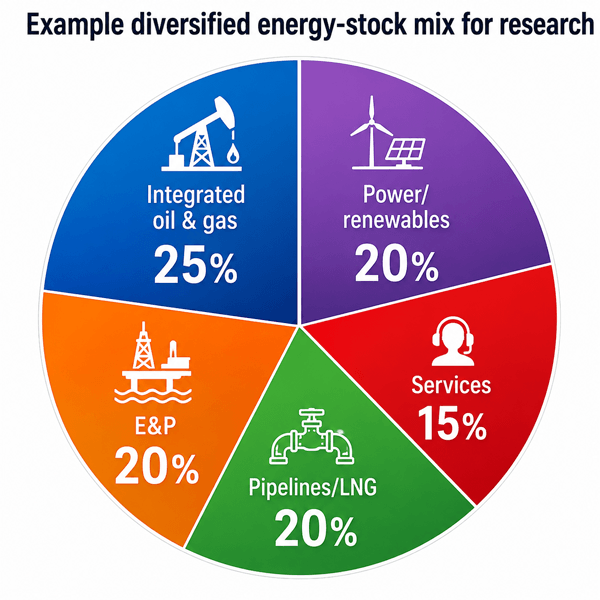
These examples are educational frameworks, not personal recommendations. The right allocation depends on age, income, risk tolerance, taxes, and the rest of the portfolio.
| Example | Possible mix | Who might research it | Main risk |
|---|---|---|---|
| Conservative energy sleeve | 40% XOM/CVX, 25% ENB, 20% NEE, 15% SHEL | A beginner who wants diversified energy exposure with less single-theme risk. | Still exposed to energy cycles, interest rates, and regulation. |
| Income-focused sleeve | 30% CVX, 30% ENB, 20% XOM, 20% SHEL | A dividend investor researching energy income. | Dividend yield can hide risk if cash flow weakens. |
| Growth and transition sleeve | 30% NEE, 25% FSLR, 20% LNG, 15% SLB, 10% CVX | An investor who wants electricity, renewables, LNG, and services exposure. | Higher valuation and policy sensitivity. |
| Balanced 10-stock basket | Equal 10% position in each stock | A learner who wants to track the whole sector before choosing favorites. | Equal weight may overexpose the portfolio to volatile names. |
8. Beginner Checklist Before Buying Any Energy Stock
- Read the latest annual report and quarterly results.
- Check whether earnings are driven by oil prices, gas prices, contracts, electricity rates, or equipment demand.
- Look at debt, free cash flow, dividend coverage, and capital spending.
- Compare valuation with peers, not with unrelated technology stocks.
- Decide whether you want income, growth, inflation protection, or diversification.
- Avoid buying after a sudden headline spike without checking valuation.
- Use limit orders and position sizing if you are new to volatile sectors.
- Rebalance instead of letting one energy stock dominate the portfolio.
9. Common Mistakes Beginners Make
| Mistake | Why it hurts | Better approach |
|---|---|---|
| Buying only because oil prices are rising | Stocks may already price in the good news. | Check valuation and cash-flow assumptions. |
| Chasing the highest dividend yield | High yield can signal market concern about a future cut. | Compare payout coverage and debt. |
| Ignoring taxes | MLPs, foreign dividends, and taxable accounts can change after-tax returns. | Understand tax forms and withholding before buying. |
| Confusing renewables with low risk | Clean-energy stocks can be volatile and policy-sensitive. | Analyze margins, backlog, and financing costs. |
| Owning too many similar producers | The portfolio may be one big oil-price bet. | Diversify across producers, infrastructure, power, and services. |
10. Risks Investors Must Understand
Energy stocks can be rewarding, but they are not safe simply because people always need energy. Key risks include commodity-price crashes, geopolitical shocks, recessions, rising interest rates, emissions policy, project delays, reserve replacement challenges, dividend cuts, lawsuits, and technology disruption. A beginner-friendly article should be honest about these risks because that improves trust and aligns with responsible financial publishing.
The most practical rule: Do not build an energy portfolio around one prediction. Oil can surprise. Natural gas can be oversupplied. Solar can face margin pressure. Utilities can fall when rates rise. Diversification and valuation discipline matter more than trying to guess one perfect theme.
11. Frequently Asked Questions
11.1 Are energy stocks good to buy in 2026?
They can be worth researching because the sector offers exposure to oil, gas, LNG, dividends, electricity demand, renewables, and data-center power. But they are cyclical and should be evaluated by valuation, balance sheet, cash flow, and risk tolerance.
11.2 What is the safest energy stock for beginners?
No stock is completely safe. Large diversified companies such as Exxon Mobil and Chevron may be easier for beginners to understand than small speculative producers, but they can still fall when oil and gas prices weaken.
11.3 What are the best dividend energy stocks?
Common names investors research include Chevron, Exxon Mobil, Enbridge, Shell, and some pipeline or midstream companies. Dividend safety depends on cash flow, debt, capital spending, and payout coverage.
11.4 Are renewable energy stocks better than oil stocks?
They are different, not automatically better. Renewable energy stocks can benefit from electricity demand and clean-energy growth, while oil stocks can produce strong cash flow during favorable commodity cycles. A balanced investor may research both.
11.5 How much of a beginner portfolio should be in energy?
Many beginners keep sector exposure modest because energy can be volatile. A practical starting point is to treat energy as one sleeve of a diversified portfolio rather than the entire portfolio.
11.6 Should I buy individual energy stocks or an ETF?
An ETF can be simpler and more diversified. Individual stocks may offer more targeted exposure, but they require more research. Beginners who do not want to read financial statements may prefer a low-cost sector ETF.
12. Methodology
This watchlist was selected to cover the major investable parts of the energy sector: integrated oil and gas, exploration and production, shale, oilfield services, LNG exports, pipelines, utilities, renewables, and solar manufacturing. The list favors large, liquid, widely followed companies over tiny speculative stocks because the target reader is a beginner. The ranking is editorial and educational, not a personalized recommendation.
Sources Consulted and Checked
The following sources were consulted and checked while preparing this article and reviewing its factual accuracy. Readers should verify time-sensitive figures and rules directly from official or primary sources before acting.
- U.S. Energy Information Administration, Short-Term Energy Outlook - https://www.eia.gov/outlooks/steo/
- International Energy Agency, Energy and AI executive summary - https://www.iea.org/reports/energy-and-ai/executive-summary
- BloombergNEF, New Energy Outlook 2026 - https://about.bnef.com/insights/clean-energy/bloombergnefs-new-energy-outlook-2026-transition-to-newer-technologies-expanded-electrification-to-strengthen-nations-energy-security/
- Morningstar, The Best Energy Stocks to Buy - https://www.morningstar.com/stocks/best-energy-stocks-buy
- The Motley Fool, Largest Energy Companies by Market Cap in June 2026 - https://www.fool.com/research/largest-energy-companies/
- The Motley Fool, 5 Best Energy Stocks for 2026 and How to Invest - https://www.fool.com/investing/stock-market/market-sectors/energy/
- Yahoo Finance Energy Sector page - https://finance.yahoo.com/sectors/energy/
- Recent market data snapshot retrieved June 23, 2026 - OpenAI finance data tool; verify live quotes before publication.
Reader Advice
This article is provided solely for educational and informational purposes. It does not constitute personalized investment, financial, tax, legal, or professional advice, and it is not an offer, solicitation, guarantee of returns, or instruction to buy or sell any security. Energy stocks can be volatile, and investors may lose some or all of their capital. The energy sector can also be influenced by changes in oil and natural gas prices, global supply and demand, geopolitical events, environmental policies, the transition to renewable energy, and other industry-specific developments, so readers may find it helpful to consider the latest sector and company-specific information as part of their own research.
Company fundamentals, share prices, market capitalizations, valuation ratios, dividend policies, tax treatment, regulations, government policies, tariffs, interest rates, and market conditions can change quickly and may differ by country, investor circumstances, and account type. Before making any decision, readers should review current company filings, confirm facts and figures through official or primary sources, consider their objectives and risk tolerance, and seek advice from appropriately licensed financial, tax, or legal professionals where necessary.