10 Best Technology Stocks to Buy in 2026
For a beginner, the best technology stocks are not always the fastest-moving names on social media. A good technology stock should have a clear business model, durable demand, strong cash generation, a realistic valuation, and a role in a trend that can last for years. In 2026, the strongest technology themes are artificial intelligence infrastructure, cloud computing, advanced semiconductors, advertising powered by AI, consumer devices, and the equipment needed to manufacture chips.
This article uses the phrase “best technology stocks to buy” because that is how many readers search. A more honest framing is “best technology stocks to research for a 2026 watchlist.” No single article can know the right stock for every reader. The aim here is to help beginners understand why these companies matter, what could go right, what could go wrong, and how to build a safer decision process.
1. What Is a Technology Stock?
A technology stock is a share of a company that earns a large part of its revenue from technology products, services, platforms, tools, chips, software, or digital infrastructure. A beginner can think of the technology sector as the “toolbox” behind the modern economy. It includes obvious companies such as Microsoft and Apple, but it also includes less visible companies such as ASML, which sells machines that help chipmakers produce advanced processors.
Technology stocks work like any other public stock: when you buy shares through an online brokerage account or retirement account, you own a small piece of the company. Your return can come from price appreciation, dividends, or both. But the price moves every day because investors constantly update their expectations for growth, profits, interest rates, competition, regulation, and future demand.
The key beginner lesson is simple: a great company is not automatically a great stock at any price. A company can be world-class and still disappoint investors if the stock already assumes near-perfect growth. That is why this guide looks at business quality, growth drivers, risks, and valuation awareness together.
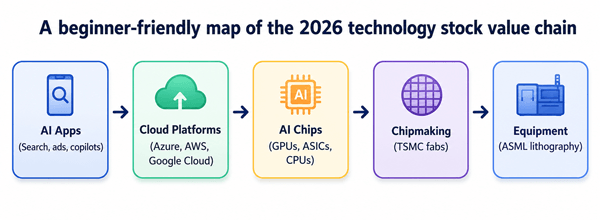
2. How Technology Stocks Make Money
Technology companies usually make money in one or more of five ways. First, they sell hardware, such as iPhones, GPUs, CPUs, servers, or lithography machines. Second, they sell software subscriptions, such as Microsoft 365 or developer tools. Third, they sell cloud infrastructure, where businesses rent computing power and storage. Fourth, they sell advertising, especially when AI improves targeting, recommendations, and measurement. Fifth, they collect platform fees from marketplaces, app stores, payment systems, or digital ecosystems.
In 2026, investors are especially focused on AI return on investment. The market wants to know whether massive spending on data centers, GPUs, networking, electricity, cooling, and software will turn into durable revenue and profits. The companies in this list are selected because they are either direct suppliers to AI infrastructure or large platforms that can turn AI into better products, lower costs, or higher customer engagement.
3. How This List Was Selected
This is not a random list of popular ticker symbols. The selection uses five practical filters that a beginner can reuse for any stock research process.
- Business quality: Does the company have a clear product, loyal customers, and a durable advantage?
- 2026 growth driver: Is there a visible reason revenue or earnings can keep growing, such as AI infrastructure, cloud demand, or services revenue?
- Financial strength: Does the company generate enough cash to invest through downturns?
- Valuation awareness: Is the stock price reasonable relative to growth, or is the market already pricing in perfection?
- Beginner usability: Can a new investor explain the company in plain English without relying on hype?
A safer way to use this article is to build a watchlist, compare valuations on a stock research platform, read the latest 10-Q or earnings release, and then consider position sizing. Beginners should not put all their money into one stock, even if the story is exciting. A diversified investment portfolio often mixes individual stocks with ETFs, cash reserves, and long-term retirement account contributions.
4. Market Snapshot: Why 2026 Is Unusual for Tech Investors
The 2026 technology market is not just “AI goes up.” It is more divided than that. Some software stocks have struggled because investors worry AI agents could reduce demand for traditional software seats. At the same time, semiconductor, cloud, and AI infrastructure companies have attracted heavy capital because companies are still building the physical and digital rails for AI. Goldman Sachs wrote in April 2026 that AI investment was expected to drive a large share of S&P 500 earnings growth and that major cloud companies planned very large 2026 capital spending. Goldman also noted that technology underperformance early in 2026 had started to create more attractive opportunities in parts of the sector.
That creates a practical opportunity and a practical danger. The opportunity is that not every technology stock is expensive for the same reason. The danger is that many beginners may chase whatever moved the most last month. The better approach is to understand the role each company plays in the AI and cloud economy.
| Ticker | Price snapshot (USD) | P/E snapshot where available | Plain-English interpretation |
|---|---|---|---|
| NVDA | $208.65 | 31.8x | Still priced for strong growth, but less extreme than many assume relative to earnings power. |
| MSFT | $367.34 | 21.9x | A mature compounder valuation compared with many high-growth AI names. |
| GOOGL | $349.68 | 26.7x | Cloud and AI growth balanced by search/regulatory worries. |
| AMZN | $232.79 | 27.8x | AWS and retail efficiency matter more than headline sales alone. |
| AVGO | $392.13 | 97.6x | High P/E reflects AI custom-chip enthusiasm and integration expectations. |
| META | $563.85 | 20.5x | Strong earnings base, but heavy AI spending must pay off. |
| TSM | $467.67 | N/A in snapshot | Foundry leader; valuation should be checked against ADR, Taiwan listing and currency factors. |
| ASML | $1,929.25 | N/A in snapshot | A high-quality equipment leader; bookings and export controls matter. |
| AAPL | $297.01 | 36.0x | Premium brand and ecosystem, but valuation needs services/AI growth to support it. |
| AMD | $551.63 | 180.9x | Very high expectations; execution in AI accelerators is critical. |
5. The 10 Best Technology Stocks to Research in 2026
5.1 NVIDIA (NVDA)
What the company does
NVIDIA is the clearest direct play on the AI infrastructure boom. The company sells GPUs, networking, software, and full data-center systems used to train and run advanced AI models. In its fiscal first quarter 2027, NVIDIA reported record revenue of $81.6 billion, up 85% from a year earlier, and record Data Center revenue of $75.2 billion, up 92% year over year. That tells beginners one important thing: NVIDIA is no longer just a gaming-chip company; it is the core infrastructure supplier for much of the AI economy.
Why beginners should care
NVIDIA’s moat comes from performance, software ecosystem, developer familiarity, networking, and the fact that many AI teams build around its platform. When a company is trying to deploy AI quickly, switching away from the default platform can create technical and operational friction.
What can go wrong
The biggest risk is not that NVIDIA is a bad business. The biggest risk is expectations. If hyperscalers slow spending, if custom chips from Broadcom, Google, Amazon, or others take more share, or if margins normalize, the stock can fall even while the company remains excellent.
Practical example
A beginner might buy NVIDIA slowly instead of all at once. For example, someone with $1,000 allocated to high-risk growth stocks could split purchases over several months and keep the position below a set percentage of the portfolio.
5.2 Microsoft (MSFT)
What the company does
Microsoft is one of the most balanced technology stocks for beginners because it combines cloud infrastructure, enterprise software, cybersecurity, developer tools, gaming, LinkedIn, and AI copilots. Microsoft reported fiscal 2026 third-quarter revenue of $82.9 billion, Microsoft Cloud revenue of $54.5 billion, and 29% growth in Microsoft Cloud revenue. Azure and other cloud services have been a key driver.
Why beginners should care
Microsoft’s advantage is distribution. It already has relationships with millions of businesses through Windows, Office, Teams, Azure, GitHub, and security products. That makes it easier to sell AI features as add-ons to tools customers already use.
What can go wrong
The risk is that AI is expensive. Data centers, chips, energy, and talent cost real money. If customers do not pay enough for Copilot and Azure AI services, margins could disappoint. Microsoft also faces regulatory scrutiny and fierce cloud competition.
Practical example
A practical beginner use case: Microsoft can act as a “core tech holding” rather than a speculative bet. It may not double quickly from a large base, but it offers broad exposure to enterprise AI, cloud, and productivity software.
5.3 Alphabet (GOOGL)
What the company does
Alphabet owns Google Search, YouTube, Android, Google Cloud, Gemini, and major AI research assets. In Q1 2026, Alphabet reported revenue of $109.9 billion, up 22% year over year, while Google Cloud revenue grew 63% to $20.0 billion. Management also highlighted strong AI usage in Search and cloud demand.
Why beginners should care
Alphabet is attractive because it has three engines: advertising cash flow, cloud growth, and AI infrastructure including TPUs. Search remains one of the most profitable digital businesses in the world, while YouTube and subscriptions add optionality.
What can go wrong
The main risk is AI disruption. If users move from traditional search links to AI answer engines, ad formats may need to change. Alphabet also faces antitrust and privacy pressure in several markets.
Practical example
A beginner example: Alphabet may suit an investor who wants AI exposure but does not want to rely only on chip stocks. The investor should track Search revenue, Google Cloud margins, AI capex, and regulatory headlines.
5.4 Amazon (AMZN)
What the company does
Amazon is both a consumer platform and a cloud infrastructure company. AWS is the key reason many investors treat Amazon as a technology stock rather than only a retailer. In Q1 2026, Amazon reported net sales of $181.5 billion, AWS sales of $37.6 billion, up 28% year over year, and operating income of $23.9 billion.
Why beginners should care
Amazon’s strength is scale. AWS rents computing power to companies building apps, databases, analytics systems, and AI workloads. Retail, advertising, Prime, logistics, and third-party seller services create additional profit pools.
What can go wrong
The risk is capital intensity. AI data centers require huge spending before the revenue arrives. Amazon also faces competition from Microsoft Azure, Google Cloud, Oracle, and specialized AI cloud providers.
Practical example
Practical use: A beginner can view Amazon as a mix of cloud computing stock, digital advertising stock, and e-commerce efficiency story. Watch AWS growth, operating margin, free cash flow, and capital expenditures.
5.5 Broadcom (AVGO)
What the company does
Broadcom has become a major AI infrastructure supplier through custom AI accelerators, networking chips, connectivity, and infrastructure software. In Q2 fiscal 2026, Broadcom said semiconductor revenue from AI reached $10.8 billion, up 143% year over year, driven by custom AI accelerators and AI networking.
Why beginners should care
Broadcom is important because not every AI workload needs a general-purpose GPU. Large cloud companies may want custom chips designed for their own models and data centers. Broadcom is positioned in that custom-chip opportunity.
What can go wrong
The risks are concentration and valuation. Custom AI chip projects can depend on a small number of giant customers. If one customer changes suppliers, slows spending, or delays a chip generation, revenue expectations can move sharply.
Practical example
Practical use: Broadcom may fit investors who believe AI infrastructure will diversify beyond NVIDIA. Beginners should compare it with NVIDIA and AMD rather than assuming all chip stocks behave the same way.
5.6 Meta Platforms (META)
What the company does
Meta owns Facebook, Instagram, WhatsApp, Messenger, Threads, and Reality Labs. The investment case is about AI improving advertising, recommendations, content creation, messaging, and eventually personal AI assistants. In Q1 2026, Meta reported revenue of $56.3 billion, up 33% year over year, operating margin of 41%, and net income of $26.8 billion.
Why beginners should care
Meta’s advantage is user attention. Billions of people already use its apps, which gives Meta a massive testing ground for AI-driven feeds, ads, shopping, messaging, and creator tools.
What can go wrong
The risk is spending discipline. Meta has guided to very high 2026 capital expenditures to support AI infrastructure. If users and advertisers do not generate enough incremental revenue, investors may question the return on investment.
Practical example
Practical use: Meta can be a strong cash-flow technology stock, but beginners should monitor capex, ad revenue growth, and management commentary about AI monetization.
5.7 Taiwan Semiconductor Manufacturing Company (TSM)
What the company does
TSMC is the world’s leading dedicated semiconductor foundry. It manufactures chips designed by companies such as NVIDIA, Apple, AMD, and many others. When investors buy TSM, they are not buying an AI app; they are buying a key manufacturing layer underneath the chip economy.
Why beginners should care
TSMC’s advantage is process technology, manufacturing scale, yield learning, and customer trust. Reuters reported in April 2026 that TSMC raised its revenue forecast and planned higher capital spending because AI chip demand remained extremely robust.
What can go wrong
The main risks are geopolitical tension, export controls, customer concentration, currency effects, and semiconductor cycles. Because TSM is an ADR, beginners should also understand that the U.S.-listed share represents ownership linked to the Taiwan-listed company.
Practical example
Practical use: TSM can diversify a chip portfolio away from designers and toward manufacturing. It may appeal to readers who believe AI demand will remain strong but prefer a “picks-and-shovels” business.
5.8 ASML (ASML)
What the company does
ASML makes lithography systems used by chip manufacturers to pattern tiny circuits on silicon wafers. Its EUV machines are essential for the most advanced chips. In Q1 2026, ASML reported total net sales of €8.8 billion, gross margin of 53.0%, and net income of €2.8 billion, and raised its 2026 net sales outlook to €36 billion to €40 billion.
Why beginners should care
ASML’s advantage is scarcity. Few companies in the world can build this type of equipment at scale. Advanced chip manufacturing depends on ASML tools, which makes it a strategic supplier to the semiconductor industry.
What can go wrong
The risks include export controls, China restrictions, customer order timing, and the cyclical nature of semiconductor capital spending. A great equipment company can still have lumpy orders.
Practical example
Practical use: ASML is useful for investors who want exposure to the long-term need for more advanced chips but do not want to choose only between NVIDIA, AMD, and Broadcom.
5.9 Apple (AAPL)
What the company does
Apple sells iPhone, Mac, iPad, Watch, AirPods, services, and an ecosystem that keeps customers engaged. In fiscal Q2 2026, Apple reported quarterly revenue of $111.2 billion, up 17% year over year, and diluted EPS of $2.01, up 22%. Services revenue reached a new all-time high.
Why beginners should care
Apple’s strength is customer loyalty. Many investors underestimate how valuable the installed base is: users buy devices, subscriptions, apps, storage, payments, accessories, and services over many years.
What can go wrong
The risk is growth. Apple is enormous, and the market often asks where the next major growth engine will come from. If AI features do not drive upgrades or services growth, a premium valuation can be harder to justify.
Practical example
Practical use: Apple may be better viewed as a quality compounder than a pure AI hypergrowth stock. Beginners should watch services revenue, iPhone upgrade cycles, margins, and on-device AI adoption.
5.10 Advanced Micro Devices (AMD)
What the company does
AMD sells CPUs, GPUs, and adaptive computing products used in PCs, gaming, embedded markets, and data centers. In Q1 2026, AMD reported data-center segment revenue of $5.8 billion, up 57% year over year, driven by EPYC processors and ramping Instinct GPU shipments.
Why beginners should care
AMD’s appeal is that it can benefit when customers want alternatives to NVIDIA GPUs and Intel server CPUs. The company has proven it can gain share when execution is strong.
What can go wrong
The risk is execution. AMD must deliver competitive AI accelerators, software support, supply, and customer wins. Its valuation can become demanding when investors expect rapid AI share gains.
Practical example
Practical use: AMD is a higher-risk, higher-upside technology stock. Beginners should size it smaller than mature holdings and track data-center growth, gross margin, AI GPU adoption, and competitive announcements.
6. Comparison Table: Which Tech Stock Fits Which Investor?
| Investor type | Best-fit names to research | Why | What to avoid |
|---|---|---|---|
| Conservative beginner who wants quality tech | MSFT, AAPL, GOOGL | Large profits, diversified businesses, strong ecosystems | Chasing short-term breakouts without checking valuation |
| AI infrastructure believer | NVDA, AVGO, AMD, TSM, ASML | Direct exposure to chips, foundries, equipment and networking | Owning only one chip stock and ignoring cyclicality |
| Cloud computing investor | MSFT, AMZN, GOOGL | Azure, AWS and Google Cloud are central to enterprise AI | Assuming cloud growth always means margin expansion |
| Advertising and consumer internet investor | GOOGL, META, AMZN | AI can improve ads, recommendations and conversion | Ignoring privacy, regulation and user behavior changes |
| Long-term diversified stock picker | MSFT, GOOGL, AMZN, NVDA, TSM | Mixes platforms and infrastructure layers | Overconcentration in expensive high-beta names |
7. Beginner Strategy: How to Use This List Without Gambling
The biggest mistake beginners make is treating a “best stocks” article like a shopping list. A more professional process is to turn the list into a research checklist. Start with the companies you understand best. Read the latest earnings release. Check revenue growth, operating margin, free cash flow, valuation, and management guidance. Then compare the stock with alternatives, including ETFs.
7.1 A Simple Five-Step Process
- Step 1: Decide your goal. Are you investing for five years, retirement, a house deposit, or short-term speculation? Short time horizons do not match volatile growth stocks.
- Step 2: Choose your exposure. You can buy individual stocks, a technology ETF, a semiconductor ETF, or a mix. ETFs reduce single-company risk but also reduce the chance of outsized gains from one winner.
- Step 3: Check valuation. Look at P/E, forward P/E, price-to-sales for less mature companies, free cash flow yield, and revenue growth. Never buy only because the company is famous.
- Step 4: Size positions. Beginners often do better with smaller positions and gradual buying. A 3% position can be easier to hold through volatility than a 30% position.
- Step 5: Review quarterly, not hourly. Technology stocks are volatile. Focus on business results, not every price move.
7.2 Example Portfolio Approach for Educational Purposes
Suppose a beginner wants $10,000 of technology exposure inside a diversified investment portfolio. One balanced approach could be 50% in a broad technology or Nasdaq-style ETF, 20% in mature platform companies such as Microsoft, Alphabet, Apple, or Amazon, 20% in AI infrastructure names such as NVIDIA, TSMC, ASML, or Broadcom, and 10% in higher-risk growth names such as AMD. This is not a recommendation; it is an example of how to avoid putting the entire portfolio into one exciting stock.
8. Key Risks Every Beginner Should Know
| Risk | What it means | How to reduce the risk |
|---|---|---|
| Valuation risk | The business performs well but the stock falls because expectations were too high. | Compare valuation with growth, margins and cash flow before buying. |
| AI spending risk | Companies spend heavily on AI infrastructure but customers do not pay enough to justify it. | Track capex, free cash flow and AI revenue commentary. |
| Competition risk | A rival product or chip takes market share. | Do not own only one company in a fast-changing theme. |
| Regulatory risk | Governments challenge ads, app stores, search, data privacy, exports or acquisitions. | Follow official filings and regulatory updates. |
| Cyclical risk | Semiconductor demand rises and falls in cycles. | Use position sizing and consider buying gradually. |
| Currency/geopolitical risk | Foreign listings and global supply chains add uncertainty. | Understand ADRs, geography, supply chains and export controls. |
9. What Beginners Should Track Each Quarter
For every technology stock, ask the same practical questions. Is revenue growing faster or slower than expected? Are margins expanding or shrinking? Is free cash flow positive? Is capital spending rising faster than revenue? Is management’s guidance realistic? Are customers renewing and expanding? Is the company buying back shares at sensible prices or using debt aggressively?
For chip stocks, watch data-center revenue, gross margin, inventory, customer concentration, and next-generation product timing. For cloud stocks, watch cloud revenue growth, operating margin, backlog, AI service adoption, and capex. For advertising stocks, watch user engagement, ad pricing, conversion tools, and regulation. For Apple, watch iPhone growth, services, installed base, and AI features that can drive upgrades.
10. Frequently Asked Questions
10.1 Are Technology Stocks Good for Beginners?
They can be, but only with diversification and patience. Technology companies are easy to recognize, but their stocks can be volatile. Beginners should consider mixing individual tech stocks with ETFs and should avoid using emergency savings for stock investing.
10.2 What Is the Safest Technology Stock in 2026?
No stock is truly safe. Among this list, Microsoft, Apple, Alphabet, Amazon and Meta have large cash-generating businesses, while NVIDIA, Broadcom, AMD, TSMC and ASML have more direct exposure to the semiconductor cycle. “Safer” depends on valuation, portfolio size and time horizon.
10.3 Should I Buy NVIDIA or AMD?
NVIDIA is the current AI infrastructure leader with far larger data-center revenue. AMD is a challenger with upside if it gains share in AI accelerators and server CPUs. A beginner who cannot choose might use smaller positions in both or use a semiconductor ETF.
10.4 Are AI Stocks Overvalued in 2026?
Some are expensive, some are not, and some look cheap only if growth stays very high. The right question is not “Is AI a bubble?” but “What growth and margins are already priced into this stock?”
10.5 Is It Better to Buy a Technology ETF?
For many beginners, yes. A technology ETF or semiconductor ETF reduces single-company risk and can be easier to hold. Individual stocks can be added only after a reader understands the business and accepts the risk.
11. Final Verdict
The best technology stocks to research in 2026 are not just the companies with the loudest AI headlines. The strongest list includes the full value chain: AI models and apps, cloud platforms, chips, chip manufacturing, and semiconductor equipment. NVIDIA, Microsoft, Alphabet, Amazon, Broadcom, Meta, TSMC, ASML, Apple, and AMD each offer a different way to invest in the technology economy.
The most beginner-friendly approach is to start with understanding, not urgency. Build a watchlist, compare valuations, read primary sources, diversify, and use honest position sizing. If a stock is too complicated to explain in one minute, keep researching before buying. Good investing is not about predicting every short-term move; it is about owning quality businesses at sensible prices for a time horizon that matches your goals.
Reader Advice
This article is provided solely for educational and informational purposes and does not constitute personalized financial, investment, tax, legal, or other professional advice. It does not recommend that any reader buy, sell, or hold a particular security. Technology companies operate in a fast-evolving industry, where developments in areas such as artificial intelligence, cloud computing, cybersecurity, semiconductors, and emerging technologies can influence business prospects and market performance. Readers may therefore wish to consider both a company's long-term potential and the changing competitive and technological landscape when exploring the stocks discussed in this article.
Stock prices, valuation multiples, company results, market conditions, regulations, tax rules, and other facts may change rapidly and may differ by country, account type, personal circumstances, and time horizon. Before making any financial decision, readers should verify all figures and material facts through current official company filings, investor-relations releases, regulatory sources, and other reliable primary sources; assess their own objectives, risk tolerance, liquidity needs, and financial circumstances; and seek advice from an appropriately qualified professional where necessary. Past performance and historical growth do not guarantee future results, and investing can result in partial or total loss of capital.
Sources Consulted and Checked
The following sources were consulted and checked when preparing this article and reviewing its factual accuracy. Readers should consult the latest versions of these sources because market information can change quickly.
- Goldman Sachs: US stocks forecast to rise in 2026
- Goldman Sachs: Are technology stocks cheap now?
- NVIDIA investor relations: Q1 fiscal 2027 results
- Microsoft investor relations: FY26 Q3 earnings
- Alphabet Q1 2026 earnings release via SEC
- Amazon Q1 2026 earnings release
- Broadcom Q2 fiscal 2026 earnings release
- Meta Q1 2026 earnings release
- Reuters: TSMC revenue forecast and AI demand, April 2026
- ASML Q1 2026 financial results
- Apple Q2 2026 results
- AMD Q1 2026 financial results