10 Best Cybersecurity Stocks to Buy in 2026
Key takeaway: Cybersecurity stocks can benefit from long-term demand for cloud security, AI security, identity protection, zero trust, and compliance, but they are still stocks. Prices can fall sharply when valuation, guidance, competition, or growth expectations disappoint.
1. Quick answer: the 10 cybersecurity stocks worth researching in 2026
For a beginner, the best cybersecurity stocks are usually not the smallest or most exciting names. They are the companies with strong products, recurring revenue, real customer demand, healthy cash flow, and a clear role in the modern security stack. In 2026, the strongest watchlist starts with platform leaders such as Palo Alto Networks, CrowdStrike, Fortinet, and Zscaler, then expands into identity, cloud edge security, observability, vulnerability management, and turnaround candidates.
| Rank | Ticker | Company | Main cybersecurity role | Why it can fit a 2026 watchlist | Main risk |
|---|---|---|---|---|---|
| 1 | PANW | Palo Alto Networks | Broad security platform; network, cloud, SOC, identity after CyberArk deal | Core platform exposure | High valuation and integration risk |
| 2 | CRWD | CrowdStrike | Endpoint, cloud workload, identity, AI-native security operations | Best pure-play growth profile | High valuation; trust risk |
| 3 | FTNT | Fortinet | Firewalls, secure networking, SASE, OT security | Profitable, cash-generative cybersecurity leader | Hardware cycles and competition |
| 4 | ZS | Zscaler | Zero trust, secure web gateway, cloud access security | Cloud zero-trust leader | Guidance volatility |
| 5 | NET | Cloudflare | Edge network, DDoS, application security, zero trust | Edge security upside | Not pure cyber; valuation risk |
| 6 | OKTA | Okta | Identity and access management | Key beneficiary of identity-first security | Execution and competition from Microsoft |
| 7 | CHKP | Check Point Software | Network security, firewall, cloud security | Mature value-aware option | Slower growth |
| 8 | DDOG | Datadog | Observability, cloud security, app security monitoring | Security attached to cloud operations budgets | Security is only part of the story |
| 9 | TENB | Tenable | Vulnerability and exposure management | Cyber hygiene theme | Scale and margin risk |
| 10 | S | SentinelOne | AI-powered endpoint and autonomous security | Higher-risk growth idea | Losses and execution risk |
CyberArk is not included as a separate pick because Palo Alto Networks completed its acquisition of CyberArk in February 2026, so investors looking for that identity-security exposure now mainly get it through Palo Alto Networks rather than CYBR as a standalone Nasdaq stock.
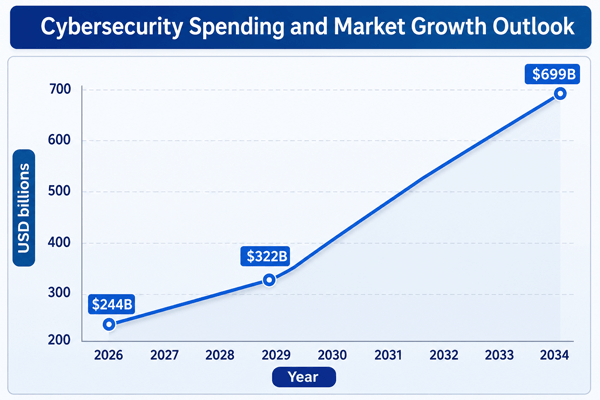
Figure 1: Cybersecurity spending remains a long-term growth market. Gartner’s 2026 global information-security forecast was around $244 billion, while other market forecasts point to much larger totals later in the decade. Use forecasts as context, not as a guarantee of stock returns.
2. What is cybersecurity, explained simply?
Cybersecurity means protecting people, companies, devices, software, networks, and data from digital attacks. A hacker may try to steal customer data, lock systems with ransomware, trick employees through phishing, abuse a stolen password, or quietly move inside a company’s cloud environment. A cybersecurity company sells tools that help prevent, detect, investigate, and respond to those threats.
Think of a company like a large building. It needs door locks, ID cards, cameras, alarms, guards, emergency plans, and insurance. Cybersecurity is the digital version of that. No single product protects everything, so businesses usually buy several layers: identity security, endpoint security, network security, cloud security, application security, data protection, monitoring, and incident response.
Key takeaway: Cybersecurity is not one product. It is a layered defense system. That is why several different kinds of cybersecurity stocks can win at the same time.
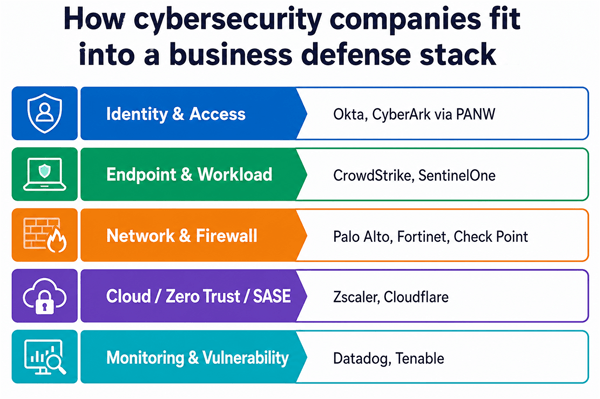
Figure 2: Beginner view of the cybersecurity stack. The best stock for one investor may depend on which layer they want exposure to: identity, endpoint, firewall, cloud, zero trust, or monitoring.
3. How cybersecurity companies make money
3.1 Subscription software
Most modern cybersecurity companies sell annual or multi-year subscriptions. This creates recurring revenue, which investors like because it can be easier to forecast than one-time hardware sales.
3.2 Platform expansion
A customer may start with one product, then add more modules over time. For example, a company may begin with endpoint protection and later add identity, cloud workload protection, log analytics, or threat intelligence.
3.3 Hardware plus services
Some companies, especially firewall leaders, sell physical or virtual appliances plus subscriptions for updates, cloud management, and support.
3.4 Professional services and incident response
Some vendors help companies after an attack, run security assessments, or provide managed detection. This can deepen customer relationships but may have different margins than software.
4. What beginners should check before buying a cybersecurity stock
| Metric | Plain-English meaning | Why it matters |
|---|---|---|
| Revenue growth | How fast sales are increasing | Fast growth can support premium valuations, but only if it is durable. |
| ARR / subscription revenue | Recurring annual software revenue | Shows whether customers keep paying and expanding usage. |
| Free cash flow | Cash left after running and investing in the business | Useful because many software companies report accounting losses but still produce cash. |
| Operating margin | How profitable the business model is | Helps compare mature names such as Fortinet and Check Point with high-growth names. |
| Net retention / expansion | Whether existing customers spend more each year | Strong expansion means the product becomes more important over time. |
| Valuation | Price compared with sales, earnings, or cash flow | Great businesses can still be bad purchases if bought at extreme prices. |
| Customer concentration and reputation | Dependence on large customers or trust issues | Cybersecurity is trust-based; failures can damage renewals and sales cycles. |
| Competition | How easily Microsoft, Google, Cisco, or another vendor can copy or bundle the product | Bundling pressure can hurt pricing and growth. |
5. Palo Alto Networks (PANW)
Best for: broad cybersecurity platform exposure
Palo Alto Networks is one of the clearest “platform” plays in cybersecurity. It began with network firewalls, but the investment case in 2026 is much broader: cloud security, security operations, AI-driven threat detection, and identity security after the CyberArk acquisition. For a beginner, PANW is like buying a large cybersecurity department in one stock rather than betting on only one tool.
Why investors like it: large enterprise relationships, broad product coverage, strong platformization strategy, and meaningful exposure to AI security and identity. Its latest company guidance showed strong next-generation security ARR growth, which suggests customers are buying more than traditional firewalls.
Main risks: the stock can trade at a rich valuation, acquisitions can be difficult to integrate, and platform companies must prove that customers truly prefer consolidation over best-of-breed tools.
Practical example: A bank may use Palo Alto firewalls for branch and data-center traffic, Prisma for cloud workloads, Cortex for security operations, and CyberArk capabilities for privileged identity. That gives PANW several ways to expand inside one customer account.
| Beginner verdict | Best suited for | What to watch next |
|---|---|---|
| Research-worthy, but buy only after checking valuation and latest earnings. | Long-term investors who understand stock volatility. | Revenue growth, margins, free cash flow, customer demand, competition, and guidance. |
6. CrowdStrike (CRWD)
Best for: cloud-native endpoint and AI security growth
CrowdStrike protects laptops, servers, cloud workloads, identities, and security operations through its Falcon platform. Endpoint security is often the first place companies spend because every employee device can become an attack doorway. CrowdStrike’s advantage is that its platform collects huge amounts of threat data and uses cloud analytics to detect suspicious behavior quickly.
Why investors like it: strong recurring revenue, high visibility, broad module expansion, and strong brand recognition among security teams. CrowdStrike reported ARR of about $5.51 billion as of April 30, 2026, with 24% year-over-year growth.
Main risks: CRWD is priced for excellence, so even small disappointments can hurt the stock. Investors must also watch reputation risk because security vendors are judged harshly when customers experience disruption.
Practical example: A remote-work company can install CrowdStrike on employee laptops. If malware appears on one device, the platform can isolate it, alert the security team, and search for similar behavior across the company.
| Beginner verdict | Best suited for | What to watch next |
|---|---|---|
| Research-worthy, but buy only after checking valuation and latest earnings. | Long-term investors who understand stock volatility. | Revenue growth, margins, free cash flow, customer demand, competition, and guidance. |
7. Fortinet (FTNT)
Best for: profitable firewall, secure networking, and SASE exposure
Fortinet is a mature cybersecurity leader known for firewalls, security appliances, and secure networking. It is especially relevant where companies need high-performance protection across offices, data centers, factories, and hybrid cloud environments. Fortinet is not just a hardware company; subscriptions and services make the model more recurring.
Why investors like it: strong profitability, operating cash flow, and a long history of execution. In Q1 2026, Fortinet reported 20% revenue growth and 31% billings growth, with strong margins and free cash flow.
Main risks: firewall demand can be cyclical, hardware refresh timing matters, and cloud-native competitors keep pushing into secure access and SASE.
Practical example: A retail chain may use Fortinet appliances in stores and branches, then add subscriptions for intrusion prevention, secure SD-WAN, web filtering, and centralized management.
| Beginner verdict | Best suited for | What to watch next |
|---|---|---|
| Research-worthy, but buy only after checking valuation and latest earnings. | Long-term investors who understand stock volatility. | Revenue growth, margins, free cash flow, customer demand, competition, and guidance. |
8. Zscaler (ZS)
Best for: zero trust and secure access service edge
Zscaler is built around the idea that users should not automatically trust a corporate network. Instead, each user and device should be verified before accessing an application. This is called zero trust. Zscaler’s cloud platform helps companies secure internet access, private app access, cloud apps, and data movement.
Why investors like it: Zscaler is a pure cloud security company with a strong position in zero trust. It benefits when companies move away from old VPNs and on-premise security boxes.
Main risks: the stock can be volatile when guidance is slightly below expectations. Competition is intense from Palo Alto, Cloudflare, Netskope, Microsoft, Cisco, and others.
Practical example: An employee working from a cafe does not connect to the entire corporate network. Zscaler checks who they are, what device they use, and which specific app they should access, then blocks everything else.
| Beginner verdict | Best suited for | What to watch next |
|---|---|---|
| Research-worthy, but buy only after checking valuation and latest earnings. | Long-term investors who understand stock volatility. | Revenue growth, margins, free cash flow, customer demand, competition, and guidance. |
9. Cloudflare (NET)
Best for: edge security plus internet infrastructure exposure
Cloudflare sits between websites, apps, users, APIs, and attackers. It is known for DDoS protection, content delivery, web application firewalls, bot management, and zero trust services. Cloudflare is not a pure cybersecurity company, but security is a major reason customers use its global network.
Why investors like it: Cloudflare combines cybersecurity, developer tools, edge computing, and network services. That gives it a large addressable market if it continues expanding with customers.
Main risks: valuation can be demanding, profitability may lag mature peers, and the story is broader than cybersecurity, which can make it harder to compare with pure-play stocks.
Practical example: An e-commerce site can use Cloudflare to keep pages fast, block bot attacks, stop DDoS traffic during a sale, and protect employee access to internal tools.
| Beginner verdict | Best suited for | What to watch next |
|---|---|---|
| Research-worthy, but buy only after checking valuation and latest earnings. | Long-term investors who understand stock volatility. | Revenue growth, margins, free cash flow, customer demand, competition, and guidance. |
10. Okta (OKTA)
Best for: identity and access management
Okta helps companies manage who can access which apps. Identity has become one of the most important security layers because attackers often prefer stealing logins over breaking firewalls. Okta provides single sign-on, multi-factor authentication, lifecycle management, and customer identity tools.
Why investors like it: identity is a durable category, and Okta can be a direct way to invest in access management. If companies continue adopting cloud apps and AI agents, identity controls may become even more important.
Main risks: competition from Microsoft is serious, sales execution matters, and identity breaches or trust concerns can weigh heavily on the stock.
Practical example: When a new employee joins, Okta can give access to approved tools. When the employee leaves, access can be removed quickly across many apps, reducing the chance of abandoned accounts being abused.
| Beginner verdict | Best suited for | What to watch next |
|---|---|---|
| Research-worthy, but buy only after checking valuation and latest earnings. | Long-term investors who understand stock volatility. | Revenue growth, margins, free cash flow, customer demand, competition, and guidance. |
11. Check Point Software (CHKP)
Best for: valuation-conscious cybersecurity exposure
Check Point is one of the older cybersecurity leaders. It is known for firewalls, threat prevention, and network security, with a more mature financial profile than many high-growth cloud names. It may appeal to investors who want cybersecurity exposure without paying the highest growth-stock multiples.
Why investors like it: profitability, established customer base, and a more conservative risk profile. Mature security companies can still benefit from steady enterprise spending even if they do not grow as fast as cloud-native peers.
Main risks: slower growth can limit upside, and investors may prefer faster-growing vendors during strong risk-on markets.
Practical example: A government agency or large enterprise may continue using Check Point to secure network perimeters, remote access, and data-center environments where reliability and trust matter more than hype.
| Beginner verdict | Best suited for | What to watch next |
|---|---|---|
| Research-worthy, but buy only after checking valuation and latest earnings. | Long-term investors who understand stock volatility. | Revenue growth, margins, free cash flow, customer demand, competition, and guidance. |
12. Datadog (DDOG)
Best for: cloud monitoring with security expansion
Datadog began as an observability platform: it helps engineering teams monitor applications, infrastructure, logs, and performance. Over time, security has become a larger part of the platform through cloud security, application security, and security monitoring.
Why investors like it: Datadog sits close to developers and cloud operations teams. If security continues shifting left into development and operations workflows, Datadog can attach security products to existing customer usage.
Main risks: it is not a pure cybersecurity company, so investors are also exposed to cloud infrastructure spending cycles and observability competition. Valuation can be high.
Practical example: A software company can use Datadog to see whether an app is slow, which server is failing, and whether a suspicious change in cloud configuration creates a security risk.
| Beginner verdict | Best suited for | What to watch next |
|---|---|---|
| Research-worthy, but buy only after checking valuation and latest earnings. | Long-term investors who understand stock volatility. | Revenue growth, margins, free cash flow, customer demand, competition, and guidance. |
13. Tenable (TENB)
Best for: vulnerability and exposure management
Tenable helps companies find weak spots before attackers exploit them. This includes vulnerabilities in servers, cloud assets, identities, and internet-facing systems. In simple terms, Tenable helps answer: “Where are we exposed, and what should we fix first?”
Why investors like it: vulnerability management is basic cyber hygiene. Regulations, insurance requirements, and board-level cyber risk reporting can support demand for exposure-management tools.
Main risks: Tenable is smaller than the mega-cap leaders, competition is strong, and investors need to monitor profitability and growth consistency.
Practical example: A hospital may use Tenable to discover outdated software on medical systems, rank the most dangerous vulnerabilities, and give IT teams a practical patching list.
| Beginner verdict | Best suited for | What to watch next |
|---|---|---|
| Research-worthy, but buy only after checking valuation and latest earnings. | Long-term investors who understand stock volatility. | Revenue growth, margins, free cash flow, customer demand, competition, and guidance. |
14. SentinelOne (S)
Best for: higher-risk endpoint and autonomous security exposure
SentinelOne competes in endpoint protection, cloud security, and AI-assisted security operations. Its pitch is autonomous protection: detect, respond, and recover quickly with less manual work. It can appeal to investors looking for a smaller, more speculative cybersecurity stock.
Why investors like it: strong technology reputation, AI-driven positioning, and possible upside if execution improves or if the company becomes a strategic acquisition target.
Main risks: SentinelOne is much riskier than the larger leaders. It faces CrowdStrike, Microsoft, Palo Alto, and others, and investors must watch losses, cash flow, customer growth, and guidance carefully.
Practical example: A mid-sized company with a small security team can use SentinelOne to automatically stop suspicious behavior on laptops and servers before an analyst investigates manually.
| Beginner verdict | Best suited for | What to watch next |
|---|---|---|
| Research-worthy, but buy only after checking valuation and latest earnings. | Long-term investors who understand stock volatility. | Revenue growth, margins, free cash flow, customer demand, competition, and guidance. |
15. Cybersecurity stock comparison: which stock fits which investor?
| Investor goal | Stocks to research first | Why |
|---|---|---|
| Most balanced large-cap exposure | PANW, FTNT, CRWD | Strong market positions, broad platforms, enterprise relevance. |
| Highest growth potential | CRWD, ZS, NET, DDOG, S | Cloud-native and AI/security expansion stories, but valuation risk is higher. |
| Profitability focus | FTNT, CHKP, PANW | More mature models and stronger margin profiles. |
| Identity security theme | OKTA, PANW | Okta is a pure identity name; PANW now includes CyberArk identity exposure. |
| Zero trust / SASE theme | ZS, NET, PANW, FTNT | Demand from remote work, cloud apps, and modern network security. |
| Smaller-cap cyber exposure | TENB, S | Potential upside, but also greater execution and volatility risk. |
16. How beginners can use this article without blindly copying a list
A smart reader should not simply buy all 10 stocks. A better approach is to use this article as a research map. Start with the business category, then compare valuation, financial quality, and risk. Cybersecurity is a strong long-term theme, but stock returns depend on the price paid and the company’s execution.
| Example approach | What it means | Who it may fit |
|---|---|---|
| Core-and-satellite watchlist | Start research with 2-3 leaders such as PANW, CRWD, FTNT, then add smaller names only if the valuation and risk make sense. | Beginners who want quality first. |
| Theme basket | Divide research across identity, endpoint, firewall, zero trust, and cloud security. | Readers who want broad cybersecurity exposure. |
| ETF-first approach | Use a cybersecurity ETF as the base, then add one or two individual stocks after learning the sector. | Beginners who do not want single-stock risk. |
| Valuation discipline | Wait for pullbacks or reasonable valuation rather than buying after a big hype move. | Long-term investors who want better risk control. |
17. Buying checklist for cybersecurity stocks in 2026
- Check the latest earnings report, not only old analyst articles.
- Compare revenue growth with valuation. A stock growing 20% is not automatically cheap if it trades at a very high sales multiple.
- Prefer recurring revenue, strong cash flow, and high renewal rates.
- Read management guidance and listen for comments about AI security, identity, zero trust, cloud security, and customer consolidation.
- Watch customer trust. In cybersecurity, reputation is part of the product.
- Diversify. Even excellent cybersecurity stocks can fall 30% or more when expectations reset.
- Avoid investing money needed in the next 3-5 years. Cybersecurity stocks can be volatile.
18. FAQ: best cybersecurity stocks to buy in 2026
18.1 Are cybersecurity stocks a good investment in 2026?
They can be attractive because companies continue spending on security, AI protection, identity, cloud access, and ransomware defense. But “good business” does not always mean “good stock at any price.” Investors should compare growth, valuation, cash flow, and risk before buying.
18.2 What is the safest cybersecurity stock?
No stock is truly safe. Among cybersecurity names, mature and profitable companies such as Fortinet and Check Point may feel less speculative, while Palo Alto Networks offers broad platform exposure. However, even large cybersecurity stocks can decline sharply.
18.3 Is CrowdStrike better than Palo Alto Networks?
They are different. CrowdStrike is strongest in cloud-native endpoint and Falcon platform expansion. Palo Alto Networks is broader, with network security, cloud security, security operations, and identity through CyberArk. The better choice depends on valuation, risk tolerance, and which business model the investor understands best.
18.4 Should beginners buy individual cybersecurity stocks or ETFs?
Beginners often benefit from starting with a cybersecurity ETF or a diversified technology allocation. Individual stocks can offer higher upside but require more research and higher tolerance for volatility.
18.5 Why is AI important for cybersecurity stocks?
AI increases both the threat and the defense opportunity. Attackers can automate phishing, vulnerability discovery, and social engineering. Defenders need AI-assisted detection, response, identity controls, and security operations. That is why AI security is a major 2026 theme.
18.6 What is zero trust?
Zero trust means “never automatically trust, always verify.” Instead of giving users broad network access, systems check identity, device, location, risk, and app permissions before allowing access.
18.7 Which cybersecurity stock is best for long-term investors?
A long-term investor may start research with PANW, CRWD, FTNT, and ZS because they have strong positions in important security categories. The final choice should depend on valuation, financial quality, and personal risk tolerance.
18.8 Can cybersecurity stocks crash even if cyberattacks increase?
Yes. Stocks move based on expectations, valuation, interest rates, earnings guidance, competition, and investor sentiment. A strong industry can still have weak stock performance if prices are too high or growth slows.
19. Final verdict: the best cybersecurity stocks for a 2026 watchlist
The best cybersecurity stocks to research in 2026 are not all the same type of company. Palo Alto Networks offers broad platform exposure. CrowdStrike offers high-quality cloud-native endpoint and AI security growth. Fortinet offers profitability and secure networking strength. Zscaler gives direct zero-trust exposure. Cloudflare adds edge security and internet infrastructure upside. Okta focuses on identity. Check Point is a more mature security name. Datadog connects security with cloud operations. Tenable focuses on exposure management. SentinelOne is a higher-risk growth candidate.
For most beginners, the practical path is simple: understand the category first, research 3-5 companies deeply, compare valuation and earnings, and avoid putting too much money into any single high-growth stock. Cybersecurity is likely to remain important for years, but the best investors still stay disciplined, diversified, and honest about risk.
Sources Consulted and Checked
These sources were consulted while preparing this article and checking its accuracy. Readers should still verify current facts, figures, filings, prices, and rules through official or primary sources before making any decision.
- Cisco: What is cybersecurity?: https://www.cisco.com/site/us/en/learn/topics/security/what-is-cybersecurity.html
- IBM: Cybersecurity definition and common threats: https://www.ibm.com/think/topics/cybersecurity
- Gartner forecast: information security worldwide 2023-2029, 3Q25 update: https://www.gartner.com/en/documents/6998666
- IDC market forecast summary via BizTechReports: https://www.biztechreports.com/news-archive/2026/3/20/global-security-spend-to-exceed-300-billion-in-2026-as-the-adoption-of-ai-driven-security-platforms-gains-momentum-idc-march-23-2026
- Palo Alto Networks Q3 FY2026 financial results and guidance: https://www.paloaltonetworks.com/company/press/2026/palo-alto-networks-reports-fiscal-third-quarter-2026-financial-results
- Palo Alto Networks completion of CyberArk acquisition: https://www.paloaltonetworks.com/company/press/2026/palo-alto-networks-completes-acquisition-of-cyberark-to-secure-the-ai-era
- CrowdStrike Q1 FY2027 financial results: https://ir.crowdstrike.com/news-releases/news-release-details/crowdstrike-reports-first-quarter-fiscal-year-2027-financial
- Fortinet Q1 2026 financial results: https://investor.fortinet.com/news-releases/news-release-details/fortinet-reports-strong-first-quarter-2026-financial-results
- Nasdaq corporate action note for CyberArk merger close: https://www.nasdaqtrader.com/TraderNews.aspx?id=ECA2026-84
- Live market data checked through finance feed on June 23, 2026 for PANW, CRWD, FTNT, ZS, NET, OKTA, S, CHKP, DDOG, TENB.: Internal finance feed
Reader Advice
This article is provided solely for educational and informational purposes. It is not personal financial, investment, legal, tax, or professional advice; it is not a recommendation to buy, sell, or hold any security; and it does not guarantee any result. Cybersecurity is a fast-evolving industry, and companies in this sector may be affected by changing cyber threats, new technologies, data-security regulations, competitive pressures, and shifts in customer spending, so readers may wish to keep these factors in mind when exploring the stocks discussed.
Markets, company performance, valuations, forecasts, laws, regulations, tax rules, product offerings, and other relevant conditions may change because of economic, regulatory, competitive, technological, or company-specific factors. Before acting, readers should review the latest company filings and earnings reports, confirm prices and other figures through reliable official sources, consider their objectives, time horizon, financial circumstances, and risk tolerance, and seek advice from a suitably licensed professional where appropriate. Past performance and industry growth do not ensure future investment returns, and all investments can lose value.