10 Best AI Stocks to Buy in 2026
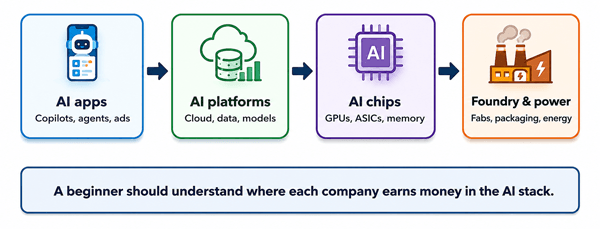
A beginner should understand where each company earns money in the AI stack.
1. What AI stocks are and why they matter in 2026
AI stocks are shares of companies that earn money from artificial intelligence. Some sell the chips used to train and run AI models. Some rent cloud computing power. Some use AI to improve advertising, software, search, shopping, cybersecurity, drug discovery, customer support, and business operations.
For beginners, the most important point is this: not every company that says 'AI' is a good investment. A strong AI stock should have real revenue, a clear business model, competitive advantages, a reasonable valuation, and the ability to keep growing even if AI hype cools down.
In 2026, the AI opportunity is no longer only about chatbots. The bigger story is the full AI value chain: chips, memory, networking, cloud platforms, data centers, enterprise software, AI assistants, advertising, and automation. That is why this guide mixes semiconductor leaders, cloud platforms, software companies, and consumer internet businesses.
The goal is not to create a hype list. The goal is to help a new investor understand what each company does, why it could benefit from AI, what can go wrong, and how to research it before putting real money into a brokerage account, retirement account, or long-term investment portfolio.
2. Quick answer: the 10 best AI stocks to research in 2026
| Rank | Stock | Ticker | AI role | Beginner fit | Main upside | Biggest risk |
|---|---|---|---|---|---|---|
| 1 | Nvidia | NVDA | GPU and AI infrastructure leader | Core but volatile | Data-center AI demand | Customer concentration and valuation |
| 2 | Microsoft | MSFT | Cloud, Copilot, enterprise AI | Core platform | Azure and Microsoft 365 AI monetization | High capex and competition |
| 3 | Amazon | AMZN | AWS, AI infrastructure, retail AI | Core platform | AWS AI services and custom chips | Spending must convert to profits |
| 4 | Alphabet | GOOGL | Search, Gemini, Google Cloud, TPU chips | Core platform | AI in search, ads, cloud, YouTube | Search disruption and regulation |
| 5 | Broadcom | AVGO | Custom AI chips and networking | Semiconductor core | ASICs and AI networking | Customer concentration |
| 6 | TSMC | TSM | Manufactures advanced AI chips | Semiconductor core | Foundry demand and advanced nodes | Geopolitical and cycle risk |
| 7 | Meta Platforms | META | AI ads, Llama, social apps | Growth platform | AI improves ads and engagement | Capex and metaverse spending |
| 8 | AMD | AMD | AI accelerators and server CPUs | Growth chip pick | Alternative to Nvidia; EPYC demand | Execution and margin pressure |
| 9 | Micron | MU | AI memory and storage | Cyclical growth | HBM and data-center memory demand | Memory price cycles |
| 10 | Palantir | PLTR | AI decision software and AIP | Higher-risk software | Commercial and government AI adoption | Very high valuation expectations |
3. How AI stocks work in simple language
Think of AI like a factory. A factory needs machines, electricity, workers, software, customers, and a product people will pay for. AI is similar:
- Chips and memory: Nvidia, AMD, Broadcom, TSMC, and Micron help create the hardware that makes AI possible.
- Cloud platforms: Microsoft Azure, Amazon AWS, and Google Cloud rent AI computing to businesses.
- Software and applications: Microsoft Copilot, Palantir AIP, Meta AI, Gemini, and other tools turn AI models into useful products.
- Data and distribution: Companies with millions or billions of users can test AI features faster and sell them through existing channels.
- Monetization: The key question is whether AI turns into revenue, margin improvement, or customer retention - not just press releases.
3.1 Beginner rule: follow the money, not the buzzword
A company may mention AI hundreds of times, but a beginner should ask: Where exactly does AI revenue show up? Is it in cloud sales, chip sales, subscriptions, advertising, consulting, or cost savings? If the answer is vague, the stock is harder to judge.
4. The 10 best AI stocks to research in 2026
4.1 Nvidia (NVDA)
What it does: Nvidia sells the GPUs, networking, systems, and software that power a large share of modern AI training and inference. Its Blackwell platform and data-center products make it one of the clearest direct beneficiaries of AI infrastructure spending.
Why it can win: Nvidia is strongest when demand for AI computing keeps exceeding supply. Cloud providers, AI labs, enterprises, and governments need huge amounts of accelerated computing. Nvidia also benefits from a software ecosystem that makes switching harder.
Main risks: A beginner should not assume Nvidia is risk-free just because it is the AI leader. The main risks are valuation, customer concentration, export controls, competition from custom chips, and the possibility that customers digest earlier purchases before ordering the next wave.
Beginner fit: Best for investors who want direct AI-chip exposure and can tolerate large price swings.
4.2 Microsoft (MSFT)
What it does: Microsoft is a diversified AI platform: Azure cloud, Microsoft 365 Copilot, GitHub Copilot, Windows, security, LinkedIn, and OpenAI-related ecosystem exposure. It is less pure-play than Nvidia but usually easier for beginners to understand because its cash flows come from many products.
Why it can win: The simple thesis is that Microsoft can add AI to products businesses already use. If Copilot increases revenue per user or improves customer retention, AI becomes a profit layer on top of an existing enterprise software machine.
Main risks: The risks are that AI features may cost a lot to run, customers may resist higher prices, and cloud competition remains intense. Heavy AI infrastructure spending can also pressure free cash flow before the payoff appears.
Beginner fit: Best for a beginner who wants a high-quality AI compounder rather than a single-product bet.
4.3 Amazon (AMZN)
What it does: Amazon benefits from AI in two big ways: AWS sells AI infrastructure and services to businesses, while Amazon uses AI in shopping, logistics, advertising, recommendations, and customer service.
Why it can win: AWS is the core AI story. Businesses that do not want to build their own data centers can rent compute, use AI models, and build applications on AWS. Amazon also designs custom chips such as Trainium to reduce costs and improve performance.
Main risks: The risk is that AI data centers require enormous spending before revenue fully arrives. Retail margins, cloud competition, regulation, and capital intensity can all affect returns.
Beginner fit: Best for investors who want a mix of cloud AI, e-commerce, advertising, and long-term infrastructure exposure.
4.4 Alphabet (GOOGL)
What it does: Alphabet owns Google Search, YouTube, Google Cloud, Android, Gemini, DeepMind, and custom TPU chips. It has world-class AI talent, massive distribution, and many ways to turn AI into revenue.
Why it can win: Google can use AI to improve search answers, ad targeting, productivity tools, cloud services, and YouTube recommendations. Google Cloud is especially important because enterprise AI workloads can become a long-term growth engine.
Main risks: The biggest question is whether AI changes search economics. If users get answers without clicking ads, Google must adapt monetization. Alphabet also faces antitrust pressure and very high AI capex.
Beginner fit: Best for investors who believe Google can defend search while growing cloud and Gemini products.
4.5 Broadcom (AVGO)
What it does: Broadcom is a key AI infrastructure supplier through custom AI accelerators, networking chips, and data-center connectivity. It is not as famous among beginners as Nvidia, but hyperscalers increasingly want custom chips for cost and performance reasons.
Why it can win: Broadcom can win when large cloud companies design custom silicon and need networking to connect massive AI clusters. Its AI semiconductor revenue has been growing sharply, showing that AI demand is already visible in the business.
Main risks: Risks include customer concentration, semiconductor cycles, integration complexity from acquisitions, and the chance that customers diversify suppliers.
Beginner fit: Best for investors who want AI infrastructure exposure beyond GPUs.
4.6 Taiwan Semiconductor Manufacturing Company (TSM)
What it does: TSMC manufactures advanced chips for many of the world’s leading semiconductor companies. In simple terms, if Nvidia, AMD, Apple, Broadcom, or other chip designers need advanced manufacturing, TSMC is often the factory behind the scenes.
Why it can win: TSMC benefits from AI even when investors argue about which chip designer wins. More AI chips usually mean more demand for advanced nodes, packaging, and manufacturing capacity.
Main risks: The biggest risks are geopolitical tension around Taiwan, semiconductor cyclicality, customer concentration, energy/water needs, and the high cost of new fabs.
Beginner fit: Best for investors who want broad AI hardware exposure through the leading foundry.
4.7 Meta Platforms (META)
What it does: Meta uses AI across Facebook, Instagram, WhatsApp, Threads, ads, ranking systems, creator tools, messaging, and its open-source Llama models. AI can improve ad performance and create new consumer assistants.
Why it can win: Meta has a practical AI advantage: billions of users and a huge ad business. If AI makes ads more relevant, automates creative work, or improves engagement, it can directly help revenue and margins.
Main risks: The risks are large capital spending, regulatory pressure, content moderation issues, privacy concerns, and uncertainty around Reality Labs/metaverse investments.
Beginner fit: Best for investors who want AI monetization through advertising and consumer apps.
4.8 Advanced Micro Devices (AMD)
What it does: AMD sells server CPUs and AI accelerators. Its EPYC server chips are already important in data centers, and its Instinct GPU line gives customers an alternative to Nvidia.
Why it can win: The opportunity is simple: AI buyers want more supply, better pricing, and more competition. If AMD keeps improving software, performance, and supply, it can take meaningful share in AI compute.
Main risks: Risks include fierce competition, lower margins than Nvidia, software ecosystem gaps, and the need to execute perfectly against larger incumbents.
Beginner fit: Best for investors seeking a higher-upside chip challenger with more execution risk.
4.9 Micron Technology (MU)
What it does: Micron makes memory and storage products. AI systems need huge amounts of high-bandwidth memory, DRAM, NAND, and storage. As models get larger and inference workloads grow, memory can become a bottleneck.
Why it can win: Micron is attractive when AI data centers create tight memory supply and better pricing. Partnerships with AI companies and demand for high-bandwidth memory can make the business look less like a commodity cycle during strong periods.
Main risks: Memory is cyclical. Prices can rise quickly and fall quickly. A beginner should expect sharp earnings swings and avoid buying only because recent numbers look spectacular.
Beginner fit: Best for investors who understand cycles and want AI memory exposure.
4.10 Palantir Technologies (PLTR)
What it does: Palantir sells software that helps governments and companies use data for decisions. Its Artificial Intelligence Platform, often called AIP, helps organizations connect AI models to real workflows.
Why it can win: Palantir is not selling chips; it sells decision software. The bull case is that companies want AI that works inside operations, not just chatbots. If AIP becomes a standard operating layer, growth can remain strong.
Main risks: The risk is valuation. Palantir can be a great company and still be a risky stock if expectations are too high. Government concentration, sales cycles, and competition also matter.
Beginner fit: Best for investors comfortable with premium-valued, high-growth software.
5. Current snapshot: prices and valuation context
These figures are point-in-time market snapshots from July 15, 2026. They are useful for context, not as a buy signal, and may change throughout the trading day.
| Ticker | Approx. price | P/E shown by market data | AI exposure type | Beginner note |
|---|---|---|---|---|
| NVDA | $209.14 | 31.8 | AI GPUs and systems | AI leader; watch concentration. |
| MSFT | $397.44 | 23.6 | Cloud and enterprise software | Diversified quality AI platform. |
| GOOGL | $370.66 | 28.3 | Search, cloud, Gemini | Search plus cloud AI. |
| AMZN | $255.78 | 30.6 | AWS and commerce AI | AWS AI plus retail ads. |
| AVGO | $388.80 | 97.6 | Custom chips and networking | High AI growth; check valuation. |
| TSM | $418.40 | N/A | Advanced foundry | Foundry backbone; geopolitical risk. |
| META | $680.62 | 24.7 | AI ads and social apps | Ads AI and user scale. |
| PLTR | $133.62 | 150.1 | AI decision software | High growth, high valuation. |
| AMD | $517.85 | 169.8 | AI accelerators and CPUs | AI challenger; execution risk. |
| MU | $903.60 | 20.5 | AI memory and storage | Memory cycle risk. |
6. How a beginner can decide which AI stock fits them
| Question | Why it matters | Beginner action |
|---|---|---|
| Risk tolerance | Can you stay calm if the stock falls 25%-40%? AI stocks can move fast. | Write down your answer before buying. |
| Business clarity | Can you explain in one sentence how the company earns AI-related money? | Write down your answer before buying. |
| Valuation discipline | Are you buying because earnings may grow, or just because the chart went up? | Write down your answer before buying. |
| Diversification | Do you already own the same companies through an S&P 500 ETF, Nasdaq ETF, or retirement account? | Write down your answer before buying. |
| Time horizon | AI infrastructure cycles can take years. Short-term traders and long-term investors need different plans. | Write down your answer before buying. |
| Position sizing | A beginner rarely needs to put all money into one AI stock. A basket or ETF can reduce single-company risk. | Write down your answer before buying. |
| Review schedule | Check earnings, margins, capex, guidance, and competition every quarter. | Write down your answer before buying. |
7. Practical example: building a simple AI stock basket
Example only: A beginner with $1,000 who wants AI exposure could avoid betting everything on one company. One simple structure is to divide exposure among platforms, semiconductors, higher-risk software, and cash or ETFs. This is not a recommendation; it is a teaching example for position sizing.
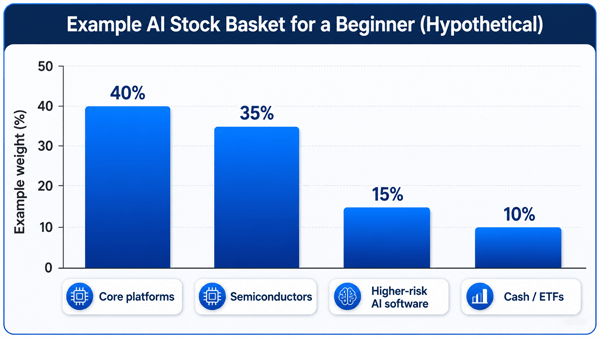
Example AI Stock Basket for a Beginner (Hypothetical)
A practical beginner approach might look like this: 40% in diversified AI platforms such as Microsoft, Amazon, Alphabet, or Meta; 35% in chip and infrastructure leaders such as Nvidia, Broadcom, TSMC, AMD, or Micron; 15% in higher-risk software such as Palantir; and 10% held in cash or broad ETFs for flexibility. The exact mix depends on risk tolerance, age, income stability, and existing investments.
8. Comparison: stock picking vs AI ETF
| Choice | Pros | Cons |
|---|---|---|
| Individual AI stocks | More control; can focus on highest-conviction companies; potential to outperform. | Requires research; higher single-stock risk; emotional decisions are harder. |
| AI or semiconductor ETF | Instant diversification; easier for beginners; less company-specific risk. | Fees; may include weaker companies; upside may be diluted. |
| Broad index fund plus a few AI stocks | Balanced; avoids overconcentration; simple to manage. | Less exciting; still requires discipline and rebalancing. |
9. Risks people often learn the hard way
- AI bubble risk: Great technology can still become overpriced. A stock can fall even if the company keeps growing.
- Capex risk: AI data centers require enormous spending on chips, buildings, power, cooling, and networking. Investors must watch whether spending converts into revenue and cash flow.
- Commoditization: Some AI services may become cheaper over time, pressuring margins.
- Competition: Nvidia competes with AMD and custom chips; cloud platforms compete with each other; software companies compete with in-house tools.
- Regulation: Privacy, copyright, antitrust, export controls, and data-security rules can affect AI companies.
- Geopolitics: Semiconductor supply chains depend on Taiwan, advanced equipment, rare materials, and global trade rules.
- Personal finance risk: Do not invest emergency-fund money in volatile stocks. Debt, short time horizons, and leverage can turn normal volatility into a serious problem.
10. FAQs: Best AI stocks to buy in 2026
10.1 What is the best AI stock for beginners?
There is no single best stock for every beginner. Microsoft, Alphabet, Amazon, and Meta may be easier to understand because they are diversified businesses. Nvidia is more directly tied to AI chips but can be more volatile.
10.2 Are AI stocks safe?
No stock is completely safe. AI stocks can be especially volatile because expectations are high and valuations can change quickly.
10.3 Should I buy Nvidia or an AI ETF?
Nvidia gives direct exposure to AI chips, while an ETF spreads risk across many companies. Beginners who do not want to track earnings closely may prefer an ETF or a smaller Nvidia position inside a diversified portfolio.
10.4 How much money do I need to start investing in AI stocks?
Many brokerage accounts allow fractional shares, so a beginner can start with a small amount. The better question is whether you have an emergency fund, no high-interest debt, and a long enough time horizon.
10.5 What numbers should I watch each quarter?
Revenue growth, gross margin, operating margin, free cash flow, capex, AI-specific revenue commentary, backlog, cloud growth, data-center revenue, and management guidance.
10.6 Can AI stocks crash in 2026?
Yes. Any fast-rising theme can correct sharply. A strong company can still fall because of valuation, earnings misses, interest rates, regulation, or slower demand.
11. Conclusion
The best AI stocks to buy in 2026 are not simply the companies with the loudest AI marketing. The strongest candidates are companies with real AI revenue paths, durable competitive advantages, and management teams that can turn massive AI demand into cash flow. Nvidia, Microsoft, Amazon, Alphabet, Broadcom, TSMC, Meta, AMD, Micron, and Palantir all offer different types of AI exposure. A smart beginner does not need to own all of them. The better approach is to understand each role in the AI stack, size positions carefully, diversify, and review the thesis every quarter.
12. Sources Consulted and Checked
The following sources were consulted and checked while preparing this article to support factual accuracy and responsible presentation. Readers should review the latest company filings and official updates because financial information can change.
- NVIDIA Investor Relations: FY2027 Q1 financial results and FY2026/FY2025 reporting: record revenue and data-center revenue; Blackwell platform details.
- Microsoft Investor Relations: FY2026 Q3 press release and performance notes: revenue growth, Microsoft Cloud, Azure, and Copilot-related performance commentary.
- Alphabet Investor Relations / 2025 10-K / Q4 2025 earnings: Google Services, Google Cloud, YouTube, AI R&D, Gemini, and cloud growth commentary.
- Amazon 2025 Annual Report / Investor Relations: AWS AI revenue run-rate commentary, AI services, custom silicon, and annual report data.
- Broadcom Investor Relations: Fiscal 2026 Q1 and Q2 results: AI semiconductor revenue growth, custom accelerators, and AI networking commentary.
- TSMC Investor Relations: Q1 2026 quarterly results and company materials: foundry position and AI/HPC demand context.
- Meta Investor Relations: Q1 2026 results: revenue, operating margin, AI commentary, capex guidance context.
- AMD Investor Relations: Q1 2026 results: data-center revenue growth, EPYC and Instinct AI accelerator demand.
- Micron / Reuters / market reports: AI memory and storage demand, Anthropic strategic supply agreement, and memory-cycle context.
- Palantir Investor Relations: Q1 2026 results and business update: AIP, U.S. revenue growth, and revenue growth metrics.
- Market data snapshot: Prices and P/E figures captured from current finance data on June 23, 2026. Market capitalization was intentionally left out because ADRs, split adjustments, and data-provider differences can confuse beginners;.
Reader Advice
This article is provided solely for educational and informational purposes and does not constitute personal financial, investment, legal, tax, or brokerage advice. The stocks discussed are research candidates, not recommendations or promises of returns. As artificial intelligence is a rapidly evolving field, developments in AI technology, adoption, competition, computing infrastructure, regulation, and related business strategies may influence companies in different ways over time. Readers may therefore wish to view the companies discussed as a starting point for further research and consider how their AI opportunities fit within their broader businesses and long-term prospects.
Prices, valuation measures, company results, regulations, tax rules, market conditions, and individual circumstances can change, sometimes quickly. Before making any decision, readers should verify facts, figures, ticker information, filings, and current rules through official company investor-relations pages, regulatory filings, qualified professionals, and other reliable primary sources. Consider personal goals, risk tolerance, time horizon, diversification, emergency savings, debt, and the possibility of losing some or all invested capital. Past performance does not guarantee future results.