10 Best Semiconductor Stocks to Buy in 2026
1. Introduction: Why semiconductor stocks matter in 2026
Semiconductors are the tiny chips that make modern technology work. They sit inside smartphones, laptops, cars, medical devices, factory machines, cloud servers and artificial intelligence data centers. When people talk about AI, electric vehicles, cloud computing, 5G, robotics or edge devices, they are really talking about systems that need more chips.
In 2026, the semiconductor market is being shaped by one major force: AI infrastructure. Training and running AI models requires graphics processors, custom accelerators, high-bandwidth memory, advanced networking chips, foundry capacity, lithography machines, etch tools, deposition systems and advanced packaging. That means the opportunity is not limited to one company. The whole chip supply chain can benefit, but each part carries different risks.
This guide explains the 10 best semiconductor stocks to buy or watch in 2026 in plain English. Instead of saying “buy this because AI is big,” it shows what each company actually does, why investors like it, what can go wrong, and how a beginner might compare these stocks before investing.
The best semiconductor stocks to buy in 2026 are Nvidia, Broadcom, Taiwan Semiconductor Manufacturing, ASML, AMD, Micron, Qualcomm, Lam Research, Applied Materials and Marvell Technology. They cover AI chips, custom silicon, foundry manufacturing, semiconductor equipment, memory, mobile chips and AI networking. A beginner should not buy all of them blindly; the smarter approach is to understand each company’s role, valuation, cyclicality and risk before building a diversified semiconductor portfolio.
2. What is a semiconductor? A simple explanation for beginners
A semiconductor is a material that can act partly like a conductor and partly like an insulator. That sounds technical, but the idea is simple: it lets engineers control the flow of electricity. By controlling tiny electrical signals, chips can store data, process information, run software, display graphics, connect devices and power AI models.
Think of a chip like a city. Transistors are the tiny switches, wires are the roads, memory is the storage, and software is the instruction book. The more advanced the chip, the more work it can do while using less power. This is why chip companies compete so hard on speed, efficiency, manufacturing scale and design quality.
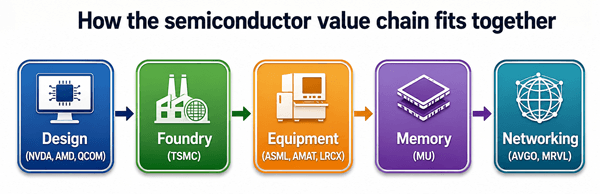
How the semiconductor value chain fits together
3. How semiconductor stocks make money
Semiconductor companies do not all make money the same way. Some design chips and outsource manufacturing. Some manufacture chips for other companies. Some sell the machines needed to make chips. Some sell memory, which can be highly cyclical. Some sell networking chips that connect thousands of AI processors inside huge data centers.
This matters because two semiconductor stocks can both benefit from AI but behave very differently. A design company may have high margins but depend on a few large customers. A foundry may have huge scale but needs massive capital spending. A memory company may look cheap near the bottom of a cycle and expensive near the top. Equipment companies may boom when fabs expand and slow down when customers pause spending.
| Business type | Plain-English meaning | Examples | Main risk |
|---|---|---|---|
| Chip designers | Design chips, often outsource production | Nvidia, AMD, Qualcomm, Marvell | Competition, valuation, product cycles |
| Foundry | Manufactures chips for other companies | TSMC | Geopolitics, capex, customer concentration |
| Equipment | Sells machines used to make chips | ASML, Lam Research, Applied Materials | Fab spending cycles, export controls |
| Memory | Stores and feeds data to processors | Micron | Commodity pricing cycles |
| Infrastructure / networking | Connects chips and servers inside AI data centers | Broadcom, Marvell | Customer concentration and fast technology shifts |
4. Quick comparison: 10 best semiconductor stocks to buy or watch in 2026
| Rank | Stock | Ticker | Main exposure | Why it fits 2026 | Biggest beginner risk |
|---|---|---|---|---|---|
| 1 | Nvidia | NVDA | AI accelerators / full AI platform | Best for investors who want direct AI data-center exposure | Very large expectations, export controls, customer concentration |
| 2 | Broadcom | AVGO | Custom AI chips, networking, infrastructure software | Best for AI infrastructure plus cash-flow discipline | High valuation, acquisition integration, hyperscaler concentration |
| 3 | Taiwan Semiconductor | TSM | World-leading foundry | Best picks-and-shovels way to own advanced chip demand | Taiwan geopolitical risk, capex intensity, customer concentration |
| 4 | ASML | ASML | EUV lithography monopoly-like position | Best equipment moat for leading-edge chips | Export controls, order cycles, premium valuation |
| 5 | AMD | AMD | Data-center CPUs and AI GPUs | Best challenger story against Nvidia and Intel | Execution risk in AI software ecosystem, valuation |
| 6 | Micron | MU | DRAM, NAND, HBM memory | Best cyclical AI memory recovery play | Memory cycles can reverse quickly; capex and pricing risk |
| 7 | Qualcomm | QCOM | Mobile, automotive, edge AI | Best balanced chip stock away from pure data centers | Smartphone cycle and major-customer dependence |
| 8 | Lam Research | LRCX | Etch and deposition tools | Best memory/fab equipment exposure | Highly cyclical equipment spending; China restrictions |
| 9 | Applied Materials | AMAT | Broad semiconductor manufacturing tools | Best broad equipment and advanced packaging exposure | Fab spending cycles and China demand risk |
| 10 | Marvell Technology | MRVL | AI networking, optical, custom silicon | Best higher-growth AI infrastructure contender | Execution risk, competition, valuation sensitivity |
4.1 Nvidia (NVDA)
What it does: Nvidia is included because its core business gives investors exposure to AI accelerators and a full AI platform. For a beginner, the easy way to think about NVDA is this: it sells a critical piece of the chip economy rather than a finished consumer gadget.
Why it stands out in 2026: Nvidia remains the clearest direct play on AI data centers. Its GPUs, networking systems, software stack and CUDA ecosystem make it more than a chip seller; it is a platform company for AI infrastructure. Nvidia reported record FY2026 revenue and continued strong data-center growth into early FY2027, showing that AI demand has remained powerful. [1][2]
Practical investor example: A beginner who believes cloud companies will keep spending heavily on AI training and inference might use Nvidia as the “core AI accelerator” position. The catch is that the stock already prices in a lot of success, so position size matters.
Beginner takeaway: Best for investors who want direct AI data-center exposure. Main risk to check before buying: Very large expectations, export controls, customer concentration.
4.2 Broadcom (AVGO)
What it does: Broadcom is included because its core business gives investors exposure to custom AI chips, networking and infrastructure software. For a beginner, the easy way to think about AVGO is this: it sells a critical piece of the chip economy rather than a finished consumer gadget.
Why it stands out in 2026: Broadcom gives exposure to custom AI accelerators, Ethernet AI switches and infrastructure software. Its AI semiconductor revenue grew strongly in fiscal 2025 and Q1 fiscal 2026, helped by demand for custom chips and AI networking. [5]
Practical investor example: Broadcom may appeal to investors who want AI exposure but prefer a company with a long record of acquisition discipline, dividends and free cash flow. It is not “safer” by default, but it is a different kind of AI bet than Nvidia.
Beginner takeaway: Best for AI infrastructure plus cash-flow discipline. Main risk to check before buying: High valuation, acquisition integration, hyperscaler concentration.
4.3 Taiwan Semiconductor (TSM)
What it does: Taiwan Semiconductor is included because its core business gives investors exposure to a world-leading foundry. For a beginner, the easy way to think about TSM is this: it sells a critical piece of the chip economy rather than a finished consumer gadget.
Why it stands out in 2026: TSMC manufactures advanced chips for many of the world’s leading designers. Its advanced technologies, defined as 7nm and smaller, represented a large share of wafer revenue in 2025, with strong demand from high-performance computing and AI-related customers. [4]
Practical investor example: If you do not know which chip designer will win, a foundry leader can be a picks-and-shovels choice because many winners still need manufacturing capacity.
Beginner takeaway: Best picks-and-shovels way to own advanced chip demand. Main risk to check before buying: Taiwan geopolitical risk, capex intensity, customer concentration.
4.4 ASML (ASML)
What it does: ASML is included because its core business gives investors exposure to an EUV lithography position with monopoly-like characteristics. For a beginner, the easy way to think about ASML is this: it sells a critical piece of the chip economy rather than a finished consumer gadget.
Why it stands out in 2026: ASML sells lithography systems used to print the world’s most advanced chips. Its EUV technology is essential for leading-edge manufacturing, and its 2025 annual report highlighted EUR32.7 billion of net sales and continuing EUV progress. [6]
Practical investor example: ASML is like owning a toll road for advanced chip manufacturing. But equipment orders can be lumpy, and export-control headlines can move the stock.
Beginner takeaway: Best equipment moat for leading-edge chips. Main risk to check before buying: Export controls, order cycles, premium valuation.
4.5 AMD (AMD)
What it does: AMD is included because its core business gives investors exposure to data-center CPUs and AI GPUs. For a beginner, the easy way to think about AMD is this: it sells a critical piece of the chip economy rather than a finished consumer gadget.
Why it stands out in 2026: AMD is a challenger in data-center CPUs and AI accelerators. Its appeal is that it can grow by taking share in servers and by offering customers an alternative to Nvidia in AI GPUs. The bull case is not that AMD must beat Nvidia; it only needs to win enough share in a very large market.
Practical investor example: AMD is suitable for investors who want a higher-upside challenger story and can tolerate execution risk. Watch data-center revenue, AI GPU adoption, software support and gross margin.
Beginner takeaway: Best challenger story against Nvidia and Intel. Main risk to check before buying: Execution risk in AI software ecosystem, valuation.
4.6 Micron (MU)
What it does: Micron is included because its core business gives investors exposure to DRAM, NAND and HBM memory. For a beginner, the easy way to think about MU is this: it sells a critical piece of the chip economy rather than a finished consumer gadget.
Why it stands out in 2026: Micron sells memory chips, including DRAM, NAND and high-bandwidth memory used in AI systems. AI servers need enormous memory bandwidth, and recent market commentary has emphasized strong HBM demand and a powerful memory upcycle. [11]
Practical investor example: Micron can rise sharply when memory prices tighten, but beginners should remember that memory is cyclical. A “cheap” P/E can be misleading near peak earnings.
Beginner takeaway: Best cyclical AI memory recovery play. Main risk to check before buying: Memory cycles can reverse quickly; capex and pricing risk.
4.7 Qualcomm (QCOM)
What it does: Qualcomm is included because its core business gives investors exposure to mobile, automotive and edge AI. For a beginner, the easy way to think about QCOM is this: it sells a critical piece of the chip economy rather than a finished consumer gadget.
Why it stands out in 2026: Qualcomm is best known for mobile chips and wireless technology, but it is also expanding in automotive, IoT and edge AI. Its fiscal 2025 filing shows dependence on large handset customers, which is both a strength and a risk. [7]
Practical investor example: Qualcomm can be used as a more diversified semiconductor holding for investors who want exposure to phones, cars and on-device AI rather than only cloud data centers.
Beginner takeaway: Best balanced chip stock away from pure data centers. Main risk to check before buying: Smartphone cycle and major-customer dependence.
4.8 Lam Research (LRCX)
What it does: Lam Research is included because its core business gives investors exposure to etch and deposition tools. For a beginner, the easy way to think about LRCX is this: it sells a critical piece of the chip economy rather than a finished consumer gadget.
Why it stands out in 2026: Lam Research provides advanced deposition and etch tools used in chip fabrication, especially important for memory and complex 3D structures. Its 2026 Boise investment release highlighted Lam tools in Micron’s high-performance memory manufacturing. [8]
Practical investor example: Lam is a picks-and-shovels stock for investors who believe memory and leading-edge fabs will keep investing. The risk is that equipment spending can pause quickly.
Beginner takeaway: Best memory/fab equipment exposure. Main risk to check before buying: Highly cyclical equipment spending; China restrictions.
4.9 Applied Materials (AMAT)
What it does: Applied Materials is included because its core business gives investors exposure to broad semiconductor manufacturing tools. For a beginner, the easy way to think about AMAT is this: it sells a critical piece of the chip economy rather than a finished consumer gadget.
Why it stands out in 2026: Applied Materials is one of the broadest semiconductor equipment companies, with tools for deposition, etch, inspection, metrology, packaging and related manufacturing steps. Its FY2025 filing discusses advanced packaging and heterogeneous integration as important technology trends. [9]
Practical investor example: Applied Materials can be a broad equipment play for investors who do not want to choose a single process technology winner.
Beginner takeaway: Best broad equipment and advanced packaging exposure. Main risk to check before buying: Fab spending cycles and China demand risk.
4.10 Marvell Technology (MRVL)
What it does: Marvell Technology is included because its core business gives investors exposure to AI networking, optical connectivity and custom silicon. For a beginner, the easy way to think about MRVL is this: it sells a critical piece of the chip economy rather than a finished consumer gadget.
Why it stands out in 2026: Marvell focuses on data infrastructure, including AI networking, switching, optical interconnect and custom silicon. In 2026 the company announced products such as a 102.4 Tbps AI/cloud data-center switch, underscoring its role in connecting AI systems. [10]
Practical investor example: Marvell is a higher-growth, higher-risk AI infrastructure idea. It may benefit as bottlenecks move from compute to networking and optical links, but expectations can change fast.
Beginner takeaway: Best higher-growth AI infrastructure contender. Main risk to check before buying: Execution risk, competition, valuation sensitivity.
5. Which semiconductor stock is best for which type of investor?
| Investor type | Better fit | Why |
|---|---|---|
| Wants direct AI exposure | Nvidia, Broadcom, AMD | These companies sell AI accelerators, custom AI chips or AI infrastructure platforms. |
| Wants picks-and-shovels exposure | TSMC, ASML, Lam, Applied Materials | They benefit when many chip designers need manufacturing and fab equipment. |
| Wants cyclical upside | Micron, Lam | Memory and equipment names can rebound strongly when supply tightens. |
| Wants diversification beyond cloud AI | Qualcomm | Mobile, automotive and edge AI reduce reliance on hyperscale data centers. |
| Wants higher-risk growth | Marvell, AMD | Both can benefit from share gains, but execution matters. |
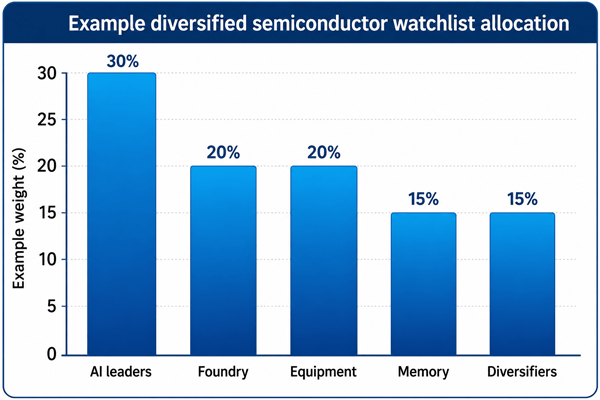
Example diversified semiconductor watchlist allocation
This is not a recommended allocation. It is a teaching example showing how a reader might avoid putting the entire semiconductor budget into one stock.
6. How beginners can use this list without gambling
Start with a watchlist, not a buy order. Read the latest quarterly report, check revenue growth by segment, compare valuation to growth, and decide what would make you sell before you buy.
Use position sizing. A volatile semiconductor stock should usually be a smaller position than a broad index fund. Beginners often make the mistake of buying the most exciting stock with the largest position size.
Compare single stocks with semiconductor ETFs. A semiconductor ETF can reduce company-specific risk, although it still carries sector risk. A reader using a brokerage account or retirement account should compare expense ratios, holdings, tax treatment and concentration before choosing an ETF or individual stock.
Avoid “guaranteed winner” thinking. The best chip company can still be a bad investment if purchased at an unrealistic valuation. Strong businesses and strong stocks are not always the same thing.
7. Valuation checklist before buying semiconductor stocks
| Question | Why it matters | Beginner-friendly interpretation |
|---|---|---|
| Is revenue growing because of real demand or only price increases? | Separates structural growth from temporary cycle benefits. | AI demand is stronger if units, customers and backlog all improve. |
| Is the stock already priced for perfection? | High valuation increases downside if growth slows. | A great company can fall if expectations are too high. |
| How concentrated are customers? | A few large buyers can create revenue risk. | Check whether one customer has too much power. |
| Does the company need heavy capital spending? | Capex can reduce free cash flow. | Foundries and equipment cycles require patience. |
| What is the export-control risk? | Chip sales and tools can be restricted by governments. | Geopolitics can affect revenue even when demand is strong. |
8. Common mistakes beginners make with semiconductor stocks
Mistake 1: Buying only the hottest ticker. A list of best semiconductor stocks should include the whole supply chain, not only the most famous AI stock.
Mistake 2: Ignoring cycles. Memory, equipment and smartphone-related chips can move in cycles. Earnings may look best near the top and worst near the bottom.
Mistake 3: Confusing product quality with stock quality. A company can make excellent chips while the stock is temporarily expensive.
Mistake 4: Not reading risk factors. Annual reports are boring, but they show customer concentration, export restrictions, supply-chain risks and margin pressure.
Mistake 5: Treating social media excitement as research. Real research includes financial statements, valuation, competitive position and scenario analysis.
9. Frequently asked questions
9.1 What is the best semiconductor stock for beginners in 2026?
There is no single best stock for every beginner. Nvidia is the most direct AI accelerator leader, TSMC is a broad foundry leader, and ASML is a high-moat equipment company. A beginner should choose based on risk tolerance, valuation and desired exposure.
9.2 Are semiconductor stocks risky?
Yes. They can be very profitable but volatile. Risks include high valuations, export controls, customer concentration, technology changes, cyclicality and competition.
9.3 Should I buy semiconductor ETFs instead of individual stocks?
A semiconductor ETF may be easier for beginners because it spreads risk across many companies. Individual stocks can offer more upside but require more research and discipline.
9.4 What is the difference between AI chip stocks and semiconductor stocks?
AI chip stocks are a subset of semiconductor stocks focused on AI accelerators, memory, networking and related data-center infrastructure. Semiconductor stocks also include mobile chips, auto chips, industrial chips, foundries and equipment makers.
9.5 How much of my portfolio should be in semiconductor stocks?
That depends on your age, goals, risk tolerance and existing holdings. Many beginners should keep sector bets modest and use broad index funds as the core of their portfolio.
10. Conclusion: The practical way to invest in chip stocks in 2026
The best semiconductor stocks to buy in 2026 are not all the same kind of investment. Nvidia and Broadcom are AI infrastructure leaders. TSMC and ASML are foundational picks-and-shovels companies. AMD and Marvell offer higher-growth challenger exposure. Micron provides memory-cycle upside. Qualcomm adds mobile, automotive and edge AI diversification. Lam Research and Applied Materials provide manufacturing-equipment exposure.
For beginners, the smartest approach is to understand the role each company plays, avoid oversized bets, compare valuation with realistic growth, and keep a written investment thesis. Semiconductor stocks can create wealth, but they can also fall sharply when expectations, cycles or geopolitics change. Good investing is not about chasing the most exciting story; it is about matching opportunity with discipline.
11. Sources Consulted and Checked
The following sources were consulted and checked while preparing this article to support factual accuracy and context.
[1] NVIDIA financial reports, FY2026 and Q1 FY2027 results: https://investor.nvidia.com/financial-info/financial-reports/default.aspx
[2] NVIDIA FY2026 annual review: https://s201.q4cdn.com/141608511/files/doc_financials/2026/ar/2026-Annual-Report-Web.pdf
[3] Deloitte 2026 Global Semiconductor Industry Outlook: https://www.deloitte.com/us/en/insights/industry/technology/technology-media-telecom-outlooks/semiconductor-industry-outlook.html
[4] TSMC 2025 annual report website: https://investor.tsmc.com/static/annualReports/2025/english/index.html
[5] Broadcom FY2025 and Q1 FY2026 results: https://investors.broadcom.com/news-releases/news-release-details/broadcom-inc-announces-first-quarter-fiscal-year-2026-financial
[6] ASML 2025 annual report: https://www.asml.com/investors/annual-report/2025
[7] Qualcomm FY2025 Form 10-K: https://www.sec.gov/Archives/edgar/data/804328/000080432825000085/qcom-20250928.htm
[8] Lam Research 2026 Boise investment release: https://newsroom.lamresearch.com/2026-02-17-Lam-Research-Deepens-Investment-in-Boise-to-Support-Projected-Growth-in-U-S-Semiconductor-Manufacturing
[9] Applied Materials FY2025 Form 10-K: https://ir.appliedmaterials.com/static-files/af687923-06c7-4b43-a7a5-45750717f3ca
[10] Marvell investor news releases: https://investor.marvell.com/news-events/press-releases
[11] Reuters: SK Hynix and HBM market context, June 22, 2026: https://www.reuters.com/world/asia-pacific/sk-hynix-overtakes-samsung-become-koreas-most-valuable-company-2026-06-22/
Reader Advice
This article provides general information and does not constitute personalized investment, financial, legal or tax advice, or a recommendation to buy, sell or hold any security. Semiconductor stocks can be volatile and may result in loss of capital. The semiconductor industry can also be affected by rapid technological change, chip demand cycles, supply-chain disruptions, geopolitical developments and shifts in trade or export restrictions, so even leading companies can face unexpected challenges. Please keep these industry-specific risks in mind when considering any semiconductor stock discussed in this article.
Before making any decision, readers should assess their objectives, financial circumstances, risk tolerance, time horizon and portfolio diversification, and consider consulting an appropriately qualified professional. Company results, market conditions, valuations, laws, tax rules, export controls and other regulations can change. Readers should therefore verify current facts, figures, filings and rules through official company, regulatory and government sources. Past performance and market leadership do not guarantee future results.