zkEVM Explained: Meaning, How It Works, Examples, Benefits and Risks
1. Quick Answer: What Is a zkEVM?
A zkEVM, or zero-knowledge Ethereum Virtual Machine, is a system that runs Ethereum-style smart contracts and produces cryptographic validity proofs showing that the execution was correct. In simple terms, it lets many transactions happen on a faster Layer 2 network while Ethereum verifies a small proof instead of re-running every transaction itself.
The idea matters because Ethereum is secure and widely used, but block space on Ethereum Layer 1 is limited. zkEVM-based rollups aim to keep Ethereum compatibility while reducing costs and increasing throughput. They are especially important for decentralized exchanges, games, wallets, NFT platforms, payments, and applications that need cheaper transactions without abandoning the Ethereum developer ecosystem.
2. Beginner Summary
| Question | Simple answer |
|---|---|
| What does zkEVM mean? | Zero-knowledge Ethereum Virtual Machine. It combines Ethereum smart-contract execution with zero-knowledge validity proofs. |
| Is a zkEVM the same as Ethereum? | No. It usually runs on Layer 2, but it tries to behave like Ethereum so developers can reuse Solidity contracts and familiar tools. |
| What does it prove? | That a batch of transactions was executed correctly according to the rules of the virtual machine. |
| Does “zero-knowledge” always mean private? | No. Many zkEVM rollups use ZK proofs for correctness, not privacy. Transaction data may still be public. |
| Why use it? | Lower fees, faster user experience, Ethereum security inheritance, and easier migration for existing Ethereum apps. |
| Main risks? | Complex cryptography, bugs in circuits or bridges, centralized sequencers, upgrade keys, data availability assumptions, and immature tooling. |
3. Why zkEVMs Exist
Ethereum executes transactions on many nodes. This is excellent for security and decentralization, but it also means every full node repeats the same work. When many users want to transact, fees rise because block space is scarce. Layer 2 rollups reduce this load by processing transactions outside Ethereum and posting compressed results back to Ethereum.
A zero-knowledge rollup does not ask Ethereum to trust the off-chain operator blindly. Instead, it posts a validity proof. Ethereum verifies the proof through a smart contract. If the proof is valid, Ethereum accepts the new Layer 2 state. This is different from optimistic rollups, which assume a transaction batch is correct unless someone challenges it during a dispute window.
A zkEVM adds Ethereum compatibility to this model. Without a zkEVM, a ZK rollup might require developers to learn a new programming model. With a zkEVM, developers can often write or port Solidity smart contracts, use familiar wallets, and interact with applications in a way that feels close to Ethereum.
4. What Is the EVM?
The Ethereum Virtual Machine, or EVM, is the execution environment that runs smart contracts on Ethereum. When someone swaps tokens, mints an NFT, borrows from a lending protocol, or votes in a DAO, the EVM processes the smart-contract instructions and updates Ethereum state.
You can think of the EVM as a shared computer that many independent nodes agree to run. It is deterministic, meaning the same input should always produce the same output. That property is essential because thousands of nodes must reach the same result.
5. What Does “Zero-Knowledge” Mean Here?
Zero-knowledge proofs are cryptographic proofs that allow one party to prove a statement is true without requiring the verifier to redo all the work. In blockchain scaling, the key statement is usually: “These transactions were processed correctly, and the resulting state is valid.”
In many zkEVM rollups, the “zero-knowledge” part is not mainly about hiding transaction details. It is mainly about succinct verification. Ethereum can verify a compact proof instead of executing hundreds or thousands of transactions itself. Privacy can be added in some systems, but it is not automatic just because a rollup uses ZK proofs.
6. How a zkEVM Works Step by Step
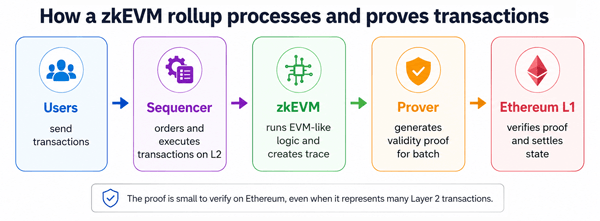
Diagram: A simplified zkEVM rollup flow from users to Ethereum settlement.
- Users submit transactions to the Layer 2 network. For example, a user swaps tokens on a decentralized exchange deployed on a zkEVM rollup.
- A sequencer orders the transactions. The sequencer gives users a fast confirmation on Layer 2 and builds a batch of transactions.
- The zkEVM executes the batch. It runs smart-contract logic in a way that matches, or closely resembles, Ethereum’s EVM rules.
- The system records an execution trace. This trace is a detailed mathematical record of each computation step, memory change, storage update, and state transition.
- A prover generates a validity proof. The proof says, in effect, that the batch was executed correctly and the new state follows from the old state.
- The proof and state update are submitted to Ethereum. An Ethereum smart contract verifies the proof.
- If the proof verifies, Ethereum accepts the Layer 2 state update. Users can eventually withdraw assets back to Ethereum according to the bridge rules.
6.1 A simple example
Imagine 10,000 people use a token swap app on a zkEVM Layer 2. Instead of Ethereum processing every swap one by one, the Layer 2 processes the swaps, bundles them, and generates a proof. Ethereum checks the proof. If the proof is valid, Ethereum accepts that the 10,000 swaps were processed correctly. This can reduce the amount of expensive Ethereum computation needed per user transaction.
7. zkEVM vs ZK Rollup vs zkVM
| Term | Meaning | Beginner explanation |
|---|---|---|
| ZK rollup | A Layer 2 that posts transaction data or state commitments to Ethereum and uses validity proofs. | The scaling system. It processes many transactions off-chain and proves correctness on-chain. |
| zkEVM | A ZK-compatible execution environment designed to support Ethereum-style smart contracts. | The engine that helps Ethereum apps run inside a ZK rollup. |
| zkVM | A general zero-knowledge virtual machine, not necessarily Ethereum-compatible. | A broader category. It may prove general programs, not just EVM-like smart contracts. |
| EVM equivalence | How closely the system behaves like Ethereum’s EVM. | The closer it is, the easier it is to port Ethereum apps and tools. |
8. Types of zkEVMs and Compatibility Trade-Offs
Not every zkEVM is equally compatible with Ethereum. A helpful way to understand the landscape is to look at the trade-off between Ethereum compatibility and proof-generation efficiency. The closer a system is to Ethereum’s exact design, the easier migration can be, but the harder and slower it may be to generate proofs. The more a system changes the execution model to be ZK-friendly, the faster proving may become, but developers may face more differences.
| Type | Compatibility goal | Main advantage | Main trade-off |
|---|---|---|---|
| Type 1: Ethereum-equivalent | Prove Ethereum itself with minimal changes. | Maximum compatibility with Ethereum clients and behavior. | Hardest to prove efficiently. |
| Type 2: EVM-equivalent | Very close to EVM behavior, with small changes to make proving practical. | Strong compatibility for most smart contracts and tools. | Some edge cases may differ. |
| Type 3: Almost EVM-compatible | More changes for proof efficiency. | Better performance and easier circuit design. | More incompatibilities for some apps or tools. |
| Type 4: High-level language compatible | Compiles Solidity or another language to a ZK-friendly VM. | Fast proving and optimized architecture. | Bytecode-level compatibility is weaker; low-level EVM assumptions may break. |
For beginners, the key lesson is simple: “EVM-compatible” does not always mean “identical to Ethereum.” Before deploying or using a protocol, check whether the specific zkEVM supports the opcodes, precompiles, tooling, wallet behavior, and bridge assumptions your application depends on.
9. Real-World Examples of zkEVM Projects
The zkEVM ecosystem changes quickly, but several well-known projects illustrate the main approaches.
| Project | What it is known for | Practical note |
|---|---|---|
| Scroll | An Ethereum-aligned zkEVM Layer 2 focused on EVM compatibility and validity proofs. | Developers often position it as a close-to-Ethereum environment, but users should still check current network maturity and risk disclosures. |
| Polygon zkEVM / Polygon CDK ecosystem | A ZK scaling stack associated with Polygon, including zkEVM technology and chain-development tooling. | Useful example of how zkEVM technology can support public rollups and custom chains, but chain-specific data availability and upgrade assumptions matter. |
| ZKsync Era | An EVM-compatible ZK rollup using a ZK-friendly architecture and its own tooling such as custom compilers and SDKs. | Many Solidity apps can be adapted, but developers should review differences from Ethereum execution. |
| Linea | A Consensys-backed zkEVM Layer 2 integrated with Ethereum developer tooling. | Shows how zkEVMs can target mainstream wallet and developer adoption. Always review live risk status before bridging large funds. |
| Taiko | An Ethereum-equivalent ZK rollup approach aiming to stay close to Ethereum design. | A useful example of the compatibility-first side of the zkEVM design spectrum. |
10. Benefits of zkEVMs
10.1 Lower transaction costs
zkEVM rollups can spread the cost of Ethereum settlement across many transactions. Users may pay less for swaps, transfers, NFT mints, and app interactions compared with doing everything directly on Ethereum Layer 1. Fees still depend on network demand, data availability costs, proof costs, and the rollup’s fee model.
10.2 Faster user experience
A Layer 2 sequencer can usually give users fast transaction feedback. This does not always mean instant final settlement on Ethereum, but it often makes applications feel much faster than using Layer 1 directly.
10.3 Ethereum compatibility
The biggest practical advantage is that developers can often reuse Solidity contracts, Ethereum wallets, RPC patterns, block explorers, and development tools. This lowers the learning curve and makes it easier for existing Ethereum apps to expand to Layer 2.
10.4 Validity proofs instead of long challenge periods
Optimistic rollups rely on fraud proofs and challenge periods. ZK rollups use validity proofs, so once a proof is verified on Ethereum, the state update has strong cryptographic confirmation. In practice, withdrawals and finality can still depend on implementation details, proof-generation speed, bridge design, and network operations.
10.5 Better scalability without leaving Ethereum
zkEVMs help Ethereum scale while keeping Ethereum as a settlement layer. Users can access cheaper transactions while still benefiting from Ethereum’s security model, provided the rollup posts sufficient data and the bridge and proof system are sound.
11. Risks and Limitations of zkEVMs
| Risk | Why it matters | What users or teams can do |
|---|---|---|
| Smart contract and circuit bugs | A bug in the rollup contracts, bridge, prover, verifier, or ZK circuits can put funds at risk. | Review audits, bug bounties, incident history, and whether the system has been battle-tested. |
| Centralized sequencers | Many rollups still rely on a centralized sequencer for transaction ordering and fast confirmations. | Understand censorship, downtime, and MEV risks. Look for decentralization roadmaps. |
| Upgrade keys and governance control | Admin keys may be able to upgrade contracts or change critical parameters. | Check timelocks, multisig structure, emergency powers, and monitoring. |
| Data availability assumptions | If transaction data is not available, users may have trouble reconstructing state or exiting safely. | Prefer rollups with clear data availability on Ethereum for highest security, or understand validium/committee assumptions. |
| Bridge risk | Bridges are frequent attack targets and can hold large amounts of value. | Bridge only what you need, use official bridges, and verify URLs carefully. |
| Compatibility gaps | Some opcodes, precompiles, gas behavior, timestamps, or tooling may differ. | Test thoroughly on testnets and read chain-specific developer docs. |
| Prover performance and cost | Generating proofs is computationally expensive and technically complex. | For app teams, monitor fees, proof latency, and network reliability before committing critical workflows. |
| False privacy assumptions | Users may assume “zero-knowledge” means their transactions are private. | Treat public rollup transactions as public unless the system explicitly provides privacy features. |
12. zkEVM vs Optimistic Rollups
| Feature | zkEVM / ZK rollup | Optimistic rollup |
|---|---|---|
| Correctness model | Uses validity proofs to prove state transitions. | Assumes batches are valid unless challenged. |
| Withdrawal experience | Can be faster in theory, depending on bridge and proof availability. | Often has a challenge-period delay for canonical withdrawals. |
| Technical complexity | Very high due to ZK circuits, provers, and verifier design. | Lower cryptographic complexity, but fraud-proof systems are also complex. |
| EVM compatibility | Improving quickly; varies by project. | Historically strong EVM compatibility in major systems. |
| Maturity | Rapidly developing; some systems remain early or partially centralized. | More battle-tested in some major networks, though still with risks. |
| Best fit | Apps that value proof-based finality, Ethereum compatibility, and long-term scalability. | Apps that need mature tooling and broad existing liquidity, depending on the network. |
13. Practical Use Cases
- Decentralized exchanges: lower-cost swaps and liquidity management.
- Wallets and payments: cheaper transfers, account abstraction, and smoother onboarding.
- Gaming and NFTs: frequent low-value transactions that would be too expensive on Layer 1.
- DeFi lending and derivatives: lower transaction costs for position management, though risk controls must be strong.
- Enterprise and institutional chains: custom ZK-powered chains with Ethereum settlement or interoperability, depending on architecture.
- Developer scaling: existing Solidity teams can reach cheaper execution environments without rebuilding everything from scratch.
14. Best Practices for Users
- Start small. Test the bridge and application with a small amount before moving meaningful funds.
- Use official links. Phishing sites often imitate bridges, airdrops, and block explorers.
- Check the network’s risk profile. Look at audits, total value secured, upgrade keys, data availability, and sequencer design.
- Understand finality. A fast Layer 2 confirmation is not always the same as final settlement on Ethereum.
- Keep wallet approvals limited. Use token approval checkers and revoke permissions you no longer need.
- Avoid assuming privacy. Unless privacy is explicitly built into the app, your transaction activity may be visible on-chain.
15. Best Practices for Developers
- Read the chain-specific compatibility documentation before deploying. Do not assume every EVM edge case behaves exactly like Ethereum.
- Test gas-sensitive logic, CREATE2 addresses, precompiles, block variables, signature verification, and low-level assembly carefully.
- Run integration tests on the actual target testnet and mainnet fork where possible.
- Design for bridge and sequencer failure modes. Ask what happens if the sequencer pauses, withdrawals slow, or L1 gas spikes.
- Use conservative upgrade patterns and clear monitoring. Rollup environments reduce some costs but do not remove smart-contract risk.
- Monitor proof and settlement status for critical operations. For high-value protocols, do not rely only on soft confirmations.
- Communicate network-specific risks to users in plain language, especially if deposits, withdrawals, or finality differ from Ethereum Layer 1.
16. Common Misconceptions About zkEVMs
16.1 Misconception 1: zkEVMs make all transactions private
Most public zkEVM rollups use zero-knowledge proofs for scalability and correctness, not automatic privacy. Transaction calldata, addresses, balances, and app interactions may still be visible depending on the system.
16.2 Misconception 2: zkEVMs remove all trust assumptions
Validity proofs reduce the need to trust off-chain execution, but users may still rely on bridge contracts, upgrade governance, sequencers, data availability, provers, and emergency controls.
16.3 Misconception 3: Any Solidity contract will work perfectly
Many contracts can be ported, but low-level assumptions can break. Developers should test thoroughly, especially if a contract uses assembly, unusual opcodes, exact gas assumptions, or chain-specific infrastructure.
16.4 Misconception 4: Lower fees mean no security trade-offs
Lower fees are valuable, but security depends on the full design. A cheap network with weak data availability, risky upgrades, poor audits, or centralized controls can be more dangerous than it appears.
17. How to Evaluate a zkEVM Network Before Using It
- Check whether it is a rollup, validium, or another design. This affects data availability and exit assumptions.
- Look for independent audits of the rollup contracts, bridge, prover, verifier, and circuits.
- Review who controls upgrades and whether changes are protected by timelocks.
- Check whether users can force transactions or exits if the sequencer goes offline or censors transactions.
- Compare ecosystem maturity: wallets, explorers, RPC providers, oracles, liquidity, and developer tooling.
- Review incident history and how transparently the team communicates risks.
- For developers, deploy a test version and run realistic transaction simulations before sending users to the network.
18. Mini Glossary
| Term | Meaning |
|---|---|
| Layer 1 (L1) | The base blockchain, such as Ethereum mainnet. |
| Layer 2 (L2) | A scaling network that uses the base chain for settlement or security. |
| Rollup | A Layer 2 that bundles transactions and posts results to Layer 1. |
| Validity proof | A cryptographic proof that a state transition was computed correctly. |
| Sequencer | The component that orders and batches Layer 2 transactions. |
| Prover | The component that generates the ZK proof. |
| Verifier contract | A smart contract on Ethereum that checks the validity proof. |
| Data availability | The guarantee that transaction data can be accessed so the state can be independently reconstructed. |
| Bridge | A mechanism for moving assets or messages between Ethereum and the Layer 2. |
19. FAQs About zkEVMs
19.1 Is zkEVM a blockchain?
Usually, a zkEVM is part of a Layer 2 blockchain or rollup system. The zkEVM is the execution environment; the full network also includes sequencers, provers, bridges, nodes, RPCs, and smart contracts on Ethereum.
19.2 Is zkEVM only for Ethereum?
The term is Ethereum-focused because it refers to EVM compatibility. However, similar ZK execution ideas can be used in other ecosystems through zkVMs or custom ZK rollup designs.
19.3 Can I use MetaMask with a zkEVM?
Often yes, if the network supports standard Ethereum wallet interfaces. You still need to add the correct network details and use official resources to avoid phishing.
19.4 Are zkEVM fees always cheaper than Ethereum?
Usually they are lower for many common actions, but not guaranteed. Fees depend on Layer 2 demand, Ethereum data costs, proof costs, sequencer pricing, and application design.
19.5 Can zkEVMs replace Ethereum Layer 1?
They are better understood as scaling Ethereum, not replacing it. Ethereum can act as a settlement and security layer while zkEVM rollups handle more execution.
19.6 What is the biggest risk for normal users?
The biggest practical risks are usually bridge risk, phishing, smart-contract bugs, upgrade controls, and misunderstanding withdrawal or finality rules.
19.7 What is the biggest risk for developers?
Compatibility assumptions. A contract that works on Ethereum may need changes or extra testing on a specific zkEVM, especially if it relies on low-level EVM details.
19.8 Does zkEVM mean zero gas fees?
No. zkEVMs can reduce costs, but users still pay fees for execution, data, and network operation.
19.9 What is the difference between EVM-compatible and EVM-equivalent?
EVM-compatible usually means Ethereum-style contracts and tools can work with some changes. EVM-equivalent means the system tries to behave much more like Ethereum at the EVM level. The exact meaning varies by project, so always check documentation.
19.10 Are zkEVMs safe today?
Some zkEVM networks are live and actively used, but the technology is still complex and maturing. Safety depends on the specific implementation, audits, governance, data availability, and operational history.
20. Conclusion: Why zkEVMs Matter
zkEVMs are one of the most important developments in Ethereum scaling because they combine two powerful ideas: Ethereum compatibility and zero-knowledge validity proofs. For users, this can mean cheaper and faster transactions. For developers, it can mean deploying familiar smart contracts in a more scalable environment. For Ethereum, it supports a future where the base chain focuses on settlement and security while Layer 2 networks handle more day-to-day activity.
At the same time, zkEVMs are not magic. They are complex systems with real risks: bridges, upgrade keys, centralized sequencers, circuit bugs, data availability assumptions, and compatibility gaps. The best approach is to use them thoughtfully, verify the specific network’s design, and treat “ZK” as a powerful tool rather than a blanket guarantee of safety or privacy.
Sources Consulted and Checked
These sources were consulted and checked while preparing this document to support accuracy and clarity.
- Ethereum.org, “Zero-knowledge rollups”
- Ethereum.org, “Danksharding” and EIP-4844 overview
- Vitalik Buterin, “The different types of ZK-EVMs”
- Scroll Documentation, “Intro to zkEVM”
- ZKsync Documentation
- L2BEAT, “Risk Analysis”
- Polygon technical documentation and zkEVM resources
Reader Advice
This article is provided for educational and informational purposes only and is not personalized legal, financial, investment, technical, or security advice or a recommendation to use any particular blockchain, network, bridge, wallet, protocol, or digital asset. Blockchain systems and zkEVM networks involve risks, including smart-contract or proof-system bugs, bridge exploits, phishing, loss of funds, network outages, governance or upgrade changes, data-availability issues, and differences between Layer 2 confirmation and Ethereum settlement. Rules, policies, laws, project features, security conditions, fees, and statistics can change over time and may vary by country or region. Before making a decision or transferring meaningful value, verify current information through official sources, review the specific network’s risk disclosures and documentation, test with a small amount, and seek qualified professional advice where appropriate.