Zero-Knowledge Proofs Explained
Meaning, How It Works, Examples, Benefits and Risks
A zero-knowledge proof is a cryptographic method that lets one party prove a statement is true without revealing the private information used to prove it. In simple terms, it lets someone say, “I can prove I know this,” without showing the secret itself. This idea is useful in privacy, identity, payments, blockchains, compliance, authentication and data sharing.
For example, you could prove you are over 18 without revealing your date of birth, prove you have enough money for a transaction without showing your full bank balance, or prove a blockchain batch of transactions is valid without making every computer re-execute all of the work.
2. What Is a Zero-Knowledge Proof?
A zero-knowledge proof, often shortened to ZKP, is a proof system with two main roles: a prover and a verifier. The prover wants to convince the verifier that a statement is true. The verifier wants confidence that the statement is true. The special part is that the verifier should learn nothing beyond the truth of the statement.
NIST describes a zero-knowledge proof as a cryptographic scheme where a prover convinces a verifier that a statement is true without providing more information than that one fact. In practice, this means the proof should not leak the secret, private data or full computation behind the claim.
2.1 A simple beginner example
Imagine Alice knows the password to open a locked door. Bob wants proof that Alice knows the password, but Alice does not want to tell Bob the password. A zero-knowledge-style process would let Alice prove she can open the door without revealing the password itself.
Real cryptographic systems are more formal than this story, but the core idea is the same: prove knowledge or correctness without exposing the underlying information.
3. The Three Core Properties of Zero-Knowledge Proofs
A useful ZKP is usually explained through three important properties: completeness, soundness and zero-knowledge.
| Property | Meaning | Beginner example |
|---|---|---|
| Completeness | If the statement is true and both parties follow the rules, the verifier should accept the proof. | If Alice really knows the password, Bob should be convinced. |
| Soundness | If the statement is false, a dishonest prover should not be able to trick the verifier except with tiny probability. | If Alice does not know the password, she should not be able to fake proof that she does. |
| Zero-knowledge | The verifier learns that the statement is true, but not the secret or extra private details. | Bob learns Alice knows the password, but not the password itself. |
4. How Zero-Knowledge Proofs Work
At a high level, a ZKP converts a private fact or computation into a proof that can be checked. The verifier does not need to see the private inputs. The verifier only checks whether the proof is valid.
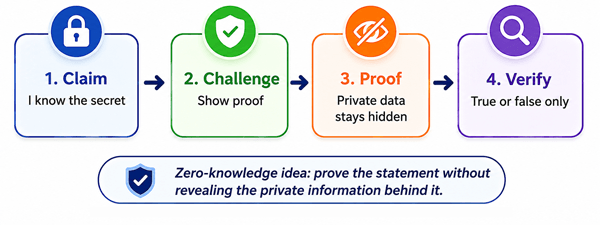
Diagram: A simple zero-knowledge proof flow.
4.1 The basic flow
- The prover has private information, such as a password, private key, age document, transaction data or computation result.
- The public statement is defined. For example: “I am over 18,” “this transaction is valid,” or “I know the private key linked to this public key.”
- The prover creates a cryptographic proof using the private information and the public statement.
- The verifier checks the proof using public verification rules.
- The verifier accepts or rejects the proof, without seeing the private information.
4.2 Interactive vs non-interactive proofs
Early zero-knowledge proofs were often interactive. The verifier asked questions or challenges, and the prover responded. Many modern blockchain and application systems use non-interactive proofs, where the prover creates one proof that anyone can verify later. Non-interactive proofs are especially useful on blockchains because a proof can be posted once and verified by many participants.
| Type | How it works | Where it is useful |
|---|---|---|
| Interactive ZKP | Prover and verifier exchange multiple messages. | Private authentication, protocols where both parties are online. |
| Non-interactive ZKP | Prover creates a proof that can be verified later without a live conversation. | Blockchains, digital credentials, public verification, rollups. |
5. Common Types of Zero-Knowledge Proofs
There are many proof systems. Beginners will most often hear about zk-SNARKs, zk-STARKs and Bulletproofs.
| Proof type | Full meaning | Main strengths | Common trade-offs |
|---|---|---|---|
| zk-SNARK | Zero-Knowledge Succinct Non-Interactive Argument of Knowledge | Very small proofs and fast verification. Popular in privacy coins and blockchain scaling. | Some SNARK systems require a trusted setup. Proving can be complex. |
| zk-STARK | Zero-Knowledge Scalable Transparent Argument of Knowledge | Transparent setup, strong scalability for large computations, often discussed as post-quantum friendly because it uses hash-based assumptions. | Proofs are usually larger than SNARK proofs and can be more expensive to verify on-chain. |
| Bulletproofs | A short non-interactive zero-knowledge proof system often used for range proofs. | No trusted setup and useful for proving values are in a valid range. | Verification may be less succinct for some large use cases compared with SNARK-style systems. |
6. Real-World Examples of Zero-Knowledge Proofs
6.1 Proving your age without revealing your birth date
A digital identity app could prove that you are over 18 without showing your exact birthday, address or document number. The verifier only learns the answer to the question: “Is this person old enough?” This can reduce unnecessary data collection.
6.2 Proving account balance without revealing the balance
A user might prove they have enough funds to complete a transaction without revealing their full account balance. This is useful when the verifier needs assurance, not complete financial visibility.
6.3 Private blockchain transactions
Some privacy-focused cryptocurrency systems use zero-knowledge proofs to prove that a transaction follows the rules while hiding details such as sender, receiver or amount. Zcash is one well-known example of a blockchain project that has used zk-SNARK technology for shielded transactions.
6.4 ZK-rollups for blockchain scaling
ZK-rollups bundle many transactions off-chain and publish a validity proof on the main blockchain. Instead of every blockchain node rechecking every transaction in full, the network verifies the proof. This can reduce data and computation pressure while still giving strong correctness guarantees.
6.5 Compliance without exposing private records
A company could prove that a customer passed a required compliance check without exposing the customer’s full identity file to every service provider. This does not remove legal obligations, but it can reduce unnecessary sharing of sensitive data.
6.6 Passwordless or privacy-preserving login
A system can be designed so a user proves they know a secret or control a credential without sending the secret itself. This can reduce the damage caused by server-side data leaks, although secure implementation is still difficult.
7. Zero-Knowledge Proofs in Blockchain
Zero-knowledge proofs are widely discussed in blockchain because public blockchains create a difficult trade-off. They need transparency so anyone can verify the system, but users and businesses often need privacy and scalability. ZK technology helps with both.
| Blockchain problem | How ZKPs help | Example |
|---|---|---|
| Privacy | Prove a transaction is valid without revealing all transaction details. | Shielded payments or confidential transfers. |
| Scalability | Prove many off-chain transactions are valid with one on-chain proof. | ZK-rollups on Ethereum. |
| Identity | Prove eligibility without exposing full identity. | Proof of age, residency or membership. |
| Data integrity | Prove a computation was performed correctly. | Proof that an off-chain calculation followed agreed rules. |
7.1 ZK-rollups vs optimistic rollups
| Feature | ZK-rollups | Optimistic rollups |
|---|---|---|
| Core idea | Use validity proofs to prove batches are correct. | Assume batches are correct unless someone challenges them. |
| Withdrawal experience | Can be faster because validity is proven directly, though implementation varies. | Often has a challenge period, which can delay withdrawals. |
| Complexity | Cryptography and prover systems are complex. | Fraud-proof design and dispute mechanisms are complex. |
| Best suited for | High-throughput systems where validity proofs are practical. | Systems where EVM compatibility and simpler computation models are priorities, though this gap has narrowed. |
8. Benefits of Zero-Knowledge Proofs
- Better privacy: ZKPs can reduce how much personal or business data must be shared.
- Stronger verification: A verifier can check a claim without trusting the prover’s word.
- Lower data exposure: Less sensitive data moves between parties, reducing breach impact.
- Blockchain scalability: Validity proofs can help compress verification of many transactions.
- Selective disclosure: Users can prove only the facts needed, such as eligibility or sufficient funds.
- Auditability without full disclosure: Organizations may prove compliance conditions without revealing every underlying record.
9. Risks and Limitations of Zero-Knowledge Proofs
Zero-knowledge proofs are powerful, but they are not magic. They can improve privacy and verification, but poor design can still create security, legal or usability problems.
| Risk or limitation | What it means | Practical advice |
|---|---|---|
| Implementation bugs | The math may be sound, but code, circuits, wallets or smart contracts can still contain bugs. | Use audited libraries, formal reviews and test circuits carefully. |
| Trusted setup risk | Some proof systems need setup parameters. If setup secrets are compromised, security can be weakened. | Understand whether the system needs a trusted setup and how it was handled. |
| High proving cost | Creating proofs can require significant computation, memory or specialized infrastructure. | Benchmark prover cost before choosing a ZK design. |
| Verification cost | Verifying proofs, especially on-chain, can be expensive depending on the proof system. | Compare gas, proof size and verification time. |
| False sense of privacy | A proof may hide one detail while metadata, timing, wallet addresses or app logs reveal others. | Analyze the full privacy model, not only the ZKP. |
| Regulatory uncertainty | Privacy-preserving systems may face compliance questions in some industries or jurisdictions. | Involve legal and compliance teams early. |
| Poor user experience | ZK systems can be hard for beginners to understand or use safely. | Design clear UX and avoid making users manage complex cryptographic details. |
10. Common Misconceptions About Zero-Knowledge Proofs
10.1 Misconception 1: Zero-knowledge means nobody knows anything
Not exactly. The verifier learns that a specific statement is true. The point is that the verifier should not learn the private data behind that statement.
10.2 Misconception 2: ZKPs automatically make everything private
A ZKP only protects what the proof system is designed to hide. Other information may still leak through metadata, public addresses, browser tracking, server logs, IP addresses or user behavior.
10.3 Misconception 3: ZKPs are only for cryptocurrency
Blockchain is a major use case, but ZKPs can also be useful in identity, access control, compliance, voting, supply chains, enterprise data sharing and privacy-preserving analytics.
10.4 Misconception 4: ZK proofs remove the need for trust completely
They reduce some trust assumptions, but they do not remove all trust. You may still need to trust the software, the setup process, the hardware, the data source, the wallet, or the organization issuing credentials.
11. Practical Best Practices
11.1 For users
- Use reputable wallets, apps and protocols with clear documentation and security history.
- Do not assume “ZK” means fully anonymous. Check what data is hidden and what remains public.
- Be careful with approvals, signatures and bridges. ZK technology does not protect you from every wallet or phishing risk.
- Prefer tools that explain what you are proving before you sign or submit a transaction.
11.2 For developers and teams
- Start with a clear statement: define exactly what must be proven and what must stay private.
- Use mature libraries and well-reviewed proof systems instead of inventing custom cryptography.
- Audit both the cryptographic circuit and the surrounding application logic.
- Benchmark proving time, memory use, proof size and verification cost before launch.
- Document trust assumptions, setup ceremonies, upgrade controls and failure modes.
- Test privacy leakage beyond the proof itself, including logs, analytics, API calls, metadata and user flows.
12. When Should You Use Zero-Knowledge Proofs?
ZKPs are useful when you need to prove something without revealing the underlying data. They are not always the simplest solution. Sometimes encryption, access controls, secure multiparty computation, trusted execution environments or conventional audits may be more practical.
| Use ZKPs when... | Consider another approach when... |
|---|---|
| You need public or third-party verification without exposing private data. | Only one trusted party needs to see the data and normal access control is enough. |
| You need to prove a computation was done correctly. | The computation is simple and can be cheaply repeated by the verifier. |
| You are building blockchain scaling or privacy infrastructure. | The team lacks the resources to audit and maintain complex cryptographic systems. |
| You need selective disclosure for identity or compliance. | Regulation requires full disclosure to a specific authority. |
13. Beginner-Friendly Summary
Zero-knowledge proofs let someone prove a claim without revealing the private information behind the claim. They are important because modern digital systems often ask for too much data. ZKPs offer a way to verify facts while sharing less.
In blockchain, they are used for privacy and scaling. In identity, they can support selective disclosure. In business, they can help prove compliance or data integrity while limiting exposure. The main challenges are complexity, cost, implementation risk and the danger of misunderstanding what is actually private.
14. FAQs About Zero-Knowledge Proofs
14.1 What does zero-knowledge proof mean in simple words?
It means proving that something is true without revealing the secret information that proves it.
14.2 What is an example of a zero-knowledge proof?
A simple example is proving you are over 18 without revealing your exact date of birth. Another example is proving a blockchain transaction is valid without revealing private transaction details.
14.3 Are zero-knowledge proofs secure?
Well-designed ZKPs can be very secure, but security depends on the proof system, implementation, trusted setup, circuit design and surrounding software. Bugs outside the proof can still create vulnerabilities.
14.4 What is the difference between zk-SNARK and zk-STARK?
zk-SNARKs usually have very small proofs and fast verification, but some require a trusted setup. zk-STARKs are transparent and scalable, but proofs are often larger and may cost more to verify in some environments.
14.5 Do zero-knowledge proofs make blockchain transactions anonymous?
They can hide certain transaction details if the protocol is designed for privacy. However, they do not automatically hide all metadata, wallet behavior, network information or app-level tracking.
14.6 Why are ZKPs important for Ethereum and other blockchains?
They can help blockchains scale by proving many transactions are valid with a compact proof. They can also support privacy-preserving applications and identity systems.
14.7 Can zero-knowledge proofs be used outside crypto?
Yes. Possible uses include identity verification, age checks, credential verification, compliance proofs, voting systems, private authentication and secure data sharing.
14.8 Are ZKPs hard to implement?
Yes, they are usually complex. Most teams should use mature tools, audited libraries and expert review rather than building a proof system from scratch.
Sources Consulted and Checked
These sources were consulted and checked while preparing this article to support clarity and accuracy.
- NIST CSRC Glossary: Zero-Knowledge Proof definition.
- Ethereum.org: Zero-knowledge proofs and ZK-rollups documentation.
- Electric Coin Company: Halo 2 explanation and trusted setup discussion.
- Zcash educational resources on zk-SNARKs and shielded transactions.
- Foundational academic concept: completeness, soundness and zero-knowledge as the three key proof properties.
Reader Advice
This article is provided for educational and informational purposes only. It explains general concepts and does not constitute personalized legal, financial, investment, compliance, cybersecurity or technical advice, nor a recommendation to use any particular protocol, platform or product. Zero-knowledge systems can involve implementation, privacy, regulatory, smart-contract and financial risks. Laws, rules, policies, technical standards, project features and statistics may change over time and vary by country or region. Before making an important decision, verify current information through official sources, assess the full risk and privacy model, and seek advice from appropriately qualified professionals where needed.