Privacy-Preserving Blockchain: Complete Guide, Examples, Risks and Best Practices
1. What Is a Privacy-Preserving Blockchain?
A privacy-preserving blockchain is a blockchain system designed to protect sensitive transaction, identity, or business data while still allowing the network to verify that the rules were followed. In simple terms, it tries to keep the benefits of blockchain - shared records, tamper resistance, auditability and settlement - without exposing every detail to the public.
This matters because many public blockchains are transparent by default. A wallet address may not show your legal name, but every transaction linked to that address can often be viewed, copied, analyzed and connected to other data. Once an address is tied to a person, company, exchange account or social profile, past and future activity can become surprisingly easy to study.
Privacy-preserving blockchain does not mean hiding everything from everyone. Good privacy design is selective. It asks: who needs to see the data, what do they need to verify, and what can remain private? For example, a payment network may need to prove that a sender has enough funds without revealing the sender's full balance to the whole world. A supply-chain application may need to prove that a product passed inspection without revealing the supplier's full customer list.
2. Why Blockchain Privacy Matters
Blockchain privacy is not only about secrecy. It is also about safety, fairness, business confidentiality and basic financial dignity. In traditional finance, your bank balance, salary, supplier payments and spending habits are not broadcast to everyone. On many public blockchains, however, transparency is a feature and a risk at the same time.
For individuals, privacy can reduce stalking, profiling, phishing, blackmail and physical security risks. For businesses, privacy can protect payroll, treasury movements, trading strategies, supplier relationships and customer data. For institutions, privacy can make blockchain more realistic for regulated finance, healthcare, identity and enterprise workflows.
At the same time, privacy tools can be misused. Criminals may try to hide stolen funds, ransomware payments, sanctions evasion or darknet activity. That is why modern blockchain privacy is moving toward a more balanced model: protect ordinary users and legitimate businesses, while enabling selective disclosure, audits, compliance checks and risk controls where appropriate.
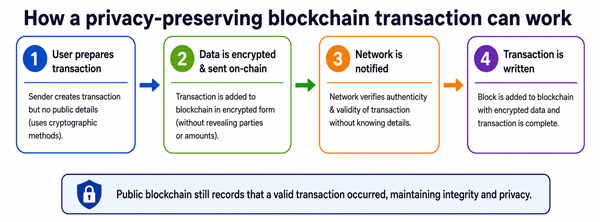
Diagram: A simplified privacy-preserving blockchain transaction flow.
3. How Privacy-Preserving Blockchain Works
Privacy can be added at different layers. Some systems hide sender, receiver and amount at the protocol level. Others use privacy smart contracts, layer 2 networks, private rollups, permissioned ledgers, confidential computing, encryption, or zero-knowledge proofs. The right design depends on the use case.
A useful way to understand the topic is to separate data from verification. A blockchain must verify that transactions are valid. It does not always need to reveal every input used to perform that verification. Privacy technologies let users prove facts about data without publishing all of the data itself.
3.1 Common Privacy Techniques
Zero-knowledge proofs allow one party to prove that a statement is true without revealing the underlying information. In blockchain, this can be used to prove that a transaction follows the rules without revealing all transaction details.
Stealth addresses help protect the receiver by creating one-time addresses for payments. Outsiders cannot easily link every payment to the receiver's public address.
Ring signatures mix a real spender with decoy spenders, making it difficult for observers to know which output was actually spent.
Confidential transactions hide the amount being transferred while still allowing the network to check that no coins were created from nothing.
Mixers and coinjoin-style systems combine transactions from multiple users to weaken transaction tracing, but they carry higher regulatory and compliance risk than many other privacy designs.
Selective disclosure lets a user reveal specific facts to an auditor, exchange, regulator or business partner without making everything public. This is important for compliant privacy.
| Technique | What it protects | Simple example | Main trade-off |
|---|---|---|---|
| Zero-knowledge proofs | Private data behind a valid claim | Prove you are eligible to use a service without publishing all personal data | Can be complex and expensive to build correctly |
| Shielded transactions | Sender, receiver, amount or memo fields | Send funds without making the amount public | Privacy depends on wallet support and usage patterns |
| Stealth addresses | Receiver identity | A merchant receives payments without reusing the same visible address | Users still need good wallet hygiene |
| Ring signatures | Sender/source of funds | A spend is hidden among several possible spenders | Large anonymity sets and careful design are needed |
| Confidential transactions | Transaction amounts | The network verifies balances while amounts are hidden | More cryptographic complexity |
| Selective disclosure | Controlled access to private facts | Show an auditor one transaction without exposing all wallet history | Requires thoughtful key and permission management |
4. Real-World Examples of Privacy-Preserving Blockchains
Zcash is a well-known example of a blockchain with optional privacy. It supports transparent addresses, which work more like ordinary public blockchain addresses, and shielded addresses, which are designed to keep financial information private. Shielded Zcash uses zero-knowledge proofs so transaction validity can be checked without exposing the same level of detail as a transparent transaction.
Monero is a privacy-focused cryptocurrency where privacy is built into the protocol. It uses techniques such as ring signatures, stealth addresses and confidential transaction amounts to make sender, receiver and amount information harder to trace.
Ethereum and other smart-contract ecosystems use zero-knowledge proofs in several ways. Many ZK systems are designed mainly for scaling, but the same family of cryptographic ideas can support privacy, private identity checks, private voting, private payments and confidential business logic.
Enterprise and permissioned blockchain projects often use privacy channels, private data collections, confidential computing or restricted access controls. These designs are not always as censorship-resistant as public blockchains, but they can be practical for businesses that need privacy, governance and legal accountability.
5. Practical Use Cases
- Private payments: A freelancer, donor, customer or business can pay without revealing their entire wallet history to the public.
- Confidential business transactions: A company can settle invoices, payroll or treasury movements without exposing supplier relationships or cash flow patterns.
- Private identity and credentials: A user can prove they are over a required age, live in a region, hold a qualification or passed KYC without revealing unnecessary personal data.
- Healthcare and research: A system can prove that records meet certain criteria while limiting access to sensitive patient data.
- Supply chain: A supplier can prove compliance with standards without revealing every internal document or commercial relationship.
- Voting and governance: A user can prove eligibility and vote validity while keeping the vote private, although secure voting systems are difficult and should be designed with expert review.
| Use case | Privacy problem | Possible blockchain privacy approach |
|---|---|---|
| Payments | Public ledgers can reveal income, balances and spending habits | Shielded transactions, confidential amounts, stealth addresses |
| Identity | Users often reveal more personal data than necessary | Zero-knowledge credentials and selective disclosure |
| Business settlement | Competitors can analyze suppliers, customers and treasury flows | Private ledgers, shielded payments, permissioned access |
| DeFi | Trading positions and liquidation levels can be visible | Private order flow, ZK proofs, privacy-preserving account design |
| Audits | Full public transparency may expose sensitive records | View keys, audit keys, selective disclosure proofs |
6. Benefits of Privacy-Preserving Blockchain
The biggest benefit is data minimization. Instead of publishing everything and hoping nobody connects the dots, privacy-preserving systems reveal only what is necessary. This reduces long-term exposure because blockchain data can remain available for years.
Privacy also improves security. Public balances and transaction histories can attract scams, phishing, extortion and targeted attacks. Businesses also gain protection against competitive intelligence and financial surveillance.
Another benefit is mainstream adoption. Many real-world industries cannot use fully transparent ledgers for sensitive workflows. Privacy-preserving blockchain can make decentralized systems more suitable for finance, healthcare, identity, supply chain and enterprise applications.
7. Risks and Limitations
Privacy is difficult to implement correctly. A protocol may use strong cryptography, but users can still lose privacy through address reuse, timing patterns, exchange deposits, browser tracking, wallet mistakes or public social media posts.
Regulatory risk is real. Some exchanges restrict privacy coins or privacy tools, and regulators often scrutinize systems that can obscure transaction history. The legal position can differ by country and can change over time.
There are also technical trade-offs. Privacy systems may require heavier computation, larger proofs, more complex wallets, slower transactions or special key management. A bug in a privacy protocol can be serious because users may rely on confidentiality that is not actually there.
Finally, privacy does not automatically mean anonymity. Many systems provide partial privacy, optional privacy or privacy against public observers but not against all counterparties, service providers or sophisticated investigators.
| Benefit | Why it matters | Important caution |
|---|---|---|
| Financial privacy | Protects balances, income and payment history | Exchange deposits and withdrawals can still reveal links |
| Business confidentiality | Prevents competitors from reading sensitive flows | Auditors may still need controlled access |
| Better user safety | Reduces targeting based on visible wealth | Operational security still matters |
| Compliance flexibility | Selective disclosure can support audits | Design must match local law and policy |
| Data minimization | Less sensitive data is published forever | Poor implementation can create false confidence |
8. Best Practices for Everyday Users
- Understand what your wallet actually hides. Do not assume a coin, wallet or app is private just because it uses privacy language.
- Avoid address reuse when the system gives you the option to use new addresses.
- Be careful when moving funds between private and transparent systems. The entry and exit points can reveal patterns.
- Do not post wallet addresses publicly if you want financial privacy.
- Use reputable wallets, keep software updated and back up keys securely.
- Remember that exchanges, bridges and payment processors may collect identity information and create links outside the blockchain.
- Treat privacy as a habit, not a button. Timing, amounts, counterparties and repeated behavior can all leak information.
9. Best Practices for Developers and Project Teams
- Start with a clear privacy threat model. Decide who you are protecting users from: public observers, counterparties, validators, service providers, analytics firms, attackers or insiders.
- Use proven cryptographic libraries and audited protocols. Do not invent custom cryptography unless your team includes qualified cryptographers and independent reviewers.
- Minimize on-chain data. Do not publish personal data, secret business data or unnecessary metadata to a permanent ledger.
- Support selective disclosure where the use case needs audits, tax reporting, compliance or dispute resolution.
- Design safe defaults. If privacy is optional, users may accidentally choose transparent settings and weaken the anonymity set for everyone.
- Document privacy limits clearly. Users should know what is hidden, what is not hidden and what behavior can break privacy.
- Get independent security audits, privacy reviews and legal review before launch. Privacy bugs and compliance mistakes can be expensive.
10. Best Practices for Businesses
- Choose the privacy model based on the workflow. A public privacy coin, private smart contract, permissioned ledger and ZK credential system solve different problems.
- Separate customer privacy from internal access control. Employees, auditors and partners should see only what they need.
- Create policies for key custody, view keys, audit access, incident response and data retention.
- Review sanctions, anti-money-laundering, tax and data protection obligations in each market where you operate.
- Do not store personal data directly on a public blockchain. Use hashes, commitments, encrypted references or off-chain storage where appropriate.
- Test the user experience. Privacy tools fail when normal users cannot understand the choices.
| Approach | Best for | Privacy strength | Compliance fit | Beginner note |
|---|---|---|---|---|
| Transparent public blockchain | Open auditability and simple transfers | Low | Often easier | Anyone can inspect addresses and transactions |
| Optional shielded privacy | Users who need privacy sometimes | Medium to high when used correctly | Can support transparent and private modes | Privacy depends on actually using shielded features |
| Privacy-by-default coin | Strong default transaction privacy | High | More regulatory friction in some markets | Powerful but not accepted everywhere |
| Permissioned private blockchain | Enterprise workflows with known participants | Medium | Often strong for businesses | Privacy comes from access control and governance |
| ZK application or credential | Private verification of facts | Use-case dependent | Can be designed for selective disclosure | Good for proving without over-sharing |
11. Privacy-Preserving Blockchain vs Anonymous Blockchain
These terms are often mixed together, but they are not identical. Privacy means controlling who can see information. Anonymity means hiding who is behind an action. A system can be private without being fully anonymous. For example, a user may keep payment details hidden from the public but still reveal selected information to an auditor or exchange.
This distinction matters because many legitimate use cases need privacy, not lawlessness. A payroll system, medical credential, business invoice or age-check application may need confidentiality and accountability at the same time.
12. Common Mistakes and Misconceptions
Mistake 1: Believing that Bitcoin or ordinary public wallets are anonymous. They are usually pseudonymous, not anonymous. Addresses are public, and transaction histories can be analyzed.
Mistake 2: Thinking one private transaction makes everything private. Privacy can be broken before or after the private step through exchanges, timing, amount patterns or address reuse.
Mistake 3: Assuming all ZK systems are privacy systems. Many zero-knowledge systems are built for scalability and verification efficiency, not user privacy.
Mistake 4: Publishing personal data on-chain and encrypting it forever. Encryption can age badly, keys can leak, and public blockchains are difficult to delete from.
Mistake 5: Ignoring the law. Privacy technology can be legitimate, but businesses still need compliance, sanctions screening, tax reporting and data protection processes.
13. How to Evaluate a Privacy-Preserving Blockchain Project
- Ask what is hidden: sender, receiver, amount, balance, identity, metadata, smart-contract state or only part of the transaction?
- Ask who can still see information: counterparties, validators, wallet providers, RPC providers, exchanges, auditors, administrators or bridge operators?
- Ask whether privacy is default or optional. Optional privacy can be useful, but users must understand how to use it.
- Ask how large the anonymity set is. Privacy is stronger when more users behave in similar ways.
- Ask whether the code and cryptography have been audited. Marketing claims are not enough.
- Ask how compliance and selective disclosure work. Serious business systems need a plan for audits, investigations, disputes and reporting.
- Ask what happens if keys are lost. Privacy systems often introduce view keys, spending keys, nullifiers or recovery procedures that users must understand.
| Question | Good sign | Warning sign |
|---|---|---|
| What is private? | Clear explanation of hidden and visible data | Vague claims like fully anonymous without details |
| Is privacy default? | Safe defaults and clear wallet UX | Users must manually choose confusing settings |
| Has it been audited? | Independent audits and open documentation | No audits or only marketing material |
| Can users disclose selectively? | View keys or proof-based disclosure options | All-or-nothing privacy |
| What metadata leaks? | Documentation discusses timing, network and wallet leaks | Only focuses on cryptography |
| Is it legally usable? | Compliance guidance for target users | Dismisses all regulation as irrelevant |
14. Regulation and Compliance Considerations
Privacy-preserving blockchain sits in a sensitive area. Privacy is a legitimate need, but financial privacy tools can also be used to hide illicit activity. This creates tension between developers, users, exchanges, law enforcement and regulators.
The Tornado Cash debate shows how complex this can become. U.S. sanctions against the mixer triggered major legal disputes, and later court and Treasury developments showed that regulators, courts and developers are still working through how decentralized privacy software should be treated. Businesses should not rely on headlines alone. They need current legal advice in their jurisdiction.
For practical compliance, privacy projects often consider selective disclosure, audit keys, transaction risk screening at entry and exit points, permissioned access for enterprise workflows, and policies for responding to lawful requests. The goal is not to remove privacy. The goal is to make privacy compatible with legitimate accountability.
15. Future of Privacy-Preserving Blockchain
The future is likely to be more selective and more usable. Instead of forcing a choice between fully public ledgers and opaque systems, newer designs aim to reveal only the minimum information needed for each purpose.
Zero-knowledge proofs are likely to remain important, especially for private credentials, compliance proofs, private payments, private DeFi and enterprise workflows. At the same time, user experience, regulation, wallet security and education will determine whether these systems reach mainstream adoption.
A realistic future is not one where every blockchain transaction is hidden from everyone. It is one where users and organizations can prove what needs to be proven without exposing everything else forever.
| Best-practice checklist | For users | For developers/businesses |
|---|---|---|
| Know what is visible | Check wallet and explorer behavior | Document visible vs hidden fields |
| Minimize data | Do not reuse addresses unnecessarily | Avoid personal data on-chain |
| Protect metadata | Watch timing and exchange links | Consider RPC, wallet and network leaks |
| Use safe tools | Use reputable wallets | Use audited libraries and protocols |
| Plan disclosure | Keep records for tax and accounting | Build selective disclosure and audit access |
| Stay compliant | Know local restrictions | Get legal review before launch |
16. FAQs About Privacy-Preserving Blockchain
16.1 Is blockchain private by default?
No. Many public blockchains are transparent by default. They may use wallet addresses instead of real names, but transactions and balances can often be viewed publicly.
16.2 What is the difference between privacy and pseudonymity?
Pseudonymity means your activity is linked to an address or identifier rather than your legal name. Privacy means the information itself is limited or protected. A pseudonymous wallet can still reveal a lot once connected to a person.
16.3 Are zero-knowledge proofs only used for privacy?
No. Zero-knowledge proofs are also used for scaling and efficient verification. A ZK system is not automatically private unless the application is designed to hide sensitive data.
16.4 Are privacy coins illegal?
Privacy coins are not universally illegal, but rules and exchange policies vary by country and can change. Some platforms restrict them because of compliance concerns. Users and businesses should check local law.
16.5 Can private blockchain transactions be traced?
Sometimes. It depends on the system, user behavior and available off-chain data. Entry and exit points such as exchanges can create links, and poor wallet habits can weaken privacy.
16.6 What is selective disclosure?
Selective disclosure means revealing only specific information to a chosen party. For example, a user might prove a transaction was legitimate to an auditor without publishing their full wallet history.
16.7 Should businesses use a public privacy coin or a private enterprise ledger?
It depends on the use case. Public privacy coins may suit open financial privacy, while enterprise ledgers may fit workflows with known participants, governance, access control and legal accountability.
16.8 What is the biggest mistake beginners make?
The biggest mistake is assuming that a blockchain address is anonymous. In many cases, public transaction history can be connected to exchange accounts, websites, social posts or repeated behavior.
17. Conclusion
Privacy-preserving blockchain is about using cryptography, design and policy to protect sensitive information while still keeping the verification benefits of blockchain. It is useful for payments, identity, business settlement, audits, supply chains, healthcare and many other real-world workflows.
The key lesson for beginners is simple: transparency and privacy are design choices. A public blockchain can be useful, but public-by-default data is not right for every situation. Strong privacy requires the right technology, good wallet habits, careful implementation, clear communication and respect for legal responsibilities.
The best privacy-preserving systems do not ask users to trust vague promises. They clearly explain what is hidden, what remains visible, how verification works, what the risks are and how users can protect themselves in practice.
Sources Consulted and Checked
These sources were consulted and checked while preparing this document to support accuracy and clarity.
- Ethereum.org: Zero-Knowledge Proofs
- Zcash: Shielded vs transparent Zcash
- Zcash documentation: Privacy recommendations and best practices
- Monero Project Moneropedia: Ring Signatures
- Chainalysis 2026 Crypto Sanctions report discussion of Tornado Cash delisting
- Reuters: Court overturns U.S. sanctions against Tornado Cash, November 27, 2024
Reader Advice
This article is provided for educational and informational purposes only and is not personalized legal, financial, investment, tax, compliance, cybersecurity, or technical advice. Blockchain privacy tools can involve financial loss, security failures, privacy leaks, fraud, sanctions and anti-money-laundering concerns, tax obligations, and other legal or operational risks. Laws, regulations, platform policies, technical standards, and statistics can change over time and vary by country or region. Before acting, verify current information through official sources and seek appropriately qualified professional advice for your circumstances. Use privacy technologies responsibly and only for lawful purposes.