Cryptoeconomics Explained: Meaning, How It Works, Examples, Benefits and Risks
Quick Answer: What Is Cryptoeconomics?
Cryptoeconomics is the design of economic incentives and cryptographic rules that help decentralized blockchain networks work securely without a central authority. It uses rewards, penalties, token value, game theory, and cryptography to encourage people to act honestly even when they do not know or trust each other.
In plain English, cryptoeconomics asks: How can a digital network make honest behavior more profitable than cheating?
1. What Does Cryptoeconomics Mean?
Cryptoeconomics is a field that combines two ideas: cryptography and economics. Cryptography protects information with tools such as hashing, digital signatures, public-private key pairs, and cryptographic proofs. Economics studies incentives, scarcity, rewards, penalties, markets, and decision-making. When these two areas are combined, they make it possible to design decentralized systems where strangers can coordinate safely over the internet.
A blockchain does not have a bank manager, payment processor, court clerk, or central database administrator who approves every action. Instead, the network uses software rules and economic incentives. If participants follow the rules, they may earn rewards. If they break the rules, they may lose money, waste resources, or be excluded from the system.
This is why cryptoeconomics is sometimes described as the security budget of a blockchain. The network is not only protected by code. It is also protected by the economic cost of attacking it. A good cryptoeconomic system makes cooperation cheaper and more rewarding than manipulation.
2. Why Cryptoeconomics Matters in Blockchain
Cryptoeconomics matters because decentralization creates a coordination problem. In a traditional company, employees follow managers, contracts, policies, and legal enforcement. In a public blockchain, participants may live in different countries, use different hardware, hold different amounts of tokens, and have different goals. The network must still agree on valid transactions.
A well-designed cryptoeconomic system helps a blockchain answer practical questions: Who gets to add the next block? Why should they follow the rules? What stops them from rewriting history? Who pays for security? How are users protected from spam? How are upgrades decided? What happens if someone tries to attack the system?
The best blockchain systems do not assume everyone is honest. They assume some participants may be selfish, careless, or malicious. Cryptoeconomics designs the system so that the safest and most profitable choice is usually to act honestly.
2.1 Cryptoeconomics Framework Diagram
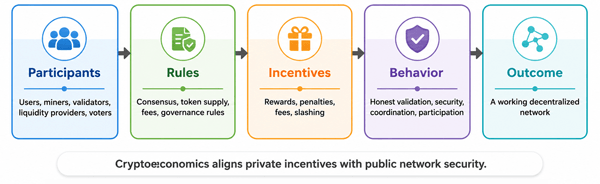
The diagram below shows the basic cryptoeconomic loop: participants follow protocol rules because incentives shape their behavior, and that behavior creates network security.
3. Core Building Blocks of Cryptoeconomics
Cryptoeconomics is not one single feature. It is a system of connected parts. The table below explains the most important building blocks in beginner-friendly language.
| Building Block | What It Does | Simple Example |
|---|---|---|
| Cryptography | Proves ownership, secures transactions, and protects network data. | A digital signature proves that a wallet owner approved a transaction. |
| Game theory | Studies how rational participants behave when rewards and penalties are involved. | A validator chooses honesty because cheating could cause slashing. |
| Incentive design | Creates rewards for useful behavior and costs for harmful behavior. | Miners or validators earn block rewards and transaction fees. |
| Consensus mechanism | Allows many computers to agree on the valid state of the blockchain. | Proof of Work and Proof of Stake are consensus mechanisms. |
| Tokenomics | Defines token supply, distribution, utility, emissions, and demand drivers. | A staking token may secure the network and participate in governance. |
| Governance | Sets rules for upgrades, parameter changes, and community decisions. | A DAO vote may decide whether to change protocol fees. |
| Security assumptions | Defines what must remain true for the network to stay safe. | A PoW network assumes attackers cannot cheaply control most hash power. |
4. How Cryptoeconomics Works Step by Step
Cryptoeconomics works by turning network participation into an economic game. The protocol defines what good behavior looks like, attaches rewards to good behavior, and attaches costs to bad behavior. Participants then make decisions based on those incentives.
A simplified flow looks like this: first, a user submits a transaction. Second, miners or validators check whether the transaction follows the rules. Third, valid transactions are included in a block. Fourth, the network rewards the participant who helped produce or validate the block. Fifth, dishonest or careless behavior may be ignored, rejected, penalized, or slashed depending on the network design.
The important point is that cryptoeconomics does not rely on hope. It relies on incentives. A validator may not personally care about the network, but if they have capital at risk and rewards to earn, they have a strong reason to follow the rules.
4.1 A Simple Real-World Analogy
Imagine a public parking lot with no guard. If parking were free and there were no consequences, some drivers might block exits, occupy disabled spaces, or park badly. Now imagine the lot uses a deposit system. Drivers get their deposit back only if they park correctly, and they lose money for blocking others. Suddenly, good behavior becomes the rational choice.
Cryptoeconomics works in a similar way. A blockchain cannot personally know who is honest, so it creates a system where honest behavior is rewarded and harmful behavior becomes expensive.
5. Cryptoeconomics vs Tokenomics vs Game Theory
Many beginners confuse cryptoeconomics with tokenomics. They are related, but they are not the same. Tokenomics focuses on the token: supply, demand, utility, allocation, vesting, inflation, burns, and distribution. Cryptoeconomics is wider. It includes tokenomics, but also consensus security, attack costs, validator behavior, governance incentives, and mechanism design.
Game theory is also part of cryptoeconomics, but it is not the whole field. Game theory helps designers predict participant behavior. Cryptoeconomics turns those predictions into working blockchain rules.
| Concept | Main Focus | Typical Questions | Example |
|---|---|---|---|
| Cryptoeconomics | Whole incentive and security system | What makes honest behavior rational? How expensive is an attack? | Ethereum staking rewards and slashing |
| Tokenomics | Token design and value flow | How many tokens exist? What creates demand? | Fixed supply, vesting, burns, staking utility |
| Game theory | Strategic behavior | What will rational actors do under these rules? | Prisoner’s dilemma, coordination games |
| Cryptography | Mathematical security | How do we prove ownership and validity? | Digital signatures, hashes, zero-knowledge proofs |
| Traditional economics | Markets, incentives, institutions | How do people allocate resources? | Supply and demand, monetary policy |
6. Key Cryptoeconomic Mechanisms
Most blockchain networks use several cryptoeconomic mechanisms at the same time. A consensus mechanism decides how blocks are produced. Fees discourage spam and compensate network participants. Token rewards encourage people to provide security. Penalties discourage harmful behavior. Governance mechanisms coordinate upgrades and parameter changes.
The right design depends on the network. A payment-focused blockchain, a smart contract platform, a DeFi lending protocol, and a decentralized oracle network all need different incentive structures.
6.1 Proof of Work: Security Through Costly Computation
Proof of Work, used by Bitcoin, asks miners to perform computational work. Miners compete to find a valid block. The work is costly because it requires hardware and electricity, but it is easy for the network to verify. The miner who wins earns a block reward and transaction fees.
The cryptoeconomic idea is simple: attacking the network should require so much computing power and energy that honest mining is more attractive than cheating. Bitcoin miners voluntarily spend resources for the chance to add blocks and earn rewards; this incentive structure is central to Bitcoin’s decentralized security model.
The main trade-off is energy use. Proof of Work can be very secure, but it depends on external resource costs. This makes it expensive to attack, but also expensive to operate.
6.2 Proof of Stake: Security Through Locked Capital
Proof of Stake replaces mining hardware with locked capital. Validators stake tokens, such as ETH in Ethereum, and participate in block validation. If they behave honestly, they can earn rewards. If they violate important rules, part of their stake can be destroyed or taken away through slashing.
Ethereum describes Proof of Stake as a system where validators put something valuable into the network that can be destroyed if they act dishonestly. Ethereum’s consensus security comes from rewards and penalties applied to capital locked by validators.
The main advantage is efficiency. Proof of Stake generally uses far less energy than Proof of Work. The main concern is concentration: if too much stake is controlled by a small number of entities, governance and validation may become less decentralized.
6.3 Slashing: Why Penalties Matter
Slashing is a penalty used in many Proof of Stake systems. It punishes serious validator misbehavior, such as signing conflicting messages or trying to support two competing versions of the chain. In Ethereum, some slashable behaviors can cause part of a validator’s ETH to be burned before the validator is removed from the active validator set.
Slashing is important because a bond only works if it can be lost. Without a penalty, a validator might try to cheat if there were a chance to profit. With slashing, the validator must consider the risk of losing real capital.
6.4 Transaction Fees and Spam Prevention
Transaction fees are also cryptoeconomic tools. They compensate validators or miners, but they also discourage spam. If transactions were completely free, attackers could flood the network with useless activity. Fees create a cost for using scarce block space.
Good fee design is difficult. Fees that are too high exclude ordinary users. Fees that are too low may encourage spam or fail to pay for security. Layer-2 networks, batching, and improved fee markets are attempts to manage this trade-off.
6.5 Token Rewards and Emissions
Many networks issue new tokens to reward participants. This can help bootstrap security and participation, especially in the early stages. However, rewards are not free. New token issuance may dilute existing holders, and unsustainable emissions can create selling pressure.
A strong reward system should answer three questions: What useful behavior is being rewarded? Who pays for the reward? Will the reward still make sense when growth slows?
6.6 Governance Incentives
Governance is part of cryptoeconomics because decisions affect incentives. Token holders may vote on fees, upgrades, treasury spending, collateral rules, risk parameters, and validator requirements. In theory, governance lets a decentralized community improve the protocol. In practice, governance can be vulnerable to voter apathy, whale influence, bribery, and short-term thinking.
Good governance design tries to balance participation, expertise, decentralization, and safety. This may include voting delays, quorum requirements, delegation, emergency controls, public discussion periods, and transparency around conflicts of interest.
6.7 Comparison: Proof of Work vs Proof of Stake
| Feature | Proof of Work | Proof of Stake |
|---|---|---|
| Security source | Costly computing power and electricity | Capital locked as stake |
| Main participant | Miner | Validator |
| Reward source | Block subsidy and transaction fees | Staking rewards and transaction fees |
| Penalty for attack | Wasted hardware, electricity, and lost opportunity | Slashing, lost rewards, and reputational damage |
| Energy use | Usually high | Usually much lower |
| Common concern | Mining centralization and energy consumption | Stake concentration and validator centralization |
| Well-known example | Bitcoin | Ethereum after The Merge |
8. Practical Examples of Cryptoeconomics
The best way to understand cryptoeconomics is to look at real systems. Each example below shows how incentives shape behavior.
Example 1: Bitcoin Mining Incentives
Bitcoin uses Proof of Work. Miners spend money on machines and electricity. They do this because they may earn bitcoin rewards and transaction fees. If a miner tries to create an invalid block, other nodes reject it. The miner wastes resources and earns nothing.
This design creates a strong incentive to follow the protocol. The miner’s rational strategy is usually to produce valid blocks because valid blocks are the only ones that can earn rewards.
Example 2: Ethereum Validators and Slashing
Ethereum uses Proof of Stake. Validators lock ETH and participate in consensus. They earn rewards for correct participation, but they can lose funds for serious rule violations. This gives validators a direct financial reason to maintain uptime, run secure infrastructure, and avoid double-signing or conflicting behavior.
For beginners, the key idea is that Ethereum security is not based on goodwill. It is based on capital at risk.
Example 3: DeFi Liquidity Incentives
A decentralized exchange needs liquidity so users can trade. To attract liquidity providers, the protocol may share trading fees or offer token rewards. This is cryptoeconomics because the protocol is paying users to provide a useful service.
However, liquidity incentives can be fragile. If rewards are too high and temporary, users may leave as soon as rewards drop. This is sometimes called mercenary liquidity. Sustainable DeFi design needs real fee revenue, useful markets, and long-term alignment.
Example 4: Stablecoin Collateral Rules
Some decentralized stablecoins require users to deposit collateral before minting stablecoins. If the collateral value falls too much, the position can be liquidated. This is a cryptoeconomic mechanism: users are allowed to borrow, but they must maintain enough collateral to protect the system.
The system depends on incentives for borrowers, liquidators, oracle providers, and governance participants. A weakness in any part can create risk.
Example 5: Decentralized Oracles
Smart contracts often need external data, such as asset prices. A decentralized oracle network can use multiple data providers, reputation systems, staking, and penalties to reduce the risk of false data. The cryptoeconomic challenge is to make accurate reporting more profitable than manipulation.
Oracle design matters because bad data can trigger liquidations, incorrect payouts, or protocol losses.
Example 6: DAO Governance
A DAO may give token holders the right to vote on treasury spending, upgrades, or fee changes. The cryptoeconomic hope is that people with economic exposure will vote in ways that protect the protocol’s long-term value.
But governance tokens do not automatically create good governance. A small group of large holders may dominate votes, passive holders may not participate, and short-term incentives may override long-term health.
9. Benefits of Cryptoeconomics
- Decentralized security: Networks can secure transactions without depending on a central operator.
- Trust minimization: Users do not need to personally trust every participant; they can rely on rules, verification, and incentives.
- Open participation: Many systems allow anyone who meets the requirements to participate as a validator, miner, liquidity provider, or voter.
- Economic alignment: Participants can be rewarded for behavior that strengthens the network.
- Transparency: Rules, rewards, penalties, and token flows can often be inspected publicly.
- Resilience: A well-designed network can continue operating even if some participants fail or act maliciously.
- Programmable coordination: Incentives can be built directly into smart contracts and protocols.
10. Risks and Limitations of Cryptoeconomics
- Bad incentive design: A protocol may accidentally reward behavior that harms long-term users.
- Centralization: Mining power, validator stake, governance tokens, or development control can concentrate.
- Speculation: Token prices may rise because of hype rather than real utility, making incentives unstable.
- Governance capture: Large holders or coordinated groups may push decisions that benefit themselves.
- Economic attacks: Attackers may borrow, bribe, manipulate markets, or exploit timing advantages.
- Oracle failures: Incorrect off-chain data can damage DeFi protocols and automated systems.
- Unsustainable rewards: High emissions can attract users temporarily but create long-term selling pressure.
- Complexity: Incentive systems can interact in unexpected ways, especially during market stress.
11. Common Cryptoeconomic Attacks and Failure Modes
Cryptoeconomic systems are designed to resist attacks, but they are not magic. The table below explains common risks in simple terms.
| Attack or Failure | What It Means | Why It Matters | Possible Defenses |
|---|---|---|---|
| 51% attack | An attacker controls most mining or validation power. | They may censor transactions or attempt chain reorganization. | More decentralization, higher attack cost, finality rules. |
| Sybil attack | One actor creates many fake identities. | They may appear to be many independent participants. | Stake requirements, reputation, identity systems, resource costs. |
| Governance attack | Voting power is used to change rules maliciously. | Treasuries, fees, or risk settings may be captured. | Quorums, timelocks, delegation, emergency review. |
| Bribery attack | Participants are paid to vote or validate against network interests. | External incentives may overpower protocol incentives. | Transparency, slashing, monitoring, stronger governance design. |
| MEV exploitation | Validators or searchers profit from transaction ordering. | Users may face worse prices or unfair execution. | MEV-aware design, private order flow, fair sequencing. |
| Oracle manipulation | External data feeds are distorted. | Can cause bad liquidations or incorrect smart contract outcomes. | Multiple data sources, circuit breakers, robust oracle design. |
| Liquidity mining collapse | Users leave when rewards decline. | Protocol usage may drop sharply. | Real revenue, sticky utility, measured emissions. |
12. What Makes a Cryptoeconomic Design Strong?
A strong cryptoeconomic design is not just generous rewards or a popular token. It is a system where incentives, security assumptions, token utility, governance, and user needs fit together. The protocol should be able to answer how security is paid for, who can attack the system, how expensive attacks would be, what happens during market stress, and whether honest participants have a sustainable reason to stay.
Strong designs also avoid relying on only one line of defense. They combine technical security, economic penalties, transparent governance, monitoring, audits, conservative risk limits, and clear emergency procedures.
13. Common Mistakes in Cryptoeconomic Design
One common mistake is assuming that token price equals security. A high token price can increase security in some systems, but price can fall quickly. Another mistake is using rewards to hide weak product-market fit. If users come only for subsidies and leave when rewards end, the incentive system is not sustainable.
Projects also sometimes underestimate governance risk. A protocol can be technically sound but still fail if governance is captured by a small group, if voters do not understand proposals, or if parameter changes create hidden risk.
14. Misconceptions Beginners Should Avoid
Misconception 1: Cryptography alone secures blockchains. In reality, cryptography proves and protects data, but incentives help determine participant behavior.
Misconception 2: Higher staking rewards always mean a better network. Very high rewards may come from inflation, risk, or unsustainable emissions.
Misconception 3: Decentralized means risk-free. Decentralized systems can still have bugs, bad governance, market manipulation, oracle failures, and economic attacks.
Misconception 4: Tokenomics and cryptoeconomics are the same. Tokenomics is part of cryptoeconomics, but cryptoeconomics is broader.
15. How to Evaluate Cryptoeconomics Before Using or Investing in a Project
Beginners do not need to become protocol researchers, but they should learn to ask better questions. Look at what the token actually does. Check who receives rewards. Study who controls governance. Understand whether security depends on token price, external liquidity, validator honesty, or oracle accuracy. Look for clear documentation, audits, open discussion, and transparent risk disclosures.
Be cautious when a project promises high yields without explaining where the yield comes from. Sustainable rewards usually come from real fees, useful services, or carefully designed security budgets. Unsustainable rewards often come from new token issuance or constant new user growth.
15.1 Beginner Checklist: Questions to Ask About Any Crypto Project
- What useful behavior does the protocol reward?
- Where do the rewards come from: fees, inflation, treasury, or new users?
- What penalties exist for harmful behavior?
- Who controls governance and upgrades?
- Is token ownership concentrated?
- What happens if the token price drops sharply?
- Can the system survive low usage or lower rewards?
- Are validators, miners, or oracle providers decentralized?
- Has the protocol explained major risks clearly?
- Are incentives aligned with long-term users or short-term speculators?
16. Best Practices for Cryptoeconomic Design
- Align rewards with real value: Reward behavior that directly improves security, liquidity, reliability, or user experience.
- Make attacks expensive: Estimate the cost of attacks under realistic market conditions, not only ideal conditions.
- Avoid unnecessary complexity: Complex incentives can create hidden loopholes and confuse users.
- Plan for market stress: Test what happens when prices fall, liquidity dries up, or participation drops.
- Limit governance risk: Use timelocks, transparency, proposal review, delegation standards, and emergency safeguards.
- Monitor concentration: Track validator concentration, token distribution, liquidity concentration, and governance power.
- Use sustainable emissions: Avoid reward programs that work only while token issuance remains high.
- Design for users, not only speculators: A strong protocol should provide real utility even when market hype cools.
- Document assumptions: Explain what must remain true for the protocol to stay secure.
- Update carefully: Changing incentives can create unintended consequences, so upgrades should be tested and reviewed.
17. Pros and Cons of Cryptoeconomic Systems
| Pros | Cons |
|---|---|
| Can coordinate strangers without a central authority | Difficult to design correctly |
| Makes security economically measurable | Can fail under extreme market stress |
| Supports open global participation | May create centralization if wealth or infrastructure concentrates |
| Allows programmable rewards and penalties | Can attract short-term speculation |
| Can create resilient decentralized systems | Requires constant monitoring and governance |
18. Cryptoeconomics in DeFi
Decentralized finance depends heavily on cryptoeconomics. Lending markets need collateral rules, liquidation incentives, interest-rate models, and oracle protection. Decentralized exchanges need liquidity incentives, fee structures, and protections against manipulation. Stablecoins need collateral, redemption, arbitrage, and governance rules.
A DeFi protocol can look successful when rewards are high, but the real test is whether it remains useful when incentives normalize. Sustainable DeFi cryptoeconomics usually combines real user demand, careful risk management, conservative collateral settings, and transparent governance.
19. Cryptoeconomics in Layer-2 Networks
Layer-2 networks aim to make blockchain transactions faster or cheaper while relying partly on a base chain for security. Their cryptoeconomic designs may include sequencer incentives, fraud proofs, validity proofs, data availability fees, bridge security, and governance rules.
For users, the main questions are: Who can order transactions? How are funds protected? What happens if the operator fails? Can users exit safely? How is data made available? These are both technical and economic questions.
20. Cryptoeconomics in DAOs
DAOs use tokens and voting systems to coordinate groups without traditional corporate management. Cryptoeconomics helps decide who gets voting power, how proposals pass, how treasuries are managed, and how contributors are rewarded.
Good DAO design should avoid turning governance into a simple wealth contest. It should encourage informed participation, reduce spam proposals, manage conflicts of interest, and protect long-term contributors and users.
21. The Future of Cryptoeconomics
Cryptoeconomics is still evolving. Future systems may use more advanced staking, shared security, restaking, modular blockchain design, cross-chain incentives, privacy-preserving proofs, decentralized identity, and AI-assisted economic simulations.
The field will likely become more practical and risk-focused over time. Early crypto systems proved that decentralized networks can work. The next challenge is building systems that remain secure, useful, fair, and understandable as they scale to more users and more valuable assets.
22. Frequently Asked Questions About Cryptoeconomics
22.1 What is cryptoeconomics in simple words?
Cryptoeconomics is the use of rewards, penalties, tokens, and cryptographic rules to make decentralized networks secure and useful.
22.2 Why is cryptoeconomics important?
It helps blockchain networks coordinate strangers, validate transactions, prevent spam, and discourage attacks without relying on a central authority.
22.3 Is cryptoeconomics the same as tokenomics?
No. Tokenomics focuses on token supply, utility, and distribution. Cryptoeconomics includes tokenomics but also covers consensus, incentives, penalties, governance, and attack resistance.
22.4 How does Bitcoin use cryptoeconomics?
Bitcoin rewards miners with BTC and transaction fees for producing valid blocks. Invalid blocks are rejected, so miners are economically encouraged to follow the rules.
22.5 How does Ethereum use cryptoeconomics?
Ethereum validators stake ETH, earn rewards for honest participation, and can lose funds for serious rule violations through slashing.
22.6 What is slashing?
Slashing is a penalty in some Proof of Stake systems where part of a validator’s stake is destroyed or removed for violating important consensus rules.
22.7 What is a 51% attack?
A 51% attack happens when one actor or group controls most of the network’s mining or validation power, potentially allowing censorship or chain reorganization.
22.8 Can cryptoeconomics prevent every attack?
No. It reduces risk by changing incentives and increasing attack costs, but bugs, governance failures, market manipulation, and unexpected conditions can still happen.
22.9 Why do blockchains need transaction fees?
Fees compensate network participants and discourage spam by making every transaction consume a scarce resource: block space.
22.10 What makes crypto rewards sustainable?
Sustainable rewards usually come from real fees, useful services, or security needs rather than endless token inflation.
22.11 What is game theory’s role in cryptoeconomics?
Game theory helps designers predict how participants may behave when different rewards, penalties, and strategic choices exist.
22.12 Can a project fail because of bad cryptoeconomics?
Yes. Poor incentive design can lead to low participation, inflation, governance capture, liquidity loss, security weaknesses, or user distrust.
22.13 Is Proof of Stake safer than Proof of Work?
Neither is automatically safer in every context. Proof of Work relies on external computation costs, while Proof of Stake relies on locked capital and penalties. Each has trade-offs.
22.14 What should beginners check before trusting a protocol?
Check who controls the token, how rewards are funded, what penalties exist, how governance works, whether security assumptions are clear, and whether incentives are sustainable.
22.15 Does cryptoeconomics only apply to blockchains?
It is most common in blockchains and crypto networks, but the broader idea can apply to decentralized infrastructure, data networks, DAOs, and digital coordination systems.
23. Conclusion
Cryptoeconomics is one of the core ideas that makes blockchain technology possible. It combines cryptography, incentives, game theory, consensus mechanisms, and token design to help decentralized networks operate without a central authority.
For beginners, the most important lesson is simple: blockchains are not secured by code alone. They are secured by a combination of code, economic incentives, social coordination, and realistic assumptions about human behavior. A strong cryptoeconomic design makes honest behavior rational, attacks expensive, and participation worthwhile.
For investors, builders, and users, understanding cryptoeconomics is a practical skill. It helps you evaluate whether a network is secure, whether a token has real utility, whether rewards are sustainable, and whether governance can protect long-term users. The more value moves on-chain, the more important good cryptoeconomic design becomes.
Sources Consulted and Checked
The following sources were consulted and checked while preparing this article and reviewing its accuracy:
- Ethereum.org documentation on Proof of Stake, consensus mechanisms, rewards, penalties, and slashing.
- Bitcoin Proof of Work and mining incentive explanations from the Bitcoin whitepaper tradition and educational materials on PoW incentives.
- General blockchain security concepts: consensus, Sybil resistance, 51% attacks, staking, slashing, governance, and oracle risk.
Reader Advice
This article is provided for educational and informational purposes only and is not personalized legal, financial, investment, tax, or technical advice or a recommendation to buy, sell, stake, lend, or use any crypto asset or protocol. Cryptoeconomic systems can involve substantial risks, including price volatility, loss of funds, smart-contract or software failures, governance problems, validator or oracle failures, fraud, regulatory changes, and the possible loss of access to assets. Rules, policies, laws, technical standards, network conditions, and statistics can change over time and may vary by country or region. Readers should verify important information through current official sources, consider their own circumstances and risk tolerance, and seek advice from an appropriately qualified professional before making decisions.