Token Engineering: Complete Guide, Examples, Risks and Best Practices
Quick answer: Token engineering is the practice of designing, testing, and improving token-based systems so that incentives, governance, security, and long-term value work together. It is not just about creating a cryptocurrency. It is about building an economic system where users, developers, validators, liquidity providers, investors, and communities have clear reasons to act in ways that support the network.
A good token can help coordinate people at internet scale. A poorly designed token can attract short-term speculation, reward the wrong behavior, drain a treasury, or create governance problems. That is why token engineering matters.
This guide explains token engineering in plain English. You will learn what it means, how token systems are designed, what tokenomics gets right and wrong, how real projects use tokens, and what risks to avoid before launching or investing in a token-based ecosystem.
1. What Is Token Engineering?
Token engineering is a structured approach to designing tokenized ecosystems. A tokenized ecosystem is any system where a digital token helps coordinate behavior, transfer value, grant access, reward contribution, govern decisions, or secure a network.
The Token Engineering Commons describes token engineering as an emerging engineering discipline focused on holistic systems design and the tools used to design and verify tokenized ecosystems. In practical terms, token engineers ask: what behavior do we want, what incentives create that behavior, and what could go wrong when real people and markets interact with the design?
A token engineer does not only choose a total supply and write a whitepaper. They think about users, incentives, market behavior, governance, security, legal risk, treasury sustainability, and feedback loops.
| Simple term | Meaning in token engineering |
|---|---|
| Token | A digital unit that can represent value, access, voting power, rewards, ownership rights, or another function. |
| Tokenomics | The economic design of a token, including supply, demand, allocation, incentives, and utility. |
| Incentive | A reward or penalty that encourages people to behave in a certain way. |
| Governance | The process for making decisions about protocol changes, treasury spending, fees, upgrades, and rules. |
| Mechanism design | Designing rules so participants are motivated to act in ways that support the desired outcome. |
| Crypto-economic security | Using tokens and economic incentives to protect a blockchain, protocol, or network from attacks. |
2. Why Token Engineering Matters
Many blockchain projects fail not because the code never worked, but because the economic design did not work. The token had no real utility, rewards were too generous, early insiders had too much control, liquidity disappeared, or governance was captured by a small group.
Token engineering matters because blockchains are open systems. Anyone can participate, speculate, coordinate, attack, arbitrage, or leave. The design has to survive real-world pressure, not just look good in a pitch deck.
- It helps align incentives between users, builders, token holders, validators, liquidity providers, and the community.
- It improves the chance that rewards are sustainable rather than temporary marketing expenses.
- It helps identify attack vectors, governance weaknesses, and market risks before launch.
- It makes token utility clearer, which helps users understand why the token exists.
- It supports better decision-making after launch by tracking real metrics instead of relying on hype.
2.1 A Simple Example
Imagine a decentralized storage network. Users pay tokens to store files. Storage providers earn tokens for keeping files available. Validators or auditors check whether providers are actually storing the files. If providers cheat, they lose part of their stake. If they perform well, they earn rewards.
Token engineering asks practical questions such as:
- How much should storage providers earn so the network attracts enough capacity?
- How large should the penalty be for dishonest behavior?
- Should users pay fixed fees, market-based fees, or subscription-style fees?
- How can the system avoid paying rewards to fake activity?
- What happens if token price falls by 70%?
- Who can change the reward formula, and how should they vote?
3. Token Engineering vs Tokenomics
People often use token engineering and tokenomics as if they mean the same thing. They are related, but not identical.
| Topic | Tokenomics | Token Engineering |
|---|---|---|
| Main focus | Token supply, demand, utility, allocation, emissions, and value flows. | Full system design, including incentives, behavior, simulations, governance, risks, security, and feedback loops. |
| Typical question | How many tokens exist and how are they distributed? | Will this token system behave safely and sustainably under real conditions? |
| Tools | Allocation tables, vesting schedules, emission charts, market assumptions. | Economic modeling, simulations, stress tests, mechanism design, scenario analysis, governance design. |
| Output | Token model and economic narrative. | Tested token system with assumptions, risks, metrics, and improvement plan. |
| Common mistake | Focusing too much on price and supply. | Overdesigning complex systems that users cannot understand. |
A useful way to remember it: tokenomics is the economic blueprint; token engineering is the disciplined process of designing, testing, and maintaining the whole system.
4. Core Components of a Token System
A token system has many moving parts. Beginners often focus on total supply, but supply is only one part of the design. The strongest token systems connect utility, incentives, security, governance, liquidity, and long-term sustainability.
4.1 Token Purpose and Utility
A token should have a clear reason to exist. Common utilities include paying network fees, staking for security, accessing a service, participating in governance, providing collateral, earning rewards, or coordinating community ownership. A token with no useful role often becomes purely speculative.
4.2 Stakeholders
Stakeholders are the people or groups affected by the token system. These may include users, developers, validators, liquidity providers, DAO voters, investors, node operators, app builders, market makers, and ecosystem partners. Each group needs different incentives.
4.3 Supply Design
Supply design answers how many tokens exist, how new tokens enter circulation, whether tokens are burned, and how emissions change over time. Fixed supply can be simple, but it is not always best. Inflationary supply can fund rewards, but excessive emissions can weaken long-term value.
4.4 Distribution and Vesting
Distribution decides who receives tokens and when. Fair distribution can build trust. Poor distribution can create centralization, sell pressure, or governance capture. Vesting schedules help prevent early recipients from selling all tokens immediately.
4.5 Incentives and Penalties
Incentives should reward behavior that helps the network. Penalties should discourage harmful behavior. In proof-of-stake systems, validators may earn rewards for honest participation and face penalties for downtime or malicious behavior.
4.6 Governance
Governance decides who can change the system. Token voting can be useful, but it can also favor wealthy holders. Some systems use delegated voting, councils, quadratic voting experiments, time locks, proposal thresholds, or multi-stage review processes.
4.7 Treasury and Funding
Many projects hold a treasury to fund development, grants, audits, liquidity, community programs, and operations. Treasury design should answer who controls funds, how spending is approved, and how long the treasury can support the ecosystem.
4.8 Liquidity and Market Design
Users need a way to buy, sell, or use the token without extreme price impact. Liquidity can come from decentralized exchanges, market makers, staking pools, or protocol-owned liquidity. However, liquidity incentives can become expensive if they only attract short-term farmers.
4.9 Risk Controls
Risk controls include audits, rate limits, emergency pauses, insurance funds, oracle safeguards, governance delays, spending limits, and monitoring dashboards. These controls reduce damage when assumptions fail.
5. Common Types of Tokens
| Token type | What it does | Example use case | Main risk |
|---|---|---|---|
| Utility token | Gives access to a product, service, or network function. | Paying for storage, compute, API usage, or app features. | No real demand if the product is weak. |
| Governance token | Lets holders vote or delegate voting power. | DAO proposals, treasury decisions, protocol parameter changes. | Large holders can dominate decisions. |
| Staking token | Secures a network or service through bonded collateral. | Validators stake tokens to participate in consensus. | Slashing, centralization, or low participation. |
| Reward token | Pays users for contribution or participation. | Liquidity mining, play-to-earn, content rewards. | Unsustainable emissions and farming. |
| Stablecoin | Designed to track a stable value such as USD. | Payments, trading, savings, DeFi collateral. | Peg failure, collateral risk, regulatory risk. |
| Security token | Represents investment rights, ownership, or claims. | Tokenized equity, debt, real-world assets. | Regulatory compliance requirements. |
6. How the Token Engineering Process Works
Token engineering is not a one-time task. It is a lifecycle. The design should be researched, modeled, tested, launched carefully, monitored, and improved over time.
| Stage | What happens | Practical output |
|---|---|---|
| 1. Define goals | Clarify what the network is trying to achieve and why a token is needed. | Problem statement, target users, success metrics. |
| 2. Map stakeholders | Identify who participates and what each group wants. | Stakeholder map and incentive needs. |
| 3. Design value flows | Show how tokens, fees, rewards, and services move through the ecosystem. | Value flow diagram and token utility map. |
| 4. Choose mechanisms | Decide staking, fees, emissions, governance, penalties, burns, collateral rules, or reward formulas. | Mechanism design document. |
| 5. Model assumptions | Estimate user growth, token demand, emissions, treasury runway, liquidity needs, and attack costs. | Spreadsheet model or simulation. |
| 6. Stress test | Ask what happens under bad conditions: low growth, token price crash, whale attack, oracle failure, reward farming. | Scenario analysis and risk register. |
| 7. Launch gradually | Start with limits, audits, monitoring, and conservative parameters. | Phased launch plan. |
| 8. Monitor and improve | Track metrics and adjust carefully through governance or predefined rules. | Dashboards, governance proposals, parameter updates. |
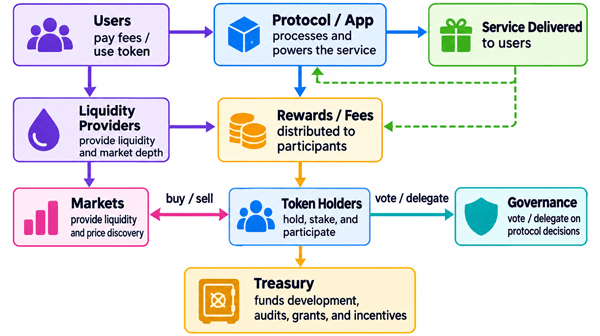
7. Simple Token Engineering Diagram
The diagram below shows a simplified token economy. In real projects, each arrow needs careful design and testing.
8. Real-World Examples of Token Engineering
The examples below are simplified for beginners. They show how token engineering ideas appear in real blockchain ecosystems.
8.1 Bitcoin: Scarcity and Miner Incentives
Bitcoin has a fixed maximum supply of 21 million BTC and uses proof-of-work mining. Miners spend resources to secure the network and are rewarded with newly issued BTC and transaction fees. The design connects scarcity, security spending, and network participation. A key trade-off is that long-term security depends increasingly on transaction fees as block subsidies decline.
8.2 Ethereum: Staking and Validator Security
Ethereum uses proof-of-stake. A validator deposits 32 ETH to activate validator software and helps store data, process transactions, and add blocks. This is a token engineering mechanism because the token is used as collateral, and validator rewards and penalties influence behavior. The design tries to make honest participation more attractive than attacks.
8.3 MakerDAO / DAI: Collateral, Stability Fees, and Governance
MakerDAO is known for DAI, a crypto-backed stablecoin system. Users lock collateral and generate DAI against it. Stability fees, collateral ratios, liquidation rules, and governance decisions help manage risk. This is token engineering because economic parameters are used to influence borrowing, collateral safety, and peg stability.
8.4 Uniswap: Liquidity Pools and Automated Pricing
Uniswap uses automated market maker pools. In a simple constant product pool, token reserves follow the formula x * y = k. Liquidity providers deposit assets and earn fees, while traders swap against the pool. The design creates always-available liquidity, but liquidity providers face risks such as impermanent loss and price volatility.
8.5 A DAO Token: Voting Power and Treasury Coordination
A DAO may issue a governance token so members can vote on grants, budgets, or protocol upgrades. This can coordinate a large community, but voting power may become concentrated. Token engineering must consider proposal thresholds, delegation, quorum, voting delays, conflict of interest rules, and treasury safeguards.
| Project pattern | Token engineering lesson |
|---|---|
| Bitcoin | Scarcity alone is not the full design. Security incentives, mining economics, and fee markets matter. |
| Ethereum staking | Tokens can act as collateral to reward honest validators and penalize harmful behavior. |
| MakerDAO / DAI | Stable systems need collateral rules, risk parameters, governance, and liquidation mechanisms. |
| Uniswap | Market design can replace order books, but liquidity providers need to understand trade-offs. |
| DAOs | Governance tokens need safeguards because voting power can become concentrated. |
9. Token Supply Models Explained
Token supply design affects incentives, perceived scarcity, funding, and long-term sustainability. There is no universally best model. The right model depends on the purpose of the network.
| Supply model | How it works | Best for | Watch out for |
|---|---|---|---|
| Fixed supply | No more than a set number of tokens can exist. | Scarcity-based assets and simple monetary narratives. | May not provide ongoing funding or rewards. |
| Inflationary supply | New tokens are created over time. | Staking rewards, ecosystem incentives, validator payments. | Too much inflation can dilute holders. |
| Deflationary mechanisms | Tokens are burned or removed from circulation. | Fee burn models or systems that want decreasing supply pressure. | Burns do not guarantee price appreciation. |
| Dynamic supply | Supply changes based on demand, collateral, governance, or algorithmic rules. | Stablecoins and adaptive systems. | Complexity and unexpected feedback loops. |
| Capped emissions | New rewards are issued for a defined period or schedule. | Bootstrapping networks and liquidity. | Rewards may end before real demand exists. |
10. Incentive Design: The Heart of Token Engineering
Incentives are the signals that tell participants what behavior is rewarded and what behavior is discouraged. Good incentives are specific, measurable, hard to exploit, and connected to real value creation.
10.1 Good Incentives Usually Reward
- Providing useful network resources, such as validation, storage, liquidity, or compute.
- Long-term participation rather than short-term farming.
- High-quality contributions, not just activity volume.
- Security, uptime, honesty, and reliability.
- Governance participation that is informed and accountable.
10.2 Weak Incentives Often Reward
- Fake activity that looks good on dashboards but creates no real value.
- Short-term liquidity that leaves when rewards decline.
- Speculative buying without product usage.
- Governance voting by uninformed or bribed participants.
- Growth numbers that ignore retention, revenue, or security.
11. Token Utility: What Makes a Token Useful?
A token should not be added just because a project is in Web3. The token should solve a coordination problem that is difficult to solve without it. Strong token utility usually connects to an actual network function.
| Utility type | Practical example | Design question |
|---|---|---|
| Payment | Users pay fees in the token. | Is token payment necessary, or would another asset work better? |
| Access | Holding or spending tokens unlocks a service. | Does this improve the product or only add friction? |
| Staking | Participants stake tokens to provide security or service quality. | Are rewards and penalties strong enough to change behavior? |
| Governance | Token holders vote on proposals. | How do you prevent whales from controlling everything? |
| Collateral | Tokens back loans, stablecoins, or guarantees. | How volatile is the collateral and how are liquidations handled? |
| Rewards | Users earn tokens for contributions. | Are rewards based on useful contribution or easy-to-fake activity? |
12. Governance Design: Who Controls the System?
Governance is one of the hardest parts of token engineering. A protocol may start centralized for speed and safety, then move toward decentralization over time. However, decentralization is not only about giving everyone a token vote. The process must be understandable, secure, and resistant to capture.
- Proposal thresholds prevent spam but can exclude smaller contributors.
- Quorum rules make sure enough voting power participates before decisions pass.
- Delegation lets token holders assign voting power to informed representatives.
- Time locks give users time to react before major changes take effect.
- Treasury spending limits reduce the damage of bad or malicious proposals.
- Emergency controls can protect users, but they should be transparent and limited.
13. Benefits of Good Token Engineering
| Benefit | Why it matters |
|---|---|
| Better incentive alignment | Participants have reasons to support the network instead of extracting value and leaving. |
| More sustainable growth | Rewards are linked to real value creation, not just temporary activity. |
| Improved security | Attack costs, penalties, and monitoring are considered before launch. |
| Clearer token utility | Users can understand why the token exists and how to use it. |
| Stronger governance | Decision-making processes are designed rather than improvised. |
| Better risk management | Teams can identify weak points before users and attackers find them. |
14. Risks and Limitations of Token Engineering
Token engineering improves design quality, but it cannot remove all risk. Real markets are messy. Human behavior is hard to predict. Regulations change. Smart contracts can have bugs. Governance can be manipulated. A responsible team should be honest about these limits.
14.1 Poor incentive alignment
Rewards may encourage the wrong behavior. For example, a project may reward transaction count, which encourages bots to create meaningless activity.
14.2 Unsustainable emissions
High token rewards can create early growth, but if real demand does not follow, emissions can create selling pressure.
14.3 Governance capture
Large holders, insiders, or coordinated groups may control votes and treasury decisions.
14.4 Speculation over utility
If people buy only because they expect price appreciation, the ecosystem may be fragile when sentiment changes.
14.5 Liquidity risk
Thin liquidity can make token prices volatile and make it hard for users to enter or exit positions.
14.6 Oracle and data risk
If a system relies on outside price data, bad oracle design can cause liquidations, exploits, or incorrect rewards.
14.7 Smart contract risk
Even a well-designed economy can fail if the code has vulnerabilities.
14.8 Regulatory risk
Some tokens may be treated as securities, commodities, payment instruments, or regulated financial products depending on jurisdiction and structure.
14.9 Complexity risk
A token model may be mathematically impressive but too difficult for users to understand or trust.
15. Common Token Engineering Mistakes
- Launching a token before proving there is real user demand.
- Creating a governance token when the project is not ready for meaningful governance.
- Using rewards to hide weak product-market fit.
- Ignoring token unlocks and future sell pressure.
- Designing emissions without calculating treasury runway.
- Rewarding activity that bots can easily fake.
- Assuming a burn mechanism automatically makes a token valuable.
- Ignoring legal and tax advice until after launch.
- Copying another project’s tokenomics without understanding why it worked there.
- Failing to monitor live data and adjust parameters carefully.
16. Token Engineering Best Practices
The following best practices are useful for founders, Web3 product teams, DAO contributors, token analysts, and beginners evaluating a token system.
16.1 Start with the problem, not the token
Ask what coordination problem the token solves. If the product works better without a token, forcing one into the design can create unnecessary risk.
16.2 Define measurable goals
Examples include active users, paid usage, validator participation, liquidity depth, governance participation, treasury runway, or network reliability.
16.3 Map every stakeholder
List what each group contributes, what they receive, and how they could exploit the system.
16.4 Make utility clear
Users should be able to explain why the token exists in one or two sentences.
16.5 Model emissions and unlocks
Calculate circulating supply over time, including team unlocks, investor unlocks, rewards, treasury spending, and liquidity incentives.
16.6 Stress test bad scenarios
Model token price crashes, low user growth, reward farming, validator downtime, oracle failure, governance attacks, and liquidity withdrawals.
16.7 Use conservative launch parameters
It is often safer to begin with lower limits, smaller rewards, and phased rollouts than to launch with aggressive assumptions.
16.8 Build dashboards early
Track supply, active users, revenue, staking ratio, governance turnout, liquidity depth, retention, treasury runway, and reward efficiency.
16.9 Design governance slowly
Start with safety, transparency, and accountability. Decentralization should be real, not performative.
16.10 Get independent review
Economic design, smart contracts, legal structure, and security assumptions should be reviewed by qualified specialists.
17. Practical Token Engineering Checklist
| Question | Why it matters |
|---|---|
| What problem does the token solve? | Avoids launching a token with no real purpose. |
| Who are the key stakeholders? | Ensures incentives are designed for real participants. |
| What actions should be rewarded? | Connects rewards to useful behavior. |
| What actions should be penalized? | Protects against cheating, downtime, spam, or abuse. |
| How does token value flow through the system? | Shows whether demand is connected to actual usage. |
| What happens when rewards decline? | Tests whether growth is sustainable. |
| How are tokens allocated and vested? | Reveals future supply pressure and control risks. |
| Who controls governance? | Identifies centralization and capture risks. |
| What are the biggest attack vectors? | Helps prioritize audits and safeguards. |
| Which metrics will be monitored after launch? | Supports continuous improvement. |
18. Metrics Token Engineers Track
| Metric | What it tells you | Warning sign |
|---|---|---|
| Active users | Whether people actually use the system. | Users disappear when rewards drop. |
| Token velocity | How quickly tokens move through the economy. | Tokens are immediately sold rather than used or held for utility. |
| Circulating supply | How many tokens are available in the market. | Large unlocks arrive before demand grows. |
| Emission rate | How quickly new tokens are issued. | Rewards are high but user retention is weak. |
| Staking ratio | How much supply is securing or participating in the network. | Low staking may weaken security or confidence. |
| Liquidity depth | How much trading can happen without major price impact. | Small trades cause large price swings. |
| Treasury runway | How long the project can fund operations and growth. | Spending is high without sustainable revenue. |
| Governance participation | How many holders vote or delegate. | Few voters decide major proposals. |
| Revenue or fees | Whether users pay for real utility. | Token incentives exceed actual protocol income. |
19. Beginner-Friendly Token Engineering Scenario
Suppose a new Web3 learning platform wants to issue a token. Students earn tokens for completing lessons. Teachers earn tokens for publishing courses. Token holders vote on new curriculum grants.
19.1 Weak Design
- Students earn tokens for clicking through lessons, so bots farm rewards.
- Teachers are paid for uploading content, not for student success.
- Governance is controlled by early investors.
- Rewards are high for three months, then the treasury runs low.
- The token has no use except speculation.
19.2 Improved Design
- Students earn limited rewards for verified learning milestones, not raw clicks.
- Teachers earn more when students complete courses and rate them highly.
- Tokens unlock premium workshops, certifications, or community access.
- Governance uses delegation and quorum rules to reduce low-quality voting.
- Rewards decline gradually as paid product revenue grows.
- A dashboard tracks completion quality, retention, treasury runway, and token emissions.
This example shows the difference between simply adding a token and engineering a token system. The improved version connects rewards to real learning outcomes and makes abuse harder.
20. Pros and Cons of Token Engineering
| Pros | Cons / Challenges |
|---|---|
| Creates clearer incentives for users and contributors. | Requires expertise across economics, technology, governance, and law. |
| Can help bootstrap networks before they have strong revenue. | Can be abused if rewards attract mercenary users. |
| Improves risk awareness before launch. | Models can be wrong if assumptions are unrealistic. |
| Supports decentralized governance and community ownership. | Governance can be captured by whales or low-turnout voting. |
| Makes token utility easier to explain. | Overly complex designs can confuse users. |
21. Legal and Ethical Considerations
Token engineering is not only a technical and economic activity. It also has legal and ethical responsibilities. Token teams should avoid misleading claims, unrealistic return promises, hidden insider advantages, unclear risks, and designs that exploit users.
- Do not market a token as a guaranteed investment or risk-free yield.
- Clearly disclose token allocations, vesting schedules, risks, and governance powers.
- Consider whether the token may fall under securities, commodities, payments, consumer protection, tax, or financial promotion rules.
- Avoid designs that depend mainly on new buyers entering the system.
- Use independent audits and publish understandable risk documentation.
- Design with user safety, transparency, and long-term sustainability in mind.
22. How to Evaluate a Token System Before Using or Investing
Before using, investing in, or building on a token, review the system carefully.
- Read the token documentation and ask whether the token has real utility.
- Check the allocation table and vesting schedule for insider concentration.
- Look at circulating supply versus fully diluted supply.
- Understand how rewards are funded and whether they are sustainable.
- Review governance participation and concentration of voting power.
- Check whether smart contracts have been audited by reputable firms.
- Look for real usage metrics, not only social media attention.
- Evaluate liquidity depth and price volatility.
- Understand regulatory, custody, smart contract, and market risks.
- Avoid decisions based only on yield, hype, or influencer promotion.
23. Frequently Asked Questions About Token Engineering
23.1 What is token engineering in simple words?
Token engineering is the process of designing a token system so that the token has a useful role, incentives are aligned, risks are managed, and the ecosystem can operate sustainably.
23.2 Is token engineering the same as tokenomics?
No. Tokenomics focuses on the economics of a token, such as supply, demand, allocation, and utility. Token engineering is broader. It includes tokenomics, but also modeling, simulations, governance design, risk controls, stakeholder behavior, and ongoing monitoring.
23.3 Do all blockchain projects need a token?
No. Some blockchain applications can work without their own token. A token should be used when it solves a real coordination, incentive, governance, security, or access problem.
23.4 What makes a token valuable?
A token may gain value from useful demand, scarce supply, network effects, staking requirements, fee usage, governance relevance, collateral demand, or market perception. However, none of these guarantee price appreciation.
23.5 What is a good token utility?
Good utility is connected to real use. Examples include paying for network services, staking to secure the network, accessing a product, providing collateral, or participating in meaningful governance.
23.6 Why do token rewards often fail?
Rewards fail when they pay for activity that does not create lasting value. If users participate only to earn and sell rewards, the system may collapse when incentives decline.
23.7 What is governance capture?
Governance capture happens when a small group controls enough voting power to make decisions for its own benefit, possibly against the wider community.
23.8 What is token velocity?
Token velocity describes how quickly tokens move through the economy. Very high velocity may suggest users immediately sell or pass on tokens instead of holding or using them for deeper utility.
23.9 Can simulations predict token success?
Simulations cannot guarantee success, but they help reveal weak assumptions, dangerous feedback loops, and likely stress points before launch.
23.10 What skills are useful for token engineering?
Useful skills include economics, game theory, statistics, systems thinking, blockchain architecture, smart contract basics, data analysis, governance design, and product strategy.
23.11 Is token engineering only for DeFi?
No. It can apply to DAOs, gaming, infrastructure networks, creator platforms, decentralized storage, DePIN, identity systems, public goods funding, and other Web3 ecosystems.
23.12 What is the biggest beginner mistake?
The biggest mistake is thinking token engineering means choosing a token supply and reward schedule. Real token engineering is about designing a complete system that works under real-world behavior and risk.
24. Conclusion: Token Engineering Is About Sustainable Coordination
Token engineering is one of the most important disciplines in blockchain and Web3 because tokens are not just digital assets. They are coordination tools. They influence how people contribute, vote, secure networks, provide liquidity, use products, and share value.
A strong token system starts with a real problem, gives the token a clear purpose, aligns incentives, tests assumptions, manages risks, and improves over time. A weak token system starts with hype and hopes that price appreciation will solve everything.
For beginners, the most important lesson is simple: do not judge a token only by its supply, price, or reward rate. Ask how the system works, who benefits, what behavior is rewarded, what risks exist, and whether the design can survive when market conditions become difficult.
Sources Consulted and Checked
These sources were consulted and checked while preparing this article to support factual accuracy and practical context.
- Token Engineering Commons - overview of token engineering as an emerging engineering discipline
- Ethereum.org - staking overview and 32 ETH validator deposit requirement
- MakerDAO historical whitepaper and protocol materials on collateral, stability fees, and DAI mechanics
- Uniswap Developer Documentation - automated market maker pools and constant product formula
Reader Advice
This article is provided for general educational and informational purposes. It does not constitute personalized legal, financial, investment, tax, technical, or regulatory advice, and it is not a recommendation or endorsement of any token, protocol, project, or strategy. Token-based systems can involve significant market, liquidity, smart-contract, governance, custody, operational, cybersecurity, and regulatory risks, including the possible loss of funds. Rules, policies, laws, technical requirements, and statistics may change over time and vary by jurisdiction, so readers should verify current information through official sources and seek advice from appropriately qualified professionals before making important decisions.