Quantum Computing and Crypto: Complete Guide, Examples, Risks and Best Practices
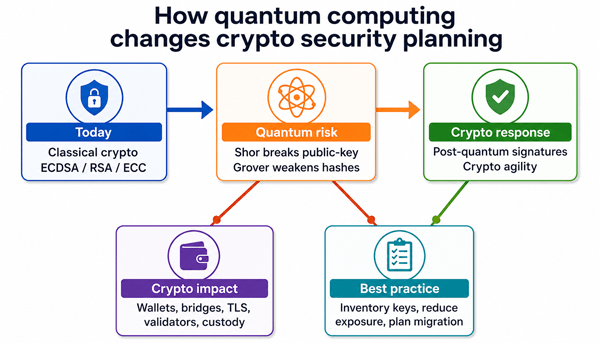
Figure 1: A simple view of how quantum computing changes crypto security planning.
Quantum computing and crypto is one of the most important long-term security topics in blockchain. It sounds technical, but the core idea is simple: many cryptocurrencies rely on mathematical problems that are extremely hard for today's normal computers. A powerful enough quantum computer could solve some of those problems much faster.
This does not mean Bitcoin, Ethereum, or every crypto wallet will suddenly fail tomorrow. Current quantum computers are not yet capable of breaking the cryptography used by major blockchains at scale. The real issue is preparation. Blockchains are public, global, and hard to upgrade. If the industry waits until a cryptographically relevant quantum computer already exists, it may be too late to migrate safely.
This guide explains what quantum computing means for crypto in beginner-friendly language. You will learn which parts of crypto are vulnerable, which parts are more resilient, what post-quantum cryptography is, how real-world attacks might work, and what users, developers, investors, exchanges, and blockchain projects can do now.
1. What Is Quantum Computing?
A quantum computer is a type of computer that uses quantum physics to process information. Instead of ordinary bits, which are either 0 or 1, quantum computers use quantum bits, usually called qubits. A qubit can represent information in ways that allow some calculations to be done very differently from classical computers.
The important point is not that quantum computers are magically faster at everything. They are not. They are useful for certain kinds of problems, especially problems involving simulation, optimization, and some areas of mathematics. Unfortunately, some of those mathematical problems are the same ones used in modern cryptography.
| Term | Beginner-friendly meaning | Why it matters for crypto |
|---|---|---|
| Qubit | A quantum unit of information. | Enough stable qubits could run algorithms that attack public-key cryptography. |
| Superposition | A qubit can hold a special quantum state instead of just a simple 0 or 1. | Helps quantum computers explore some problem spaces differently. |
| Entanglement | Qubits can be linked so their states are connected. | Useful for complex quantum calculations. |
| Error correction | Methods used to make noisy qubits reliable. | Breaking real-world crypto likely requires fault-tolerant, error-corrected quantum computers. |
| Cryptographically relevant quantum computer | A quantum computer powerful enough to break widely used cryptographic systems. | This is the type of machine that would create serious crypto risk. |
2. What Does Crypto Depend On?
Cryptocurrency systems use cryptography in several ways. The word crypto in cryptocurrency does not just mean coins or tokens. It means the system depends on cryptographic tools to prove ownership, verify transactions, secure wallets, protect network connections, and maintain trust without a central authority.
- Digital signatures prove that the owner of a private key authorized a transaction.
- Hash functions help create addresses, transaction IDs, block hashes, Merkle trees, proof-of-work mining, and data commitments.
- Public-key cryptography helps wallets and protocols prove identity or exchange secrets.
- Encryption protects communication channels, APIs, custody systems, databases, and user data.
- Consensus mechanisms use cryptographic proofs and signatures to agree on the state of the blockchain.
Quantum risk is not the same for all of these tools. Digital signatures and public-key systems are the biggest concern. Hash functions are affected differently and are usually easier to strengthen by using larger security parameters.
3. Why Quantum Computing Matters for Crypto
Most major cryptocurrencies use elliptic curve digital signatures. Bitcoin uses ECDSA and Schnorr-style signatures, while Ethereum accounts currently rely on elliptic curve signatures such as ECDSA over secp256k1. These systems are safe against known classical attacks when implemented correctly. The problem is that a large fault-tolerant quantum computer running Shor's algorithm could derive a private key from a public key.
That matters because a private key controls the funds. If an attacker can calculate your private key from your public key, they can sign transactions as if they were you.
3.1 The Two Quantum Algorithms Beginners Should Know
| Quantum algorithm | What it threatens | Crypto impact | Simple explanation |
|---|---|---|---|
| Shor's algorithm | RSA, ECC, ECDSA, Schnorr and similar public-key systems. | Could expose private keys from public keys if a large enough fault-tolerant quantum computer exists. | It solves certain math problems, such as factoring and discrete logarithms, much faster than classical methods. |
| Grover's algorithm | Symmetric encryption and hash search. | Reduces effective security strength, but does not usually destroy hash functions outright. | It can speed up brute-force search, so systems can respond by using larger keys or hashes. |
4. Which Parts of Crypto Are Most at Risk?
| Crypto component | Quantum risk level | Why | Practical takeaway |
|---|---|---|---|
| Wallet signatures | High long-term risk | Public-key signatures based on elliptic curves can be vulnerable to Shor's algorithm. | Blockchains need quantum-resistant signature options before the threat becomes practical. |
| Exposed public keys | High long-term risk | A public key may allow a future quantum attacker to calculate the private key. | Avoid address reuse and reduce unnecessary public-key exposure. |
| Hash functions | Medium to low risk | Grover's algorithm weakens brute-force resistance but does not break hashes in the same way. | Use strong hash sizes and avoid weak or outdated parameters. |
| Mining proof-of-work | Usually lower immediate risk | Quantum advantage for mining is less straightforward than signature theft. | Monitor research, but signatures are the priority. |
| Exchange custody systems | High operational risk | Centralized custody depends on wallet security, internal key management, TLS, databases, and access controls. | Custodians need crypto-agile infrastructure and migration plans. |
| Bridges and cross-chain protocols | High risk | They often hold large pooled funds and depend on signatures, validators, and multi-party controls. | Bridge designs should plan for post-quantum signature upgrades. |
5. How a Quantum Attack on Crypto Might Work
A realistic quantum attack would depend on the chain, wallet type, address type, transaction timing, and the attacker's hardware. The broad pattern looks like this:
- A user or protocol reveals a public key on-chain, often when spending from an address or using an account.
- A quantum attacker uses a powerful enough quantum computer to derive the matching private key.
- The attacker signs a competing transaction that transfers the funds to their own address.
- The attacker tries to get their transaction confirmed before the legitimate user or protocol can move the funds safely.
This is why public-key exposure matters. Some blockchain address types reveal the public key only when funds are spent. Others expose public keys earlier or continuously. Account-based chains often have public keys or recoverable signature data visible as part of normal account activity. The exact risk depends on implementation details.
5.1 Example 1: A Bitcoin User Reusing an Address
Imagine Alice receives Bitcoin to the same address many times and later spends from it. Once she spends, her public key becomes visible on-chain. In today's world that is normally fine. In a future world with a powerful quantum attacker, the exposed public key could become dangerous. If Alice later sends more funds back to the same already-exposed address, she increases the risk because an attacker may already have the information needed to target that key.
Practical lesson: Address reuse is already bad for privacy. In a post-quantum threat model, it can also become a security concern because it increases public-key exposure.
5.2 Example 2: A DeFi Bridge Holding Large Funds
A cross-chain bridge may hold hundreds of millions of dollars in locked assets. If its validator set or multi-signature control scheme depends on quantum-vulnerable signatures, a future attacker would not need to attack every user. They could target the control keys that secure the bridge. This makes bridges, custodians, and validator systems especially important in quantum migration planning.
5.3 Example 3: Long-Lived Encrypted Data
Not every quantum risk is about stealing coins immediately. Some attackers may collect encrypted data today and wait for future quantum computers to decrypt it later. This is often called a harvest-now, decrypt-later risk. It matters for exchanges, wallet companies, identity systems, customer records, trade secrets, private keys stored in backups, and blockchain infrastructure logs.
6. Is Bitcoin Quantum-Proof?
No. Bitcoin is not fully quantum-proof today. Bitcoin's core security depends heavily on elliptic curve signatures. A sufficiently powerful fault-tolerant quantum computer could threaten exposed Bitcoin public keys. However, that does not mean Bitcoin is currently broken. The practical threat depends on when such quantum machines become available and whether Bitcoin upgrades before then.
Bitcoin also has some helpful properties. Many modern Bitcoin addresses do not reveal the public key until coins are spent. That can reduce exposure compared with systems where public keys are always visible. But old address types, reused addresses, and already-exposed public keys create more concern. Bitcoin would need broad consensus for a quantum-resistant migration, which is technically and socially challenging.
7. Is Ethereum Quantum-Proof?
Ethereum is also not fully quantum-proof today. Ethereum accounts use signature schemes that can be vulnerable to a future Shor's algorithm attack. Ethereum has more flexibility than some chains because account abstraction, smart contract wallets, and protocol upgrades can create paths toward quantum-resistant signatures. However, migration is still complex because Ethereum includes wallets, validators, smart contracts, bridges, rollups, infrastructure providers, and many application layers.
The most practical Ethereum path is likely not one single instant switch. It is more likely to involve staged upgrades, optional post-quantum account types, wallet migration tools, rollup-level experimentation, and eventually stronger protocol-level requirements.
8. What Is Post-Quantum Cryptography?
Post-quantum cryptography, often shortened to PQC, means cryptographic algorithms designed to resist attacks from both classical and quantum computers. These algorithms do not require quantum computers to use. They run on normal computers, phones, servers, hardware wallets, validators, and blockchain nodes.
PQC is different from quantum cryptography. Quantum cryptography usually refers to technologies such as quantum key distribution that use quantum physics to communicate securely. Post-quantum cryptography is software-friendly cryptography designed for the post-quantum era.
| Concept | What it means | Crypto relevance |
|---|---|---|
| Post-quantum cryptography | New cryptographic algorithms believed to resist quantum attacks. | Needed for future wallet signatures, custody systems, and secure communications. |
| Quantum-resistant blockchain | A blockchain that uses or can migrate to quantum-safe primitives. | A long-term goal for major networks. |
| Crypto agility | The ability to replace cryptographic algorithms without rebuilding everything. | Critical because standards and threat models may change over time. |
| Hybrid cryptography | Using classical and post-quantum methods together during transition. | Useful for reducing migration risk while PQC adoption matures. |
9. Current Post-Quantum Standards and Algorithms
The most important standards work is being led by the U.S. National Institute of Standards and Technology (NIST). In August 2024, NIST released three finalized post-quantum standards: FIPS 203 for ML-KEM, FIPS 204 for ML-DSA, and FIPS 205 for SLH-DSA. NIST also selected HQC in March 2025 as an additional backup encryption algorithm for future standardization. FALCON was selected earlier and is expected to become a future digital signature standard known as FN-DSA.
| Standard / algorithm | Main use | Plain-English role | Crypto relevance |
|---|---|---|---|
| ML-KEM / FIPS 203 | Key establishment | Helps two parties agree on shared secrets securely against quantum attacks. | Useful for TLS, APIs, node communication, exchange systems, and encrypted infrastructure. |
| ML-DSA / FIPS 204 | Digital signatures | A primary post-quantum signature option based on lattice cryptography. | Potentially relevant for wallets, validators, protocol signatures, and software signing. |
| SLH-DSA / FIPS 205 | Digital signatures | A stateless hash-based signature option. | Useful as a conservative backup signature design, though signatures can be larger/slower. |
| FN-DSA / future FIPS 206 | Digital signatures | A future standard based on FALCON. | May offer smaller signatures, but implementation details can be more delicate. |
| HQC / selected 2025 | Key establishment | A code-based backup for ML-KEM. | Useful for algorithm diversity if lattice-based assumptions weaken. |
10. Why Blockchains Cannot Just Switch Overnight
Changing cryptography in a normal company system is hard. Changing cryptography in a public blockchain is harder because the system is decentralized, public, financially valuable, and often backwards-compatible with old accounts and scripts.
- Nodes need software upgrades and consensus rules must remain consistent.
- Wallets and hardware devices need to support new address and signature types.
- Users must move funds safely from old keys to new quantum-resistant keys.
- Smart contracts may need new verification logic and larger gas budgets.
- Exchanges, custodians, bridges, and validators must coordinate operational changes.
- Old inactive addresses may never migrate, which creates unresolved risk for dormant funds.
The real challenge is not just mathematics. It is coordination. A technically sound algorithm is only useful if people, wallets, exchanges, applications, and protocols can actually adopt it safely.
11. Common Misconceptions About Quantum Computing and Crypto
| Misconception | Reality |
|---|---|
| Quantum computers will break all crypto tomorrow. | Current quantum computers are not yet powerful enough to break major blockchain signature systems at scale. The risk is serious but long-term and preparation-focused. |
| Only Bitcoin has a quantum problem. | Any system using vulnerable public-key cryptography can be affected, including blockchains, wallets, exchanges, bridges, TLS, and custody systems. |
| Hashes are broken the same way as signatures. | No. Shor's algorithm is the big threat to public-key signatures. Grover's algorithm weakens brute-force resistance for hashes, but larger parameters can help. |
| Post-quantum means quantum computers are required. | No. PQC algorithms run on normal classical computers and are designed to resist future quantum attacks. |
| A new algorithm solves everything. | Migration, wallet support, governance, old funds, user education, and implementation security are equally important. |
12. Benefits of Preparing Early
- More time to test post-quantum signatures before large amounts of value depend on them.
- Less panic if quantum hardware improves faster than expected.
- Better protection for long-lived encrypted data that could be collected today and decrypted later.
- Safer migration paths for wallets, custodians, bridges, and validators.
- Improved crypto agility, which helps with future cryptographic changes beyond quantum risk.
- Stronger trust from users, institutions, regulators, and enterprise partners.
13. Risks and Limitations of Post-Quantum Migration
Post-quantum migration is necessary, but it is not risk-free. New cryptography can introduce new problems if it is rushed, poorly implemented, or added without understanding trade-offs.
| Risk | Why it matters | How to reduce it |
|---|---|---|
| Large signatures and keys | Some PQC signatures are much larger than ECDSA signatures, increasing transaction size, storage, and fees. | Benchmark options and use efficient account or script designs. |
| Implementation bugs | New cryptographic code can be fragile and hard to audit. | Use vetted libraries, audits, test vectors, and staged rollouts. |
| Governance disagreement | Public chains need broad agreement for consensus-level changes. | Start research and community discussion early. |
| User migration failures | Users may lose funds if migration tools are confusing. | Make wallet UX simple and provide clear warnings. |
| False sense of security | PQC does not fix phishing, malware, seed phrase theft, or smart contract bugs. | Treat PQC as one layer in a broader security model. |
14. Best Practices for Crypto Users
Ordinary crypto users do not need to panic, but they can build safer habits now.
- Do not reuse addresses when your wallet and chain support fresh addresses.
- Use reputable wallets that actively maintain security updates.
- Keep hardware wallet firmware and wallet software updated.
- Avoid sending funds back to old addresses whose public keys are already exposed.
- Do not store large long-term holdings in experimental wallets or unaudited smart contracts.
- Follow official project migration guidance if your blockchain introduces quantum-resistant addresses.
- Remember that most current theft still comes from phishing, malware, fake apps, seed phrase leaks, and smart contract exploits - not quantum computers.
15. Best Practices for Developers and Blockchain Projects
- Create a cryptographic inventory. List every place your system uses signatures, key exchange, encryption, hashing, certificates, hardware security modules, and third-party custody tools.
- Design for crypto agility. Avoid hard-coding one signature scheme forever. Make it possible to add, deprecate, and rotate algorithms.
- Test post-quantum signatures in non-production environments. Measure transaction size, verification cost, latency, storage impact, and user experience.
- Consider hybrid approaches during transition. Combining classical and post-quantum methods can reduce dependence on any single new assumption.
- Plan wallet migration early. Users need safe ways to move assets from old key types to new key types.
- Audit implementations carefully. Side-channel risks, randomness errors, serialization bugs, and invalid-signature handling can be as dangerous as the algorithm choice.
- Coordinate with exchanges, bridges, custodians, validators, and hardware wallet vendors. Protocol upgrades fail when the surrounding ecosystem is not ready.
- Document the threat model clearly. Explain what is protected now, what remains vulnerable, and what users should do.
16. Best Practices for Exchanges, Custodians and Institutions
- Inventory all public-key systems, including wallets, signing services, TLS, VPNs, APIs, databases, backup encryption, certificates, and vendor integrations.
- Classify data by shelf life. Data that must remain confidential for 10, 20, or 30 years should be prioritized for quantum-safe protection.
- Adopt crypto-agile key management systems that can support algorithm rotation.
- Pilot post-quantum TLS and hybrid key exchange where supported by vendors.
- Review cold storage designs for public-key exposure and migration paths.
- Run tabletop exercises for a future emergency quantum migration.
- Ask vendors for post-quantum roadmaps and implementation timelines.
- Avoid making unsupported marketing claims such as “fully quantum-proof” unless the claim has been independently verified and narrowly defined.
17. A Practical Quantum Readiness Checklist
| Readiness step | For users | For projects / companies |
|---|---|---|
| Reduce public-key exposure | Avoid address reuse where possible. | Analyze when and where public keys become visible. |
| Keep systems updated | Update wallets and devices. | Maintain dependencies and cryptographic libraries. |
| Inventory cryptography | Know which wallets hold long-term funds. | Map all signing, encryption, TLS, HSM, and backup systems. |
| Plan migration | Watch official chain guidance. | Build migration tools and testnets. |
| Test PQC | Not usually needed directly. | Benchmark ML-DSA, SLH-DSA, hybrid signatures, and protocol-level alternatives. |
| Communicate clearly | Beware of panic claims. | Publish honest, practical guidance without hype. |
18. How Quantum Computing Could Affect Different Crypto Sectors
| Sector | Main concern | Likely preparation path |
|---|---|---|
| Layer 1 blockchains | Consensus signatures, account signatures, old funds, governance upgrades. | Research, testnets, new address types, staged migration. |
| Layer 2 networks and rollups | Sequencer keys, fraud/validity proof systems, bridge contracts, account design. | Add PQ-friendly account models and upgrade bridges. |
| DeFi protocols | Admin keys, oracles, multisigs, bridges, treasury controls. | Use upgradeable key policies, multisig migration planning, and audited wallet infrastructure. |
| NFT platforms | Wallet ownership proofs, marketplace signatures, custody, metadata services. | Support future wallet migration and protect account recovery systems. |
| Stablecoins | Issuer controls, custody, blacklist/admin keys, reserve systems. | Institutional key management and PQC vendor roadmaps. |
| Exchanges | Hot/cold wallets, API keys, TLS, user data, backups. | Crypto-agile custody and long-term data protection. |
19. What Should Investors Watch?
Investors should avoid panic, but they should also avoid ignoring the issue. Quantum readiness may become a serious quality signal for blockchain projects, custodians, exchanges, and infrastructure companies.
- Does the project acknowledge quantum risk honestly, without hype?
- Is there active research into post-quantum signatures or account migration?
- Can the protocol upgrade cryptography without breaking existing users?
- Are major wallets, exchanges, and validators involved in planning?
- Does the project rely heavily on bridges or centralized admin keys?
- Are claims like “quantum-proof” supported by technical documentation and audits?
20. Pros and Cons of Quantum-Resistant Crypto
| Pros | Cons / trade-offs |
|---|---|
| Better long-term protection against future quantum attacks. | Larger signatures and keys may increase storage and transaction costs. |
| Improves trust for institutions and long-term holders. | Migration is complex and can introduce operational risk. |
| Encourages crypto agility and better security architecture. | Some algorithms are newer and need implementation maturity. |
| Protects long-lived confidential data from harvest-now, decrypt-later attacks. | Users may be confused by new address types and migration steps. |
| Creates a path for blockchains to survive future cryptographic disruption. | Governance delays can slow adoption on decentralized networks. |
21. Beginner-Friendly Technical Deep Dive
21.1 Private keys, public keys and signatures
A private key is a secret number. A public key is mathematically related to the private key. A digital signature proves that the holder of the private key approved a message or transaction. In a blockchain, this is how the network knows you authorized a transfer.
Classical computers cannot realistically calculate the private key from the public key for modern elliptic curve systems. That is the security assumption. A future large quantum computer could change that assumption.
21.2 Hashes and why they are different
A hash function turns data into a fixed-size fingerprint. It should be easy to calculate but extremely hard to reverse or manipulate. Blockchains use hashes everywhere: blocks, transactions, Merkle trees, addresses, commitments, and proof-of-work.
Quantum computers can speed up brute-force search through Grover's algorithm, but this is not the same as instantly reversing every hash. Strong hash sizes and careful design can preserve meaningful security margins.
21.3 Why exposed public keys matter
A quantum attack on signatures generally needs the public key. Some systems hide or hash the public key until the user spends. Others reveal it earlier. Once a public key is visible forever on a public blockchain, future attackers can target it if quantum hardware becomes strong enough.
22. Recommended Migration Roadmap for a Crypto Project
- Research phase: study NIST standards, blockchain-specific signature needs, transaction size limits, verification costs, hardware wallet support, and smart contract verification costs.
- Prototype phase: add PQC signature support to a test wallet, testnet, or rollup environment. Measure performance and failure modes.
- Hybrid phase: allow users or validators to use both classical and post-quantum authentication, especially for high-value accounts.
- Migration phase: provide clear tools for moving funds to quantum-resistant accounts or scripts. Prioritize high-value and exposed-key accounts.
- Deprecation phase: gradually discourage or restrict vulnerable key types once safe alternatives are widely supported.
- Long-term maintenance: keep crypto-agility, monitor cryptanalysis, update libraries, and keep migration documentation current.
23. What Not to Do
- Do not claim a chain is quantum-proof just because it uses a large hash function.
- Do not assume inactive old wallets will magically migrate.
- Do not roll your own cryptographic algorithm.
- Do not treat PQC as a replacement for audits, secure key storage, phishing protection, or smart contract safety.
- Do not wait for a confirmed quantum attack before planning. Public blockchain migration takes time.
- Do not ignore transaction size and fee impacts when testing PQC signatures.
24. Future Outlook: What Happens Next?
The next several years will likely bring more post-quantum experiments in blockchain wallets, rollups, bridges, validators, and institutional custody systems. Some upgrades may start at the application layer through smart contract wallets or hybrid signatures before becoming base-layer consensus changes.
The most realistic path is gradual. First, infrastructure providers and security-focused projects test post-quantum tools. Then wallets and custodians add support. Later, major chains may introduce official quantum-resistant account types, scripts, or signature verification rules. Finally, old vulnerable key types may be deprecated or treated as risky.
No one can give an exact date for when quantum computers will become powerful enough to break today's public-key cryptography. Predictions vary widely, and technical progress can speed up or slow down. The safest position is neither panic nor denial. The right approach is early, careful preparation.
25. FAQs About Quantum Computing and Crypto
25.1 Can quantum computers steal my crypto today?
There is no public evidence that current quantum computers can break the elliptic curve signatures used by major cryptocurrencies at scale today. Most current crypto theft comes from phishing, malware, leaked seed phrases, weak custody, and smart contract bugs.
25.2 Will quantum computing kill Bitcoin?
Not necessarily. Bitcoin would need a carefully designed and widely adopted migration to quantum-resistant signatures. The risk is serious, but it is a migration and governance challenge rather than an automatic death sentence.
25.3 Will quantum computing kill Ethereum?
Not necessarily. Ethereum also needs post-quantum planning, but it has several possible paths through protocol upgrades, account abstraction, smart contract wallets, and ecosystem-level migration.
25.4 What is the biggest quantum risk for crypto?
The biggest risk is that a powerful quantum computer could derive private keys from exposed public keys in vulnerable signature systems such as ECDSA or Schnorr-style schemes.
25.5 Are seed phrases vulnerable to quantum computers?
Seed phrases themselves are not the main quantum target. The bigger issue is the public-key signature scheme derived from the seed. However, weak seed storage, phishing, and malware are major risks today.
25.6 Are hardware wallets quantum-safe?
Most current hardware wallets still use classical signature schemes for major chains. Hardware wallets help protect private keys from normal attacks, but they do not automatically make the underlying blockchain signature scheme quantum-resistant.
25.7 What is a quantum-resistant wallet?
A quantum-resistant wallet would support signature schemes believed to resist quantum attacks, along with safe migration, good backups, and secure user experience. The term should be used carefully because security depends on the full protocol, not just the wallet app.
25.8 Do hash functions protect crypto from quantum attacks?
Hash functions help, but they do not solve every problem. They can reduce public-key exposure in some address designs and remain important for blockchain security, but vulnerable signatures still need a post-quantum replacement.
25.9 What should crypto projects do first?
They should inventory cryptography, design for crypto agility, test post-quantum signatures, evaluate costs, and create clear migration plans before the threat becomes urgent.
25.10 Should beginners avoid crypto because of quantum computing?
Quantum risk is worth understanding, but it is not the main day-to-day risk for most beginners today. Beginners should focus on safe wallet practices, avoiding scams, protecting seed phrases, and using reputable tools while watching official quantum migration updates.
26. Conclusion
Quantum computing is a real long-term issue for crypto, but it should be understood clearly rather than treated as fear-driven hype. The biggest concern is public-key cryptography, especially digital signatures used to control wallets, validators, bridges, custody systems, and protocol upgrades. Hash functions are affected differently and can usually be strengthened with larger parameters.
The practical answer is post-quantum cryptography, crypto agility, careful migration, and honest communication. Users can reduce risk by avoiding address reuse, keeping wallets updated, and following official migration guidance. Developers and institutions should start with cryptographic inventories, test PQC options, design flexible systems, and coordinate with the broader ecosystem.
The best time to prepare for quantum risk is before it becomes an emergency. Crypto systems that begin planning early will have a much better chance of protecting users, preserving trust, and surviving the next major era of cryptographic change.
Sources Consulted and Checked
These sources were consulted and checked while preparing this article to support accuracy and reliability.
- NIST, “NIST Releases First 3 Finalized Post-Quantum Encryption Standards,” August 13, 2024.
- NIST CSRC, “Post-Quantum Cryptography Standardization Process,” including FIPS 203, FIPS 204, FIPS 205, FIPS 206 in development, and HQC selection.
- NIST, “NIST Selects HQC as Fifth Algorithm for Post-Quantum Encryption,” March 11, 2025.
- Ethereum.org, “Future-proofing Ethereum and crypto quantum security,” updated June 2026.
- Bitcoin Optech, “Quantum resistance,” updated June 2026.
- Chaincode Labs, “Bitcoin and Quantum Computing: Current Status and Migration Considerations,” 2025.
Reader Advice
This article is provided for educational and informational purposes only. It is not personalized financial, legal, investment, tax, or cybersecurity advice, and it should not be treated as a recommendation to buy, sell, hold, or use any cryptocurrency, product, service, or security method. Quantum-computing capabilities, cryptographic standards, blockchain rules, laws, policies, and statistics can change over time and may vary by country or region, so readers should verify important details through current official sources and seek qualified professional guidance where appropriate. Cryptocurrency and cybersecurity decisions can involve loss, fraud, technical failure, regulatory, privacy, and market risks; use reputable tools, protect private keys and seed phrases, test migration steps carefully, and never risk funds or data you cannot afford to lose.