Governance Models in Crypto: Complete Guide, Examples, Risks and Best Practices
Crypto is not only about coins, wallets, and blockchains. Every crypto network or protocol also needs a way to make decisions. Who decides when software should be upgraded? Who controls the treasury? Who can change fees, list new assets, pause a risky contract, or respond to an emergency? The answer is crypto governance.
Governance models in crypto are the systems, rules, processes, and social norms that decide how a blockchain, DAO, or decentralized application changes over time. Good governance helps a project adapt without relying too much on one founder or company. Weak governance can create confusion, voter apathy, insider control, security risks, and even protocol failure.
This guide explains crypto governance in plain English. You will learn the main types of governance models, how proposals and votes work, real examples, common risks, and practical best practices for users, token holders, founders, delegates, and DAO contributors.
1. Key Takeaways
- Crypto governance is how blockchain networks, DAOs, and protocols make decisions and change rules.
- The two broad categories are on-chain governance, where voting and sometimes execution happen on the blockchain, and off-chain governance, where discussion and coordination happen outside the chain.
- Token voting is common, but it can concentrate power among whales, venture investors, teams, exchanges, or passive delegated voting blocs.
- The best governance systems usually combine transparent proposals, active discussion, clear voting rules, delegation, security review, emergency procedures, and accountability after execution.
- No governance model is perfectly decentralized. The practical goal is to make power visible, reduce capture, manage risk, and improve decisions over time.
2. What Is Crypto Governance?
Crypto governance is the decision-making framework used by a crypto project. It covers who can propose changes, who can vote or influence decisions, what rules must be followed, and how approved decisions are implemented.
In traditional companies, shareholders vote for boards, executives make decisions, and legal contracts define authority. In crypto, governance may involve developers, token holders, validators, miners, foundations, delegates, users, liquidity providers, security councils, multisig signers, and informal community leaders.
Governance can affect technical upgrades, economic parameters, treasury spending, grants, partnerships, fee switches, validator rules, risk settings, smart contract upgrades, emergency responses, and ecosystem strategy.
| Governance question | What it means in practice |
|---|---|
| Who can propose? | Can any user submit an idea, or only delegates, core teams, token holders, or validators? |
| Who can vote? | Do votes come from tokens, validators, reputation, elected councils, or community signaling? |
| How is power measured? | One token one vote, quadratic voting, validator stake, identity, reputation, or multisig approval. |
| What threshold is required? | Simple majority, quorum, supermajority, time delay, veto period, or security review. |
| How is the decision executed? | Automatically by smart contracts, manually by developers, by a multisig, or through software upgrades. |
| How are mistakes handled? | Emergency pause, rollback, patch proposal, council veto, or social coordination. |
3. Why Governance Matters in Crypto
A blockchain or DeFi protocol is not static. Markets change, bugs are found, new competitors appear, regulations evolve, and users ask for better features. Governance is how a project responds.
- Security: Governance can approve fixes, audits, emergency pauses, and risk parameter changes.
- Decentralization: Governance decides whether power is spread across users or concentrated among a few insiders.
- Trust: Transparent rules help users understand who controls upgrades, treasuries, and critical permissions.
- Protocol economics: Governance can change fees, emissions, collateral rules, rewards, and treasury spending.
- Long-term survival: Projects that cannot adapt may become obsolete, while projects with poor governance may be captured or mismanaged.
4. Simple Diagram: How Crypto Governance Usually Works
Although every project is different, many governance processes follow a similar lifecycle: idea, discussion, vote or signal, execution, and review.
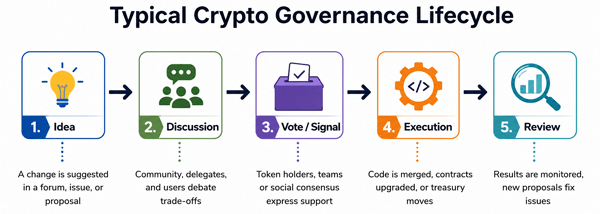
Typical Crypto Governance Lifecycle
5. Main Types of Governance Models in Crypto
Most projects use a hybrid model, but the categories below help you understand the design choices.
5.1 On-Chain Governance
On-chain governance means proposals, votes, and sometimes execution happen directly on the blockchain. Token holders or validators vote by signing transactions. If a proposal passes, a smart contract may execute the change after a delay. This model is transparent and auditable, but it can also be slow, expensive, or vulnerable to vote buying and whale control.
Common examples: Protocol parameter changes in DeFi; Treasury spending votes; Validator or staking rule changes; Smart contract upgrades controlled by governance contracts.
5.2 Off-Chain Governance
Off-chain governance happens through social coordination outside the blockchain. Communities discuss proposals in forums, calls, GitHub issues, research posts, improvement proposals, and developer meetings. Final implementation usually requires software changes and voluntary adoption by node operators, validators, miners, exchanges, and users.
Common examples: Ethereum improvement proposal discussions; Bitcoin improvement proposal discussions; Client team coordination; Social consensus during controversial upgrades.
5.3 DAO Governance
A DAO, or decentralized autonomous organization, is a community-led structure that uses crypto tools to coordinate decisions. DAOs often use governance tokens, forums, snapshot votes, working groups, grants committees, and multisigs. In practice, many DAOs are not fully autonomous; they depend on contributors, service providers, legal wrappers, and security controls.
Common examples: Protocol DAOs such as Uniswap governance; Grant DAOs; Investment or collector DAOs; Service DAOs.
5.4 Token-Based Governance
Token-based governance gives voting power to holders of a governance token. The common design is one token equals one vote. It is simple and easy to measure, but it can favor wealthy holders, early insiders, exchanges, and investors.
Common examples: UNI holders voting on Uniswap governance; COMP holders voting on Compound proposals; MKR/SKY governance in the Maker/Sky ecosystem.
5.5 Delegated Governance
Delegated governance allows token holders to assign voting power to another person or organization. This is useful because many holders do not have time or expertise to review proposals. Delegation can improve participation, but it also creates powerful delegate blocs that need transparency and accountability.
Common examples: Token holders delegating votes to active governance delegates; Public delegate platforms and voting records; University, research, or protocol specialist delegates.
5.6 Validator or Miner Governance
In validator or miner governance, block producers influence decisions through signaling, software choices, staking behavior, or chain support. This is common in layer-1 networks where validators or miners are responsible for network security.
Common examples: Validators choosing whether to run upgraded software; Miner signaling for protocol changes; Validator votes in proof-of-stake networks.
5.7 Foundation or Core-Team Governance
Many crypto projects begin with strong foundation or core-team control. A foundation may manage grants, trademarks, partnerships, legal matters, research, and early development. This can help speed execution, but it may reduce decentralization if the foundation has too much control.
Common examples: Early-stage protocols; Ecosystem foundations; Grant programs; Emergency upgrade coordination.
5.8 Multisig and Security Council Governance
A multisig requires several trusted signers to approve an action. Security councils or guardian committees may pause contracts, patch bugs, or veto dangerous proposals. These systems are practical for risk management, but users should know who the signers are and what powers they have.
Common examples: Emergency pause committees; Treasury multisigs; Layer-2 upgrade councils; Protocol guardian roles.
| Model | Best for | Main strength | Main risk |
|---|---|---|---|
| On-chain governance | Clear, auditable protocol actions | Transparent votes and execution | Whale control and voter apathy |
| Off-chain governance | Base-layer networks and social consensus | Flexible and hard to capture with one token | Less formal and slower to coordinate |
| DAO governance | Community-owned protocols and treasuries | Open participation and shared ownership | Low participation and unclear accountability |
| Token voting | Parameter changes and treasury votes | Simple and easy to implement | Plutocracy: wealth can equal power |
| Delegated voting | Complex protocols with many proposals | More informed voting | Delegate capture or inactive delegates |
| Foundation-led governance | Early-stage execution and legal coordination | Fast decisions and operational focus | Centralization and dependence on insiders |
| Security council/multisig | Emergency response and critical permissions | Fast action in crises | Trust in a small group |
6. How Crypto Governance Works Step by Step
6.1 A problem or opportunity is identified
A user, developer, delegate, risk team, or foundation notices something that needs action. This might be a bug, new feature, treasury request, fee change, incentive program, or upgrade.
6.2 A proposal is drafted
The proposer explains what should change, why it matters, expected benefits, risks, budget, timeline, and technical details. Strong proposals include measurable goals and implementation plans.
6.3 The community discusses the proposal
Discussion usually happens in forums, Discord, governance calls, GitHub, research posts, or delegate meetings. This stage is important because it can reveal hidden risks before voting starts.
6.4 A temperature check or signaling vote may happen
Some projects use informal polls before a binding vote. This helps test whether the idea has enough support to justify deeper work.
6.5 A formal vote is created
The vote may happen on-chain or through an off-chain voting tool. Rules define who can vote, how much voting power they have, how long voting stays open, and what quorum is required.
6.6 The decision is executed
Execution may be automatic through governance smart contracts, performed by a multisig, implemented by developers, or adopted by node operators running new software.
6.7 The outcome is monitored
Good governance does not stop after a vote. The project should monitor results, publish updates, review spending, track security effects, and correct mistakes.
7. Real-World Examples of Crypto Governance
7.1 Ethereum: Mostly Off-Chain Social Governance
Ethereum is often described as using off-chain governance for core protocol changes. Ideas are discussed through Ethereum Improvement Proposals, developer calls, research forums, client teams, validators, application developers, exchanges, and the wider community. No single token vote automatically changes Ethereum. Instead, upgrades require broad social agreement and adoption by the network.
Practical lesson: Off-chain governance can protect a base layer from simple token capture, but it depends heavily on open discussion, credible developers, client diversity, and community trust.
7.2 Uniswap: Token Holder and Delegate Governance
Uniswap governance uses the UNI token. UNI holders can delegate voting power to themselves or to delegates. Governance can control important areas such as treasury spending, protocol fee decisions, and certain governance permissions. The Uniswap Foundation describes a formal governance process with discussion, temperature checks, and on-chain proposals for final approval.
Practical lesson: Delegation can make governance more active because not every token holder has time to analyze proposals. However, large delegates should publish clear voting rationales and disclose conflicts of interest.
7.3 MakerDAO / Sky: Complex DeFi Governance and Risk Management
MakerDAO, now associated with the Sky ecosystem, is one of the best-known examples of DeFi governance because governance affects stablecoin risk, collateral choices, debt ceilings, fees, treasury matters, and ecosystem strategy. Its evolution also shows how governance can become more complex as a protocol grows.
Practical lesson: Governance for financial protocols must treat risk management as a core function, not an afterthought. Stablecoin and lending governance can affect real user funds, so proposals need careful analysis, audits, and monitoring.
7.4 Tezos: Formal On-Chain Upgrade Governance
Tezos is commonly used as an example of on-chain protocol amendment governance. The design aims to let the network propose, vote on, test, and adopt upgrades through a structured process. This shows one path for blockchains that want formal upgrade rules built into the protocol itself.
Practical lesson: Formal upgrade systems can reduce uncertainty, but they still need informed voters and safeguards against rushed or captured decisions.
7.5 Bitcoin: Conservative Off-Chain Governance
Bitcoin governance is highly conservative. Changes are usually discussed through Bitcoin Improvement Proposals, developer review, miner and node operator behavior, market acceptance, and social consensus. Because many participants value stability and resistance to capture, changes tend to move slowly.
Practical lesson: Slow governance can be frustrating, but for a base money network, caution can be a feature rather than a bug.
8. Major Risks and Limitations of Crypto Governance
8.1 Whale dominance
If voting power is based on token holdings, large holders can have outsized influence. This can make governance look decentralized while control is concentrated.
8.2 Low voter turnout
Many token holders do not vote because proposals are complex, voting costs money, or they do not feel their vote matters. Low turnout makes governance easier to capture.
8.3 Voter apathy and proposal overload
Too many proposals can overwhelm voters and delegates. Important risks may be missed because participants do not have enough time.
8.4 Vote buying and bribery
Governance votes can be influenced by direct payments, hidden deals, or markets for borrowed voting power.
8.5 Delegation capture
Delegation improves participation, but a few popular delegates can become too powerful or stop representing their delegators well.
8.6 Insider influence
Founders, investors, market makers, foundations, and early contributors may hold large token allocations or informal influence.
8.7 Poor proposal quality
Vague budgets, weak success metrics, missing risk analysis, or unclear execution plans can waste treasury funds.
8.8 Smart contract and upgrade risk
Governance can approve code that contains bugs or gives too much power to administrators.
8.9 Emergency power abuse
Security councils and multisigs can protect users in crises, but they can also become centralized control points.
8.10 Legal and regulatory uncertainty
DAO participants, foundations, and token holders may face legal questions depending on jurisdiction and activity.
9. Best Practices for Safer Crypto Governance
9.1 For Protocol Teams and DAO Designers
- Publish a clear governance constitution or process document that explains proposal stages, voting thresholds, quorum, execution rules, and emergency powers.
- Separate discussion, signaling, formal voting, execution, and review. Do not rush complex proposals directly to binding votes.
- Use time delays before high-risk execution so users and security teams can react.
- Require audits, technical reviews, and risk assessments for upgrades that affect user funds.
- Make treasury proposals specific: amount requested, recipient, milestones, reporting schedule, success metrics, and refund rules.
- Disclose token allocations, delegate voting power, multisig signers, foundation powers, and conflicts of interest.
- Design emergency powers narrowly. Define who can pause, what can be paused, how long it lasts, and how powers are reviewed.
- Encourage delegate accountability through public profiles, voting histories, rationales, compensation disclosures, and periodic reviews.
- Avoid relying on only one governance mechanism. A hybrid system is often safer than pure token voting alone.
9.2 For Token Holders and Voters
- Read the proposal summary, but also check the budget, execution method, risks, and who benefits.
- Look for independent comments from risk teams, security reviewers, and experienced delegates.
- Be careful with proposals that use urgent language but provide little evidence.
- Delegate to someone with a public track record if you do not have time to vote directly.
- Review your delegate periodically. Delegation should not be a set-and-forget decision.
- Understand that a passed vote does not guarantee a good outcome. Governance is decision-making under uncertainty.
9.3 For Delegates
- Publish clear voting principles so token holders know what you stand for.
- Explain important votes in plain language, including trade-offs and uncertainty.
- Disclose conflicts of interest, compensation, grants, investments, and relationships with proposers.
- Avoid voting on proposals you have not reviewed properly.
- Support post-vote accountability by asking funded teams to report outcomes.
10. Common Mistakes and Misconceptions
| Misconception | Reality |
|---|---|
| A DAO is always decentralized. | Many DAOs still rely on foundations, multisigs, core teams, or a few large voters. |
| On-chain voting removes politics. | It makes votes visible, but politics, lobbying, coalitions, and incentives still exist. |
| One token one vote is fair. | It is simple, but wealth concentration can become governance concentration. |
| High turnout means good governance. | Turnout helps, but voters still need good information and aligned incentives. |
| Emergency councils are always bad. | They can be useful for security, but their powers must be limited and transparent. |
| Decentralization means no leadership. | Healthy crypto communities often need leadership, but it should be accountable and replaceable. |
11. How to Evaluate a Crypto Project’s Governance Before Participating
Before you buy a governance token, delegate votes, join a DAO, or rely on a protocol, review its governance design. Use this checklist:
- Who controls upgrades and admin keys?
- Is there a public governance forum and proposal history?
- What percentage of tokens is held by insiders, investors, exchanges, or foundations?
- Can token holders vote directly, delegate, or both?
- What quorum and approval thresholds are required?
- Are votes binding, signaling-only, or executed by a multisig?
- Is there a timelock before execution?
- Who can pause the protocol in an emergency?
- Are treasury payments tied to milestones and reporting?
- Do delegates disclose conflicts and publish rationales?
- Has governance been tested during a crisis?
- Are past decisions easy to audit?
12. Where Crypto Governance Is Heading
Crypto governance is still evolving. Early designs often copied shareholder voting, but newer systems are experimenting with better participation and risk controls. Important trends include more professional delegates, public governance analytics, security councils with limited powers, legal wrappers for DAOs, quadratic or reputation-based voting experiments, optimistic governance, cross-chain governance, and stronger treasury accountability.
The likely future is not one perfect model. Different protocols need different governance. A base-layer blockchain, a lending protocol, a stablecoin system, a gaming DAO, and a layer-2 network all have different risk profiles. The best governance model is the one that matches the project’s purpose, maturity, user funds at risk, and need for adaptability.
13. FAQs About Governance Models in Crypto
13.1 What is the simplest definition of crypto governance?
Crypto governance is the way a blockchain, DAO, or crypto protocol makes decisions and changes rules. It decides who can propose, vote, execute, and review changes.
13.2 What is the difference between on-chain and off-chain governance?
On-chain governance uses blockchain-based voting and sometimes automatic execution. Off-chain governance relies on discussion, developer coordination, improvement proposals, and social consensus outside the blockchain.
13.3 Is DAO governance the same as token voting?
Not always. Many DAOs use token voting, but DAOs can also use delegation, working groups, multisigs, councils, reputation systems, or hybrid models.
13.4 Why do governance tokens have value?
Governance tokens may have value because they can influence protocol decisions, treasury spending, fees, incentives, or ecosystem direction. However, governance rights do not guarantee profits or legal ownership of a company.
13.5 Can crypto governance be hacked?
Yes. Governance can be attacked through smart contract bugs, vote buying, flash-loan-style voting designs, compromised delegates, malicious proposals, or captured admin keys. Good design reduces these risks but cannot remove them completely.
13.6 What is quorum in crypto governance?
Quorum is the minimum amount of voting participation required for a proposal to be valid. For example, a protocol may require a certain number of tokens to vote before a proposal can pass.
13.7 What is delegation in DAO governance?
Delegation lets a token holder assign voting power to another wallet, delegate, or organization without transferring the tokens. It helps inactive holders be represented by people who follow governance more closely.
13.8 Is on-chain governance better than off-chain governance?
Neither is always better. On-chain governance is transparent and programmable. Off-chain governance is flexible and can be harder to capture through token wealth alone. Many projects use a hybrid approach.
13.9 What is a governance attack?
A governance attack happens when someone uses voting power, borrowed tokens, bribery, proposal tricks, or admin access to push through a harmful decision.
13.10 How can beginners participate safely?
Start by reading proposal summaries, following trusted delegates, reviewing voting histories, understanding the risks, and delegating only to people or groups with transparent reasoning.
14. Conclusion
Governance models in crypto decide how decentralized systems evolve. They affect upgrades, treasuries, fees, risk settings, security responses, and community trust. The most important lesson is that governance is not only a voting mechanism. It is a full decision-making system made of rules, incentives, people, code, transparency, and accountability.
For beginners, the best approach is to ask practical questions: Who has power? How visible is that power? Can decisions be reviewed? Are risky changes delayed and audited? Do voters and delegates have enough information? If a project can answer these questions clearly, its governance is easier to trust. If it cannot, proceed carefully.
Sources Consulted and Checked
The following sources were consulted and checked while preparing this document and reviewing its accuracy.
- Ethereum.org - Ethereum governance
- Uniswap Developers - Governance overview
- Uniswap Foundation - Governance process
- Uniswap Developers - Governance glossary and delegation
- MakerDAO official site - transition to Sky
- CoinDesk - “MakerDAO Is Now Sky” (August 2024)
- Wharton Cryptogovernance Workshop - Blockchain Governance in the Wild
Reader Advice
This article is provided for educational and informational purposes only. It is not personalized legal, financial, investment, tax, security, or technical advice, and it should not be treated as a recommendation to buy, sell, hold, vote, delegate, or participate in any crypto project or DAO. Crypto governance can involve financial loss, smart-contract failures, malicious proposals, voting manipulation, changing token values, operational disruption, and legal or regulatory uncertainty. Rules, policies, laws, technical arrangements, project controls, and statistics can change over time and may vary by region and platform. Before making a decision, verify material information through current official sources, review the relevant proposal and governing documents, assess your own risk tolerance, and seek qualified professional advice where appropriate.