Smart Contract Security Basics
Beginner Guide, Key Concepts, Examples and Common Mistakes1. What Is Smart Contract Security?
Smart contract security is the practice of designing, writing, testing, reviewing, deploying, and monitoring blockchain programs so they behave as intended and cannot be easily abused. A smart contract is code that runs on a blockchain. Once deployed, it may control tokens, NFTs, lending positions, treasury funds, voting rights, or other valuable assets.
The main challenge is that smart contracts are public, automated, and often difficult or impossible to change after deployment. Anyone can inspect the code or interact with the contract. That openness is useful, but it also means mistakes can become public attack opportunities.
For beginners, the simplest way to think about smart contract security is this: a contract should only allow the right users to do the right actions, with the right values, at the right time, under the right conditions.
2. Why Smart Contract Security Matters
Traditional software bugs can be serious, but smart contract bugs can be especially costly because the software may directly hold money. There may be no customer support team, bank reversal, or central administrator who can undo a malicious transaction. On public blockchains, confirmed transactions are usually final.
Good security protects more than code. It protects users, protocol reputation, governance systems, liquidity, business continuity, and legal trust. Even a small missing permission check can let an attacker mint tokens, drain a pool, change an oracle price, or take over an upgrade function.
| Security benefit | What it means | Beginner example |
|---|---|---|
| Protects funds | Prevents unauthorized withdrawals, minting, or transfers. | A vault only lets a depositor withdraw their own balance. |
| Protects rules | Keeps contract logic consistent and fair. | A voting contract counts one eligible wallet once. |
| Protects operations | Allows teams to respond to incidents without abusing users. | A pause function can stop deposits during an emergency. |
| Protects trust | Reduces the chance of public exploits and loss of confidence. | An audited token sale avoids obvious role and math mistakes. |
3. How Smart Contract Attacks Usually Happen
Smart contract attacks do not always look like hacking in movies. Many attacks are simply normal contract calls made in an unexpected order, with unexpected values, by an unexpected user, or through another contract. Attackers read the code, find an assumption, and create a transaction that breaks that assumption.
A common pattern is: the developer assumes users will behave honestly; the attacker behaves strategically. For example, a contract may assume a price feed cannot be manipulated, an admin function cannot be reached, or a token transfer always succeeds. Security work is about testing those assumptions before attackers do.
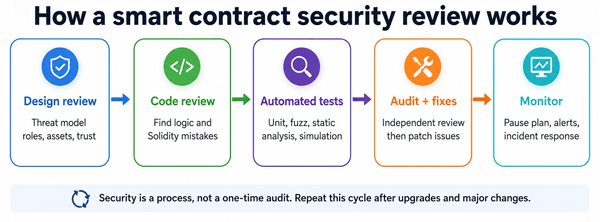
How a smart contract security review works
4. Core Smart Contract Security Concepts for Beginners
4.1 Assets
An asset is anything valuable the contract controls or influences. This includes ETH, tokens, NFTs, collateral, voting power, whitelist spots, upgrade authority, and oracle data. A security review should begin by asking: what can be stolen, frozen, inflated, manipulated, or misused?
4.2 Trust assumptions
A trust assumption is something the contract depends on being honest, correct, or available. Examples include the owner wallet, a multisig, an oracle, an upgrade administrator, a bridge, or another protocol. Every trust assumption should be documented because attackers often target the weakest dependency.
4.3 Access control
Access control decides who is allowed to call sensitive functions. Common examples include onlyOwner, role-based access control, multisig approvals, timelocks, and governance votes. Weak access control is one of the most dangerous smart contract mistakes because it can give attackers direct administrative power.
4.4 External calls
An external call happens when one contract calls another contract or sends ETH/tokens to another address. External calls are risky because the called address may be a malicious contract. It may fail, consume gas, return unexpected data, or call back into your contract before the first function finishes.
4.5 State changes
State is the contract data stored on the blockchain, such as balances, owners, roles, prices, and configuration values. Secure contracts usually update important internal state before making risky external calls. This reduces the chance that another contract can exploit outdated information.
4.6 Invariants
An invariant is a rule that should always remain true. For example, total user shares should match the assets in a vault, a user should not withdraw more than their balance, and a token cap should never be exceeded. Invariants are useful for audits, fuzz tests, and security thinking.
4.7 Upgradeability
Some smart contracts are upgradeable through proxy patterns. Upgrades can fix bugs, but they also add new risks: storage layout mistakes, compromised admin keys, unsafe initialization, and governance abuse. Upgradeable systems need stricter access control, clear processes, timelocks, and careful testing.
5. Common Smart Contract Vulnerabilities and Beginner Examples
The exact risk depends on the blockchain, language, architecture, and business logic. However, the following categories appear repeatedly in smart contract reviews and public vulnerability lists, including OWASP Smart Contract Top 10 guidance.
| Vulnerability | Simple meaning | Beginner example | Basic prevention |
|---|---|---|---|
| Access control failure | A sensitive function can be called by the wrong person. | Anyone can call mint() or upgradeTo(). | Use onlyOwner, roles, multisig, and tests for unauthorized users. |
| Reentrancy | A contract is called again before the first call finishes. | withdraw() sends ETH before reducing the user balance. | Use checks-effects-interactions, ReentrancyGuard, and pull payments. |
| Unchecked external call | The contract assumes another call worked when it failed. | A low-level call returns false but the contract still updates balances. | Check return values and use safer libraries. |
| Oracle manipulation | A contract trusts a price that attackers can influence. | A lending app uses one DEX spot price as collateral value. | Use robust oracle design, TWAPs, multiple sources, and sanity checks. |
| Integer overflow/underflow | Math exceeds the allowed number range. | Old Solidity code subtracts from zero and wraps around. | Use Solidity 0.8+, checked math, and safe casting. |
| Bad randomness | A random value can be predicted or influenced. | A lottery uses block.timestamp as the winning number. | Use commit-reveal or verified randomness where appropriate. |
| Denial of service | A function becomes too expensive or impossible to run. | A loop over thousands of users blocks withdrawals. | Avoid unbounded loops and design pull-based actions. |
| Logic error | The code does not match the intended business rule. | Fees are calculated twice or rewards can be claimed repeatedly. | Write clear specs, tests, reviews, and invariant checks. |
5.1 Reentrancy example in plain English
Imagine a vault that keeps a record of each user balance. Alice has 1 ETH. The vault sends Alice 1 ETH, then updates her balance to zero. If Alice is a malicious contract, it can receive the ETH and immediately call withdraw() again before the vault updates the balance. The vault still thinks Alice has 1 ETH and sends more.
The safer order is to check the balance, update Alice’s balance to zero, and only then send ETH. This is called the checks-effects-interactions pattern. Reentrancy guards and pull-payment patterns add extra protection.
5.2 Access control example
A token contract has a mint() function. The developer expects only the project owner to call it, but forgets to add an onlyOwner or role check. An attacker calls mint() and creates unlimited tokens. This is not a complex cryptographic attack. It is a missing permission check.
5.3 Oracle manipulation example
A lending contract lets users borrow based on the value of their collateral. It checks the token price using a small decentralized exchange pool. An attacker temporarily moves the pool price with a large trade or flash loan, borrows too much, then lets the price return to normal. The contract followed its code, but the design trusted a weak price source.
6. Secure Smart Contract Development Lifecycle
Security is strongest when it starts before coding. Waiting until the final audit is risky because deep design problems are harder to fix late. A practical beginner-friendly workflow looks like this:
- Write a short specification: what the contract should do, who can do it, and what must never happen.
- Identify assets and trust assumptions: funds, roles, upgrade keys, oracle inputs, and external protocols.
- Use proven libraries when possible instead of writing everything from scratch.
- Write unit tests for normal behavior and failure cases.
- Add fuzz tests and invariant tests for important rules.
- Run static analysis tools to catch common mistakes.
- Perform manual review and peer review.
- Get an independent audit for high-value contracts.
- Fix findings, retest, and document accepted risks.
- Deploy carefully, verify source code, monitor events, and prepare an incident response plan.
7. Best Practices for Smart Contract Security
7.1 Use simple designs
Complex systems are harder to secure. Beginners should avoid unnecessary upgrade mechanisms, complicated reward formulas, hidden admin powers, and too many external dependencies. A smaller contract with clear rules is usually easier to test and audit.
7.2 Follow checks-effects-interactions
A function should generally check requirements first, update internal state second, and interact with external contracts last. This pattern reduces reentrancy risk and makes code easier to reason about.
7.3 Use established libraries carefully
Libraries such as OpenZeppelin Contracts provide commonly used implementations for access control, token standards, pausing, reentrancy protection, and utility functions. They reduce the need to reinvent sensitive code, but they do not automatically make your whole system secure. You still need correct configuration, tests, and business-logic review.
7.4 Limit admin power
Admin functions should be minimal, transparent, and protected. Use multisigs for valuable systems, consider timelocks for major changes, and document what admins can do. Avoid giving one private key unlimited control over user funds.
7.5 Validate inputs
Do not assume inputs are reasonable. Check addresses are not zero when needed, amounts are not zero, deadlines have not passed, arrays have safe lengths, and configuration values stay within safe ranges.
7.6 Treat external contracts as untrusted
A token, receiver, oracle, bridge, or protocol integration can behave unexpectedly. External calls can fail, return false, trigger callbacks, or change state elsewhere. Test integrations with mock contracts that behave maliciously, not only honest mocks.
7.7 Plan for emergencies
High-value contracts often need monitoring, alerting, pause mechanisms, and clear runbooks. A pause feature can reduce damage during an incident, but it must be governed carefully so it does not become a centralization or censorship risk.
8. Common Beginner Mistakes
| Mistake | Why it matters |
|---|---|
| Thinking an audit guarantees safety | An audit reduces risk; it does not remove all risk. Auditors review a specific code version and scope. |
| Copying code without understanding it | Copied contracts may be outdated, incompatible, insecure, or wrong for your design. |
| Testing only happy paths | Attackers use edge cases: zero values, repeated calls, failed transfers, strange token behavior, and unusual ordering. |
| Using one wallet as the admin | A single compromised private key can become a full protocol compromise. |
| Ignoring economic attacks | A contract can be technically correct but economically exploitable through prices, incentives, or liquidity. |
| Forgetting initialization | Upgradeable contracts often use initialize() instead of constructors. If initialization is unprotected, attackers may take ownership. |
| Assuming private variables are secret | Blockchain data is public. private in Solidity limits contract access, not public visibility. |
| Deploying without monitoring | Security does not end at deployment. You need alerts for unusual withdrawals, role changes, pauses, upgrades, and oracle issues. |
9. Smart Contract Security Tools Beginners Should Know
Tools help find common problems faster, but they are not a replacement for understanding the system. Use tools as layers of defense.
| Tool type | What it helps with | Examples of use |
|---|---|---|
| Unit testing | Checks expected behavior and errors. | Test deposits, withdrawals, role restrictions, and edge cases. |
| Fuzz testing | Tries many random inputs to find unexpected failures. | Check users cannot withdraw more than deposited. |
| Invariant testing | Checks rules that should always hold. | Total shares should not exceed expected asset accounting. |
| Static analysis | Scans code for known risky patterns. | Find reentrancy patterns, unused returns, shadowing, or unsafe calls. |
| Formal verification | Mathematically checks specific properties. | Useful for high-value or simple critical logic. |
| Manual audit | Human review of design, code, tests, and assumptions. | Find business-logic and integration risks tools may miss. |
10. Beginner Security Checklist Before Deployment
- Is there a written specification for expected behavior?
- Have all admin functions been identified and protected?
- Are roles controlled by a multisig or appropriate governance process?
- Are all external calls reviewed and tested for failure?
- Does the code follow checks-effects-interactions where relevant?
- Are reentrancy protections used for functions that move funds or call external contracts?
- Are oracle sources robust enough for the value at risk?
- Are input limits, zero-address checks, and amount checks in place?
- Are upgrade and initialization functions protected?
- Are tests covering failure cases, edge cases, and unauthorized users?
- Have fuzz or invariant tests been added for critical rules?
- Has the contract been deployed to a testnet or fork and tested with realistic scenarios?
- Has source code verification been planned?
- Is there a monitoring and emergency response plan?
11. Pros and Cons of Strong Smart Contract Security Practices
| Benefits | Trade-offs or limitations |
|---|---|
| Lower chance of fund loss and public exploits. | Security takes time and budget. |
| More user trust and better protocol reputation. | Audits can delay launches. |
| Cleaner code and better documentation. | Extra controls can make systems less flexible. |
| Faster response during emergencies. | Pause or admin powers must be governed carefully. |
| Better long-term maintainability. | No process can guarantee perfect safety. |
12. Practical Example: A Safer Withdrawal Function
A beginner should not rely on this simplified example as production-ready code, but it shows the security thinking. The unsafe idea is to send money before reducing the recorded balance. The safer idea is to update the balance first and then make the external transfer.
// Simplified pattern, not a complete production contract
function withdraw(uint256 amount) external nonReentrant {
    require(balances[msg.sender] >= amount, "Not enough balance");

    // Effects: update internal state before the external call
    balances[msg.sender] -= amount;

    // Interaction: external call happens last
    (bool success, ) = msg.sender.call{value: amount}("");
    require(success, "Transfer failed");
}
The important lesson is not only the code. The lesson is the order of operations: validate, update internal records, then interact with outside addresses.
13. Misconceptions About Smart Contract Security
13.1 “The blockchain is secure, so my contract is secure.”
A blockchain can be secure while an application on top of it is vulnerable. The network may correctly execute flawed code.
13.2 “The code is public, so someone will find the bug before attackers do.”
Public code helps transparency, but it also helps attackers. Responsible review, testing, and audits are still necessary.
13.3 “We can fix bugs later.”
Some contracts are immutable. Upgradeable contracts can fix some bugs, but upgrades introduce their own risks and may require governance approval. Design for security before deployment.
13.4 “Only complex contracts get hacked.”
Simple mistakes can be devastating. A missing role check, unsafe price source, or bad withdrawal order can be enough.
14. FAQ
14.1 What is the most important smart contract security basic for beginners?
Start with access control and asset protection. Know who can call each important function, what assets the contract controls, and what conditions must always remain true.
14.2 Can a smart contract be 100% secure?
No serious security process can promise perfect safety. The goal is to reduce risk through simple design, proven libraries, testing, review, audits, monitoring, and careful operations.
14.3 Do I need an audit for every smart contract?
Small learning projects may not need a professional audit. Contracts that hold user funds, manage valuable assets, or affect production systems should get independent review before launch.
14.4 What is the difference between testing and auditing?
Testing checks whether known scenarios behave correctly. Auditing is a broader review of design, code, assumptions, edge cases, and attack paths. Both are useful, and neither replaces the other.
14.5 Are OpenZeppelin contracts automatically safe?
OpenZeppelin contracts are widely used and reviewed, but your implementation can still be unsafe if you configure roles incorrectly, add flawed custom logic, or use the wrong pattern for your system.
14.6 What is the checks-effects-interactions pattern?
It is a coding pattern where a function first checks requirements, then updates internal state, and only afterward interacts with external contracts or sends funds. It helps reduce reentrancy risk.
14.7 Why are oracles risky?
Smart contracts cannot directly know real-world prices or events. They depend on data sources called oracles. If a contract trusts weak or manipulable data, attackers can exploit the contract logic.
14.8 What should I learn after smart contract security basics?
Learn Solidity deeply, common vulnerability classes, testing frameworks, fuzzing, invariant testing, DeFi mechanics, token standards, upgradeable contract patterns, oracle design, and incident response.
15. Conclusion
Smart contract security is not just about preventing famous attacks. It is about building a habit of careful design. Beginners should learn to ask practical questions: who can call this, what assets are at risk, what external systems do we trust, what happens if a call fails, and what rule must always remain true?
The best security work happens early and continues after deployment. Use simple designs, proven libraries, strong access control, thorough testing, manual review, audits for valuable systems, and monitoring. A smart contract may be small, but if it controls valuable assets, it deserves serious security thinking.
Sources Consulted and Checked
These sources were consulted and checked while preparing this document to support accuracy and clarity.
- Solidity Documentation - Security Considerations
- Ethereum.org - Smart Contract Security
- OWASP Smart Contract Top 10
- OWASP Smart Contract Top 10 2026
- OpenZeppelin Contracts 5.x Utilities and Security Modules
- OpenZeppelin Contracts 4.x Security Modules
Reader Advice
This article is provided for educational and informational purposes and is not personalized legal, financial, investment, cybersecurity, or professional advice. Smart contracts and blockchain systems can involve significant technical, operational, financial, governance, and regulatory risks, including coding errors, exploits, irreversible transactions, loss of digital assets, and changing compliance obligations. Rules, policies, laws, standards, tool capabilities, and security statistics may change over time and vary by blockchain, project, and region. Readers should verify important information through current official documentation and qualified professionals, test code carefully, and obtain an independent security review before deploying or relying on any contract that controls valuable assets. The simplified examples in this article are for learning purposes and should not be treated as production-ready code or as a guarantee of security.