Reentrancy Attack Explained: Meaning, How It Works, Examples, Benefits and Risks
1. Quick Answer: What Is a Reentrancy Attack?
A reentrancy attack is a smart contract vulnerability where an external contract calls back into a vulnerable contract before the first function call has finished. If the vulnerable contract sends funds or makes an external call before updating its internal records, the attacker may repeatedly re-enter the same function and drain funds, duplicate withdrawals, or corrupt contract state.
In simple terms: the contract opens the door, hands over money, and only later updates its notebook. The attacker keeps walking back through the open door before the notebook is corrected.
2. Why Reentrancy Matters in Blockchain Security
Smart contracts often hold cryptocurrency, tokens, NFTs, governance power, and user balances. Unlike a traditional web app, deployed smart contract code can be difficult or impossible to patch quickly. A small ordering mistake can therefore become a serious financial risk.
Reentrancy is one of the classic Ethereum and Solidity security issues because it exploits a normal feature of smart contracts: contracts can call other contracts. External calls are useful, but they also hand control to another piece of code. If your contract is not prepared for that code to call back, the result can be dangerous.
3. What Does “Reentrancy” Mean?
Reentrancy means that a function is entered again before its previous execution has completed. This can happen when Contract A calls Contract B, and Contract B immediately calls back into Contract A.
Not every reentrant call is automatically malicious. Some systems are intentionally designed to allow callbacks. The problem happens when the first contract assumes its function will finish before anyone can call it again.
3.1 Simple Analogy
| Real-world analogy | Smart contract equivalent | Problem |
|---|---|---|
| Bank teller pays cash before marking the account as paid | Contract sends ETH before reducing the user balance | Same account can be paid more than once |
| Store gives a refund before recording the returned item | Contract transfers funds before updating state | Refund can be requested repeatedly |
| Ticket gate opens before scanning the ticket | Contract performs interaction before checks/effects are complete | The same ticket may be reused |
4. How a Reentrancy Attack Works Step by Step
A common reentrancy attack follows this sequence:
- A vulnerable contract stores user balances and has a withdraw function.
- An attacker deposits funds or creates a balance in the contract.
- The attacker calls withdraw.
- The vulnerable contract sends ETH to the attacker before setting the attacker’s balance to zero.
- The attacker’s receiving contract runs fallback or receive logic when it gets ETH.
- That fallback logic calls withdraw again before the first withdrawal finishes.
- Because the vulnerable contract has not updated the balance yet, it sends funds again.
- The loop repeats until the vulnerable contract runs out of funds, gas, or hits another limit.
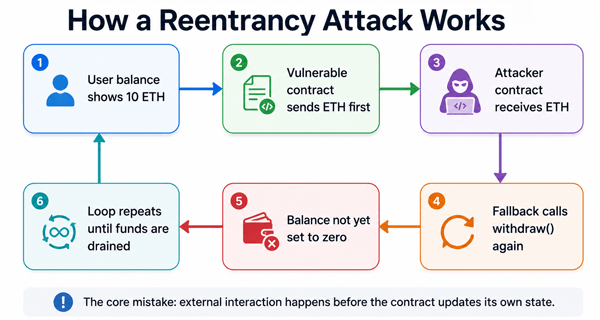
Diagram: Typical reentrancy attack flow. The vulnerability is the timing gap between sending value and updating internal state.
5. A Simple Vulnerable Solidity Example
The following simplified example shows the dangerous pattern. It is intentionally vulnerable and should not be used in production.
// Vulnerable example - do not use in production
pragma solidity ^0.8.20;

contract VulnerableVault {
    mapping(address => uint256) public balances;

    function deposit() external payable {
        balances[msg.sender] += msg.value;
    }

    function withdraw() external {
        uint256 amount = balances[msg.sender];
        require(amount > 0, "No balance");

        // Dangerous: external call before state update
        (bool sent, ) = msg.sender.call{value: amount}("");
        require(sent, "Transfer failed");

        // Too late. The attacker may have re-entered already.
        balances[msg.sender] = 0;
    }
}
5.1 What Is Wrong With This Code?
The issue is not simply that the contract sends ETH. Sending ETH is common. The issue is the order:
- The contract reads the user balance.
- It sends ETH to msg.sender.
- Only after the send succeeds does it set the balance to zero.
If msg.sender is a malicious contract, receiving ETH can trigger code. That code can call withdraw again while the old balance is still recorded.
5.2 Simplified Attacker Contract Example
// Educational example only
pragma solidity ^0.8.20;

interface IVulnerableVault {
    function deposit() external payable;
    function withdraw() external;
}

contract ReentrancyAttacker {
    IVulnerableVault public vault;

    constructor(address _vault) {
        vault = IVulnerableVault(_vault);
    }

    function attack() external payable {
        require(msg.value > 0, "Need ETH");
        vault.deposit{value: msg.value}();
        vault.withdraw();
    }

    receive() external payable {
        if (address(vault).balance >= 1 ether) {
            vault.withdraw();
        }
    }
}
6. How to Fix Reentrancy: Checks-Effects-Interactions
The most important prevention pattern is Checks-Effects-Interactions, often shortened to CEI. The idea is simple:
- Checks: validate permissions, balances, and inputs.
- Effects: update your contract’s internal state.
- Interactions: call external contracts or send ETH only after state has been updated.
A safer version updates the balance before sending ETH:
pragma solidity ^0.8.20;

contract SaferVault {
    mapping(address => uint256) public balances;

    function deposit() external payable {
        balances[msg.sender] += msg.value;
    }

    function withdraw() external {
        uint256 amount = balances[msg.sender];
        require(amount > 0, "No balance");

        // Effect first: update internal state before external call
        balances[msg.sender] = 0;

        // Interaction last
        (bool sent, ) = msg.sender.call{value: amount}("");
        require(sent, "Transfer failed");
    }
}
If the attacker re-enters after receiving ETH, the recorded balance is already zero, so the repeated withdrawal fails.
7. Using a Reentrancy Guard
A reentrancy guard is a lock that prevents a protected function from being entered again while it is already running. In Solidity projects, many developers use OpenZeppelin’s ReentrancyGuard and the nonReentrant modifier.
import "@openzeppelin/contracts/utils/ReentrancyGuard.sol";

contract GuardedVault is ReentrancyGuard {
    mapping(address => uint256) public balances;

    function withdraw() external nonReentrant {
        uint256 amount = balances[msg.sender];
        require(amount > 0, "No balance");

        balances[msg.sender] = 0;

        (bool sent, ) = msg.sender.call{value: amount}("");
        require(sent, "Transfer failed");
    }
}
A guard is useful, but it should not be the only protection. Good design still matters. Use CEI, reduce unnecessary external calls, test edge cases, and review how functions interact with each other.
8. Types of Reentrancy Attacks
| Type | What happens | Example risk | Beginner note |
|---|---|---|---|
| Single-function reentrancy | The same function is called again before finishing. | Repeated withdrawals from one function. | The classic example most beginners learn first. |
| Cross-function reentrancy | A different function is called during the first function’s execution. | A second function reads state that is temporarily inconsistent. | Fixes must consider all related functions, not only withdraw. |
| Cross-contract reentrancy | Several contracts interact, and the callback affects another contract in the system. | Vault, token, lending pool, or strategy contracts affect each other. | Common in complex DeFi systems. |
| Read-only reentrancy | A callback changes or observes state in a way that misleads a view or pricing function. | Incorrect price, share value, or accounting value is used. | No direct withdrawal is needed for damage to occur. |
| Token hook reentrancy | Token standards or callbacks trigger code during transfers. | ERC-777-style hooks or NFT callbacks create unexpected control flow. | Safe token handling requires understanding token behavior. |
9. Risks of Reentrancy Attacks
The biggest risk is financial loss, but reentrancy can cause several kinds of damage:
- Drained ETH, tokens, or pooled assets.
- Incorrect balances, shares, rewards, or debt accounting.
- Manipulated prices, exchange rates, or vault share values.
- Broken governance logic or duplicated voting effects.
- Loss of user trust and reputational damage.
- Emergency pauses, migration costs, legal disputes, and audit expenses.
10. Are There Any Benefits of Reentrancy?
A reentrancy attack has no benefit for honest users. However, the broader concept of callbacks and contract-to-contract interaction can be useful when designed safely.
| Concept | Potential benefit | Security condition |
|---|---|---|
| Callbacks | Allow contracts to react automatically when receiving tokens or data. | Must not expose inconsistent state. |
| Composability | Lets DeFi protocols connect with wallets, tokens, vaults, and exchanges. | External calls must be treated as untrusted. |
| Hooks | Enable custom logic during transfers or lifecycle events. | Use strict access control, guards, and careful ordering. |
So the useful feature is not the attack. The useful feature is composability. Reentrancy is what happens when composability is handled unsafely.
11. Common Causes of Reentrancy Vulnerabilities
- Updating balances after sending funds.
- Using low-level call without thinking about callbacks.
- Assuming transfer or send fully solves reentrancy.
- Calling untrusted contracts in the middle of important accounting logic.
- Leaving related functions unguarded while guarding only one function.
- Using token standards with hooks without reviewing callback behavior.
- Depending on a view function or price calculation while state is temporarily inconsistent.
12. Unsafe vs Safer Smart Contract Design
| Area | Unsafe approach | Safer approach |
|---|---|---|
| Withdrawals | Send funds first, update balance later. | Update state first, then send funds. |
| External calls | Assume external contract behaves normally. | Assume external contract can be malicious. |
| Protection | Guard only the obvious withdraw function. | Review all functions that share state. |
| Testing | Test only happy-path user flows. | Test malicious callbacks and repeated calls. |
| Emergency response | No pause or recovery plan. | Use carefully designed pause controls where appropriate. |
13. Best Practices to Prevent Reentrancy Attacks
- Use Checks-Effects-Interactions: Write functions so that validation happens first, state updates happen second, and external calls happen last.
- Use ReentrancyGuard where appropriate: Apply a lock to sensitive functions, especially withdrawals, claims, swaps, deposits that mint shares, and functions that call external contracts.
- Prefer pull payments: Instead of pushing funds to users during complex logic, record what they can withdraw and let them withdraw in a separate, protected step.
- Minimize external calls: The fewer external calls you make, the smaller the attack surface. Avoid calling untrusted contracts unless necessary.
- Protect related functions together: A nonReentrant modifier on one function does not automatically fix all cross-function interactions. Review shared state across the whole contract.
- Be careful with token hooks: Understand whether a token transfer can trigger receiver logic. ERC-721 safe transfers, ERC-1155 receiver hooks, and ERC-777-style hooks can change control flow.
- Use secure libraries: Rely on battle-tested libraries where suitable, but still understand their limits and configuration.
- Test like an attacker: Write tests with malicious receiver contracts that attempt to call back into your protocol.
- Get an independent audit: For contracts holding meaningful funds, professional review is strongly recommended.
- Use monitoring and emergency controls: For high-value systems, add monitoring, pause mechanisms, rate limits, or withdrawal delays where appropriate.
14. Developer Checklist Before Deployment
- Does any function send ETH or tokens to an external address?
- Does any function call an unknown contract?
- Are balances, shares, debts, rewards, and ownership records updated before external calls?
- Can a token receiver hook call back into this contract?
- Are there cross-function paths that use the same state?
- Have you tested with a malicious contract that re-enters?
- Are protected functions arranged so nonReentrant functions do not call each other incorrectly?
- Do emergency pause controls have clear governance and access limits?
- Has the contract been reviewed by someone who did not write it?
15. Tools That Can Help Find Reentrancy Bugs
| Tool or method | What it helps with | Limitation |
|---|---|---|
| Unit tests | Confirm expected behavior in normal and malicious flows. | Only covers scenarios you write. |
| Fuzz testing | Tries many inputs and sequences automatically. | Requires good invariants and setup. |
| Static analyzers | Scan code for known risky patterns. | May produce false positives or miss business-logic issues. |
| Manual review | Finds design-level and cross-contract risks. | Depends on reviewer skill and time. |
| Formal verification | Checks mathematical properties for critical code. | Can be expensive and requires precise specifications. |
16. Common Misconceptions About Reentrancy
- “Solidity 0.8 fixed reentrancy.” Solidity 0.8 added checked arithmetic by default, but it does not automatically prevent reentrant control flow.
- “Only withdraw functions are risky.” Withdrawals are common targets, but reentrancy can affect deposits, swaps, rewards, minting, lending, and pricing logic.
- “Using transfer is always safer.” Gas costs and EVM behavior have changed over time. Do not rely on transfer as a complete security strategy.
- “A reentrancy guard solves everything.” A guard helps, but poor design, cross-function paths, and external dependencies can still create risk.
- “View functions cannot be part of the problem.” Read-only reentrancy can mislead pricing or accounting even if the view function itself does not write state.
17. Real-World Context: Why This Became Famous
Reentrancy became widely known after major smart contract incidents in Ethereum’s early history, especially attacks where recursive withdrawals drained funds from vulnerable contracts. Since then, reentrancy has remained a standard topic in smart contract audits, Solidity security guides, and developer training.
Modern DeFi systems are more complex than the early examples. Today, reentrancy risk may involve vault shares, lending positions, token callbacks, pricing functions, liquidity pools, bridges, and multi-contract strategies. That is why developers should understand the principle, not just memorize one withdraw example.
Sources Consulted and Checked
These sources were consulted and checked while preparing this document to support accuracy and practical usefulness.
- Solidity documentation recommends the Checks-Effects-Interactions pattern for avoiding reentrancy and shows a vulnerable withdraw-style example.
- OpenZeppelin Contracts documents ReentrancyGuard as a module that prevents nested reentrant calls to protected functions and also provides PullPayment and Pausable patterns.
- The SWC Registry classifies reentrancy as SWC-107 and describes it as a recursive call issue where a malicious contract calls back before the first invocation finishes. The registry itself is no longer actively maintained, so it is useful historical context rather than the only current source.
- The Smart Contract Security Field Guide covers forms of reentrancy and practical guidance for identifying it in Solidity code.
18. FAQs About Reentrancy Attacks
18.1 What is a reentrancy attack in simple words?
It is an attack where a malicious contract calls back into a vulnerable contract before the vulnerable contract finishes updating its records. This can allow repeated withdrawals or incorrect state changes.
18.2 Is reentrancy only an Ethereum problem?
No. It is most commonly discussed in Ethereum and Solidity, but the underlying idea can apply to any smart contract platform or programming environment where external callbacks can occur before state is finalized.
18.3 What is the best way to prevent reentrancy?
Use Checks-Effects-Interactions, apply reentrancy guards to sensitive functions, minimize external calls, test malicious callbacks, and review cross-function and cross-contract state interactions.
18.4 Does ReentrancyGuard replace secure coding?
No. It is a helpful tool, not a complete design strategy. You still need correct accounting, safe external calls, testing, and review.
18.5 Can token transfers cause reentrancy?
Yes, depending on the token standard and implementation. Some token transfers can trigger receiver hooks or callbacks. Developers should not assume token transfers are always passive.
18.6 Can a read-only function be involved in reentrancy?
Yes. Read-only reentrancy can affect systems that rely on view functions for prices, share values, or accounting snapshots while state is temporarily inconsistent.
18.7 Should beginners avoid all external calls?
No. External calls are part of smart contract development. Beginners should learn to treat them as untrusted and place them after internal state updates whenever possible.
18.8 Is reentrancy still relevant today?
Yes. Better libraries and education have reduced simple cases, but complex DeFi systems still create reentrancy opportunities through callbacks, shared state, and multi-contract interactions.
19. Final Thoughts
A reentrancy attack is powerful because it exploits a simple assumption: that a function will finish before it can be called again. In smart contracts, that assumption can be false whenever your code makes an external call.
The safest mindset is to treat every external contract as untrusted. Update your own state before interacting with others, use proven guard patterns, test with malicious contracts, and review the full system rather than one function at a time. For beginners, mastering reentrancy is one of the best ways to understand why smart contract security depends on both code and careful execution flow.
Reader Advice
This article is provided for educational and informational purposes and is not personalized legal, financial, investment, cybersecurity, or professional advice. The Solidity examples, including vulnerable and attacker-style code, are included only to explain reentrancy and should be used solely in systems you own or are expressly authorized to test; unauthorized testing or exploitation may cause financial loss, service disruption, or legal consequences. Smart-contract tools, platform behavior, security practices, rules, policies, laws, and statistics can change over time and may vary by network and region, so verify important details through current official documentation and qualified professionals before deploying code, investing funds, conducting a security test, or making another material decision. Smart contracts can contain hidden defects even after testing or auditing, and interacting with them may involve loss of assets, transaction fees, irreversible actions, and other technical or market risks.