Crypto Bridge Hacks Explained: Meaning, Examples, Risks and Prevention
1. Quick Answer: What Is a Crypto Bridge Hack?
A crypto bridge hack is an attack on a cross-chain bridge: a system that helps move crypto assets or messages between different blockchains. Because blockchains do not naturally understand each other, a bridge usually locks assets on one chain and creates a matching representation on another chain, or sends a verified message that triggers an action on the destination chain.
A bridge hack happens when an attacker finds a weakness in that process. The weakness may be in the smart contract code, validator or multisig keys, message verification, relayer infrastructure, governance controls, user approvals, or the website that people use to bridge assets.
In simple terms: a crypto bridge is like a checkpoint between two separate roads. A bridge hack is when someone tricks the checkpoint into releasing funds, minting fake wrapped tokens, or approving a transfer that should never have been allowed.
2. Why Crypto Bridges Exist
Different blockchains are like separate networks with separate rules. Bitcoin, Ethereum, BNB Chain, Solana, Polygon, Arbitrum, Avalanche and other chains do not automatically share balances or transactions with one another. A token that exists on Ethereum does not magically appear on Solana or BNB Chain.
Crypto bridges were created to solve this problem. They allow people and applications to use assets across chains, move liquidity, access cheaper transaction fees, join DeFi markets on another network, or connect smart contracts across ecosystems.
| Bridge use case | What it means |
|---|---|
| Asset transfer | Move value from one blockchain to another, usually through lock-and-mint, burn-and-release, or liquidity pools. |
| Cross-chain DeFi | Use assets from one network in lending, trading, staking, yield farming, or liquidity pools on another network. |
| Interoperability | Let decentralized applications communicate across chains instead of staying isolated. |
| User convenience | Avoid selling assets on an exchange just to buy the same or related asset on another chain. |
3. How a Crypto Bridge Works in Simple Terms
Bridge designs differ, but most follow one of three broad models. Understanding these models makes bridge hacks easier to understand.
3.1 Lock and mint
In a lock-and-mint bridge, the user deposits a token into a contract on the original chain. The bridge then mints a wrapped version of that token on the destination chain. For example, a user may lock ETH on Ethereum and receive wrapped ETH on another chain.
3.2 Burn and release
When the user wants to go back, the wrapped token is burned on the destination chain. After the bridge verifies the burn, the original asset is released from the contract on the source chain.
3.3 Liquidity network
Some bridges do not mint wrapped assets. Instead, they use liquidity pools. A user deposits one asset on Chain A, and a liquidity provider releases the equivalent asset on Chain B. This can be faster, but it creates its own liquidity, pricing and operational risks.
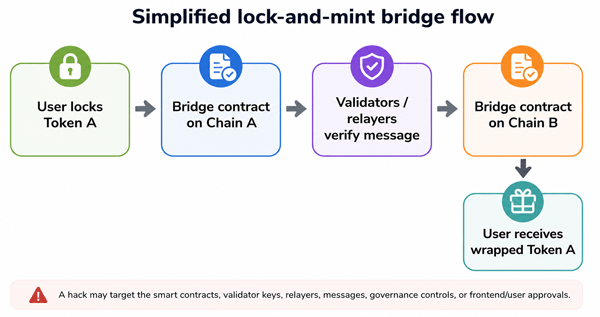
Figure 1: A simplified bridge flow. Real bridges can be more complex, but most attacks target one of these trust points.
4. Why Bridge Hacks Are So Common and So Costly
Bridge hacks have been among the largest incidents in crypto because bridges often concentrate large amounts of locked value. A popular bridge can hold hundreds of millions or billions of dollars in reserves that support wrapped assets on other chains. That creates a high-value target.
Chainalysis reported in August 2022 that about $2 billion had been stolen across 13 cross-chain bridge hacks, and that bridge attacks accounted for 69% of total crypto funds stolen in 2022 up to that point. Chainlink’s bridge-risk resources also warn that bridge attacks are among the largest cryptocurrency hacks by value, while its education material notes that bridge losses have exceeded $2.8 billion by public estimates.
5. Common Types of Crypto Bridge Hacks
| Attack type | Meaning | Practical example |
|---|---|---|
| Smart contract bug | A flaw in bridge code lets attackers bypass checks, mint unbacked assets, or withdraw funds improperly. | Wormhole and Nomad are commonly cited examples of verification or message-handling failures. |
| Private key or validator compromise | Attackers steal or control enough keys to approve fraudulent bridge messages. | Ronin is a major example: attackers obtained enough validator signatures to approve withdrawals. |
| Bad message verification | The destination chain accepts a message that was not truly valid on the source chain. | This can happen when proof verification, signatures, roots, or replay protections are implemented incorrectly. |
| Upgrade or governance failure | A bridge upgrade, admin key, or governance action introduces a dangerous configuration. | A small configuration error can become catastrophic if the bridge manages large reserves. |
| Relayer or oracle weakness | Off-chain infrastructure passes wrong, delayed, or malicious information to contracts. | Bridges often depend on relayers, watchers, or external services. |
| Frontend and approval attacks | Users interact with a fake or compromised website and approve malicious transactions. | Wallet drainers often exploit approvals, not the bridge contract itself. |
| Liquidity and accounting failure | The bridge cannot properly match locked assets, wrapped assets, pool balances, or fees. | This can cause insolvency, frozen withdrawals, or unfair losses. |
6. Real-World Examples of Major Crypto Bridge Hacks
The numbers below are approximate because token prices move, sources count recovered funds differently, and some incidents involve multiple assets. The purpose is to show the scale and the type of weakness, not to rank every hack perfectly.
| Bridge | Date | Reported loss | Main weakness | Beginner-friendly lesson |
|---|---|---|---|---|
| Ronin Bridge | March 2022 | About $624M / $625M | Validator/private key compromise | Attackers gained enough validator signatures to approve fraudulent withdrawals. |
| Poly Network | August 2021 | About $610M / $612M | Access-control and contract logic weakness | The attacker manipulated privileged logic to move assets across chains; much of the value was later returned. |
| Wormhole | February 2022 | About $320M / $326M | Signature/proof verification issue | The attacker minted unbacked wrapped ETH on Solana by bypassing verification. |
| Nomad Bridge | August 2022 | About $156M-$190M+ | Message verification/configuration bug | A bad update allowed many attackers to copy transactions and drain funds. |
| BNB Bridge | October 2022 | About $570M | Bridge proof/message exploit | Attackers created or moved unauthorized BNB; the chain was temporarily halted and some funds were frozen. |
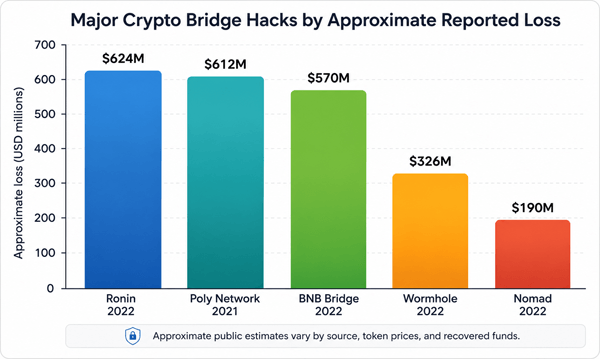
Figure 2: Approximate reported losses from selected major bridge hacks. Values vary by source and market price.
7. What Actually Happens During a Bridge Hack?
A bridge hack can look complicated on-chain, but the core pattern is usually simple: the attacker convinces the bridge to release, mint, or credit assets without a valid corresponding action on the other chain.
- The attacker studies the bridge design, code, keys, relayers, upgrades, or user-facing website.
- They find a way to bypass a security check or gain control over a required approval path.
- They create a fraudulent withdrawal, mint, message, or claim.
- The bridge accepts the fraudulent action as valid.
- Funds are drained, wrapped tokens become undercollateralized, or liquidity pools become insolvent.
- The attacker may quickly swap, bridge again, split funds across wallets, or use mixers to hide the trail.
For safety, this article does not provide step-by-step exploit instructions or code. The important point for beginners is that bridge hacks usually exploit trust assumptions, not just one visible transaction.
8. Why Bridges Are Hard to Secure
A normal smart contract usually needs to understand one blockchain. A bridge must understand at least two chains, plus the communication between them. That makes the security model much harder.
| Security challenge | Why it matters |
|---|---|
| Multiple chains | Each chain has different finality rules, fees, block times and transaction models. |
| Large locked value | Bridge reserves make them attractive targets. |
| Off-chain components | Relayers, validators, watchers, APIs and websites can all become attack surfaces. |
| Complex upgrades | A small upgrade mistake can affect many chains at once. |
| Different trust models | Some bridges rely on multisigs, some on validators, some on light clients, and some on liquidity providers. |
| Fast attacker movement | Stolen funds can be swapped and moved quickly across chains. |
9. Main Risks for Regular Users
Most users do not audit bridge contracts. They need practical risk awareness. Here are the most important user-level risks.
- Loss of funds: If a bridge is hacked, withdrawals may pause and users may lose deposited or wrapped assets.
- Wrapped token depeg: A wrapped asset can lose value if people believe it is no longer fully backed.
- Frozen transfers: Bridges may stop deposits or withdrawals during an incident.
- Approval risk: A malicious or compromised bridge frontend can trick users into giving broad token approvals.
- Wrong-chain mistakes: Sending funds to the wrong network or address can be difficult or impossible to reverse.
- Liquidity risk: Even if the bridge works, there may not be enough liquidity for a fast exit.
- Phishing risk: Fake bridge websites often appear during popular airdrops, token launches, or migration events.
10. Main Risks for Projects and Developers
For builders, bridge security is not only a code-audit problem. It is an operational, economic and governance problem.
- A bridge compromise can damage the entire protocol, not just one contract.
- Wrapped assets can become unbacked, causing losses for users, liquidity providers and integrated DeFi apps.
- Emergency pauses can protect funds but may also freeze legitimate users.
- Admin keys, multisigs, deployment scripts and upgrade processes can be just as important as contract code.
- Integrations that blindly accept bridged assets may inherit bridge risk without understanding it.
- Reputation loss can continue long after the technical issue is fixed.
11. Trusted Bridges vs Trust-Minimized Bridges
| Bridge model | How it works | Potential benefit | Main risk |
|---|---|---|---|
| Custodial or centralized bridge | A company or custodian controls deposits and releases assets. | Simple UX and fast support. | Users trust the operator, custody controls and internal security. |
| Multisig / validator bridge | A group of signers approves messages or withdrawals. | Flexible and widely used. | If enough keys are compromised, funds can be stolen. |
| Optimistic bridge | Messages are accepted after a challenge window unless disputed. | Can reduce trust in a fixed signer set. | Slower withdrawals and complex dispute assumptions. |
| Light-client / trust-minimized bridge | Contracts verify another chain’s state or proofs more directly. | Stronger cryptographic assumptions in theory. | More complex and expensive to build; implementation bugs still matter. |
| Liquidity bridge | Uses liquidity pools instead of minting wrapped tokens in some flows. | Often faster and convenient. | Liquidity, pricing and pool solvency risks. |
12. How Users Can Reduce Bridge Hack Risk
There is no risk-free bridge. The goal is to reduce avoidable risk and avoid treating a bridge like a normal wallet transfer.
- Use official links only. Access bridge links from the project’s verified website, documentation or official social accounts. Avoid ads and random search results.
- Start with a small test transfer. Send a small amount first, confirm it arrives, and only then consider a larger transfer.
- Avoid keeping large balances in wrapped assets for longer than needed. If you bridge to use a network, know how you will exit.
- Check recent security status. Look for paused withdrawals, warnings, audits, incident reports and active community alerts.
- Review token approvals. Use a reputable approval checker to revoke old or unlimited approvals you no longer need.
- Prefer bridges with transparent security design. Look for audits, bug bounties, clear signer information, emergency procedures and proof systems.
- Be careful during hype events. Airdrops, new launches and urgent migrations attract phishing pages and fake bridge links.
- Do not ignore slippage, fees and finality times. A transaction that seems stuck may still be pending; repeated attempts can create mistakes.
- Use hardware wallets for meaningful amounts. They do not eliminate contract risk, but they reduce key-theft risk.
- Never sign transactions you do not understand. If the wallet warning says you are granting broad permission, pause and verify.
13. How Projects Can Prevent Bridge Hacks
Projects that build or integrate bridges need layered defense. A single audit is not enough for a system that controls large cross-chain value.
| Prevention layer | Practical implementation |
|---|---|
| Threat modeling | Map every trust assumption: contracts, signers, relayers, proofs, governance, upgrades, frontend, APIs and monitoring. |
| Independent audits | Use multiple specialized auditors for bridge logic, cryptography, access control and upgrade paths. |
| Formal verification where suitable | Prove critical invariants such as no unbacked minting, no double withdrawals and correct message validation. |
| Bug bounty program | Offer meaningful rewards before attackers find the issue. Use clear scope and rapid triage. |
| Key management | Use hardware security modules, MPC or strong multisig practices; avoid single points of failure. |
| Rate limits and withdrawal caps | Limit damage from a first exploit transaction and give monitoring systems time to react. |
| Circuit breakers | Pause suspicious routes, assets or chains without shutting down more than necessary. |
| Real-time monitoring | Watch for abnormal withdrawals, unexpected mints, signer behavior, liquidity imbalance and message replay patterns. |
| Safe upgrade process | Use timelocks, staged deployments, canary limits, independent review and rollback plans. |
| Incident response plan | Prepare communication, pause procedures, law-enforcement contacts, exchange alerts and recovery workflows before an incident. |
14. Bridge Security Checklist for Users
| Checklist item | Why it matters |
|---|---|
| Official URL verified | Do not use sponsored ads or unknown links. |
| Recent incident check completed | Search the bridge name plus “hack”, “paused”, “exploit”, and “withdrawals”. |
| Small test transaction sent | Confirm the route works before sending a larger amount. |
| Fees and destination chain understood | Make sure you have gas on the destination chain. |
| Approvals reviewed | Avoid unlimited approvals unless necessary; revoke later. |
| Exit plan known | Know how to bridge back or swap out if needed. |
| Amount is affordable to risk | Never bridge more than you can afford to lose. |
15. Bridge Security Checklist for Teams
| Control | Question to ask |
|---|---|
| No unbounded minting | Destination-chain minting must be backed by valid source-chain events or proofs. |
| Replay protection | Messages cannot be reused across chains, contracts, nonces or forks. |
| Signer threshold is robust | No small group or single compromised party can drain reserves. |
| Withdrawal limits exist | Large abnormal movements trigger delay, review or automatic pause. |
| Critical upgrades are delayed | Timelocks and staged rollout reduce sudden catastrophic mistakes. |
| Monitoring is live | The team can detect abnormal activity within minutes, not days. |
| Emergency authority is clear | Who can pause? What can they pause? How is abuse prevented? |
| User communication is prepared | Incident pages, status updates and warnings are ready before a crisis. |
16. Common Misconceptions About Crypto Bridge Hacks
16.1 Misconception 1: “The blockchain was hacked.”
Usually, the base blockchain was not hacked. The bridge system, smart contract, signer setup or frontend was compromised. That difference matters because a bridge can fail even when the underlying chains continue working normally.
16.2 Misconception 2: “Audited means safe.”
Audits reduce risk, but they do not remove it. Some major incidents happened in systems that had audits or experienced teams. Bridges need audits, monitoring, limits, careful upgrades and strong operations.
16.3 Misconception 3: “Decentralized always means secure.”
Decentralization helps only when the design is actually resilient. A bridge controlled by a small validator set or poorly protected multisig can still have a central point of failure.
16.4 Misconception 4: “Wrapped tokens are the same as native tokens.”
Wrapped tokens depend on the bridge or issuer that backs them. If the bridge reserve is drained, the wrapped token may lose its backing and trade below the value of the native token.
17. What to Do If You Used a Bridge That Was Hacked
- Do not panic-sign new transactions from unknown links. Attackers often create fake recovery pages after incidents.
- Check official announcements from the bridge team, not screenshots or random social posts.
- Revoke risky approvals if the official guidance or security community recommends it.
- Document your transaction hashes, wallet addresses and asset amounts.
- Avoid buying “discounted” wrapped assets unless you fully understand the backing risk.
- Watch for recovery, claims or reimbursement plans, but verify every link carefully.
- For large losses, consider professional legal, tax or security advice.
18. The Future of Bridge Security
Bridge security is improving, but the problem is not solved. Better designs increasingly focus on reducing trust in small signer groups, using stronger proof systems, adding rate limits, improving monitoring and isolating failures so one compromised route does not drain everything. Research also explores failure-containment models, where a bridge can degrade safely instead of failing all at once.
For users, the practical lesson is simple: treat bridges as powerful but risky infrastructure. For teams, the lesson is stricter: cross-chain systems need defense in depth, continuous monitoring and conservative design because a single bridge weakness can affect many chains and many users at once.
19. Conclusion
Crypto bridges make blockchains more useful by allowing assets and messages to move across networks. But the same role makes them high-value targets. A bridge hack can happen through smart contract bugs, compromised validator keys, weak message verification, bad upgrades, frontend attacks or operational failures.
Beginners should remember three things: use official links, test with small amounts and do not leave more value bridged than necessary. Projects should remember that bridge security is not just about code. It also depends on key management, monitoring, governance, limits, incident response and honest communication with users.
20. FAQs About Crypto Bridge Hacks
20.1 What is a crypto bridge hack?
A crypto bridge hack is an attack that exploits a cross-chain bridge to steal locked assets, mint unbacked wrapped tokens, approve fake transfers, or drain liquidity.
20.2 Why do hackers target bridges?
Bridges often hold large reserves and connect multiple chains. One successful exploit can unlock a large pool of assets.
20.3 Are all bridges unsafe?
No, but every bridge has risk. The level of risk depends on the bridge design, audits, validator setup, monitoring, limits, governance and operational security.
20.4 Can I recover funds after a bridge hack?
Sometimes users receive partial or full reimbursement, but it is not guaranteed. Recovery depends on the bridge team, stolen-fund tracing, frozen funds, insurance, treasury reserves and legal outcomes.
20.5 Is a native token safer than a bridged token?
Usually, a native token does not depend on a bridge reserve. A bridged or wrapped token depends on the system backing it, so it carries extra bridge risk.
20.6 What is the safest way to bridge crypto?
There is no perfectly safe method. Use official links, choose reputable bridges, check current status, send a test transaction, limit the amount, review approvals and avoid keeping large balances bridged unnecessarily.
20.7 What is the difference between a bridge hack and a wallet drainer?
A bridge hack targets bridge infrastructure. A wallet drainer usually tricks a user into signing malicious approvals or transfers. A fake bridge website can be used as part of a wallet-drainer attack.
20.8 Do audits prevent bridge hacks?
Audits help, but they are not enough on their own. Bridges also need formal checks where useful, strong key management, monitoring, withdrawal limits, safe upgrades and bug bounties.
20.9 Why do wrapped tokens depeg after a bridge hack?
If users believe the wrapped token is no longer fully backed by locked reserves, they may sell it at a discount. This can cause the wrapped token to trade below the value of the original asset.
20.10 Should beginners use crypto bridges?
Beginners can use bridges, but only with caution. Start small, understand the route, use official links and avoid bridging funds you cannot afford to lose.
Sources Consulted and Checked
These sources were consulted and checked while preparing this document to support its accuracy and reliability.
- Chainalysis, “Cross-Chain Bridge Hacks Emerge as Top Security Risk,” August 2022.
- Chainalysis, “Introduction to Cross-Chain Bridges,” December 2024.
- Chainlink, “Cross-chain bridges and associated risks,” accessed 2026.
- Chainlink Education Hub, “Seven Key Cross-Chain Bridge Vulnerabilities Explained,” last updated 2026.
- CertiK, “Cross-Chain Vulnerabilities & Bridge Exploits in 2022,” August 2022.
- Elliptic, “Nomad Loses $156 Million in Seventh Major Crypto Bridge Exploit of 2022,” August 2022.
- Reuters, “Crypto’s biggest hacks and heists after $1.5 billion theft from Bybit,” February 2025.
- Reuters, “Losses from crypto hacks jump to $2.2 bln in 2024, report says,” December 2024.
- Immunefi, “Common Cross-Chain Bridge Vulnerabilities,” August 2023.
- Academic survey: “SoK: A Review of Cross-Chain Bridge Hacks in 2023,” arXiv, January 2025.
Reader Advice
This article is provided for educational and informational purposes only and is not personalized legal, financial, tax, investment, cybersecurity, or other professional advice or a recommendation to use any bridge, token, platform, or service. Crypto bridges and wrapped assets involve technical, market, liquidity, smart-contract, operational, phishing, and loss-of-funds risks, and recovery after an incident is not guaranteed. Rules, policies, laws, security conditions, project features, and statistics can change over time and may vary by region, so readers should verify current information through official sources and seek qualified professional advice where appropriate before making a decision.