51% Attack in Blockchain Explained: How It Works, Examples, Risks and Prevention
1.1 Quick Answer: What Is a 51% Attack?
A 51% attack is a blockchain security threat where one miner, validator, mining pool, or coordinated group gains enough control over a network’s consensus power to influence which blocks become the accepted version of history. In proof-of-work systems, this usually means controlling more than half of the network’s mining hash power. In proof-of-stake systems, the idea is similar but usually relates to a large share of staked validators or voting power.
The main danger is not that the attacker can magically steal every wallet. The main danger is that the attacker can reorganize recent blocks, reverse their own payments, and double-spend coins. They may also delay or censor some transactions while they control the network.
| Question | Simple answer |
|---|---|
| What does 51% mean? | Majority control over the power used to decide the valid chain. It does not always need to be exactly 51%; the practical threshold depends on the network and attack type. |
| What can the attacker do? | Reorganize recent blocks, double-spend their own coins, and temporarily censor transactions. |
| What can’t the attacker do? | They cannot break private keys, create unlimited coins, or directly spend coins from other people’s wallets. |
| Who is most at risk? | Smaller proof-of-work chains, chains with rented hash power available, low-liquidity coins, exchanges accepting deposits too quickly, and merchants selling irreversible goods. |
| Is Bitcoin vulnerable? | In theory, any open proof-of-work chain can be attacked. In practice, Bitcoin is much harder to attack because of its large hash rate, miner diversity, economic incentives, and liquidity depth. |
2. Blockchain Basics: Why Majority Control Matters
Blockchains are shared databases. Instead of one company keeping the master record, many computers, called nodes, keep copies of the ledger. The network needs a way to agree on which transactions are valid and which block comes next. This agreement process is called consensus.
In a proof-of-work blockchain, miners compete to create blocks by spending computing power. The chain with the most accumulated work is generally treated as the valid chain. In a proof-of-stake blockchain, validators lock up assets and vote or attest to blocks according to the protocol rules.
A 51% attack targets the consensus layer. It does not usually exploit a smart contract bug or steal a private key. It attacks the process used to decide which version of the transaction history the network accepts.
3. Important Terms Before We Go Further
| Term | Beginner-friendly meaning |
|---|---|
| Hash power | The total computing power miners use to secure a proof-of-work blockchain. |
| Validator | A participant that helps confirm blocks in a proof-of-stake network. |
| Block confirmation | A new block added after your transaction block. More confirmations usually mean lower reversal risk. |
| Chain reorganization | When the network replaces recent blocks with a different valid chain. Short reorganizations can happen naturally; deep reorganizations are more serious. |
| Double spend | Spending the same coins twice by reversing one payment after receiving goods, services, or exchange credit. |
| Finality | The point at which a transaction is practically or formally considered irreversible. Some networks have probabilistic finality; others have stronger finality rules. |
4. How a 51% Attack Works Step by Step
The easiest way to understand a 51% attack is to imagine two versions of the blockchain being built at the same time: the public chain that everyone sees and a private chain secretly built by the attacker.
- The attacker obtains majority consensus power. In proof of work, this may involve controlling mining equipment, coordinating a pool, or renting hash power. In proof of stake, the attacker would need enough stake or validator influence to disrupt consensus under the protocol’s rules.
- The attacker starts mining or validating a private alternate chain. The public network continues normally, but the attacker secretly builds another version of recent history.
- The attacker sends coins to a target. For example, they deposit coins to an exchange, wait for the exchange to credit the account, and trade or withdraw another asset.
- The attacker excludes that payment from the private chain. In the secret version of history, the payment to the exchange never happened or is replaced by a transaction back to the attacker.
- The attacker publishes the private chain. If it has more accumulated work or otherwise satisfies the protocol’s winning-chain rule, the network may accept it.
- The original payment disappears from the accepted history. The target has already delivered value, but the attacker still controls the original coins. This is the double-spend.
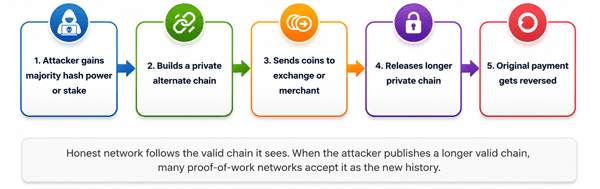
Diagram: A simplified 51% attack flow. The attacker privately builds an alternate chain, then releases it to replace recent public history.
5. What a 51% Attacker Can and Cannot Do
| Can do | Cannot normally do |
|---|---|
| Reverse their own recent transactions by causing a chain reorganization. | Steal coins from wallets without private keys. |
| Double-spend against exchanges, merchants, or services that accept deposits too quickly. | Create coins beyond the protocol’s issuance rules. |
| Temporarily censor or delay selected transactions while the attack lasts. | Change old history easily if the chain is deep, widely monitored, and expensive to reorganize. |
| Damage confidence in the blockchain and cause exchanges to pause deposits. | Break the underlying cryptographic signatures used by wallets. |
This distinction matters because beginners often hear “51% attack” and assume every user’s funds can be directly drained. That is not accurate. The attack is serious, but it mainly affects transaction ordering, recent history, and confidence in final settlement.
6. Why Smaller Blockchains Are Usually More Vulnerable
A large blockchain is expensive to overpower because an attacker must compete with a huge amount of honest mining or validator activity. A smaller blockchain may have less security budget, fewer independent miners, lower liquidity, or a mining algorithm that can be rented cheaply. This creates an economic problem: if the cost of the attack is lower than the value that can be double-spent, the network becomes attractive to attackers.
| Risk factor | Why it increases 51% attack risk |
|---|---|
| Low hash rate or low stake distribution | An attacker needs fewer resources to gain majority influence. |
| Rentable mining power | Attackers may not need to own hardware; they can temporarily rent hash power. |
| Shared mining algorithm with larger coins | Miners can redirect power from another chain and overwhelm the smaller chain. |
| Low confirmation requirements | Exchanges or merchants may release value before a transaction is safely buried under enough blocks. |
| Weak monitoring | Deep reorganizations may be detected slowly, allowing more damage. |
| High exchange liquidity relative to security | Attackers can extract more value than the cost of the attack. |
7. Real-World Examples of 51% Attacks
51% attacks are not just theoretical. They have affected several smaller proof-of-work networks, especially where mining power could be rented or redirected. Loss estimates vary by source, market price, and counting method, so the figures below should be treated as approximate.
| Network | When | What happened | Key lesson |
|---|---|---|---|
| Bitcoin Gold (BTG) | May 2018 | An attacker double-spent roughly 388,000 BTG, commonly reported at about $18 million at the time. | Changing mining access goals does not remove the need for enough security budget and exchange confirmation controls. |
| Ethereum Classic (ETC) | January 2019 | Coinbase reported deep chain reorganizations and double-spend activity affecting ETC; trading and deposits were halted by some platforms. | Exchanges must monitor reorganizations and adjust confirmations based on live risk. |
| Ethereum Classic (ETC) | August 2020 | Coinbase reported two attacks in early August 2020 involving about 800,000 ETC and 460,000 ETC in double-spend transactions. Bitquery estimated the first attack’s double spend at about 807,260 ETC, worth around $5.6 million at the time. | Repeated attacks can happen when the economic incentive remains attractive. |
| Bitcoin Gold (BTG) | January 2020 | A later attack reportedly double-spent tens of thousands of dollars worth of BTG. | One fix may not be enough if the underlying economics still favor attackers. |
A practical lesson from these cases is that the victim is often not an ordinary wallet holder. The direct target is commonly an exchange or service that credits deposits before the transaction is sufficiently final. However, ordinary users can still suffer indirectly through halted deposits, delistings, price drops, lower confidence, and network disruption.
8. The Economics of a 51% Attack
A rational attacker compares expected profit with cost and risk. The attack becomes more tempting when the cost of temporary majority power is low, the coin is liquid enough to exchange for other assets, and the victim accepts deposits after too few confirmations.
| Economic variable | Attacker wants | Defender wants |
|---|---|---|
| Cost of majority power | Low rental or coordination cost | High hash rate, diverse miners, or strong stake penalties |
| Value extractable from exchanges | High liquidity and fast withdrawals | Risk-based limits, delays, and monitoring |
| Confirmation time | Few confirmations before crediting deposits | More confirmations for risky assets and large deposits |
| Detection risk | Slow detection and weak response | Real-time reorg alerts and clear incident playbooks |
| Reputation impact | Victims slow to react | Exchanges, wallets, and teams coordinate quickly |
9. Main Risks of a 51% Attack
9.1 For regular users
- Deposits or withdrawals may be paused during an incident.
- Recent transactions may require more confirmations before they are accepted.
- The token price may fall if confidence drops.
- Wallet balances may look confusing during a chain reorganization, especially if explorers disagree temporarily.
9.2 For exchanges and payment processors
- Direct double-spend losses if deposits are credited too early.
- Operational disruption from frozen deposits and withdrawals.
- Reputational damage if users lose funds or trading continues during uncertainty.
- Need for emergency confirmation increases, delisting decisions, or chain-specific risk controls.
9.3 For blockchain projects
- Reduced trust from users, exchanges, developers, and liquidity providers.
- Pressure to change the mining algorithm, add checkpoints, or modify consensus.
- Possible fragmentation if the community disagrees on response.
- Higher cost to regain exchange support and ecosystem confidence.
10. Common Misconceptions About 51% Attacks
| Misconception | Reality |
|---|---|
| A 51% attack lets hackers steal every wallet. | No. They still need private keys to spend other people’s coins. The common risk is double spending and reorganization of recent history. |
| Only exactly 51% matters. | The phrase is shorthand. More than half gives strong control in many proof-of-work contexts, but smaller shares can still increase reorg probability and some consensus systems have different thresholds. |
| More confirmations make attacks impossible. | More confirmations make attacks more expensive and less practical, but not mathematically impossible in every chain. |
| Big exchanges are the only victims. | Exchanges are common direct targets, but merchants, bridges, custodians, and users can be affected indirectly. |
| Proof of stake has no majority-attack risk. | Proof of stake changes the economics and penalties, but stake concentration, validator collusion, and finality failures can still be security concerns depending on the design. |
11. How to Prevent or Reduce the Risk of 51% Attacks
There is no single universal fix. Good prevention combines technical design, economic incentives, monitoring, exchange policies, and user caution.
11.1 Increase the cost of attacking the network
- Grow honest mining hash rate or validator participation.
- Encourage decentralization across miners, pools, validators, clients, geographies, and infrastructure providers.
- Avoid relying on a small number of pools or validators that could coordinate or fail together.
- Use consensus designs that make attacks expensive and punishable where possible.
11.2 Use risk-based confirmation policies
Exchanges and merchants should not use the same confirmation threshold for every coin and every deposit size. A small payment on a high-security chain is different from a large deposit on a low-hash-rate chain.
| Transaction situation | Practical confirmation approach |
|---|---|
| Small payment on a high-security network | Normal confirmation policy may be enough. |
| Large deposit on a smaller proof-of-work chain | Require many more confirmations and possibly manual review. |
| Network showing unusual hash-rate swings | Temporarily raise confirmations or pause deposits. |
| Recent deep reorganization detected | Pause deposits and withdrawals until the chain stabilizes. |
11.3 Monitor chain reorganizations in real time
- Track block depth, orphan rates, competing chains, and unusual mining patterns.
- Set alerts for reorganizations deeper than normal.
- Compare multiple nodes and block explorers instead of trusting one data source.
- Create an incident response plan before an attack occurs.
11.4 Limit fast withdrawals after deposits
Many double-spend attacks work because an attacker deposits a vulnerable coin, trades it for a safer asset, and withdraws quickly. Exchanges can reduce exposure with withdrawal delays, limits, and risk scoring for newly deposited funds.
11.5 Consider checkpoints or finality mechanisms carefully
Some networks use checkpoints, finality gadgets, or social recovery rules to make deep reorganizations harder. These can improve practical safety but may also introduce trade-offs, such as more trust in developers, validators, or governance decisions. A prevention method should match the network’s values and threat model.
11.6 Make attacks economically unattractive
- Reduce maximum extractable value through deposit limits.
- Coordinate with exchanges to avoid weak confirmation settings.
- Increase the cost of rented hash power by using a stronger security model.
- Use slashing or penalty mechanisms in proof-of-stake systems where the design supports them.
12. How Regular Users Can Protect Themselves
- Use well-established networks for high-value transfers when possible.
- Wait for enough confirmations, especially for large transactions or smaller coins.
- Be cautious when an exchange pauses deposits or withdrawals; do not assume it is just a minor delay.
- Check official project channels and reputable exchange notices during network incidents.
- Avoid treating “confirmed once” as final for high-value payments on smaller proof-of-work chains.
- For businesses, set payment policies by network risk and transaction value, not by habit.
13. 51% Attack vs Other Blockchain Attacks
| Attack type | What it targets | Typical result | How it differs from a 51% attack |
|---|---|---|---|
| 51% attack | Consensus and chain history | Double spends, reorgs, censorship | Requires majority influence over consensus power. |
| Smart contract exploit | Bug in contract code | Funds drained from a contract or protocol | Does not require controlling the blockchain consensus. |
| Private key theft | User or custodian keys | Wallet funds stolen | Bypasses consensus; attacker signs valid transactions. |
| Phishing or wallet drainer | User approvals and deception | User signs malicious transaction or approval | Targets human behavior and wallet permissions. |
| Sybil attack | Network identity layer | Many fake nodes or identities | Can support other attacks but does not automatically give majority consensus power. |
14. What Should a Project or Exchange Do During a 51% Attack?
- Pause deposits and withdrawals for the affected asset if deep reorganizations are detected.
- Increase confirmation requirements immediately for new deposits.
- Compare chain state across independent nodes and monitoring providers.
- Communicate clearly with users, including what is paused, what is safe, and when updates will follow.
- Estimate exposure by reviewing deposits, withdrawals, reorganized blocks, and trading activity.
- Coordinate with other exchanges, miners, validators, wallets, and block explorers.
- Review whether a technical fix, checkpoint, algorithm change, or listing policy change is required.
- Publish a post-incident report explaining the cause, impact, response, and prevention improvements.
15. Does This Mean Blockchain Security Is Broken?
No. A 51% attack shows that blockchain security is economic as well as technical. Open networks allow anyone to participate, which is powerful, but they must make dishonest behavior expensive and honest participation more attractive. Strong networks combine cryptography, decentralization, incentives, monitoring, and social coordination.
| Strength of open blockchains | Related trade-off |
|---|---|
| Anyone can verify the ledger. | The network needs a robust consensus process to handle competing versions of history. |
| No single company controls settlement. | Security depends on distributed miners or validators behaving honestly or being economically discouraged from attacking. |
| Transactions can settle globally. | Finality may be probabilistic and may require waiting for confirmations. |
| Public transparency helps detection. | Public data does not prevent every attack by itself. |
16. Practical 51% Attack Prevention Checklist
| For users | For exchanges and merchants | For blockchain teams |
|---|---|---|
| Wait for sufficient confirmations before treating payments as final. Use stronger networks for high-value transfers. Follow official incident notices. | Use dynamic confirmation thresholds. Monitor reorganizations in real time. Apply withdrawal delays for risky deposits. Pause deposits during abnormal chain behavior. | Improve miner or validator decentralization. Strengthen economic incentives. Coordinate with exchanges on confirmation policy. Consider finality, checkpointing, or consensus upgrades with transparent trade-off analysis. |
17. FAQs About 51% Attacks
17.1 Can a 51% attack happen to Bitcoin?
In theory, yes, because proof-of-work security depends on majority hash power. In practice, attacking Bitcoin would be extremely difficult and expensive because of its very large hash rate, mature mining ecosystem, liquidity, and global monitoring.
17.2 Does a 51% attack mean the attacker owns 51% of the coins?
Not in proof of work. It usually means the attacker controls most mining hash power. In proof of stake, the concern is closer to control over staked validator power, but details depend on the protocol.
17.3 Can a 51% attacker steal my coins from my wallet?
Normally, no. They cannot spend your coins without your private key. The bigger risk is that recent payments can be reorganized, especially payments involving the attacker.
17.4 Why do exchanges increase confirmations after attacks?
More confirmations make it harder and more expensive to reverse a deposit. If a network is under attack, an exchange may need hundreds or even thousands of confirmations, or it may pause deposits entirely.
17.5 Are 51% attacks only possible on proof-of-work chains?
The classic 51% attack is usually discussed in proof-of-work systems. Proof-of-stake networks have different majority-control risks, such as validator collusion, finality disruption, or stake concentration, but the mechanics and penalties differ.
17.6 What is double spending in simple words?
Double spending means using the same coins twice. In a 51% attack, the attacker may pay a target, receive value, then replace the transaction history so the payment no longer exists.
17.7 How many confirmations are safe?
There is no universal number. It depends on the network’s security, current hash rate or validator set, transaction value, liquidity, and recent attack signals. Larger or riskier transactions need more confirmations.
17.8 Can a hard fork fix a 51% attack?
Sometimes a hard fork or emergency update can help, but it is not a guaranteed fix. If the network remains cheap to attack, the problem can return.
17.9 What is a chain reorganization?
A chain reorganization happens when nodes replace one version of recent blocks with another valid version. Small reorganizations can happen naturally. Large or repeated reorganizations are a serious warning sign.
17.10 Why do attackers often target exchanges?
Exchanges may credit deposits and allow withdrawals into other assets. If the original deposit is later reversed, the attacker may keep the withdrawn value while the exchange loses the deposited coins.
18. Key Takeaways
- A 51% attack is a majority-control attack against blockchain consensus.
- The most common serious outcome is double spending through a chain reorganization.
- Attackers cannot directly steal coins from wallets without private keys.
- Smaller proof-of-work chains with rentable hash power are more exposed.
- Prevention depends on stronger economic security, decentralization, monitoring, confirmation policies, and incident response.
- For beginners, the practical rule is simple: the weaker or smaller the network and the larger the transaction, the more confirmations and caution you need.
Sources Consulted and Checked
The following sources were consulted and checked while preparing this article and reviewing its accuracy.
- Coinbase, “Coinbase’s Perspective on the Recent Ethereum Classic (ETC) Double Spend,” August 2020.
- Ethereum.org, “Proof-of-stake (PoS)” documentation, especially the explanation of finality and checkpoints.
- Chainlink, “What Is a 51% Attack?”, updated February 2026.
- MIT Digital Currency Initiative, 51% Attacks project and related research by James Lovejoy.
- Bitcoin Gold public history and incident reporting around the 2018 and 2020 attacks.
- Bitquery, “Attacker Stole 807K ETC in Ethereum Classic 51% Attack,” August 2020.
- Coindesk reporting on Ethereum Classic 51% attacks in August 2020.
- Binance Academy, “What Is a 51% Attack?”, updated May 2026.
Reader Advice
This article is provided for educational and informational purposes only and is not personalized legal, financial, investment, cybersecurity, or technical advice or a recommendation to use, buy, sell, or rely on any blockchain network or digital asset. Blockchain transactions and digital assets can involve significant technical, operational, market, fraud, and loss risks, including delayed or reversed transactions during network disruption. Rules, policies, laws, security conditions, and statistics can change over time and may vary by country, platform, and network. Before making an important decision, verify current information through official project documentation, regulators, exchanges, and other reliable sources, and seek advice from an appropriately qualified professional where needed.