Sybil Attack in Blockchain Explained: Meaning, Examples, Risks and Prevention
1. Quick Answer
A Sybil attack in blockchain happens when one attacker creates or controls many fake identities, such as nodes, wallets, accounts, or validators, to gain more influence than they should have. The goal may be to disrupt consensus, spam the network, manipulate voting, farm rewards, censor transactions, or trick users and protocols into trusting fake activity.
Blockchains reduce Sybil attacks by making influence costly or difficult to fake. Proof-of-work uses computational cost, proof-of-stake uses staked capital and penalties, and many Web3 applications add extra protections such as reputation checks, rate limits, identity verification, proof-of-personhood, social graphs, allowlists, audits, and monitoring.
2. What Is a Sybil Attack in Blockchain?
A Sybil attack is a security threat where one person, group, bot farm, or organization pretends to be many independent participants. In blockchain, this usually means creating many wallets, nodes, validator identities, social accounts, or governance profiles to influence a decentralized system.
The core problem is simple: decentralized systems often rely on participation from many independent actors. If one actor can cheaply create thousands of fake actors, the system may mistakenly treat one attacker as a large community.
A useful beginner example is an online poll. If every person gets one vote, the result may be fair. But if one person can create 10,000 fake accounts and vote 10,000 times, the poll no longer measures real community opinion. A Sybil attack in blockchain is similar, but the target may be consensus, governance, airdrops, peer-to-peer networking, reputation, or rewards.
2.1 Simple definition
A Sybil attack in blockchain is an attempt by one attacker to gain unfair control or influence by creating many fake identities in a decentralized network or application.
3. Why Is It Called a “Sybil” Attack?
The term “Sybil attack” comes from computer security research and refers to a single entity using many identities. In blockchain discussions, the word is used broadly for fake wallets, fake nodes, bot accounts, duplicate validator identities, fake users in airdrops, or coordinated identities in governance systems.
4. How a Sybil Attack Works
A Sybil attack usually follows a predictable pattern. The exact method depends on the target, but the attacker’s basic strategy is to multiply identities faster and cheaper than the system can verify them.
- The attacker chooses a target, such as a blockchain network, DAO vote, airdrop, bridge, DeFi protocol, NFT mint, or peer-to-peer node network.
- The attacker creates many identities, for example wallets, nodes, accounts, validator keys, IP addresses, or social profiles.
- The fake identities behave like separate users or nodes. They may submit transactions, vote, relay messages, join allowlists, or interact with an app.
- The system gives those identities influence, rewards, visibility, trust, or network access.
- The attacker uses the multiplied influence to gain money, control decisions, block others, spread false data, or disrupt the network.
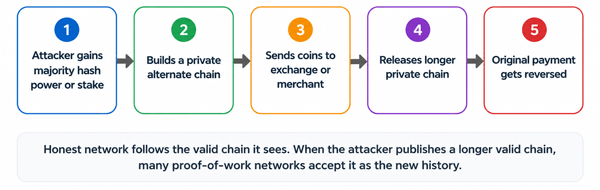
Diagram: A Sybil attack turns one real attacker into many apparent participants.
5. Sybil Attack vs 51% Attack: What Is the Difference?
A Sybil attack and a 51% attack are related, but they are not the same. A Sybil attack is about creating many identities. A 51% attack is about controlling most of the effective consensus power, such as hash power in proof-of-work or stake in proof-of-stake.
| Comparison point | Sybil attack | 51% attack |
|---|---|---|
| Main idea | One actor pretends to be many actors. | One actor or group controls majority consensus power. |
| What is multiplied | Identities: wallets, nodes, accounts, validators, IPs. | Effective voting power: hash rate, stake, or validator weight. |
| Can fake identities alone break consensus? | Usually no, if the chain has strong Sybil resistance. | Yes, if majority consensus power is actually controlled. |
| Common targets | Airdrops, DAO votes, P2P networks, reputation systems, validator discovery, spam controls. | Consensus finality, transaction censorship, reorgs, double-spending on vulnerable chains. |
| Main defense | Make identities costly, limited, verified, reputation-based, or stake-weighted. | Keep mining/staking power decentralized and economically expensive to control. |
6. Why Blockchains Are Vulnerable to Sybil Attacks
Blockchains are designed to be open. In many networks, anyone can create a wallet, run a node, submit a transaction, or interact with smart contracts without asking permission. This openness is a strength, but it also creates a challenge: the network must avoid confusing “many identities” with “many independent people.”
If influence were based only on the number of accounts or IP addresses, an attacker could cheaply create more accounts or rent more IP addresses. This is why major blockchains do not normally give consensus power on a simple one-account-one-vote or one-IP-one-vote basis.
6.1 The key design question
A blockchain must answer this question: How do we allow open participation while making it hard for one attacker to cheaply pretend to be thousands of independent participants?
7. How Major Blockchains Resist Sybil Attacks
The most important Sybil defense in blockchain is not always identity verification. Instead, it is often economic cost. A well-designed blockchain makes influence expensive to fake.
| Defense model | How it works | Why it helps | Main limitation |
|---|---|---|---|
| Proof-of-work (PoW) | Participants spend computing power and electricity to mine blocks. | A fake identity does not matter much unless it controls real hash power. | Mining can concentrate in large pools, and energy cost is high. |
| Proof-of-stake (PoS) | Validators lock tokens as stake and can lose rewards or stake for bad behavior. | Creating many validator identities does not create more power without more stake. | Stake can concentrate among large holders, exchanges, or staking pools. |
| Stake-weighted networking | Network resources or message priority are weighted by stake. | A spammer cannot gain equal network influence just by creating many low-stake identities. | Must be designed carefully so small honest participants are not unfairly excluded. |
| Identity or proof-of-personhood | Users prove uniqueness through KYC, biometrics, social verification, attestations, or trusted credentials. | Useful for airdrops, voting, grants, and apps that need human uniqueness. | May reduce privacy, accessibility, or permissionless participation. |
| Rate limits and fees | Accounts pay fees or face usage limits. | Mass fake activity becomes more expensive. | Attackers may still pay if the reward is higher than the cost. |
7.1 Proof-of-work as Sybil resistance
In proof-of-work systems such as Bitcoin, voting influence is tied to computational work, not to the number of identities. An attacker can create many nodes, but those nodes do not gain mining power unless the attacker also controls real computing resources. Bitcoin’s whitepaper explains this idea as moving away from one-IP-address-one-vote toward proof-of-work based voting power.
7.2 Proof-of-stake as Sybil resistance
In proof-of-stake systems, influence comes from staked tokens, not from the number of accounts. Creating 1,000 validator identities does not automatically give an attacker 1,000 times more consensus power. The attacker must also supply the required stake, and dishonest behavior can lead to penalties. Ethereum’s documentation describes proof-of-work and proof-of-stake as Sybil resistance mechanisms and block-author selection methods, not complete consensus protocols by themselves.
8. Types of Sybil Attacks in Blockchain and Web3
8.1 Network-layer Sybil attack
In a network-layer Sybil attack, the attacker runs many nodes or peer identities to surround, isolate, or influence honest nodes. The attacker may try to control what information a victim node sees, delay block propagation, or make the network less reliable.
This can become especially dangerous when combined with eclipse attacks, where a victim node is surrounded by attacker-controlled peers and receives a distorted view of the blockchain network.
8.2 Consensus-level Sybil attack
A consensus-level Sybil attack tries to gain influence over block production, validation, or voting in consensus. Strong blockchains are specifically designed to prevent fake identities from directly creating consensus power. However, smaller chains, weak validator systems, low-cost networks, or poorly designed protocols can still be exposed.
8.3 DAO governance Sybil attack
In DAO governance, a Sybil attacker may create many wallets or accounts to influence proposals, especially if voting uses one-wallet-one-vote. Token-weighted voting reduces simple wallet splitting, but it creates a different issue: wealthy participants may dominate. Some DAOs use delegation, reputation, quadratic voting, identity checks, or voting power caps to reduce Sybil risk.
8.4 Airdrop farming and reward Sybil attacks
Airdrop farming is one of the most common Sybil-style problems in Web3. An attacker creates many wallets, performs small actions from each wallet, and tries to appear like many real users. The goal is to receive more airdrop tokens, whitelist spots, loyalty points, or incentives than a single user should receive.
8.5 Reputation and social Sybil attacks
Some Web3 systems rely on reputation, reviews, attestations, social graphs, or community participation. A Sybil attacker may create fake profiles that endorse each other, farm reputation, manipulate rankings, or create the illusion of community support.
8.6 NFT mint and whitelist Sybil attacks
In NFT launches, attackers may create many wallets or social accounts to bypass per-wallet mint limits, win more allowlist spots, or claim more free mints. Per-wallet limits alone are weak because wallets are cheap to create.
9. Realistic Examples of Sybil Attacks
Not every Sybil attack looks like a dramatic blockchain takeover. Many are practical, financial, and application-level. Here are realistic examples beginners can understand.
| Scenario | What the attacker does | Why it matters | Better protection |
|---|---|---|---|
| Airdrop farming | Creates 5,000 wallets and performs the minimum activity from each. | The attacker captures rewards meant for genuine users. | Use behavior analysis, minimum meaningful activity, anti-bot checks, sybil clustering, and clear eligibility rules. |
| DAO vote manipulation | Splits identity across many wallets in a one-wallet-one-vote system. | A proposal may pass without real community support. | Use token-weighted voting, proof-of-personhood, reputation, delegation, or quorum design. |
| P2P network flooding | Runs many cheap nodes to influence peer discovery. | Honest nodes may connect to attacker-controlled peers. | Use peer diversity rules, reputation, connection limits, and identity costs. |
| NFT allowlist abuse | Creates many social and wallet identities to win many spots. | Real collectors get crowded out by bots. | Use wallet history, captcha, allowlist curation, proof-of-personhood, and mint limits that consider identity quality. |
| Fake protocol growth | Creates many addresses to make a dApp look more active. | Investors, users, or token distributors may be misled. | Analyze unique users carefully, remove obvious clusters, and focus on high-quality activity metrics. |
10. What Damage Can a Sybil Attack Cause?
The damage depends on what the fake identities can influence. In a strong base-layer blockchain, fake wallets alone usually cannot take over consensus. In applications, governance systems, airdrops, and reputation networks, the damage can be much more direct.
- Unfair reward distribution: attackers capture tokens, points, or NFTs meant for real users.
- Governance manipulation: fake identities distort voting or create false community support.
- Network disruption: fake nodes can spam, slow down, or mislead parts of the peer-to-peer network.
- Censorship or transaction delays: if combined with stronger network or validator control, attackers may delay information or transactions.
- Reputation manipulation: fake accounts boost ratings, endorsements, or trust scores.
- Bad data and analytics: fake activity makes user numbers, TVL-related behavior, or engagement metrics look stronger than reality.
- Loss of trust: users may stop trusting a protocol if they believe bots or insiders captured most rewards.
11. Who Is Most at Risk?
Sybil risk is not equal everywhere. Mature blockchains with strong economic security are harder to attack at the consensus layer. Newer projects, small networks, low-cost applications, and incentive programs are often easier targets.
| Target | Risk level | Why |
|---|---|---|
| Large PoW or PoS base chains | Lower at identity level, but not zero | Consensus power is tied to hash power or stake, not simple account count. |
| Small or new blockchains | Higher | Lower economic security can make influence cheaper to buy or fake. |
| Airdrops and points programs | Very high | Rewards attract wallet farming, bots, and scripted activity. |
| DAO one-wallet-one-vote systems | High | Wallets are cheap, so one-wallet-one-vote can be easy to manipulate. |
| NFT mints and allowlists | High | Per-wallet limits are easy to bypass without stronger checks. |
| Reputation systems | Medium to high | Fake accounts can coordinate and endorse one another. |
12. Warning Signs of a Sybil Attack
Sybil attacks are often detected through patterns. One wallet may look normal, but thousands of related wallets may reveal common behavior.
- Many new wallets created around the same time.
- Wallets funded from the same source or through similar funding paths.
- Identical transaction patterns, timing, gas behavior, or contract interactions.
- Many accounts doing only the minimum required task for eligibility.
- Unusual spikes in users without matching growth in meaningful usage.
- Repeated IP, device, browser, or social account patterns in off-chain systems.
- A proposal receiving many votes from low-history wallets or newly created accounts.
- NFT mints with many wallets immediately transferring assets to one collection wallet.
13. How to Prevent Sybil Attacks in Blockchain
There is no single perfect solution. The best defense depends on what the system is trying to protect. A base blockchain, DAO, NFT mint, and airdrop program all need different controls.
13.1 Use economic costs for important power
Do not give important influence to free identities. Consensus, governance, and high-value rewards should require some cost, stake, reputation, or proof of meaningful contribution. This does not mean every system must be expensive, but it should not be profitable to create unlimited fake accounts.
13.2 Avoid simple one-wallet-one-vote governance
One-wallet-one-vote sounds democratic, but wallets are not people. For serious decisions, consider token-weighted voting, reputation-weighted voting, delegation, proof-of-personhood, quadratic voting with Sybil resistance, minimum account age, or multi-layer governance.
13.3 Design airdrops around quality, not just activity count
Airdrops should reward meaningful usage, not repetitive low-effort actions. Good eligibility design may consider account age, transaction quality, diverse usage, long-term participation, risk scoring, and suspicious wallet clusters. Projects should publish rules carefully but avoid revealing every anti-Sybil detail before the snapshot.
13.4 Add friction where abuse is likely
Friction can include fees, deposits, cooldowns, rate limits, captcha, email or phone checks, social verification, allowlists, or proof-of-personhood. The goal is not to punish real users. The goal is to make mass fake activity less profitable than honest participation.
13.5 Monitor wallet clusters and behavior patterns
On-chain analysis can detect groups of wallets that behave as one actor. Useful signals include common funders, identical transaction sequences, synchronized timing, shared withdrawal addresses, and repeated contract interaction patterns.
13.6 Protect peer-to-peer networking
Node software should avoid connecting only to similar or suspicious peers. Useful protections include peer diversity, connection limits, reputation scoring, banning abusive peers, rate limiting, and careful peer discovery design.
13.7 Use audits and threat modeling
Sybil risk should be considered before launch, not only after abuse happens. Teams should ask: What can one user gain by creating 1,000 identities? What is the cost? What is the reward? What signals can we use to detect abuse? What false positives might hurt real users?
14. Best Practices for Different Users
14.1 For blockchain protocol teams
- Do not base consensus influence on raw identity count.
- Use proven Sybil resistance models such as proof-of-work, proof-of-stake, or carefully designed permissioned validator sets.
- Monitor validator concentration, staking pool concentration, and peer network health.
- Stress-test the network under spam, bot, and peer-flooding scenarios.
- Document assumptions clearly so users understand what the system does and does not protect.
14.2 For DAO and governance teams
- Avoid one-wallet-one-vote for high-value decisions unless there is strong proof-of-personhood.
- Use quorum, proposal thresholds, delegation, voting delays, and review periods.
- Watch for newly created wallets or sudden voting clusters.
- Separate low-risk community polls from high-risk treasury or protocol changes.
- Consider identity, reputation, or contribution-based systems, but balance them against privacy and decentralization.
14.3 For airdrop and growth teams
- Reward meaningful long-term behavior instead of simple transaction counts.
- Use sybil clustering before distributing rewards.
- Avoid rules that are easy to automate, such as “make one swap” or “bridge once.”
- Create an appeal process for real users who may be falsely flagged.
- Measure real retention after incentives, not only wallet count before incentives.
14.4 For everyday crypto users
- Do not assume a project is healthy just because it has many wallets or followers.
- Be cautious of DAOs or protocols where voting can be easily manipulated by new wallets.
- Check whether airdrop campaigns and NFT mints have anti-bot rules.
- Use reputable wallets and avoid interacting with suspicious fake accounts or phishing campaigns.
- Remember that “unique addresses” does not always mean “unique users.”
15. Common Misconceptions About Sybil Attacks
| Misconception | Reality |
|---|---|
| “More nodes always means more decentralization.” | More independent nodes can improve decentralization, but many nodes controlled by one actor can create a false appearance of decentralization. |
| “A wallet equals a user.” | One person can create many wallets, and one wallet can represent many people, such as an exchange or custody account. |
| “Proof-of-stake is automatically Sybil-proof.” | PoS reduces identity-based Sybil attacks by tying power to stake, but stake concentration and validator centralization still matter. |
| “KYC solves all Sybil attacks.” | KYC can reduce duplicate identities, but it introduces privacy, access, cost, and centralization trade-offs. |
| “Sybil attacks only affect blockchains.” | They also affect DAOs, social platforms, marketplaces, airdrops, reputation systems, and online voting. |
16. Benefits and Trade-Offs of Sybil Resistance
Sybil resistance is necessary, but every defense has trade-offs. A system that is too open may be abused by bots. A system that is too strict may exclude real users or reduce decentralization.
| Approach | Benefit | Trade-off |
|---|---|---|
| Proof-of-work | Strong open-participation Sybil resistance through real-world cost. | High energy use and mining concentration risk. |
| Proof-of-stake | Energy-efficient Sybil resistance through capital at risk. | Can favor large token holders and staking providers. |
| KYC or identity checks | Useful for one-person-one-account systems. | Privacy concerns and less permissionless access. |
| Proof-of-personhood | Can support fairer human-based voting or airdrops. | Hard to implement globally without false positives or privacy issues. |
| Rate limits and fees | Simple way to reduce spam and bot activity. | May hurt small users if costs are too high. |
| Reputation systems | Rewards long-term honest participation. | New users may struggle, and reputation can be farmed if poorly designed. |
17. Sybil Attack Prevention Checklist
Use this checklist when designing or reviewing a blockchain application, DAO, or incentive campaign.
- What valuable thing can a user gain by creating many accounts?
- Is influence based on wallet count, stake, reputation, identity, or meaningful behavior?
- Is the reward higher than the cost of creating fake identities?
- Can suspicious wallet clusters be detected before rewards or votes are finalized?
- Are there rate limits, fees, cooldowns, or minimum activity requirements?
- Is there a plan for false positives and user appeals?
- Does the system protect privacy while reducing abuse?
- Are network nodes protected against peer flooding and eclipse-style risks?
- Are governance decisions separated by risk level?
- Has the team tested bot, spam, and Sybil scenarios before launch?
18. Beginner-Friendly Analogy
Imagine a town meeting where every resident gets one vote. The system works only if each voter is truly a separate resident. Now imagine one person wears 100 disguises and votes 100 times. The meeting may look democratic, but the result is controlled by one person. A Sybil attack is the digital version of those disguises. Blockchain systems fight back by requiring something harder to fake: computing work, staked value, long-term reputation, verified uniqueness, or meaningful participation.
19. Frequently Asked Questions
19.1 What is a Sybil attack in simple words?
A Sybil attack happens when one attacker creates many fake identities to gain more influence than they should have. In blockchain, those identities may be wallets, nodes, validators, accounts, or social profiles.
19.2 Can a Sybil attack take over Bitcoin?
Creating many Bitcoin nodes does not automatically take over Bitcoin because mining influence depends on proof-of-work, not simple node count. A serious consensus attack would require enormous hash power, not just many fake identities.
19.3 Can a Sybil attack happen on proof-of-stake blockchains?
Yes, but not in the same simple way as fake account creation. In proof-of-stake, consensus power depends on stake. An attacker can split stake across many validators, but splitting does not create more total stake. The bigger concern is stake concentration or validator coordination.
19.4 Are airdrop farmers Sybil attackers?
Often, yes. If one person creates many wallets to look like many users and claim more rewards, that is a Sybil-style attack or Sybil farming.
19.5 Is KYC the best way to stop Sybil attacks?
KYC can help in some systems, but it is not always the best answer. It can reduce privacy, limit access, and introduce centralized gatekeepers. Many crypto projects prefer a mix of behavior analysis, economic cost, proof-of-personhood, reputation, and rate limits.
19.6 What is the difference between a bot and a Sybil attacker?
A bot is automation. A Sybil attacker uses many identities. Many Sybil attacks use bots, but not every bot attack is a Sybil attack.
19.7 Why is one-wallet-one-vote risky?
Wallets are easy to create. If voting power is based only on wallet count, one person can create many wallets and gain unfair influence.
19.8 How can users spot possible Sybil activity?
Look for sudden growth from low-history wallets, repetitive transactions, identical behavior, newly created accounts, and many addresses funded from the same source.
19.9 Can Sybil resistance be perfect?
No defense is perfect. The goal is to make fake identity attacks expensive, detectable, and less profitable while keeping the system usable for honest participants.
19.10 Does more decentralization always reduce Sybil attacks?
Real decentralization helps, but fake decentralization does not. A network with many identities controlled by one actor may look decentralized while being more centralized than it appears.
20. Conclusion
A Sybil attack in blockchain is about fake influence. One attacker creates many identities and tries to make a decentralized system believe those identities represent many independent participants. The attack can affect consensus, peer-to-peer networking, governance, airdrops, NFT mints, reputation systems, and analytics.
The best defense is to avoid giving important power to cheap identities. Strong blockchains use proof-of-work or proof-of-stake to tie influence to real cost. Applications and DAOs need additional protections such as better voting design, behavior analysis, rate limits, proof-of-personhood, reputation systems, and careful incentive design.
For beginners, the most important lesson is this: in crypto, “many wallets” does not always mean “many users.” Good blockchain security depends on understanding that difference and designing systems that cannot be easily fooled by fake identities.
Sources Consulted and Checked
These sources were consulted and checked while preparing this article to support accuracy and clarity.
- Bitcoin whitepaper: Bitcoin: A Peer-to-Peer Electronic Cash System
- Ethereum documentation: Consensus mechanisms
- Ethereum documentation: Proof-of-stake
- Solana documentation: Stake-weighted Quality of Service
Reader Advice
This article is provided for educational and informational purposes only. It explains general blockchain-security concepts and is not legal, financial, investment, cybersecurity, or other personalized professional advice or a recommendation to use any particular network, protocol, token, or service. Blockchain systems, attack methods, project rules, platform policies, laws, technical standards, and statistics can change over time and may vary by country or region. Readers should verify important information through current official documentation and, where appropriate, consult a qualified professional before making decisions. Crypto and Web3 activities can involve technical failures, scams, loss of funds, privacy risks, regulatory uncertainty, and rapidly changing market conditions, so use independent judgment and appropriate safeguards.