Crypto Bug Bounties: Complete Guide, Rewards, Examples and Best Practices
Crypto bug bounties are programs that pay security researchers for finding and privately reporting weaknesses in cryptocurrency and blockchain systems. A program may cover smart contracts, wallets, exchanges, bridges, blockchains, websites, mobile apps, APIs, or infrastructure. The goal is to fix a vulnerability before a criminal can exploit it.
The basic idea is simple, but participating safely is not. A researcher must understand exactly what is in scope, which testing methods are allowed, what evidence is required, how severity is judged, and when public disclosure is permitted. A technically valid finding can still be rejected if it is a duplicate, out of scope, unsupported, or obtained through prohibited testing.
In simple terms: A crypto bug bounty is a formal reward program in which a blockchain or cryptocurrency project compensates a researcher for responsibly disclosing an eligible security vulnerability under published rules. The reward usually depends on demonstrated impact, affected assets, exploitability, report quality, and whether the issue is new and in scope.
- A bug bounty is a contract-like ruleset, not blanket permission to attack a project.
- Crypto programs often judge smart-contract findings by real economic impact, such as funds at risk or loss of protocol control.
- High advertised maximums are not typical payouts; the actual award depends on severity, proof, scope, and program discretion.
- Do not move real user funds, access private data, disrupt services, or continue testing after proving impact unless the policy explicitly allows it.
- A clear, reproducible, private report is often as important as discovering the bug itself.
- Bug bounties supplement audits, monitoring, testing, and secure development; they do not guarantee that a system is safe.
2. What Is a Crypto Bug Bounty?
The U.S. National Institute of Standards and Technology (NIST) defines a bug bounty as a method of compensating people for reporting software errors or flaws that could enable security exploitation. In crypto, the same model is adapted to systems where software can directly control tokens, digital assets, governance rights, private keys, or transaction processing.[1]
A vulnerability is more than an annoying software defect. It is a weakness that a threat actor could exploit to harm confidentiality, integrity, availability, users, or assets. In a blockchain setting, the harm may include unauthorized token transfers, frozen funds, manipulated prices, counterfeit assets, governance takeover, chain disruption, or leakage of signing material.[2]
2.1. What Systems Can Be Covered?
| Asset type | What it does | Example security impact |
|---|---|---|
| Smart contracts | Execute on-chain rules for tokens, lending, trading, staking, bridges, or governance. | An attacker drains a pool, mints unauthorized tokens, or bypasses access control. |
| Blockchain or DLT code | Runs consensus, networking, validation, nodes, or runtime logic. | A flaw causes chain halt, invalid state acceptance, double spending, or consensus failure. |
| Wallets and custody | Create, store, sign, or transmit transactions and keys. | Private keys leak, transactions are altered, or authentication is bypassed. |
| Centralized exchanges | Provide accounts, trading, deposits, withdrawals, and APIs. | Account takeover, withdrawal bypass, or market-integrity weakness. |
| Bridges and interoperability | Move messages or assets between chains. | Forged messages release unbacked assets or unlock custody funds. |
| Websites, mobile apps, and APIs | Provide the user interface and off-chain services. | Session theft, authorization bypass, sensitive-data exposure, or malicious transaction prompts. |
| Operational infrastructure | Includes cloud services, deployment pipelines, key management, monitoring, and admin tools. | An attacker gains deployment access or compromises signing operations. |
3. Bug Bounty, Vulnerability Disclosure Program, Audit, and Penetration Test
These terms overlap, but they are not interchangeable.
| Approach | Who participates | Timing | Payment model | Main strength | Main limitation |
|---|---|---|---|---|---|
| Bug bounty | Approved independent researchers | Usually continuous | Rewards for eligible findings | Broad, ongoing testing by diverse researchers | Coverage and payout depend on rules; no guarantee every area is tested |
| Vulnerability disclosure program (VDP) | Anyone following the policy | Usually continuous | May offer no payment | Creates a safe reporting channel and clear process | Researchers may have less financial incentive |
| Security audit | Contracted audit team | Defined review period | Professional service fee | Structured review of specified code and assumptions | Point-in-time assessment; may miss later changes |
| Penetration test | Authorized testing team | Scheduled engagement | Professional service fee | Controlled testing of agreed systems and attack paths | Limited by time, scope, and test environment |
| Audit competition / contest | Multiple researchers during a fixed window | Time-limited | Shared reward pool or judged awards | Concentrated review before launch or upgrade | Not continuous; incentives depend on contest design |
4. How Crypto Bug Bounties Work: Step by Step
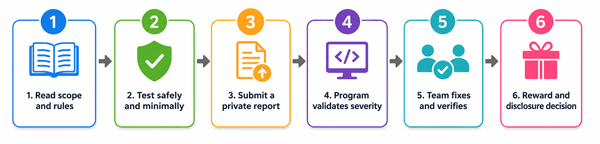
Figure 1. Typical crypto bug bounty workflow. Exact steps vary by program.
4.1. The project publishes a policy
The policy identifies eligible assets, impacts, reward ranges, prohibited actions, report requirements, identity or compliance conditions, and disclosure rules.
4.2. The researcher studies the scope
Before testing, the researcher confirms the exact domains, repositories, contracts, chains, versions, and environments covered. Similar-looking assets may be excluded.
4.3. Testing is performed within the rules
The researcher uses the least harmful method needed to establish the vulnerability. Testing should normally use local forks, testnets, private accounts, or minimal proofs rather than real users or live funds.
4.4. The report is submitted privately
A useful report explains the affected asset, root cause, attack prerequisites, step-by-step reproduction, impact, proof of concept, and recommended fix or mitigation.
4.5. The program triages the finding
The team checks whether the report is new, valid, reproducible, in scope, and eligible. It may ask questions, challenge assumptions, or reduce severity if the claimed impact is not demonstrated.
4.6. Severity and reward are determined
Programs may use their own impact tables, CVSS, platform-specific severity rules, or a percentage of funds at risk. Some give precedence to demonstrated impact over the underlying technical weakness.
4.7. The issue is fixed and retested
The project patches the vulnerability, adds tests, reviews related components, and may ask the reporter or an auditor to confirm that the fix works.
4.8. Payment and disclosure follow
After eligibility and remediation are settled, the researcher receives the bounty under the program terms. Public disclosure may be allowed immediately, after a waiting period, or only with written approval.
5. What Determines a Crypto Bug Bounty Reward?
There is no universal crypto bug bounty price list. Advertised maximum rewards are ceilings, not promises. Programs commonly consider the following factors.
| Factor | Why it matters | Practical question |
|---|---|---|
| Impact | Rewards are usually highest when a bug can directly cause loss of funds, permanent freezing, unauthorized minting, chain failure, or control of critical systems. | What concrete harm can occur? |
| Funds or assets at risk | Some smart-contract programs calculate critical rewards as a percentage of directly affected funds, subject to minimums and caps. | How much value is genuinely reachable in the proven attack path? |
| Exploitability | A vulnerability requiring rare permissions, unrealistic timing, or many victims may receive a lower severity. | Can an external attacker reproduce it under realistic conditions? |
| Attack prerequisites | Admin access, compromised keys, governance approval, user interaction, or unusual market conditions can reduce eligibility or severity. | What must already be true before exploitation? |
| Repeatability | A one-time impact may differ from an attack that can be repeated across accounts, pools, or chains. | Can the same flaw be exploited again? |
| Scope and version | Only listed assets and versions are normally eligible. | Is the exact affected component in scope today? |
| Novelty | The first valid report typically receives priority. Known issues and duplicates usually receive no reward. | Has this issue already been reported, disclosed, or documented? |
| Report quality | Clear evidence reduces validation time and prevents misunderstandings. | Can the team reproduce the issue safely from the report alone? |
| Program terms | Payment currency, compliance checks, caps, exclusions, and discretion differ. | What does the current policy actually promise? |
5.1. Illustrative Reward Severity Levels
The table below is conceptual. Always use the program’s own definitions and current reward table.
| Severity | Typical crypto impact | Illustrative example |
|---|---|---|
| Critical | Direct theft or permanent freezing of substantial funds; unauthorized minting; consensus failure; private-key compromise; control of protocol-critical functions. | A permission check can be bypassed to withdraw assets from a bridge vault. |
| High | Serious loss or disruption with meaningful prerequisites, limited affected funds, or non-systemic impact. | A user can claim another user’s rewards under a specific state condition. |
| Medium | Limited financial impact, temporary disruption, or security weakness requiring substantial interaction or constraints. | An API reveals non-public account metadata without enabling account takeover. |
| Low | Minor security impact, defense-in-depth issue, or limited information exposure. | A low-sensitivity internal identifier is exposed with no practical attack path. |
| Informational / not eligible | Best-practice suggestion, theoretical concern without impact, duplicate, known issue, or excluded class. | A gas optimization or centralized-admin observation already described in documentation. |
Reality check: A program advertising “up to $1 million” does not mean most valid reports earn anything close to that amount. The maximum generally applies only to narrowly defined, demonstrated critical impact.
6. Examples of Crypto Bug Bounty Rewards and Programs
The examples below show how reward structures can differ. They are snapshots for educational comparison, not a current offer. Always open the live policy before testing.
| Example | Published reward information | What it teaches |
|---|---|---|
| Wormhole historical critical report (2022) | Wormhole paid a $10 million bounty for an uninitialized proxy vulnerability. Immunefi reported that it was patched without loss of user funds.[7] | Exceptionally large awards exist, but they are rare and tied to extraordinary protocol-level impact. |
| Wormhole current program snapshot (accessed July 2026) | The listed maximum was up to $1 million in W tokens for the most serious multi-chain TVL impact, with lower caps for narrower critical outcomes.[8] | A program can use impact tiers, payment tokens, and asset-specific caps. |
| Coinbase retrospective (2022) | Coinbase reported a $250,000 bounty for a serious trading-interface vulnerability and published a technical retrospective.[9] | Centralized crypto platforms also reward high-impact findings and may explain the root cause publicly after remediation. |
| Coinbase program expansion (2025) | Coinbase announced a new program with rewards up to 5 million USDC for specified critical scenarios.[10] | Program maximums and eligible products change over time; current terms matter more than old articles. |
| Impact-based smart-contract programs | Some live program policies specify a percentage of directly affected funds, combined with a minimum critical reward and a maximum cap.[11] | Two critical bugs can receive different awards because the provable economic exposure differs. |
7. Common Vulnerabilities Found in Crypto and Web3 Systems
OWASP’s Smart Contract Top 10 and broader Web3 security material provide useful categories, but each program decides what is eligible. The most important beginner lesson is to connect a technical flaw to a realistic impact.[3]
7.1. Access-control failures
A sensitive function does not correctly verify who may call it.
Example: An ordinary address can change a price feed, upgrade a contract, pause withdrawals, or transfer treasury assets.
7.2. Business-logic errors
The code behaves as written, but the economic or state-transition rules are wrong.
Example: A user can repeatedly claim a one-time reward or bypass a collateral rule by ordering actions unexpectedly.
7.3. Price-oracle manipulation
A protocol trusts a price source that can be moved, delayed, or calculated unsafely.
Example: An attacker temporarily changes a low-liquidity market price and borrows more assets than the collateral supports.
7.4. Reentrancy
An external call allows another contract to call back before the original state is safely updated.
Example: A withdrawal function can be entered repeatedly before the user balance is reduced.
7.5. Unchecked external calls or return values
The contract assumes another call succeeded or returned valid data.
Example: Accounting proceeds even though a token transfer failed.
7.6. Input-validation and arithmetic errors
The program accepts unexpected values or performs unsafe calculations.
Example: Rounding, decimal mismatch, overflow assumptions, or zero values create extra shares or incorrect debt.
7.7. Upgradeability and proxy flaws
Initialization, storage layout, upgrade authorization, or implementation selection is unsafe.
Example: An attacker initializes an uninitialized implementation or changes the logic contract.
7.8. Signature and replay weaknesses
Signed messages are not bound to the right chain, contract, nonce, action, or expiry.
Example: A valid approval is replayed on another chain or reused multiple times.
7.9. Bridge message verification failures
Cross-chain messages are accepted without sufficient proof or validator checks.
Example: A forged message releases locked assets or mints unbacked tokens.
7.10. Frontend and wallet transaction deception
The interface, API, or wallet flow misrepresents what a user is signing.
Example: A legitimate-looking action silently grants unlimited token approval to an attacker-controlled address.
7.11. Key-management and operational failures
Secrets, signing systems, CI/CD pipelines, or admin processes are exposed.
Example: A deployment key leaks from a repository or build log.
7.12. Denial of service and griefing
An attacker can block normal operation or impose disproportionate costs.
Example: One malicious position prevents liquidations or causes every withdrawal to revert.
8. What Is Usually Out of Scope?
Exclusions vary, but many programs reject or prohibit some combination of the following:
- Issues in assets, domains, contracts, forks, test code, or versions not specifically listed.
- Known issues, duplicates, previously audited findings, or risks already disclosed in documentation.
- Purely theoretical attacks without a reproducible path and measurable impact.
- Attacks requiring stolen private keys, compromised administrators, or governance capture unless the policy includes those assumptions.
- Phishing, social engineering, physical attacks, employee targeting, denial-of-service testing, or automated scanning that harms availability.
- Testing third-party services that the project does not own or authorize.
- Self-XSS, low-impact configuration observations, rate-limit complaints without security impact, or missing best-practice headers.
- Economic criticism that is an intended design choice rather than a software vulnerability.
- Publicly disclosing the issue before the program permits disclosure.
- Using the vulnerability to take funds, access user data, demand payment, or retain leverage over the project.
9. Legal and Ethical Risks
Security research can create legal exposure when access is unauthorized, data is obtained, systems are disrupted, or testing crosses jurisdictional boundaries. A platform’s safe-harbor statement can reduce uncertainty, but it is not a universal shield from every criminal law, civil claim, contract, third-party right, sanctions rule, or local requirement.
NIST recommends clear processes for receiving, assessing, and managing vulnerability reports. CISA’s coordinated disclosure guidance emphasizes clear authorization and safe-harbor language for good-faith research. The U.S. Department of Justice has stated that good-faith security research should not be charged under its CFAA charging policy, but the policy is prosecutorial guidance and does not authorize activity outside a program’s rules or resolve laws in other countries.[4][5][6]
Before touching a live target: Read the full policy, confirm the exact target, save a dated copy of the rules, use your own accounts and funds, minimize impact, and obtain legal advice when the scope or local law is unclear.
10. How to Read a Bug Bounty Policy
- Confirm the program is live and note the last-updated date.
- Identify every in-scope asset: domain, repository, contract address, chain, mobile package, API, version, and environment.
- Read the impact list. In many crypto programs, an impact is eligible only when both the asset and the outcome are in scope.
- Review prohibited testing: denial of service, social engineering, automated traffic, mainnet exploitation, privacy access, or third-party testing.
- Check proof-of-concept rules. Some programs require executable code; others prohibit public-chain demonstrations.
- Study reward calculations, minimums, maximums, payment currency, vesting, identity checks, tax forms, sanctions screening, and dispute rules.
- Find the disclosure timeline and whether publication requires written approval.
- Read safe-harbor language and understand its limits.
- Save evidence of the policy version that applied when testing began and when the report was submitted.
11. Safe Testing Practices for Beginners
A responsible proof should demonstrate the issue while creating the least possible harm.
| Prefer | Avoid |
|---|---|
| Local blockchain forks, unit tests, simulators, and private test environments. | Testing destructive scenarios directly against production contracts. |
| Your own accounts, wallets, API keys, and test funds. | Accessing another person’s account, records, wallet, or transaction data. |
| Minimal-value transactions when live testing is explicitly permitted. | Moving or locking meaningful funds “to prove” impact. |
| Manual, rate-limited validation. | High-volume scanning, brute force, spam, or traffic that degrades service. |
| A stop condition once impact is demonstrated. | Continuing to escalate privileges or explore unrelated systems. |
| Redacted screenshots and sanitized logs. | Including private keys, seed phrases, personal data, or reusable secrets in the report. |
| Private communication through the official channel. | Posting details on social media or contacting users before remediation. |
12. How to Write a High-Quality Crypto Bug Bounty Report
A strong report should let the triage team reproduce the issue without guessing. Use this structure:
- Clear title: Name the affected component and impact. Example: “Missing access check allows unauthorized withdrawal from Vault X.”
- Program and asset: Identify the exact policy, chain, contract address, commit, domain, app version, or API endpoint.
- Executive summary: Explain the flaw and impact in two or three plain-English sentences.
- Severity claim: State the program’s severity category and the exact in-scope impact you believe applies.
- Prerequisites: List required balances, permissions, market conditions, user actions, timing, or setup.
- Technical root cause: Point to the relevant code or logic and explain why the intended security control fails.
- Reproduction steps: Provide numbered, deterministic steps with commands, transactions, inputs, and expected versus actual results.
- Proof of concept: Include safe code or a local-fork test when permitted. Keep it minimal and avoid unnecessary weaponization.
- Impact analysis: Show what an attacker can obtain or disrupt, which users or funds are affected, whether the attack is repeatable, and what limits the damage.
- Suggested remediation: Offer a practical fix, invariant, validation rule, permission change, or test case. The project may choose another solution.
- Supporting evidence: Attach transaction traces, logs, screenshots, call graphs, test output, and environment details without exposing secrets.
- Disclosure statement: Confirm that the report is private, testing stopped, no user data was retained, and you will follow the policy’s disclosure process.
12.1. Mini Report Example
Title: Incorrect share calculation allows repeated over-redemption after a rounding edge case.
Summary: When a withdrawal amount produces a zero-rounded share burn, assets are transferred but the user’s share balance does not decrease. The user can repeat the operation until the affected vault is depleted.
Affected asset: Vault contract 0xExample on the listed test environment, commit abc123.
Prerequisites: Attacker holds at least one vault share and chooses an amount below the share-conversion rounding threshold.
Steps: Deploy the listed commit locally, deposit test tokens, call withdraw with the edge-case amount, observe that assets leave the vault while shares remain unchanged, then repeat.
Impact: A user can withdraw more assets than their ownership permits. The maximum exposure is limited by available vault liquidity.
Suggested fix: Reject withdrawals that calculate to zero shares, use rounding that protects the vault, and add an invariant test proving assets cannot be withdrawn without burning a positive share amount.
13. Common Mistakes to Avoid
| Mistake | Why it causes problems | Better practice |
|---|---|---|
| Testing before reading the policy | You may touch an excluded asset or use a prohibited technique. | Map the exact asset and permitted method first. |
| Claiming “critical” without proving impact | A serious-sounding bug may have no reachable economic consequence. | Demonstrate the full attack path and realistic limit. |
| Using mainnet when a local fork is enough | Live testing can harm users or create legal risk. | Reproduce locally and use live systems only when explicitly allowed. |
| Submitting a vague report | Triage cannot reproduce or distinguish the issue. | Include exact versions, steps, proof, and expected versus actual behavior. |
| Over-testing after proof | Additional access or transactions may exceed authorization. | Stop as soon as the minimum proof is established. |
| Ignoring duplicate risk | Publicly known or previously reported issues usually earn nothing. | Search documentation, audits, repositories, and known disclosures first. |
| Exposing sensitive data in evidence | A report can create a second security incident. | Redact secrets and minimize retained data. |
| Public disclosure too early | It can endanger users and violate program terms. | Wait for written disclosure approval or the policy deadline. |
| Assuming the maximum reward applies | Maximums are reserved for defined top-tier outcomes. | Estimate conservatively from the published impact and cap rules. |
| Treating a bounty as guaranteed income | Findings are uncertain, competitive, and may be rejected. | Build skills first and treat rewards as variable, not dependable salary. |
14. Pros and Cons of Crypto Bug Bounties
| Benefits | Limitations and risks |
|---|---|
| Continuous testing can uncover issues after an audit or software update. | A bounty cannot prove that no vulnerabilities remain. |
| Researchers with different skills examine code, economics, infrastructure, and user flows. | Researchers concentrate on attractive rewards and familiar targets, leaving coverage gaps. |
| Impact-based rewards can align incentives with the value protected. | Disputes can arise over severity, assumptions, duplicate status, or funds-at-risk calculations. |
| Private disclosure can prevent losses and support safer remediation. | Poor policies may expose researchers to unclear legal or payment risk. |
| Public retrospectives can improve industry knowledge after fixes. | Premature publication can create copycat attacks. |
| Programs can create a measurable channel for external security feedback. | Projects still need audits, monitoring, incident response, key security, and secure development practices. |
15. Best Practices for Crypto Projects Running a Bug Bounty
A good program protects both users and researchers. Project teams should:
- List exact assets, contract addresses, repositories, versions, and chains; update them after every deployment.
- Define eligible impacts in plain language and explain how severity, funds at risk, repeatability, and prerequisites affect rewards.
- Publish safe-harbor language, authorized techniques, prohibited testing, privacy expectations, and a reliable reporting channel.
- Fund the program and make payment terms realistic, including currency, caps, compliance requirements, and timelines.
- Acknowledge reports quickly, assign clear ownership, preserve evidence, and communicate status even when remediation takes time.
- Use technical triagers who understand smart contracts, economics, blockchain infrastructure, and the project’s architecture.
- Avoid changing rules retroactively for a submitted report; preserve the policy version that governed the research.
- Create an appeal or mediation process for good-faith disagreements.
- Patch the root cause, review similar code paths, add regression tests, and monitor for exploitation.
- Coordinate disclosure and publish a postmortem when doing so will help users and the wider security community.
16. Best Practices for Researchers
- Start with one technology stack and learn it deeply rather than scanning many projects superficially.
- Practice on intentionally vulnerable labs, capture-the-flag exercises, local chains, and open-source test suites.
- Read protocol documentation and understand the economic invariants before reviewing code.
- Keep a research log with dates, policy versions, targets, commands, transaction hashes, assumptions, and stop conditions.
- Use separate research wallets and devices where practical; never store seed phrases in reports or source repositories.
- Verify every finding from a clean environment and reduce the proof to the smallest reproducible case.
- Write the report for two audiences: a technical engineer who needs to fix it and a decision-maker who needs to understand impact.
- Be conservative about severity and transparent about uncertainty.
- Communicate professionally and do not threaten publication, fund movement, or reputational harm to obtain payment.
- Plan for taxes, payment volatility, identity checks, and sanctions or compliance screening before relying on a reward.
17. A Beginner Learning Roadmap
| Stage | What to learn | Practical output |
|---|---|---|
| 1. Core security | Authentication, authorization, input validation, web security, cryptography basics, threat modeling, and responsible disclosure. | Write a clear report for an intentionally vulnerable web application. |
| 2. Blockchain basics | Transactions, blocks, gas, wallets, signatures, RPC, tokens, and chain finality. | Trace a transaction and explain every state change. |
| 3. Smart contracts | Solidity or the target language, storage, calls, events, modifiers, upgradeability, token standards, and testing frameworks. | Build and test a small vault or token locally. |
| 4. DeFi mechanics | AMMs, lending, collateral, liquidations, staking, bridges, oracles, governance, and economic invariants. | Document the security assumptions of one protocol type. |
| 5. Security tooling | Static analysis, fuzzing, invariant testing, symbolic execution, debuggers, local forks, and transaction simulation. | Reproduce a public historical vulnerability in a safe lab. |
| 6. Real programs | Policy analysis, scope mapping, report writing, and minimal-impact validation. | Review a small, clearly scoped program and submit only when evidence is complete. |
18. Useful Tools and Resources
Tool choice depends on the chain and language. Common categories include:
- Source-code review and version control: repository search, dependency review, commit comparison, and architecture diagrams.
- Smart-contract testing: unit tests, property tests, fuzzing, invariant tests, and local blockchain forks.
- Static and symbolic analysis: tools that inspect code paths, patterns, and constraints without executing every real transaction.
- Transaction analysis: debuggers, traces, event logs, calldata decoders, and state-difference tools.
- Web and API testing: intercepting proxies, browser developer tools, API clients, and carefully rate-limited scanners where allowed.
- Threat modeling: asset inventories, trust boundaries, privilege maps, attack trees, and protocol invariant lists.
Tool warning: Owning a security tool does not authorize its use. Automated scanners, fuzzers, and scripts can create harmful traffic or transactions. Use them only within the policy’s limits.
19. How Projects Should Evaluate a Bug Bounty Program
- Measure time to acknowledge, validate, remediate, and pay—not just the number of reports.
- Track unique valid findings, duplicates, false positives, affected components, and root-cause themes.
- Review whether reward levels match the value at risk and the skill needed to discover the issue.
- Compare bounty findings with audit coverage, incidents, monitoring alerts, and secure-development defects.
- Update scope after architecture changes, acquisitions, migrations, contract upgrades, and new integrations.
- Audit the program itself: reporting channels, triage permissions, researcher communications, payment funding, and emergency escalation.
20. Frequently Asked Questions About Crypto Bug Bounties
20.1. Are crypto bug bounties legal?
They can be lawful when research is clearly authorized and follows the program’s rules, but legality depends on the activity, jurisdiction, contracts, third-party systems, and applicable laws. Safe harbor helps but is not universal legal immunity.
20.2. Can a beginner earn a crypto bug bounty?
Yes, but beginners should first practice in labs and learn one technical area well. Valid findings require more than running a scanner; they usually require understanding the system, proving impact, and writing a reproducible report.
20.3. Do I need to know Solidity?
Not for every program. Wallets, APIs, websites, exchanges, infrastructure, and blockchains use many languages. Solidity is highly relevant for Ethereum-compatible smart contracts, but the right skill depends on the target.
20.4. How much can a crypto bug bounty pay?
Rewards range widely. Some programs offer small fixed awards, while exceptional critical findings can earn very large payouts. The published maximum is not a typical reward and may apply only to a specific catastrophic impact.
20.5. Why was my report marked as a duplicate?
Another researcher may have reported the same root cause or impact first. Programs generally reward the earliest valid report because the project only needs to fix the issue once.
20.6. What does “funds at risk” mean?
It generally means the value directly reachable through the demonstrated exploit under the program’s calculation rules. It may exclude speculative price effects, unrelated assets, or funds protected by real constraints.
20.7. What is a proof of concept?
A proof of concept is the minimum evidence needed to show that the vulnerability works. It may be a test, script, transaction simulation, trace, or controlled sequence of steps. It should prove impact without causing unnecessary harm.
20.8. Can I test a live smart contract?
Only when the policy clearly permits the exact activity. A local fork or test environment is usually safer. Never assume that public blockchain code is automatically authorized for adversarial testing.
20.9. Can I keep funds taken during testing?
No. Taking or retaining funds can be theft or unauthorized access and normally violates program rules. Use non-destructive proof and immediately follow the program’s instructions if funds move accidentally.
20.10. When can I disclose a vulnerability publicly?
Only according to the program’s disclosure terms or explicit written approval. Early disclosure can endanger users, make the report ineligible, and create legal risk.
20.11. Are bug bounty rewards paid in cash or crypto?
Either is possible. Programs may pay fiat, stablecoins, project tokens, or another asset. Check payment currency, conversion method, vesting, transaction fees, identity checks, tax treatment, and volatility risk.
20.12. Are rewards taxable?
Often yes, but tax treatment depends on jurisdiction and personal circumstances. Keep records of the award’s date, asset, fair value, fees, and later disposals, and consult a qualified local tax professional.
20.13. What if a project refuses to pay?
Review the exact policy version, eligibility requirements, triage record, and dispute process. Platform mediation may help. Do not threaten exploitation or premature disclosure; seek legal advice for a material dispute.
20.14. Does a bug bounty mean a crypto project is safe?
No. It is a positive security practice, but it does not guarantee safety. Evaluate audits, upgrade controls, key management, incident response, monitoring, documentation, governance, and the project’s operational history.
20.15. What is the difference between ethical hacking and black-hat hacking?
Ethical research is authorized, limited, and responsibly disclosed to reduce harm. Black-hat activity is unauthorized or malicious and may steal, extort, disrupt, or exploit users.
20.16. Should investors rely on bounty size when choosing a project?
No. A large maximum can be a useful signal of commitment, but it does not prove code quality, sufficient funding, good triage, or low risk. Treat it as one part of a broader security review.
21. Final Checklist for Researchers
- The program is live, and I saved the current rules.
- The exact asset and impact are in scope.
- My testing method is explicitly permitted.
- I am using my own accounts, data, wallets, and funds.
- I can prove the issue safely, preferably in a local or test environment.
- I stopped once the minimum proof was complete.
- My report includes exact steps, root cause, evidence, prerequisites, and impact limits.
- I removed secrets and unnecessary personal data.
- I submitted through the official private channel.
- I will follow the disclosure, compliance, payment, and tax requirements.
22. Conclusion
Crypto bug bounties can prevent serious losses by giving researchers a structured path to report weaknesses before criminals exploit them. They also create an opportunity for skilled researchers to be rewarded for careful, ethical work. The best results come from a clear program, realistic incentives, prompt triage, technically strong reports, and disciplined testing that minimizes harm.
For beginners, the practical starting point is not chasing the largest advertised payout. It is learning security fundamentals, understanding one blockchain stack, practicing in safe environments, reading scope precisely, and communicating evidence clearly. In crypto security, restraint and documentation are professional skills—not obstacles to discovery.
Sources Consulted and Checked
The following sources were consulted and checked while preparing this article and reviewing its accuracy:
- [1] NIST CSRC, “Bug bounty” glossary and NIST SP 800-216.
- [2] NIST CSRC, “Vulnerability” glossary.
- [3] OWASP Smart Contract Security, Smart Contract Top 10.
- [4] NIST, Vulnerability Disclosure Guidelines and SP 800-216.
- [5] CISA, Coordinated Vulnerability Disclosure Program and guidance.
- [6] U.S. Department of Justice, CFAA charging policy and good-faith security research.
- [7] Immunefi, Wormhole Uninitialized Proxy Bugfix Review (2022).
- [8] Wormhole bug bounty program snapshot, accessed July 22, 2026.
- [9] Coinbase, Retrospective: Recent Coinbase Bug Bounty Award (2022).
- [10] Coinbase, new $5M bug bounty program announcement (2025).
- [11] Example live impact-based reward policy: Strata on Immunefi, accessed July 22, 2026.
- Additional: OWASP Web3 Attack Vectors beyond smart contracts.
- Additional: CVE Program, public vulnerability identification and cataloging.
Reader Advice
This article is provided for general educational and informational purposes. It is not legal, tax, investment, financial, or personalized cybersecurity authorization advice or a recommendation to test any system. Crypto bug bounty rules, program scope, reward terms, laws, policies, security practices, and statistics can change over time and may vary by platform and region. Always verify current requirements through official program pages and relevant authorities before acting. Security testing can involve financial, technical, privacy, and legal risks, so use only clearly authorized methods, minimize potential harm, never access or move another person’s assets or data, and seek qualified professional advice when the rules or local law are unclear.