Oracle Manipulation: Complete Guide, Examples, Risks and Best Practices
Oracle manipulation is one of the most important smart contract security risks in decentralized finance. A smart contract often needs outside information, such as the price of ETH, the value of a stablecoin, the result of a sports game, a weather event, or an interest rate. A blockchain oracle is the system that brings that information on-chain. If the oracle gives a wrong or distorted value, the smart contract may make a wrong decision automatically.
This guide explains oracle manipulation in simple language. It focuses mainly on price oracle manipulation because that is the most common and financially damaging form in DeFi, but the same principles also apply to other oracle-dependent systems.
1. What Is Oracle Manipulation?
Oracle manipulation is an attack or failure where the data used by a smart contract is intentionally or accidentally distorted. The contract then acts on that bad data as if it were true.
In DeFi, the manipulated data is usually an asset price. For example, a lending protocol may let users borrow against a token. If the protocol believes the token is worth $100 when the real market price is $10, an attacker may deposit the overvalued token as collateral and borrow more than they should.
Simple definition: Oracle manipulation happens when a smart contract trusts a data source that can be pushed, delayed, spoofed, or otherwise made inaccurate at the moment the contract uses it.
2. Why Smart Contracts Need Oracles
Blockchains are good at verifying on-chain transactions, balances, and contract state. They do not natively know off-chain facts. A smart contract cannot directly ask a bank, exchange, weather station, API, or sports website for information unless an oracle system supplies that information in a blockchain-readable form.
Oracles are used for many purposes:
- DeFi prices for lending, borrowing, swaps, derivatives, vaults, and liquidations.
- Stablecoin and collateral values.
- Randomness for games, lotteries, and NFT minting.
- Insurance triggers, such as flight delays or weather events.
- Cross-chain messages and asset proofs.
- Real-world event results for prediction markets.
The oracle problem is simple to understand but hard to solve: a smart contract may be decentralized and tamper-resistant, but it can still make unsafe decisions if it depends on weak external data.
3. How Oracle Manipulation Works
Most oracle manipulation attacks follow a predictable pattern. The attacker identifies a contract that trusts a weak data source, changes that data source for a short time, calls the vulnerable function while the bad data is active, and then exits with profit.
- Find a protocol that relies on a manipulable price or data feed.
- Borrow or gather enough capital, often using a flash loan, to move a market price or influence a data source.
- Push the oracle-referenced price away from the true market price.
- Call the protocol function that depends on that price, such as borrow, mint, redeem, swap, or liquidate.
- Reverse the price movement or let arbitrage restore the market.
- Repay any flash loan and keep the extracted value.
The attack can happen inside one transaction if the protocol reads a spot price from a decentralized exchange pool. More robust systems make this harder by using time-weighted prices, multiple sources, freshness checks, liquidity checks, and circuit breakers.
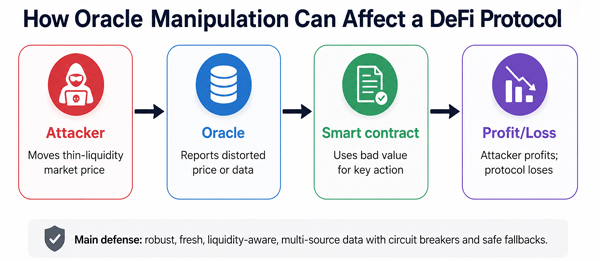
Diagram: A simplified oracle manipulation flow. The attacker changes a data source, the oracle reports the bad value, and the smart contract makes an unsafe decision.
4. Common Types of Oracle Manipulation
| Type | How it works | Example risk | Typical defenses |
|---|---|---|---|
| DEX spot price manipulation | The protocol reads the current price from one automated market maker pool. The attacker moves that pool price briefly. | Borrowing too much, unfair liquidations, mispriced swaps. | Use TWAP, deep liquidity, multiple sources, deviation limits. |
| Short TWAP manipulation | The protocol uses an average price, but the time window or liquidity is too small. | A short-lived price spike still affects the average enough to exploit the system. | Longer windows, liquidity-weighted sources, risk monitoring. |
| Single-source oracle risk | The contract trusts one exchange, one API, one signer, or one data provider. | A single failure or compromise controls the contract outcome. | Use decentralized networks, aggregation, median pricing, fallback sources. |
| Stale price usage | The oracle value is old, but the contract still accepts it. | Users trade, borrow, or liquidate using outdated market data. | Check timestamps, heartbeat, round completion, max staleness. |
| Wrong decimals or scaling | The contract misreads feed decimals, token decimals, or unit conversions. | Prices become 10x, 100x, or 1e10x wrong. | Normalize units, test decimals, assert realistic ranges. |
| Cross-market manipulation | The attacker changes a price in one market that influences another protocol. | A small pool becomes the reference for a larger lending market. | Use market-depth checks and source weighting. |
| Governance or admin oracle abuse | A privileged account changes feed settings, sources, or parameters maliciously or by mistake. | Protocol-wide mispricing or shutdown. | Timelocks, multisigs, role separation, monitoring. |
5. Price Oracle Manipulation: A Beginner Example
Imagine a small lending protocol that accepts TOKEN as collateral. It gets the TOKEN price from a single liquidity pool on a decentralized exchange. The pool is thin, meaning a large trade can move the price a lot.
| Step | What happens | Why it matters |
|---|---|---|
| 1 | TOKEN normally trades around $10. | The protocol should value 100 TOKEN at about $1,000. |
| 2 | An attacker uses a flash loan to buy TOKEN in the small pool and pushes the pool price to $100. | The oracle now sees a temporary price that is 10x too high. |
| 3 | The attacker deposits 100 TOKEN as collateral. | The protocol believes the deposit is worth $10,000. |
| 4 | The attacker borrows stablecoins against the inflated collateral. | The protocol lends far more than it safely should. |
| 5 | The attacker sells back, price returns near $10, and the loan is undercollateralized. | The protocol and its users may suffer bad debt. |
The important lesson is not that decentralized exchanges are bad. The problem is using a thin or short-term market price as if it were a reliable global price. A DEX pool is a trading venue first. It can be part of an oracle design, but it should not be blindly trusted without safeguards.
6. Real-World Oracle Manipulation Scenarios
Many DeFi incidents have involved some version of unsafe price assumptions. The exact mechanics differ, but the pattern is usually the same: a protocol depends on a price that can be moved more cheaply than the value that can be extracted.
- Flash-loan-assisted price manipulation: capital is borrowed and repaid inside one transaction while the attacker temporarily changes a price.
- Low-liquidity collateral markets: a token with shallow trading depth is accepted as collateral in a larger lending system.
- Bad fallback logic: when a primary feed is unavailable, the protocol falls back to a weaker source without strict limits.
- Outdated data: a price feed stops updating, but the protocol continues accepting the last value.
- Unsafe liquidation logic: liquidators can trigger liquidations using a distorted price and buy collateral at an unfair discount.
Practical rule: An oracle is not safe just because it is on-chain. Ask: who can move this value, how expensive is it to move, how long must it stay moved, and how much profit can be extracted?
7. Spot Price vs TWAP vs Decentralized Price Feeds
| Approach | What it means | Strengths | Weaknesses | Best use |
|---|---|---|---|---|
| Spot price from one DEX pool | Reads the current pool price at this moment. | Simple, cheap, fully on-chain. | Very vulnerable if liquidity is low or a flash loan can move the pool. | Usually not enough for high-value lending or liquidation logic. |
| TWAP | Uses an average price over a period of time. | Harder to manipulate than a single spot price. | Still weak if the window is short, pool liquidity is low, or the attacker can influence several blocks. | Useful as one input with sufficient window and liquidity. |
| Median of multiple sources | Combines several feeds and rejects extreme values. | Reduces single-source failure. | More complex and may still fail if sources are correlated. | Useful for robust pricing of important assets. |
| Decentralized oracle network | Multiple nodes/data providers aggregate off-chain and on-chain market data. | Better coverage, aggregation, and operational maturity. | Requires correct integration, freshness checks, and fallback design. | Common choice for major DeFi protocols. |
| Manual/admin price setting | A trusted operator sets or updates prices. | Can work for small controlled systems. | Centralized, slow, and trust-heavy. | Only for limited cases with transparency and strong controls. |
8. Why Oracle Manipulation Is Dangerous
Oracle manipulation is dangerous because smart contracts execute automatically. Once a vulnerable transaction succeeds, it may be difficult or impossible to reverse. The impact can extend beyond one contract because many protocols are composable and depend on each other.
| Risk | What can go wrong |
|---|---|
| Bad debt | A lending protocol lends more than collateral is really worth. |
| Unfair liquidations | Healthy positions are liquidated because the oracle reports an artificial price. |
| Mispriced swaps or mints | Users mint, redeem, or swap assets at an incorrect rate. |
| Stablecoin depegging pressure | A protocol using bad collateral prices can weaken confidence in a stable asset. |
| Governance damage | If token prices affect voting power or treasury actions, manipulation can influence governance. |
| Loss of trust | Even a contained oracle incident can damage user confidence and integrations. |
9. Warning Signs of a Weak Oracle Design
A protocol may be exposed to oracle manipulation if one or more of these warning signs appear:
- It reads a spot price directly from a single AMM pool for lending, liquidation, minting, or redemption.
- The referenced pool has low liquidity compared with the amount that can be borrowed or extracted.
- There is no maximum price age or staleness check.
- There is no deviation check against another source.
- The contract does not verify oracle round completeness or update timestamps.
- The protocol accepts a newly listed or thinly traded token as collateral without strict caps.
- The fallback oracle is much weaker than the primary oracle.
- The code assumes all price feeds use the same decimals.
- Emergency pause, borrow caps, or circuit breakers are missing.
- Oracle configuration can be changed instantly by one admin key.
10. Best Practices to Prevent Oracle Manipulation
10.1 Do not rely on a single thin-liquidity market
The most basic defense is to avoid using a small pool as the only source of truth. If the protocol can lose millions of dollars, but the oracle price can be moved for thousands, the design is unsafe. Compare the cost of manipulation with the maximum extractable value.
10.2 Use multiple independent sources where possible
A robust oracle design should reduce dependence on one venue, one API, one signer, or one liquidity pool. Aggregating prices and using a median can help reduce the effect of outliers. Independence matters: five sources are less useful if they all ultimately depend on the same thin market.
10.3 Use TWAP carefully, not blindly
A time-weighted average price can make one-block manipulation harder, but it is not a magic shield. The TWAP window must be long enough for the asset, chain, liquidity profile, and protocol risk. Very short windows can still be manipulated. Long windows may be safer against short attacks, but they react more slowly during real market crashes.
10.4 Check freshness and staleness
Every oracle read should verify that the value is recent enough for the protocol action. For example, a lending protocol may reject prices older than a defined maximum age. The right age depends on volatility and risk. A highly volatile crypto asset may need a tighter threshold than a slow-moving real-world data feed.
10.5 Add deviation limits and circuit breakers
A circuit breaker pauses or limits sensitive actions when a price changes too much too quickly. This does not solve every attack, but it can stop a manipulated price from being used in the most dangerous moment.
- Reject prices that move beyond a maximum percentage from the previous accepted price unless confirmed by multiple sources.
- Pause borrowing or liquidation when sources disagree sharply.
- Use separate rules for normal trading, liquidations, minting, and redemptions.
- Alert operators and users when a circuit breaker triggers.
10.6 Use caps for new or risky collateral
Even a decent oracle may not be enough for a new, illiquid, or highly volatile token. Borrow caps, supply caps, lower loan-to-value ratios, and isolation mode can reduce the damage if pricing fails.
10.7 Validate decimals, units, and return values
Many oracle bugs are not glamorous attacks. They are integration mistakes. Developers should normalize all prices to a standard unit, test tokens with different decimals, handle negative or zero values, and verify that returned data is complete.
10.8 Design safe fallback behavior
A fallback oracle should not quietly reduce security. If the primary feed is stale or unavailable, the protocol may need to pause risky actions rather than switch to a weak spot price. Fallback logic should be tested under realistic failure conditions.
10.9 Separate roles and protect oracle administration
Oracle configuration changes should use multisigs, timelocks, role separation, and monitoring. A single compromised admin key should not be able to instantly replace a feed or remove safeguards.
10.10 Monitor oracle behavior after launch
Oracle security is not only a pre-launch concern. Liquidity changes, market structure changes, bridge issues, exchange outages, and asset volatility can change the risk profile. Monitoring should watch price deviations, feed freshness, liquidity depth, failed updates, and unusual borrowing or liquidation activity.
11. Developer Checklist Before Using an Oracle
| Question | Why it matters |
|---|---|
| What exact source does the price come from? | You need to know whether the value is from one pool, several venues, off-chain aggregation, or an admin. |
| Can one transaction move the price? | If yes, spot-price usage is dangerous for high-value actions. |
| How deep is the liquidity? | Thin markets are easier to manipulate. |
| How old can the price be? | Stale prices can be as dangerous as manipulated prices. |
| What happens when the feed fails? | Fallback and pause behavior determine whether the system fails safely. |
| Are decimals and units normalized? | Unit mistakes can cause severe mispricing. |
| Are there deviation and sanity checks? | They help catch abnormal values before execution. |
| What is the maximum extractable value? | Risk depends on potential profit, not just oracle design in isolation. |
| Has the integration been audited and tested? | Oracle bugs often live in integration code, not only in oracle contracts. |
| Is there live monitoring? | Markets change after deployment. |
12. Example Solidity Patterns: Safer Oracle Thinking
The following simplified examples are educational, not production-ready. They show the mindset developers should use when reading oracle data.
12.1 Unsafe pattern: trusting a spot price directly
Example problem: A contract reads the current price from one DEX pair and immediately uses it for borrowing or liquidation. If an attacker can move that pool price in the same transaction, the contract may accept a false value.
12.2 Safer pattern: validate before use
- Read from a reputable feed or robust aggregation design.
- Check that the value is positive and within realistic bounds.
- Check that the update timestamp is recent.
- Compare with another source or internal reference when the action is high risk.
- Reject or pause if the value changes too sharply.
- Apply conservative caps for risky collateral.
13. Oracle Manipulation in Non-DeFi Use Cases
Price feeds receive the most attention, but oracle manipulation can affect any smart contract that relies on outside data.
| Use case | Possible manipulation problem | Safer design idea |
|---|---|---|
| On-chain games | Predictable or manipulated randomness changes outcomes. | Use verifiable randomness and avoid block attributes as randomness. |
| Insurance | A false weather, flight, or event report triggers a payout. | Use reputable data providers, dispute windows, and multiple sources. |
| Prediction markets | A bad event result settles the market incorrectly. | Use clear resolution rules and trusted/disputed resolution processes. |
| Cross-chain bridges | Incorrect proof or message data releases funds on another chain. | Use robust verification, validator diversity, monitoring, and limits. |
| Real-world asset protocols | Incorrect valuation or reserve data causes mispriced minting or redemption. | Use audited attestations, delayed settlement, proof systems, and conservative limits. |
14. Common Misconceptions About Oracle Manipulation
| Misconception | Reality |
|---|---|
| “Using an oracle means the data is automatically safe.” | An oracle is a design choice, not a guarantee. You still need secure integration and risk controls. |
| “TWAP completely prevents manipulation.” | TWAP raises the cost of manipulation, but short windows or low liquidity can still be risky. |
| “Only small protocols need to worry.” | Large protocols can be targets because the reward is larger. Size does not remove oracle risk. |
| “A price feed is safe if it usually matches the market.” | Security depends on behavior during stress, outages, volatility, and attack conditions. |
| “Fallbacks always improve safety.” | A weak fallback can create the exact failure path attackers need. |
15. Best Practices by Role
| Role | What to focus on |
|---|---|
| Beginner developer | Do not build financial logic on a single spot price. Learn decimals, timestamps, and sanity checks. |
| Protocol founder | Treat oracle risk as product risk, not only engineering risk. Use audits, caps, monitoring, and incident plans. |
| Auditor | Model the cost of manipulation versus profit. Test stale feeds, wrong decimals, fallback paths, and low-liquidity assets. |
| DAO voter | Review collateral onboarding, oracle source quality, risk parameters, and emergency controls. |
| User or liquidity provider | Prefer protocols that clearly disclose oracle design, audits, risk limits, and monitoring. |
16. Practical Oracle Security Checklist
- Use reputable oracle infrastructure for high-value assets.
- Avoid direct spot prices for critical accounting.
- Use sufficiently long TWAPs only when liquidity and market conditions support them.
- Aggregate independent sources and reject outliers where appropriate.
- Set maximum staleness thresholds.
- Validate decimals, units, positive values, and expected ranges.
- Use conservative loan-to-value ratios for volatile or illiquid collateral.
- Set supply caps and borrow caps.
- Add circuit breakers for sharp price changes or source disagreement.
- Pause risky actions when feeds are stale, unavailable, or abnormal.
- Protect oracle configuration with multisig, timelock, and monitoring.
- Test manipulation scenarios with fork tests and adversarial simulations.
- Run independent security audits before handling meaningful value.
- Monitor after launch and update risk parameters when liquidity changes.
17. How to Explain Oracle Manipulation in One Minute
A smart contract is only as reliable as the data it uses. If a DeFi protocol uses a weak price oracle, an attacker may temporarily change the reported price and make the protocol lend, liquidate, mint, or swap at the wrong value. The main defenses are robust data sources, time-weighted prices, multiple independent feeds, freshness checks, deviation limits, circuit breakers, conservative collateral settings, and continuous monitoring.
18. FAQs About Oracle Manipulation
18.1 What is oracle manipulation in crypto?
Oracle manipulation in crypto is when an attacker distorts the data a smart contract uses, often an asset price, so the contract makes an incorrect financial decision.
18.2 Why do DeFi protocols use oracles?
They use oracles because smart contracts need external information, such as token prices, exchange rates, interest rates, or real-world events, to execute many financial functions.
18.3 Is Chainlink or any oracle network immune to manipulation?
No system should be treated as magically immune. Reputable decentralized oracle networks can reduce many risks, but developers must still integrate feeds correctly, check freshness, handle failures, and use appropriate risk controls.
18.4 Is a TWAP oracle safe?
A TWAP is usually safer than a single spot price, but safety depends on the time window, liquidity, asset volatility, chain conditions, and how much value the protocol exposes.
18.5 Can flash loans cause oracle manipulation?
Flash loans can provide temporary capital that helps an attacker move prices inside one transaction. The root problem is not the flash loan itself; it is the vulnerable oracle design that accepts the manipulated price.
18.6 What is the biggest oracle mistake beginners make?
The biggest mistake is assuming that the current price from one DEX pool is a reliable market price. For important actions, that price should be validated or replaced by a stronger oracle design.
18.7 What should a protocol do if the oracle becomes stale?
For high-risk actions, the safest behavior is often to pause borrowing, liquidations, minting, or redemptions until reliable data returns. The exact response should be planned and tested before launch.
18.8 How can users judge oracle risk?
Users can look for public documentation, audits, known oracle providers, collateral caps, circuit breakers, price-feed monitoring, and clear incident response processes.
18.9 Does oracle manipulation only affect Ethereum?
No. Any blockchain or smart contract platform that uses external data can face oracle manipulation risk.
18.10 Can oracle manipulation be completely eliminated?
It can be reduced, monitored, and made economically impractical in many cases, but it cannot be ignored. Markets, liquidity, and external data sources change over time.
19. Conclusion
Oracle manipulation is a core smart contract security issue because it attacks the information a contract trusts. The contract code may work exactly as written, but still cause losses if the data input is wrong. For beginners, the key idea is simple: never treat one easy-to-move price as the truth for high-value financial logic.
Good oracle design uses layers of defense. It considers source quality, liquidity, time, freshness, deviation limits, fallback behavior, governance controls, and ongoing monitoring. The safest protocols do not ask, “Can we get a price?” They ask, “Can this price be trusted under attack, during volatility, and when systems fail?”
Sources Consulted and Checked
The following sources were consulted and checked while preparing this document and supporting its accuracy.
- Chainlink. Smart Contracts and External Data: The Complete Guide.
- OpenZeppelin. The Dangers of Price Oracles.
- OWASP. Smart Contract Top 10 - Price Oracle Manipulation.
- Uniswap. Uniswap v3 TWAP Oracles in Proof of Stake.
- Smart Contract Security Field Guide. Oracle Manipulation Attacks.
- EIP-1470. Smart Contract Weakness Classification.
- Cyfrin. The Full Guide to Price Oracle Manipulation Attacks.
- ChainSecurity. Oracle Manipulation After the Merge.
Reader Advice
This article is provided for educational and informational purposes only and is not legal, financial, investment, cybersecurity, or other personalized professional advice or a recommendation. Oracle and smart-contract systems can involve technical, market, operational, governance, and financial risks, including loss of funds. Rules, policies, laws, technical standards, security practices, and statistics can change over time and may vary by network, protocol, and region. Readers should verify important information through current official sources, review the specific documentation and risks involved, and seek appropriately qualified professional advice before making decisions or deploying, auditing, investing in, or using any protocol.