RPC Nodes and APIs: Complete Guide, Examples, Risks and Best Practices
1. Introduction: Why RPC Nodes Matter
Most people use blockchain apps without thinking about how the app actually talks to the blockchain. When you check a wallet balance, swap a token, look up a transaction, mint an NFT, or send crypto, your wallet or application needs a way to ask the blockchain for information and send requests. In many blockchain systems, that connection happens through RPC nodes and RPC APIs.
RPC nodes are not only a technical detail for developers. They affect speed, reliability, privacy, security, and sometimes even whether a transaction appears to work correctly. A beginner who understands RPC nodes can make better decisions when using wallets, choosing infrastructure providers, building apps, or running a node.
Quick definition: An RPC node is a blockchain node that accepts Remote Procedure Call requests. An RPC API is the set of methods an application can call to read blockchain data or submit transactions.
2. What Is RPC?
RPC stands for Remote Procedure Call. In simple terms, it lets one program ask another program to perform a specific action. The two programs may be on the same machine, or they may be connected over the internet.
In blockchain, RPC is commonly used when a wallet, dApp, exchange, analytics tool, indexer, or backend service needs to communicate with a blockchain node. The application sends a request such as “What is this account balance?” or “Send this signed transaction.” The node processes the request and sends back a response.
Many blockchain RPC APIs use JSON-RPC, a lightweight remote procedure call format that uses JSON data. The JSON-RPC 2.0 specification describes requests with fields such as method, params, and id, and responses that return either a result or an error.
| Term | Plain-English meaning | Example |
|---|---|---|
| RPC | A way for software to request actions or data from another system. | A wallet asks a node for an account balance. |
| API | A defined set of rules and methods software can use. | eth_getBalance or getblockchaininfo. |
| RPC node | A node configured to receive RPC requests. | An Ethereum node serving wallet requests. |
| Endpoint | The URL or address where requests are sent. | https://example-provider.com/rpc |
| JSON-RPC | A common JSON-based format for RPC requests and responses. | A POST request containing method and params. |
3. What Is an RPC Node?
An RPC node is a blockchain node that exposes an interface applications can call. The node may be a full node, archive node, light client, validator node, or specialized infrastructure node depending on the blockchain and use case.
The important idea is this: the node has access to blockchain data and network communication. The RPC interface gives external software a controlled way to ask the node for data or submit transactions.
3.1 What an RPC Node Can Do
- Return the latest block number or block hash.
- Show wallet balances or account state.
- Estimate fees or gas for a transaction.
- Submit a signed transaction to the network.
- Return transaction receipts, logs, and event data.
- Provide smart contract data when called through the correct method.
- Support developer workflows such as testing, monitoring, and indexing.
3.2 What an RPC Node Usually Should Not Do
- It should not receive your seed phrase or private key.
- It should not be treated as automatically correct if you do not trust the provider.
- It should not be exposed publicly without authentication and rate limits.
- It should not be your only reliability point for a production application.
4. How RPC Nodes and APIs Work
The basic flow is simple. An application creates a request, sends it to an RPC endpoint, the node handles the request, and the node returns a response. If the application is sending a transaction, the transaction is normally signed locally first. The node receives only the signed transaction, not the private key.
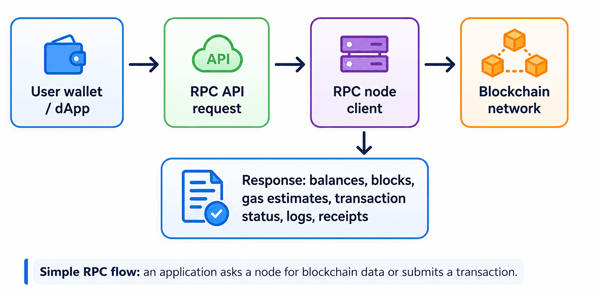
Simple RPC flow: an application asks a node for blockchain data or submits a transaction.
4.1 Step-by-Step Example
- A user opens a wallet and selects an account.
- The wallet sends a request to an RPC endpoint asking for the latest balance.
- The RPC node checks its current blockchain state.
- The node returns the balance to the wallet.
- The wallet shows the result to the user.
- If the user sends a transaction, the wallet signs it locally and sends the signed transaction through the RPC node.
5. Example JSON-RPC Request
A JSON-RPC request usually includes the protocol version, the method name, optional parameters, and an id that helps match responses to requests.
{
  "jsonrpc": "2.0",
  "method": "eth_blockNumber",
  "params": [],
  "id": 1
}
A simplified response might look like this:
{
  "jsonrpc": "2.0",
  "result": "0x12f3a9b",
  "id": 1
}
The result is often encoded in a format chosen by the blockchain API. For example, Ethereum JSON-RPC commonly returns many numeric values as hexadecimal strings.
6. Common RPC API Methods
Different blockchains use different method names. Ethereum and EVM-compatible networks commonly use methods beginning with eth_. Bitcoin Core exposes a different set of RPC commands for blockchain, mempool, network, mining, and wallet operations.
| Use case | Ethereum / EVM example | Bitcoin Core example | What it does |
|---|---|---|---|
| Check latest chain height | eth_blockNumber | getblockcount | Returns the latest known block height or number. |
| Get block data | eth_getBlockByNumber | getblock | Returns information about a block. |
| Get transaction details | eth_getTransactionByHash | getrawtransaction | Looks up a transaction by hash. |
| Submit a transaction | eth_sendRawTransaction | sendrawtransaction | Broadcasts a signed transaction. |
| Estimate transaction cost | eth_estimateGas | estimatesmartfee | Helps estimate required execution cost or fee. |
| Check node/network status | net_version / web3_clientVersion | getnetworkinfo | Returns network or node information. |
7. RPC Nodes vs APIs vs Indexers vs Block Explorers
Beginners often mix these terms together. They are related, but they are not the same.
| Tool | Main purpose | Best for | Limitations |
|---|---|---|---|
| RPC node | Direct communication with a blockchain node. | Current chain state, transaction submission, standard node queries. | Can be slow for complex historical analytics unless it is an archive or indexed setup. |
| RPC API | The method set exposed by a node or provider. | Developer calls from wallets, dApps, scripts, and backends. | Only supports available methods and provider limits. |
| Indexer | Organizes blockchain data into query-friendly databases. | Analytics, dashboards, token histories, NFT metadata, event searches. | May lag behind the chain or introduce interpretation errors. |
| Block explorer | Human-friendly website for blockchain data. | Manual transaction lookup and public browsing. | Not ideal as the main backend for production apps. |
| Subgraph / data API | Specialized indexed data for one protocol or domain. | Protocol dashboards and historical queries. | Depends on indexer quality and schema design. |
8. Types of RPC Nodes
| Node type | What it stores or does | Typical use | Trade-off |
|---|---|---|---|
| Full node | Verifies and stores current blockchain state and required chain data. | Wallets, dApps, normal reads and transaction broadcasting. | Usually enough for many apps, but may not answer all historical state queries. |
| Archive node | Stores historical state across many past blocks. | Historical balances, old contract state, deep analytics. | Requires much more storage and maintenance. |
| Light client | Uses less data and relies on proofs or peers. | Resource-limited environments. | May not support the same RPC capabilities. |
| Validator node | Participates in consensus on proof-of-stake networks. | Block proposal/validation plus infrastructure operations. | Should be secured carefully and often separated from public RPC. |
| Hosted provider node | Managed by a third-party infrastructure company. | Fast setup and scalable app development. | Creates provider dependency and privacy considerations. |
9. Public RPC vs Private RPC vs Self-Hosted RPC
| Option | Pros | Cons | Good fit |
|---|---|---|---|
| Public free RPC | Easy, no setup, useful for testing. | Rate limits, reliability issues, privacy leakage, possible congestion. | Learning, quick tests, low-risk experiments. |
| Paid hosted RPC | Better uptime, dashboards, support, global routing, higher limits. | Monthly cost and provider dependency. | Production dApps, wallets, analytics tools. |
| Self-hosted node | More control, privacy, custom settings, reduced third-party reliance. | Requires hardware, storage, updates, monitoring, security work. | Teams needing control, compliance, reliability, or trust minimization. |
| Hybrid setup | Combines own node with fallback providers. | More complexity. | Serious production systems that need redundancy. |
10. Practical Examples of RPC Nodes in Real Life
10.1 Example 1: A Wallet Checking Your Balance
A wallet does not magically know your balance. It usually asks an RPC node for account state, token contract data, or transaction history. The answer comes back through the API and is displayed in the wallet interface.
10.2 Example 2: A dApp Loading a DeFi Pool
A decentralized exchange interface may call smart contract read methods through an RPC endpoint to show pool reserves, token prices, user allowance, and estimated swap output. If the RPC endpoint is slow, the app may feel broken even if the blockchain is working normally.
10.3 Example 3: Sending a Signed Transaction
When a user clicks “send,” the wallet prepares and signs the transaction locally. The signed transaction is sent to the node through a method such as eth_sendRawTransaction on EVM networks or sendrawtransaction on Bitcoin Core. The node then broadcasts it to peers.
10.4 Example 4: A Backend Monitoring Events
A backend service may poll an RPC API for new blocks or subscribe to logs if the provider supports WebSocket subscriptions. This is common for dashboards, bots, payment processors, bridges, and notification systems.
11. Benefits of RPC Nodes and APIs
- They make blockchain data accessible to wallets, apps, and developers.
- They allow applications to submit signed transactions without handling private keys on the server.
- They support automation, monitoring, analytics, and backend workflows.
- They let developers build on multiple networks using standard request patterns.
- Hosted providers can reduce operational burden for small teams.
- Self-hosted nodes can improve privacy, control, and trust minimization.
12. Risks and Limitations
RPC infrastructure is powerful, but it introduces several risks. Some affect ordinary users, while others affect developers and businesses.
| Risk | What can happen | How to reduce it |
|---|---|---|
| Privacy leakage | A provider may see IP addresses, wallet addresses, request patterns, and app usage. | Use trusted providers, privacy-conscious wallets, self-hosting, VPNs, or request minimization. |
| Downtime | The app cannot load data or send transactions if the endpoint fails. | Use multiple endpoints, monitoring, retries, and fallback providers. |
| Rate limits | Requests are rejected or slowed during heavy use. | Cache safe reads, batch where appropriate, upgrade plan, or add more capacity. |
| Incorrect assumptions | An app treats a single node response as final or complete. | Use confirmations, validate chain IDs, handle reorgs, and compare providers for critical data. |
| Security exposure | A public node with weak access control can be abused. | Require authentication, restrict methods, firewall access, rotate credentials, and separate internal/admin RPC. |
| Centralization dependency | Many apps rely on a few infrastructure providers. | Use diversified providers, self-host where practical, and design fallbacks. |
13. Important Security Rules for Beginners
- Never enter your seed phrase or private key into an RPC website, node dashboard, or support chat.
- A normal RPC endpoint does not need your private key to read balances or broadcast a signed transaction.
- Do not expose a self-hosted node RPC port to the public internet without strong controls.
- Use HTTPS or secure network paths for remote RPC access.
- Keep RPC credentials separate from wallet keys and production secrets.
- Limit dangerous or administrative methods when a node supports method-level restrictions.
- Monitor unusual traffic, high error rates, and sudden request spikes.
- Keep node software updated and follow the security guidance of the client you run.
Critical warning: RPC access can be sensitive. Bitcoin Core documentation warns that clients with valid RPC credentials should be treated as having significant control over the node and resources the node process can access. Do not share RPC credentials casually.
14. Best Practices for Using RPC APIs
14.1 For Wallet Users
- Use the default RPC settings in reputable wallets unless you know why you are changing them.
- When adding a custom network, confirm the chain ID, currency symbol, block explorer, and RPC URL from an official source.
- Be careful with random RPC URLs from social media or unknown Telegram groups.
- If a wallet shows strange balances or failed loading, try a trusted alternative endpoint before assuming your funds are gone.
14.2 For Developers
- Use environment variables or secret managers for provider keys.
- Validate chain ID at startup so your app does not accidentally connect to the wrong network.
- Implement retries with exponential backoff, but avoid infinite retry loops.
- Cache stable read data such as token metadata, but avoid caching volatile state too aggressively.
- Use batching only where supported and safe; large batches can create provider or timeout problems.
- Design for reorgs by waiting for confirmations before treating important transactions as final.
- Track latency, error rate, rate-limit responses, and block freshness.
- Separate read-heavy public traffic from privileged internal operations.
- Use WebSockets or event indexing for real-time event streams when polling becomes inefficient.
- Document which methods your app depends on and test provider compatibility before launch.
14.3 For Teams Running Their Own RPC Node
- Choose the right node type: full node for standard operations, archive node for deep historical state.
- Use a firewall and bind RPC services only to trusted interfaces when possible.
- Place public access behind a reverse proxy, load balancer, or gateway with authentication and rate limits.
- Separate validator duties from public RPC workloads where relevant.
- Plan storage growth, backups, software updates, alerting, and incident response.
- Keep an external fallback endpoint for emergencies or maintenance windows.
- Log enough to debug problems, but avoid storing more user-identifying request data than necessary.
15. Common Mistakes and Misconceptions
| Mistake or myth | Reality |
|---|---|
| “RPC is the blockchain.” | RPC is only an access layer. The blockchain is the underlying network and data. |
| “Any free RPC is safe for production.” | Free public RPC endpoints can be rate-limited, unstable, or unsuitable for sensitive workloads. |
| “If one RPC says it, it must be final.” | Nodes can lag, providers can fail, and blockchains can reorganize. Critical apps need confirmation logic. |
| “Running a node is always cheaper.” | Self-hosting can save provider fees, but it adds hardware, storage, DevOps, and security costs. |
| “A custom RPC can steal my funds directly.” | An RPC endpoint should not receive private keys, but it may affect what your wallet sees, leak privacy, or manipulate displayed data in some contexts. Always verify transactions before signing. |
| “Archive nodes are always required.” | Many apps only need current state and recent data. Archive access is mainly needed for historical state queries. |
16. How to Choose an RPC Provider or Setup
The best RPC setup depends on your use case. A beginner testing scripts does not need the same infrastructure as a wallet serving millions of requests.
| Question | Why it matters |
|---|---|
| Which blockchain networks do you need? | Provider support varies by chain, testnet, and archive availability. |
| How many requests per second will you send? | This affects rate limits, cost, caching, and architecture. |
| Do you need archive data? | Archive access is more expensive and storage-heavy. |
| Do you need WebSockets? | Real-time subscriptions can be better than constant polling. |
| What uptime do you need? | Production apps need monitoring and fallback endpoints. |
| What privacy requirements do you have? | Request metadata can reveal user and business activity. |
| Do you need compliance or data residency controls? | Some teams must meet legal or enterprise requirements. |
| Can you operate infrastructure safely? | Self-hosting requires maintenance, patching, and security skills. |
17. Sample Beginner Architecture
For a small dApp, a practical architecture might look like this:
- Frontend wallet connection for user signing.
- Primary hosted RPC provider for normal reads and transaction broadcasting.
- Secondary fallback provider in case the primary fails.
- Small backend service for caching token lists, app settings, and non-sensitive metadata.
- Monitoring for RPC latency, errors, rate limits, and block freshness.
- Optional indexer or subgraph for complex historical data.
This setup is easier than running a full infrastructure stack from day one, but it still avoids a single point of failure.
18. RPC API Error Handling: What Beginners Should Know
RPC APIs can fail for normal reasons. Good applications expect errors and explain them clearly instead of showing confusing technical messages to users.
| Problem | Possible cause | Good app behavior |
|---|---|---|
| Timeout | Endpoint is slow, overloaded, or network is unstable. | Retry, switch endpoint, and show a clear loading message. |
| Rate limit | Too many requests for the plan or public endpoint. | Back off, cache, reduce polling, or upgrade capacity. |
| Method not found | Provider does not support that method. | Detect compatibility and use a supported alternative. |
| Wrong chain | Wallet or backend is connected to the wrong network. | Check chain ID and ask user to switch networks. |
| Transaction underpriced | Fee or gas settings are too low. | Re-estimate fees and explain the issue. |
| Transaction not found | The transaction has not propagated or the node is behind. | Wait, query another endpoint, and avoid panic messaging. |
19. How RPC Relates to REST, GraphQL, and WebSockets
| Interface style | How it works | Blockchain use case |
|---|---|---|
| RPC / JSON-RPC | Call named methods with parameters. | Standard node communication for many chains. |
| REST | Use URLs and HTTP verbs to access resources. | Explorer APIs, exchange APIs, and simple backend services. |
| GraphQL | Ask for exactly structured data from a schema. | Indexed blockchain data and analytics APIs. |
| WebSockets | Keep a live connection open for updates. | New blocks, logs, pending transactions, and real-time app updates. |
20. Checklist: Safe and Reliable RPC Usage
- Confirm the network and chain ID before using an endpoint.
- Use trusted RPC URLs from official docs, reputable providers, or your own infrastructure.
- Never send private keys or seed phrases to an RPC endpoint.
- Use HTTPS for remote endpoints.
- Add rate limits, authentication, and firewall rules for self-hosted endpoints.
- Monitor block freshness, latency, error rate, and request volume.
- Build fallback logic for production applications.
- Use confirmations and handle chain reorganizations for important transactions.
- Use archive nodes only when your app really needs historical state.
- Review provider terms, privacy practices, supported methods, and pricing before relying on them.
21. FAQs About RPC Nodes and APIs
21.1 What does RPC mean in crypto?
RPC means Remote Procedure Call. In crypto, it usually refers to the way wallets and applications call methods on blockchain nodes to read data or submit transactions.
21.2 Is an RPC node the same as a blockchain node?
An RPC node is a blockchain node with an RPC interface available for software requests. Not every node is intended to serve public RPC traffic.
21.3 Do I need to run my own RPC node?
Most beginners do not need to run one. Developers and teams may run their own node when they need more control, privacy, reliability, or custom configuration.
21.4 Can an RPC endpoint steal my crypto?
A normal RPC endpoint cannot spend funds without your private key or signature. However, an untrusted endpoint can create privacy risks, provide misleading data, or interfere with app behavior. Always verify transaction details before signing.
21.5 What is a public RPC endpoint?
A public RPC endpoint is an endpoint that anyone can use, often for free. It is useful for testing but may have rate limits, downtime, or privacy concerns.
21.6 What is an archive RPC node?
An archive node keeps historical blockchain state, making it useful for old balance checks, historical smart contract state, and analytics. It usually requires much more storage than a standard full node.
21.7 Why is my wallet RPC not working?
The endpoint may be down, overloaded, rate-limited, on the wrong chain, blocked by your network, or unsupported by the wallet. Try a trusted alternative endpoint and confirm network settings.
21.8 What is the difference between RPC and an API?
RPC is a style of communication where software calls named procedures. An API is the broader interface definition. A JSON-RPC API is an API that uses JSON-RPC rules.
21.9 Should production apps use only one RPC provider?
Usually no. Serious apps should consider fallback endpoints, monitoring, caching, and provider diversity to reduce downtime.
21.10 Are RPC calls free?
Some public endpoints are free but limited. Hosted providers often charge based on request volume, features, latency, or dedicated infrastructure. Self-hosting has hardware and operations costs.
22. Conclusion: The Practical Way to Think About RPC Nodes
RPC nodes and APIs are the communication bridge between blockchain applications and blockchain networks. They help wallets show balances, dApps read smart contracts, backends monitor transactions, and users broadcast signed transactions.
For beginners, the most important lessons are simple: use trusted endpoints, never share private keys, understand that RPC providers can affect privacy and reliability, and do not assume every endpoint is equal. For developers and teams, the best approach is to design for failures, monitor infrastructure, validate network settings, handle rate limits, and choose the right mix of hosted and self-managed nodes.
A good RPC setup is not just about speed. It is about trust, safety, accuracy, privacy, and resilience.
Sources Consulted and Checked
The following sources were consulted and checked while preparing this article and reviewing its technical accuracy.
- JSON-RPC 2.0 Specification
- Ethereum.org JSON-RPC API documentation
- Bitcoin.org RPC API Reference
- Bitcoin Core RPC documentation
- Bitcoin Core JSON-RPC interface security notes
- OpenRPC Specification
Reader Advice
This article is provided for general educational and informational purposes only. It is not personalized legal, financial, investment, cybersecurity, or technical advice, and it does not recommend any particular RPC provider, node setup, wallet, network, or service. Blockchain tools and RPC endpoints can involve risks such as outages, incorrect or delayed data, privacy exposure, security misconfiguration, transaction loss, and changing fees or service terms. Laws, regulations, provider policies, technical standards, network rules, and statistics can change over time and may differ by country or region. Before acting, verify important details through current official documentation and, where appropriate, seek advice from a qualified professional. Always protect private keys and seed phrases, review transaction details carefully, and test unfamiliar configurations with low-risk amounts or non-production systems first.