Mining Profitability: Complete Guide, Examples, Risks and Best Practices
1. Quick Answer: What Is Mining Profitability?
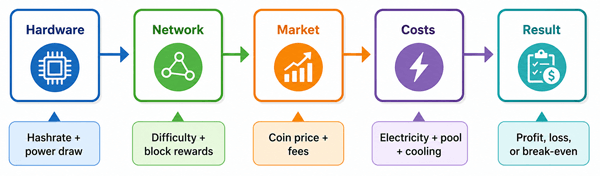
Mining profitability is the difference between the money a mining machine earns and the total cost of running it. Revenue depends on hashrate, network difficulty, block rewards, transaction fees, coin price, and pool performance. Costs include electricity, hardware, cooling, maintenance, internet, pool fees, taxes, and the risk that your equipment loses value.
A miner is profitable only when its real earnings are higher than all operating and capital costs. A machine that looks profitable on a calculator may still lose money if electricity is expensive, the coin price falls, difficulty rises, or the hardware fails before it pays for itself.
2. The Basic Mining Profitability Formula
At the simplest level, mining profitability can be estimated with this formula:
Mining Profit = Mining Revenue - Electricity Cost - Pool Fees - Cooling/Maintenance - Hardware Depreciation - Other Costs
For beginners, the most important lesson is that revenue is uncertain, while many costs are fixed. Your power bill arrives whether the coin price rises or falls.
| Term | Meaning | Why it matters |
|---|---|---|
| Hashrate | How much computing power your machine contributes. | Higher hashrate usually means a bigger share of mining rewards. |
| Power draw | How much electricity the miner uses, usually shown in watts. | Electricity is often the largest ongoing cost. |
| Network difficulty | How hard it is to mine a block on that network. | As difficulty rises, the same machine earns less coin. |
| Block reward | New coins and fees paid to the miner or pool that finds a block. | A lower reward reduces miner revenue unless price or fees offset it. |
| Coin price | The market value of the mined coin. | Revenue in dollars changes when the coin price changes. |
| Pool fee | A percentage charged by a mining pool. | Small fees can matter over months or years. |
| ROI / payback period | How long it takes to recover the hardware cost. | A short payback period is safer than a long one in a volatile market. |
3. How Crypto Miners Earn Money
Proof-of-work miners compete to solve cryptographic puzzles. The winning miner adds the next block to the blockchain and receives the block reward. In pool mining, many miners combine their computing power and share rewards according to each participant’s contribution.
In Bitcoin mining, rewards consist of the fixed block subsidy plus transaction fees. After the April 2024 halving, Bitcoin’s block subsidy became 3.125 BTC per block. Transaction fees vary from block to block, so total miner revenue is not the same every day.
Mining profitability changes because several inputs move at the same time: the coin price, network difficulty, fee income, hardware efficiency, and electricity price.
4. Practical Mining Profitability Examples
The examples below are educational estimates, not live financial projections. Real results change daily. Always run fresh numbers with your exact machine, electricity rate, pool, and coin price before buying hardware.
4.1 Example 1: ASIC Bitcoin Miner
| Input | Example value |
|---|---|
| Machine | ASIC miner rated at 200 TH/s |
| Power draw | 3,500 watts, or 3.5 kW |
| Electricity price | $0.08 per kWh |
| Estimated gross mining revenue | $8.00 per day |
| Pool fee | 2% of revenue |
| Hardware price | $3,000 |
Daily electricity cost = 3.5 kW x 24 hours x $0.08 = $6.72
Pool fee = $8.00 x 2% = $0.16
Estimated daily profit before cooling and maintenance = $8.00 - $6.72 - $0.16 = $1.12
Simple payback period = $3,000 / $1.12 = about 2,679 days, or more than 7 years. That is not attractive because difficulty, hardware value, and coin price will change long before then. This example shows why cheap electricity and efficient hardware are critical.
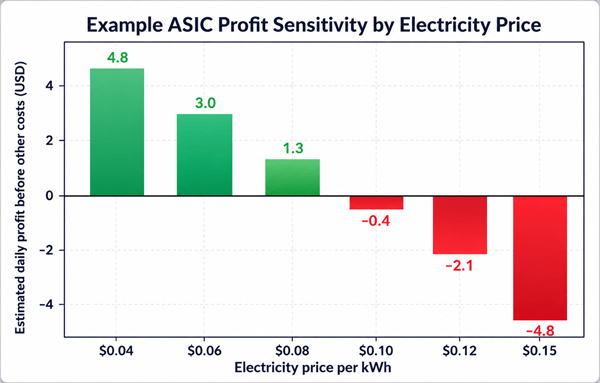
Figure: A simple sensitivity chart showing how the same miner can move from profit to loss as electricity becomes more expensive.
4.2 Example 2: GPU Mining Altcoins
| Input | Example value |
|---|---|
| Hardware | One GPU mining a proof-of-work altcoin |
| Power draw | 160 watts, or 0.16 kW |
| Electricity price | $0.12 per kWh |
| Estimated gross revenue | $0.45 per day |
| Pool/software fee | $0.02 per day |
Daily electricity cost = 0.16 kW x 24 x $0.12 = $0.46
Estimated result = $0.45 - $0.46 - $0.02 = -$0.03 per day
This miner is slightly unprofitable at $0.12/kWh. It could become profitable if electricity is cheaper, the coin price rises, or the miner switches to a more profitable coin. However, GPU mining profits can change quickly because miners often move between coins.
4.3 Example 3: Hosted Mining
Hosted mining means your ASIC runs in someone else’s facility. You pay for hosting, electricity, management, and sometimes repair services. It can be easier than running miners at home, but the contract terms matter.
| Item | Why to check it |
|---|---|
| Hosting electricity rate | A low rate is valuable only if it includes all required fees. |
| Uptime guarantee | Downtime reduces revenue immediately. |
| Repair terms | Find out who pays for failed fans, hashboards, shipping, and labor. |
| Withdrawal policy | Make sure you can receive payouts regularly. |
| Contract exit terms | Know whether you can remove or sell your hardware. |
| Operator reputation | Scams and weak operators are common in mining-related offers. |
5. ASIC vs GPU Profitability
| Factor | ASIC mining | GPU mining |
|---|---|---|
| Best use | Coins with ASIC-dominated algorithms such as Bitcoin SHA-256. | Altcoins that remain GPU-mineable. |
| Efficiency | Usually much higher for one specific algorithm. | Lower efficiency but more flexible. |
| Flexibility | Poor. An ASIC is often useful for one algorithm only. | Better. GPUs can switch coins or be resold for gaming, AI, or workstation use. |
| Noise and heat | Very high. Often unsuitable for bedrooms or small apartments. | Lower than ASICs, but still creates heat and noise. |
| Upfront cost | Can be high, especially for newer efficient models. | Can start smaller, but profitability is often thin. |
| Resale risk | High if the algorithm becomes unprofitable or newer ASICs dominate. | Usually better resale value, but still market-dependent. |
| Beginner friendliness | Simple to configure but demanding for power, cooling, and noise. | More hands-on tuning and coin switching may be required. |
In general, ASIC mining is about scale and energy efficiency. GPU mining is about flexibility. A beginner with expensive electricity should be very cautious with both.
6. Costs Beginners Often Forget
- Cooling: Mining hardware turns electricity into heat. In hot climates, cooling can become a serious cost.
- Ventilation and electrical work: High-power ASICs may require dedicated circuits, safe cabling, exhaust fans, or professional installation.
- Noise control: Many ASIC miners are loud enough to disturb neighbors or family members.
- Downtime: Every hour offline reduces revenue while fixed costs remain.
- Repairs and spare parts: Fans, power supplies, and hashboards can fail.
- Internet and monitoring: Mining needs stable connectivity and basic monitoring tools.
- Taxes and accounting: Mined coins may create taxable income, and later sales may create gains or losses depending on your jurisdiction.
- Hardware depreciation: Mining machines can lose value quickly when newer models become more efficient.
- Exchange and withdrawal fees: Turning mined coins into local currency may involve fees, spreads, and banking friction.
7. How to Calculate Break-Even Electricity Price
Break-even electricity price tells you the highest power rate you can pay before the miner loses money, ignoring other costs.
Formula: Break-even $/kWh = Daily gross revenue / (Power in kW x 24)
Using the ASIC example: $8.00 / (3.5 x 24) = $0.095 per kWh
That means the miner breaks even on electricity at about 9.5 cents per kWh before pool fees, cooling, repairs, taxes, and hardware depreciation. In reality, you would need a lower power rate to create a margin of safety.
8. How to Use Mining Profitability Calculators Correctly
Mining calculators are useful starting points, but they are not guarantees. They usually estimate revenue from current network conditions and market prices. They cannot know your future electricity rate, hardware failures, downtime, local taxes, or future coin price.
Popular calculator types include ASIC profitability calculators, GPU mining calculators, pool calculators, and marketplace calculators where users can estimate earnings by hashrate or device. Tools such as WhatToMine and NiceHash calculators are commonly used by miners, but their results should be treated as estimates.
| Step | What to do | Beginner tip |
|---|---|---|
| 1 | Enter the exact hashrate. | Do not use the manufacturer’s best-case number if your real setup runs lower. |
| 2 | Enter real wall power draw. | Measure at the wall if possible. Software power readings can be incomplete. |
| 3 | Use your real electricity price. | Include taxes, delivery charges, and peak pricing if applicable. |
| 4 | Add pool and platform fees. | A 1-3% fee matters over time. |
| 5 | Test multiple coin prices and difficulties. | Look at best case, base case, and bad case. |
| 6 | Estimate downtime. | Even 5-10% downtime can damage thin margins. |
| 7 | Include hardware payback. | Daily operating profit is not enough if hardware never pays for itself. |
9. When Mining Can Make Sense
- You have genuinely cheap and reliable electricity. Power cost is the biggest advantage in proof-of-work mining.
- You can manage heat, noise, and uptime. Mining is a physical infrastructure business, not only a crypto activity.
- You understand hardware resale risk. A miner is not like a savings account. It is a machine that wears out and can become obsolete.
- You are comfortable with price volatility. You may mine coins during weak markets and hold them for future upside, but that adds investment risk.
- You can start small and learn. A small test setup is safer than buying multiple machines without experience.
10. When Mining Usually Does Not Make Sense
- Your electricity price is high or unpredictable.
- You live in a place where noise, heat, or electrical load will create problems.
- You need guaranteed monthly income.
- You are borrowing money to buy mining equipment.
- You do not understand the coin, mining pool, or payout method.
- The projected payback period is longer than the likely useful life of the hardware.
- The offer promises fixed high returns without explaining real mining costs and risks.
11. Main Risks of Crypto Mining Profitability
| Risk | What can happen | How to reduce it |
|---|---|---|
| Coin price falls | Revenue drops while electricity costs stay the same. | Run bad-case scenarios before buying hardware. |
| Network difficulty rises | Your share of rewards gets smaller. | Use conservative assumptions and efficient hardware. |
| Hardware failure | Revenue stops and repair costs rise. | Keep spare fans, monitor temperatures, and buy from reputable sellers. |
| Electricity price increases | A profitable setup can become unprofitable. | Avoid long payback periods and understand your tariff. |
| Regulatory changes | Rules may affect mining, taxes, energy use, or business registration. | Check local laws and keep records. |
| Pool or platform risk | Payouts may be delayed, fees may change, or a service may fail. | Use reputable pools and avoid keeping large balances on platforms. |
| Scams | Fake cloud mining and hosted mining offers may steal funds. | Avoid guaranteed-return claims and verify ownership, contracts, and operator history. |
| Environmental and community issues | Noise, heat, and power demand may create complaints or restrictions. | Plan ventilation, noise control, and responsible energy use. |
12. Best Practices for Beginners
- Calculate profit three ways. Use optimistic, realistic, and pessimistic assumptions. If only the optimistic case works, the setup is probably too risky.
- Focus on electricity first. A cheap miner with expensive power is usually worse than an efficient miner with cheap power.
- Measure power at the wall. The power supply and cooling equipment can add more consumption than expected.
- Do not ignore heat. Heat reduces hardware life and may increase cooling costs.
- Use a reputable mining pool. Compare fees, payout method, minimum payout, transparency, and uptime.
- Track results weekly. Record coins mined, revenue, electricity cost, downtime, temperature, and pool fees.
- Avoid debt-funded mining. Mining income is too volatile for beginners to rely on fixed loan payments.
- Have an exit plan. Know when you will shut down, sell hardware, switch coins, or move hosting.
- Keep security simple. Use strong passwords, two-factor authentication, secure wallets, and regular withdrawals.
- Learn before scaling. One machine teaches lessons that calculators cannot show.
13. Common Mining Profitability Mistakes
- Buying based on today’s calculator result only: Mining economics can change within days or weeks.
- Ignoring hardware depreciation: A miner may earn daily profit but still fail to repay its purchase cost.
- Using advertised electricity rates instead of real total rates: Delivery fees, taxes, and peak charges can change the true cost per kWh.
- Forgetting noise and heat: A profitable machine on paper may be impossible to run at home.
- Confusing revenue with profit: Gross mining revenue is not what you keep.
- Trusting cloud mining guarantees: Many offers hide fees or are outright scams.
- Mining a coin without understanding liquidity: A coin may look profitable but be hard to sell at the quoted price.
14. Mining Profitability Checklist Before You Buy Hardware
- I know my full electricity cost per kWh, including taxes and delivery charges.
- I know the machine’s real wall power draw, not only the advertised power rating.
- I calculated daily profit after pool fees and realistic downtime.
- I included cooling, ventilation, electrical setup, maintenance, and repairs.
- I calculated payback period and tested what happens if revenue falls by 30-50%.
- I understand where payouts go and how I will secure my wallet.
- I checked local rules, taxes, and landlord or building restrictions.
- I have a plan for noise and heat.
- I can afford the hardware even if mining becomes unprofitable.
- I compared mining with simply buying the coin instead.
15. Mining vs Buying Crypto: Which Is Better?
Beginners should compare mining with simply buying the coin. Mining can make sense when you have a real operational advantage, especially cheap electricity or access to efficient infrastructure. Buying may be simpler if your main goal is price exposure to Bitcoin or another coin.
| Question | Mining may fit | Buying may fit |
|---|---|---|
| Do you have cheap power? | Yes, especially below the break-even rate with margin. | No, buying avoids power and hardware risk. |
| Do you want hands-on operations? | Yes, you enjoy equipment, monitoring, and troubleshooting. | No, you prefer simpler exposure. |
| Can you handle noise and heat? | Yes, you have suitable space and ventilation. | No, mining at home may be impractical. |
| Do you need liquidity? | No, hardware resale may take time. | Yes, coins can usually be sold more easily than machines. |
| Are you comfortable with maintenance? | Yes, you can manage repairs and downtime. | No, buying is less operationally complex. |
16. FAQs About Mining Profitability
16.1 Is crypto mining still profitable?
It can be profitable for miners with efficient hardware, low electricity costs, good uptime, and disciplined risk management. It is often not profitable for beginners with high power costs or unrealistic expectations.
16.2 What is the most important factor in mining profitability?
Electricity cost is usually the most important ongoing factor. Hardware efficiency, coin price, network difficulty, and uptime are also critical.
16.3 How much electricity does a miner use?
It depends on the machine. A modern ASIC can use several thousand watts continuously, while a GPU may use around 100-300 watts depending on settings. Always check real wall power draw.
16.4 What is a good payback period for mining hardware?
Shorter is safer. Many miners prefer payback periods under 12-18 months, but even that can be risky in volatile markets. Very long payback periods are dangerous because hardware and network conditions change.
16.5 Can I mine Bitcoin with a laptop or normal PC?
Practically, no. Bitcoin mining is dominated by specialized ASIC machines. A normal computer cannot compete economically on the Bitcoin network.
16.6 Are mining calculators accurate?
They are useful estimates, not guarantees. They depend on current data and assumptions. Your actual results may differ because of downtime, fees, power rates, market prices, difficulty changes, and hardware performance.
16.7 What is the difference between revenue and profit?
Revenue is what the miner earns before costs. Profit is what remains after electricity, fees, cooling, repairs, hardware depreciation, and other expenses.
16.8 Is cloud mining safe?
Cloud mining is risky. Some services are legitimate, but many offers are misleading or fraudulent. Be especially careful with guaranteed returns, vague company details, or pressure to deposit quickly.
16.9 Should I join a mining pool?
Most small miners use pools because solo mining rewards are unpredictable. Pools provide steadier payouts, but they charge fees and require trust in pool operations.
16.10 What happens when Bitcoin halvings reduce rewards?
A halving cuts the block subsidy in half. If price, fees, or efficiency do not offset that reduction, miner revenue can fall. Less efficient miners are usually affected most.
17. Final Takeaway
Mining profitability is not just about buying a powerful machine. It is a full cost-and-risk calculation. The same miner can be profitable in one location and unprofitable in another because electricity prices, cooling needs, uptime, and local conditions are different.
For beginners, the safest approach is to start with the formula, verify real electricity costs, use conservative assumptions, compare mining against simply buying the coin, and avoid any offer that promises easy or guaranteed returns. Mining can be a serious business, but it rewards careful planning more than excitement.
Sources Consulted and Checked
The following sources were consulted and checked while preparing this document and reviewing its accuracy.
- Bitcoin block reward and subsidy examples - Learn Me a Bitcoin
- Bitcoin halving date and 3.125 BTC subsidy overview - CoinGecko
- Cambridge Bitcoin Electricity Consumption Index methodology - Cambridge Centre for Alternative Finance
- Cryptocurrency mining electricity use - U.S. Energy Information Administration
- Mining profitability calculators - WhatToMine
- Profitability calculator - NiceHash
Reader Advice
This article is provided for educational and informational purposes only and is not personalized financial, investment, tax, or legal advice or a recommendation to buy, operate, host, or finance mining equipment. Mining results can change quickly because of coin prices, network difficulty, electricity rates, equipment performance, fees, downtime, taxation, and other operating conditions. Laws, regulations, policies, tariffs, and statistics also change over time and vary by country, region, utility, building, and service provider, so please confirm current requirements and figures through official sources and qualified local professionals before making a decision. Crypto mining can involve loss of capital, equipment failure, scams, cybersecurity issues, noise, heat, electrical hazards, and environmental or community impacts; assess these risks carefully and use only money you can afford to lose.