ASIC vs GPU Mining: Key Differences, Pros, Cons, Risks and Best Use Cases
ASIC vs GPU mining is one of the first comparisons beginners face when they start learning about crypto mining. Both are ways to use computing power to help secure proof-of-work blockchains and earn mining rewards, but they are built for very different jobs. An ASIC miner is a specialized machine designed to mine one algorithm as efficiently as possible. A GPU miner uses graphics cards, which are more flexible but usually less efficient for coins already dominated by ASICs.
The right choice depends on what you want to mine, your electricity cost, your budget, your tolerance for heat and noise, and whether you want a serious mining business or a learning-friendly home setup. This guide explains the difference in plain English, with practical examples, pros and cons, risks, best use cases, and a decision framework you can use before buying hardware.
Quick answer
ASIC miners are usually best for Bitcoin and other networks where specialized machines dominate. GPU miners are usually better for beginners, testing, resale value, and some altcoins, but they are rarely competitive on ASIC-dominated networks. Profitability depends mainly on coin price, network difficulty, hardware efficiency, electricity cost, cooling, fees, taxes, and uptime.
1. What Is Crypto Mining?
Crypto mining is the process used by proof-of-work blockchains to confirm transactions, add new blocks, and protect the network from spam or manipulation. Miners run hardware that repeatedly performs hashing calculations. The miner or mining pool that finds a valid block receives a reward, usually made up of newly issued coins and transaction fees.
Mining is competitive. The more total computing power a network has, the harder it becomes for any single miner to win rewards. That is why hardware efficiency matters so much: a miner needs enough hashpower to compete, but it must not spend more on electricity and operating costs than it earns.
2. What Is ASIC Mining?
ASIC stands for Application-Specific Integrated Circuit. In mining, an ASIC is a machine built to run one mining algorithm extremely fast and efficiently. For example, Bitcoin uses the SHA-256 mining algorithm, so profitable Bitcoin mining today is normally done with SHA-256 ASIC miners, not normal computers or graphics cards.
ASIC miners are purpose-built. They usually have high hashrate, high power draw, strong cooling fans, and very little use outside mining. A Bitcoin ASIC cannot be turned into a gaming PC. It is closer to industrial equipment than a normal consumer computer.
3. What Is GPU Mining?
GPU stands for Graphics Processing Unit. A GPU is the graphics card used in gaming PCs, workstations, rendering systems, AI experiments, and some mining rigs. GPU mining uses one or more graphics cards to mine coins whose algorithms are still reasonably suitable for general-purpose parallel computing.
GPU mining used to be strongly associated with Ethereum. That changed in September 2022, when Ethereum completed the Merge and moved from proof-of-work to proof-of-stake, officially ending Ethereum mining and reducing the network's energy use by roughly 99.95%. Today, GPUs are used for other mineable coins, testing, hobby mining, or repurposed for gaming, rendering, and compute tasks.
| Feature | ASIC mining | GPU mining |
|---|---|---|
| Main purpose | Built for one mining algorithm | General-purpose graphics/compute hardware |
| Typical use | Bitcoin, Litecoin/Dogecoin, Kaspa and other ASIC-supported coins | Some altcoins, experimentation, hobby mining, resale or repurposing |
| Efficiency | Usually much higher on its target algorithm | Lower on ASIC-dominated algorithms, but flexible |
| Flexibility | Low; tied to one algorithm or coin family | High; can switch coins and uses |
| Noise and heat | Often loud and hot; industrial fans are common | Usually easier to manage, but multi-GPU rigs still run hot |
| Resale value | Depends heavily on mining profitability and algorithm demand | Often better because GPUs have non-mining buyers |
| Beginner friendliness | Simple to configure, harder to power/cool safely | More parts and setup, easier to learn and repurpose |
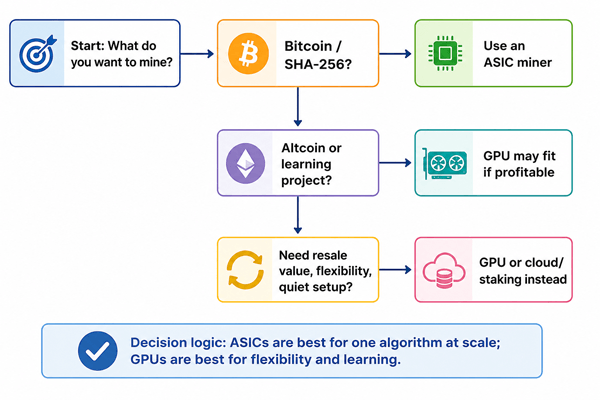
Simple decision diagram: ASIC or GPU?
4. ASIC vs GPU Mining: The Core Difference
The core difference is specialization versus flexibility. An ASIC is like a factory machine designed to do one task all day with maximum efficiency. A GPU is like a powerful workshop tool that can do many tasks well, but not always as efficiently as a dedicated machine.
For Bitcoin, the difference is decisive. Bitcoin mining difficulty is so high that GPUs are not a practical way to mine BTC directly. A GPU can technically compute hashes, but it cannot compete economically with modern SHA-256 ASICs. For smaller proof-of-work altcoins, the answer can be more nuanced because some networks are still GPU-friendly or only partially ASIC-dominated.
5. How ASIC Mining Works
An ASIC miner connects to power, internet, and mining software or a mining pool. The machine receives block data, performs trillions of hash attempts, and submits valid shares to the pool. The pool combines the work of many miners and distributes rewards according to each miner's contributed hashrate.
ASIC performance is usually discussed in hashrate and efficiency. Hashrate tells you how much work the machine can perform. Efficiency tells you how much electricity it uses for that work. For Bitcoin ASICs, efficiency is often measured in joules per terahash (J/TH). Lower J/TH is better.
6. How GPU Mining Works
A GPU mining rig uses graphics cards, a motherboard, power supplies, risers or PCIe slots, storage, memory, and mining software. The software runs a mining algorithm on the GPUs and connects to a mining pool. Rewards are paid based on accepted shares, similar to ASIC pool mining.
GPU profitability is usually more sensitive to coin selection. A GPU miner may switch between coins or algorithms when profitability changes. However, switching is not a magic solution. If many miners switch to the same coin, difficulty rises and profits can shrink quickly.
| Scenario | Better fit | Why |
|---|---|---|
| Mining Bitcoin seriously | ASIC | Bitcoin is SHA-256 and dominated by specialized ASIC hardware. GPUs are not economically competitive for direct BTC mining. |
| Learning how mining pools, wallets and hashrate work | GPU or small ASIC | A small setup limits risk and teaches the basics without committing to industrial power and cooling. |
| Home setup in a bedroom or small apartment | Usually neither; maybe low-power GPU | Most profitable ASICs are loud and hot. A GPU is quieter, but profit may be low or negative. |
| Mining with very cheap power and space for ventilation | ASIC | Low electricity cost and good airflow are the biggest advantages for serious proof-of-work mining. |
| Keeping hardware resale options open | GPU | GPUs can be resold to gamers, creators, AI hobbyists, and workstation users. |
| Mining an ASIC-dominated altcoin such as modern Kaspa mining | ASIC | Some altcoins that began as GPU-friendly later become ASIC-dominated when specialized machines arrive. |
7. ASIC Mining Pros and Cons
7.1 Pros
- Highest efficiency on supported algorithms.
- Simpler mining setup once power, cooling, wallet and pool are ready.
- Best choice for Bitcoin and many mature proof-of-work networks.
- Can scale well in a properly designed mining facility.
7.2 Cons
- Expensive upfront cost for competitive machines.
- Usually loud, hot and power-hungry.
- Limited use outside mining.
- Can become unprofitable if coin price falls, difficulty rises or electricity costs increase.
- Older ASICs can lose resale value quickly.
8. GPU Mining Pros and Cons
8.1 Pros
- Flexible hardware that can switch coins or be repurposed.
- Better resale market than most ASICs.
- Good for learning, testing and small hobby setups.
- Usually easier to source standard parts and repair components.
8.2 Cons
- Lower efficiency than ASICs on mature mining algorithms.
- Profitability may be weak after electricity and hardware costs.
- Multi-GPU rigs require careful tuning, drivers and airflow.
- Some GPU-friendly coins can become ASIC-dominated over time.
- Not suitable for direct Bitcoin mining in practice.
9. Profitability: The Numbers That Matter Most
Mining profit is not simply “coin earned minus electricity.” A realistic calculation should include hardware, power, cooling, pool fees, downtime, repairs, taxes and the resale value of equipment.
| Factor | Why it matters | Beginner tip |
|---|---|---|
| Electricity price | The largest ongoing cost for most miners. | Calculate cost per kWh before buying hardware. High residential rates often make mining unprofitable. |
| Hardware efficiency | Efficient miners earn more per watt. | Compare watts, hashrate and efficiency, not only sticker price. |
| Network difficulty | More miners competing means fewer rewards per unit of hashrate. | Use a calculator but assume results can change quickly. |
| Coin price | Revenue rises and falls with market price. | Do not buy hardware based only on a short price spike. |
| Cooling and ventilation | Heat reduces reliability and can damage equipment. | Plan airflow, noise and safe electrical load before plugging in. |
| Pool fees and payout method | Fees reduce revenue; payout methods affect income stability. | Use reputable pools and understand minimum payouts. |
| Taxes and records | Mining income may be taxable depending on jurisdiction. | Track rewards, costs, dates and market values from day one. |
9.1 Simple Mining Profit Formula
Daily profit = mining revenue - electricity cost - pool fees - other operating costs.
Electricity cost per day = machine power in kW x 24 x electricity price per kWh.
Example: A miner using 3,000 watts uses 3 kW. At $0.10 per kWh, daily electricity cost is 3 x 24 x $0.10 = $7.20 per day, before cooling and other costs.
10. Key Risks of ASIC and GPU Mining
- Profitability risk: Mining calculators show estimates, not guaranteed income. Coin price, difficulty and fees can change fast.
- Hardware obsolescence: Newer ASICs can make older machines uncompetitive. GPUs age more slowly but can still lose value.
- Electricity and fire risk: Overloaded circuits, poor cables and weak power supplies can be dangerous.
- Heat and noise risk: Mining converts electricity into heat. Many ASICs sound like industrial equipment, not a normal PC.
- Regulatory risk: Some regions restrict mining, require registration, change electricity tariffs or impose special reporting rules.
- Liquidity risk: A miner can earn coins that are hard to sell or whose price falls before payout.
- Pool and software risk: Fake mining software, malicious firmware and unreliable pools can steal funds or reduce payouts.
- Environmental and community risk: Large mining operations can affect local electricity demand, emissions and neighborhood noise.
11. Best Use Cases for ASIC Mining
- Bitcoin mining where only specialized SHA-256 machines are realistic.
- Commercial or semi-commercial setups with cheap power, good ventilation and safe electrical infrastructure.
- Miners who want maximum efficiency for one coin or algorithm.
- Operations that can tolerate high noise, heat and hardware concentration risk.
- Altcoin mining where ASICs clearly dominate the target algorithm, such as many modern Scrypt or kHeavyHash setups.
12. Best Use Cases for GPU Mining
- Beginners who want to learn mining without buying single-purpose hardware.
- Users who already own GPUs and want to test mining during idle time.
- Altcoins where GPU mining is still viable after electricity costs.
- People who value resale value and the ability to repurpose hardware for gaming, rendering or AI workloads.
- Small experimental rigs where flexibility matters more than maximum efficiency.
13. Common Beginner Mistakes to Avoid
- Buying hardware before checking local electricity cost.
- Using a profitability calculator once and assuming the number will stay the same.
- Ignoring noise, heat and ventilation.
- Trying to mine Bitcoin with GPUs.
- Buying old ASICs because they look cheap, without checking efficiency and break-even cost.
- Forgetting pool fees, power supply losses, import duties, repairs and taxes.
- Mining directly to an exchange address without understanding payout rules.
- Downloading mining software from random links instead of official project or pool sources.
14. Best Practices Before Buying Mining Hardware
- Calculate electricity cost first. If your power is expensive, mining may not make sense.
- Use several mining calculators and test different coin prices and difficulty levels.
- Check the exact algorithm. An ASIC for one algorithm cannot automatically mine another coin.
- Plan power safely. Use properly rated circuits, cables, outlets and power supplies.
- Plan cooling and noise before the miner arrives.
- Start small if you are new. Treat your first setup as education, not guaranteed income.
- Keep records of hardware purchases, electricity use, rewards, fees and sales.
- Understand local rules, taxes, import duties and utility policies.
- Use reputable pools, wallets and firmware sources.
- Have an exit plan: resale, repurposing, shutdown threshold or switching strategy.
15. ASIC vs GPU Mining: Which Should You Choose?
| Choose ASIC mining if... | Choose GPU mining if... |
|---|---|
| You want to mine Bitcoin or another ASIC-dominated coin. | You want to learn, experiment or keep hardware flexible. |
| You have cheap electricity and proper ventilation. | You already own GPUs or can repurpose them later. |
| You can handle high noise and heat. | You need a quieter, smaller setup. |
| You are comfortable with single-purpose equipment. | You want stronger resale options outside crypto mining. |
| You can calculate break-even and accept hardware obsolescence risk. | You understand profits may be lower but risk may be easier to manage. |
For most beginners, GPU mining is easier to learn from, but ASIC mining is the realistic choice for Bitcoin. For most serious miners, the answer is not “ASIC or GPU” in general; it is “which coin, which algorithm, which electricity price, which machine, and which risk level?”
16. FAQs About ASIC vs GPU Mining
16.1 Is ASIC mining better than GPU mining?
ASIC mining is better for coins and algorithms where ASICs dominate, especially Bitcoin. GPU mining is better for flexibility, learning and resale value. “Better” depends on the coin, power cost, hardware price and your goal.
16.2 Can I mine Bitcoin with a GPU?
Technically a GPU can perform hashing, but in practice GPU Bitcoin mining is not competitive against modern SHA-256 ASICs. If your goal is Bitcoin exposure, buying BTC or mining with a proper ASIC is more realistic than GPU mining BTC directly.
16.3 Is GPU mining dead?
No, but it changed significantly after Ethereum ended proof-of-work mining. GPUs can still mine some altcoins, but profitability is more selective and often lower than during Ethereum mining booms.
16.4 Why are ASIC miners so loud?
ASIC miners use high-speed fans to remove heat from dense chips running continuously. Many are designed for warehouses or mining rooms, not bedrooms.
16.5 Which is cheaper to start: ASIC or GPU mining?
A small used GPU setup can be cheaper and easier to repurpose. However, a low-cost ASIC may deliver more mining power for a specific algorithm. The cheaper option is not always the safer or more profitable option.
16.6 Can an ASIC mine different coins?
Only if those coins use the same compatible mining algorithm. A Bitcoin SHA-256 ASIC cannot mine a coin that uses a completely different algorithm.
16.7 Do mining calculators guarantee profit?
No. Calculators are estimates based on current hashrate, difficulty, coin price, fees and electricity cost. Real profit can change daily.
16.8 What is the biggest cost in mining?
Electricity is usually the biggest ongoing cost. Hardware is the biggest upfront cost. Cooling, downtime, repairs and fees also matter.
16.9 Is home mining worth it?
Home mining can be worth it for learning, heating reuse, very cheap electricity or small hobby setups. It is often not profitable at high residential electricity rates, especially after noise and cooling are considered.
16.10 What should I check before buying a miner?
Check algorithm, hashrate, power draw, efficiency, electricity cost, cooling needs, noise level, pool support, firmware reputation, warranty, import duties, expected resale value and local rules.
17. Final Takeaway
ASIC and GPU mining are not direct substitutes. ASICs win when one algorithm has become a high-efficiency industrial race, especially Bitcoin mining. GPUs win when flexibility, learning, resale value and multipurpose hardware matter more than maximum efficiency. Before buying either, calculate electricity cost, compare real efficiency, plan cooling and noise, and treat profitability as uncertain rather than guaranteed.
Sources Consulted and Checked
The following sources were consulted and checked while preparing this article to support accuracy and context:
- Ethereum.org, “The Merge” - confirms Ethereum completed its transition to proof-of-stake on September 15, 2022 and deprecated proof-of-work mining, with about 99.95% lower energy use.
- Bitcoin.org - describes Bitcoin as a peer-to-peer network with issuance and transaction management carried out collectively by the network.
- U.S. Energy Information Administration, “Tracking electricity consumption from U.S. cryptocurrency mining operations” - notes rapid growth in electricity demand and preliminary estimates for U.S. crypto mining electricity use.
- Cambridge Centre for Alternative Finance, Cambridge Bitcoin Electricity Consumption Index - provides ongoing estimates and context for Bitcoin electricity demand.
- NiceHash profitability calculator and ASIC Miner Value - useful examples of live profitability tools, but calculator results should be treated as estimates rather than guarantees.
- Current mining market sources checked in June 2026 for context on ASIC efficiency, Kaspa ASIC dominance, and profitability sensitivity.
Reader Advice
This article is provided for educational and informational purposes only and is not personalized financial, investment, tax, legal, electrical-safety, or other professional advice. Crypto mining involves uncertainty and may result in financial loss, hardware obsolescence, high electricity costs, heat, noise, equipment damage, fire or electrical hazards, scams, and regulatory or environmental concerns. Hardware specifications, profitability estimates, coin prices, network difficulty, laws, taxes, utility policies, and statistics can change over time and vary by region, so please verify current information through official sources and consult qualified professionals where appropriate before buying equipment or making a decision.