Oracles Explained: Meaning, How It Works, Examples, Benefits and Risks
1. Quick Answer: What Is a Blockchain Oracle?
A blockchain oracle is a service, protocol, or network that brings information from outside a blockchain into smart contracts, or sends blockchain events to external systems. Smart contracts can read data already stored on-chain, but they cannot naturally check real-world facts such as an asset price, a weather event, a sports result, a bank payment, or an API response. Oracles solve this gap by collecting data, validating it, and delivering it in a format that on-chain code can use.
In simple terms: a smart contract is like a vending machine with rules, and an oracle is the trusted data bridge that tells it whether the required real-world condition has happened.
| Beginner question | Simple answer |
|---|---|
| What does an oracle do? | It supplies external data to a blockchain or helps a blockchain trigger external actions. |
| Why are oracles needed? | Blockchains are intentionally isolated, so smart contracts need a secure way to use off-chain information. |
| Are oracles always safe? | No. Bad data, downtime, manipulation, or poor design can cause smart contracts to behave incorrectly. |
| What is the oracle problem? | The challenge of trusting external data without weakening the trust-minimized design of blockchain systems. |
2. Why Smart Contracts Need Oracles
Smart contracts are programs that run on blockchains. They are useful because their logic is transparent and difficult to change after deployment. However, blockchains are deterministic systems: every node must be able to independently verify the same result. If a smart contract could directly call any random website, API, or server during execution, different nodes might receive different answers, the chain could fail to agree, and the security model would break.
This is why blockchains usually do not fetch outside data by themselves. Instead, oracles bring selected external information on-chain through transactions or specialized oracle mechanisms. Ethereum documentation describes this as the “oracle problem”: smart contracts need correct data, but trusting external oracle operators can weaken the trustless nature of smart contracts. Chainlink similarly describes blockchains as isolated networks that need oracle infrastructure to connect to off-chain data.
3. How Blockchain Oracles Work
Different oracle systems use different designs, but most follow the same basic pattern:
- A smart contract needs external information, such as the ETH/USD price or whether a shipment arrived.
- An oracle fetches the information from one or more data sources, such as exchanges, APIs, sensors, or institutions.
- The oracle validates, signs, aggregates, or filters the data depending on its design.
- The oracle posts the result to a blockchain or makes it available for the smart contract to read.
- The smart contract executes its programmed logic based on the data it receives.
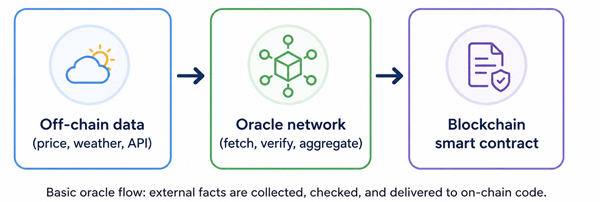
Figure: A simplified data flow from the real world to a smart contract through an oracle network.
3.1 A Simple Example
Imagine a decentralized lending app that lets users borrow stablecoins against ETH. The app must know the current ETH price to decide whether a loan is healthy or under-collateralized. The smart contract cannot check exchange prices by itself. A price oracle publishes an ETH/USD price feed on-chain. The lending contract reads that feed and uses it to calculate collateral value.
If the price feed is accurate and available, the lending app can work as intended. If the feed is stale, manipulated, or unavailable, users may be unfairly liquidated, the protocol may take losses, or attackers may exploit the price difference.
4. Types of Blockchain Oracles
| Oracle type | What it means | Common example | Main risk |
|---|---|---|---|
| Inbound oracle | Brings external data into a blockchain. | Asset price feed for a DeFi lending protocol. | Incorrect or delayed input data. |
| Outbound oracle | Sends blockchain events to an external system. | A contract triggers an off-chain payment, message, or database update. | External system may fail or act incorrectly. |
| Software oracle | Gets data from online sources such as APIs, websites, exchanges, or databases. | Crypto price, flight status, sports result. | API downtime, spoofing, bad source quality. |
| Hardware oracle | Connects physical-world data to smart contracts using devices or sensors. | Supply-chain sensor, IoT temperature monitor. | Device tampering, calibration errors, weak custody chain. |
| Human oracle | Relies on individuals or organizations to report information. | Manual event reporting or expert attestation. | Bias, bribery, mistakes, slow reporting. |
| Centralized oracle | Uses one operator or one main source. | One API feeding one contract. | Single point of failure and manipulation. |
| Decentralized oracle network | Uses multiple nodes and often multiple data sources. | Aggregated price feed from independent node operators. | More complex and often more expensive, but safer than a single source. |
| Push oracle | Oracle updates data on-chain at intervals or when thresholds change. | Price feed updated every few seconds or after a price move. | May be stale between updates. |
| Pull oracle | Users or apps fetch and submit the latest signed oracle data when needed. | Some high-frequency price-feed designs. | Integration complexity and update responsibility. |
5. Real-World Examples of Oracles
Oracles are used anywhere a smart contract needs information that does not originate directly on its own blockchain. Common examples include:
- DeFi price feeds: lending, derivatives, stablecoins, options, perpetuals, and automated risk systems use token, forex, commodity, or index prices.
- Insurance contracts: weather data, flight delay data, crop data, or disaster information can trigger automated payouts.
- Prediction markets: market outcomes may depend on sports results, election results, court decisions, or economic data.
- Supply chains: sensors, shipment records, customs events, and warehouse scans can support product tracking.
- Gaming and NFTs: verifiable randomness or external game events can influence rewards, minting, or in-game outcomes.
- Real-world assets: tokenized securities, invoices, commodities, and property-related products may need valuations, attestations, or compliance checks.
- Cross-chain applications: messaging or proof systems can tell one chain what happened on another chain.
6. Popular Oracle Models and Networks
Oracle providers are not all the same. Some focus on general-purpose data, some specialize in market data, and others emphasize first-party data providers or cross-chain infrastructure. Three useful examples are Chainlink, Pyth, and API3.
| Project/model | Basic idea | Beginner-friendly takeaway |
|---|---|---|
| Chainlink | A decentralized oracle network model that uses independent oracle nodes and multiple data sources for many types of data and services. | Often used as a general-purpose oracle infrastructure layer, especially for DeFi price feeds and smart contract services. |
| Pyth Network | A market-data-focused oracle where data publishers provide price information that can be consumed on-chain. | Commonly associated with low-latency financial market data and a pull-style update model in many integrations. |
| API3 | A first-party oracle approach where API providers can operate oracle infrastructure more directly. | Focuses on reducing middlemen between data providers and smart contracts. |
These examples are included to explain design patterns, not to say one oracle is always best. The right choice depends on the chain, data type, latency needs, security requirements, cost, and available integrations.
7. The Oracle Problem Explained
The oracle problem is one of the most important ideas to understand. Blockchains can verify on-chain transactions through consensus, but they cannot automatically know whether an off-chain statement is true. If a smart contract depends on an external fact, someone or something must report that fact. That reporting layer creates trust assumptions.
For example, a smart contract may be secure, audited, and immutable. But if it relies on a weak price oracle, an attacker may manipulate the reported price and drain value from the contract. In that case, the smart contract code did not necessarily fail; the input data failed.
7.1 Why It Matters
- Smart contracts are only as reliable as the data they use.
- Centralized data feeds can become single points of failure.
- Economic incentives matter: the more value a contract controls, the more attractive oracle manipulation becomes.
- Oracle risk is not only technical. It can involve governance, legal, operational, and market risks.
8. Benefits of Oracles
| Benefit | Why it matters | Example |
|---|---|---|
| Real-world connectivity | Smart contracts can react to real events instead of only on-chain balances. | Insurance payout after verified flight delay. |
| Automation | Apps can execute rules without manual intervention once trusted data arrives. | Liquidation or settlement based on price feed. |
| More useful DeFi | Lending, derivatives, stablecoins, and structured products need reliable market data. | ETH/USD feed for collateral valuation. |
| Cross-system integration | On-chain and off-chain systems can communicate. | A contract event updates an enterprise database. |
| Transparency | Some oracle designs publish data sources, update times, signatures, and on-chain history. | Users can check whether a price feed is fresh. |
| Programmable risk management | Protocols can use feeds for limits, circuit breakers, or emergency logic. | Pause borrowing if price data is stale. |
9. Risks and Limitations of Oracles
Oracles make smart contracts more powerful, but they also introduce new risks. These risks should be designed for from the beginning, not treated as an afterthought.
| Risk | What can go wrong | Practical protection |
|---|---|---|
| Bad data | A source reports an incorrect price, result, or event. | Use multiple reputable sources and aggregation. |
| Centralization | One operator controls the feed. | Prefer decentralized oracle networks for high-value use cases. |
| Stale data | The feed has not updated recently. | Check timestamps and reject old data. |
| Latency | Data arrives too late for fast markets. | Choose feeds designed for the required update speed. |
| Manipulation | Attackers move thinly traded markets or exploit low-liquidity sources. | Use volume-weighted data, multiple venues, and liquidity-aware checks. |
| Downtime | Oracle nodes, APIs, or networks stop responding. | Add fallback logic and safe failure modes. |
| Governance risk | Admins can change feed settings, sources, or contracts. | Review upgrade controls, multisigs, timelocks, and documentation. |
| Cost | Frequent on-chain updates may be expensive. | Balance update frequency with risk and gas costs. |
| Complexity | More moving parts increase integration mistakes. | Use audited integrations and test edge cases. |
10. Common Oracle Attacks and Failure Scenarios
10.1 Price Manipulation
An attacker may manipulate the price of a low-liquidity asset on one exchange, then exploit a protocol that relies on that exchange as its only price source. This is why serious DeFi systems usually avoid single-venue spot prices for important decisions.
10.2 Stale Price Exploits
If a protocol accepts an old price without checking when it was last updated, attackers may trade against outdated information. Smart contracts should check freshness before using oracle data.
10.3 Single Oracle Failure
A single node, server, API key, or admin account can fail or be compromised. This can lead to incorrect data or no data at all.
10.4 Decimal and Unit Mistakes
Some feeds use different decimals, symbols, or quote currencies. Confusing ETH/USD with USD/ETH, or using 8 decimals as if they were 18, can break calculations.
10.5 Wrong Feed Selection
A developer may integrate the wrong network address, testnet feed, asset pair, or stale contract. Always verify feed IDs, contract addresses, network names, and update policies from official documentation.
11. Best Practices for Developers and Protocol Teams
- Use reputable oracle providers with clear documentation, active maintenance, and transparent update policies.
- Prefer decentralized oracle networks or multi-source aggregation for high-value contracts.
- Check data freshness before using a feed. Reject data that is older than your application can safely tolerate.
- Understand heartbeat and deviation thresholds. A price feed may update after a fixed time interval, after a price move, or both.
- Validate decimals, units, quote assets, and network addresses. Treat oracle integration as a security-critical step.
- Add circuit breakers for abnormal price changes, missing updates, or impossible values.
- Use fallback logic carefully. A fallback oracle can help during outages, but it can also introduce inconsistent pricing if poorly designed.
- Avoid relying on a single thin-liquidity market for prices. Use aggregated, liquidity-aware sources where possible.
- Monitor oracle health in production. Track update times, feed values, node status, and unusual deviations.
- Document oracle assumptions for users. Explain what feeds are used, how often they update, and what happens during failure.
12. Best Practices for Everyday Users and Investors
- Before using a DeFi app, check whether it explains its oracle sources and risk controls.
- Be cautious with small or new protocols that secure large value using unclear price feeds.
- Understand liquidation risk. Oracle prices may differ from the price you see on one exchange.
- Avoid assuming “audited” means oracle risk is solved. Audits may not eliminate bad data or governance risk.
- Pay attention to incidents, feed migrations, and protocol announcements involving oracle changes.
- Use extra caution with low-liquidity tokens, exotic collateral, and highly leveraged products.
13. Oracle Design Checklist
| Question | Why it matters |
|---|---|
| What exact data does the contract need? | Clear requirements prevent overengineering and wrong-feed integrations. |
| How much value depends on the data? | Higher-value systems need stronger oracle security. |
| How fresh must the data be? | Fast markets need low-latency updates; slow processes may not. |
| What happens if the oracle fails? | Safe failure modes reduce catastrophic losses. |
| Can the data be independently verified? | Verifiability improves trust and monitoring. |
| Who can upgrade or change the oracle? | Admin control can be a hidden centralization risk. |
| Are units and decimals tested? | Small formatting mistakes can create huge financial errors. |
| Is monitoring in place? | Problems should be detected before users are harmed. |
14. Oracles vs APIs: What Is the Difference?
A regular API provides data to software. A blockchain oracle provides data to smart contracts in a way that fits blockchain constraints. The oracle may use APIs as sources, but it usually adds signing, validation, aggregation, delivery, and on-chain availability.
| Feature | Regular API | Blockchain oracle |
|---|---|---|
| Main user | Web or mobile applications. | Smart contracts and blockchain applications. |
| Trust model | Usually trust the API provider directly. | May use cryptographic proofs, multiple nodes, and aggregation. |
| Delivery | Data is returned to a server or client. | Data is posted or made readable on-chain. |
| Cost model | Usually subscription or request-based. | May include API costs, node costs, and blockchain gas fees. |
| Failure impact | App may show wrong or missing data. | Smart contract may move real funds incorrectly. |
15. Centralized vs Decentralized Oracles
| Factor | Centralized oracle | Decentralized oracle network |
|---|---|---|
| Security | Depends heavily on one operator or source. | Spreads trust across multiple nodes and often multiple sources. |
| Cost | Often cheaper and simpler. | Usually more expensive and operationally complex. |
| Speed | Can be fast if well-run. | Can be fast, but aggregation and consensus may add complexity. |
| Reliability | One failure can affect the whole feed. | Can tolerate some node or source failures. |
| Best for | Low-value, experimental, or internal use cases. | High-value DeFi, public protocols, and critical automation. |
16. Misconceptions About Oracles
| Misconception | Reality |
|---|---|
| “Oracles make data automatically true.” | Oracles report data; they do not magically guarantee truth. Their design determines reliability. |
| “A smart contract is trustless even if its oracle is centralized.” | The contract may be trust-minimized, but the oracle adds trust assumptions. |
| “Any API can be used safely as an oracle.” | Raw APIs are not enough for high-value smart contracts without validation and security controls. |
| “More updates are always better.” | Frequent updates can reduce staleness but increase cost and complexity. |
| “One oracle provider fits every use case.” | Different applications need different data types, latency, chains, and security models. |
17. Practical Scenario: Choosing an Oracle for a Lending Protocol
Suppose a team is building a lending market where users can borrow against a crypto asset. The team should ask:
- Is the asset liquid across several trusted venues?
- Does an established price feed already exist for this asset on the target blockchain?
- How often does the feed update, and under what price-change threshold?
- What happens if the price feed becomes stale during market volatility?
- Can the protocol pause borrowing, liquidations, or withdrawals if the oracle behaves abnormally?
- Does the oracle provider explain its data sources, aggregation method, and risk assumptions?
A conservative design might only support assets with deep liquidity, established feeds, fresh timestamps, reasonable deviation checks, and emergency controls. A risky design might list a thinly traded token using one exchange price and no staleness checks.
18. When Oracles Are Not the Right Solution
Oracles are powerful, but they are not always appropriate. If a contract cannot tolerate incorrect external data, or if no reliable way exists to verify the needed event, automation may be unsafe. Some real-world events are subjective, disputed, private, or legally complex. In those cases, a hybrid design with human review, arbitration, insurance, or traditional legal agreements may be more realistic than full automation.
19. FAQs About Blockchain Oracles
19.1 What is an oracle in crypto?
An oracle in crypto is a data bridge that helps smart contracts use information from outside the blockchain, such as prices, weather, event results, or API data.
19.2 Why can’t smart contracts access the internet directly?
Blockchains need every node to agree on the same result. Direct internet calls can return different answers to different nodes, so external data must be brought on-chain through controlled oracle mechanisms.
19.3 What is the oracle problem?
The oracle problem is the challenge of using external data without reintroducing too much trust, centralization, or manipulation risk into smart contracts.
19.4 Are decentralized oracles risk-free?
No. Decentralization can reduce single points of failure, but risks such as bad sources, stale data, governance issues, integration errors, and market manipulation can still exist.
19.5 What is a price oracle?
A price oracle reports asset prices to smart contracts. DeFi protocols use price oracles for lending, collateral, liquidations, derivatives, stablecoins, and risk management.
19.6 What is the difference between push and pull oracles?
A push oracle posts updates on-chain when certain conditions are met. A pull oracle lets users or applications fetch signed data and submit it when needed.
19.7 Can oracles send data from a blockchain to the real world?
Yes. Outbound oracles or automation services can help external systems respond to on-chain events, such as sending a message, updating a database, or triggering a workflow.
19.8 How do I know if an oracle is reliable?
Look for multiple high-quality sources, independent nodes, transparent update rules, fresh timestamps, monitoring, audits, clear documentation, and a design that matches the value at risk.
19.9 What happens if an oracle fails?
The impact depends on the application. A protocol may pause, use fallback data, reject stale data, or in poor designs, execute incorrectly and lose funds.
19.10 Do all blockchain apps need oracles?
No. Apps that only use on-chain information may not need oracles. Apps that depend on prices, real-world events, or external systems usually do.
20. Final Takeaway
Oracles are essential infrastructure for many blockchain applications because they connect smart contracts to real-world data and off-chain systems. Without oracles, most DeFi, insurance, prediction markets, real-world asset products, and cross-system automation would be limited or impossible.
The key lesson is simple: an oracle is not just a data pipe. It is a security-critical part of the application. Good oracle design considers data quality, decentralization, latency, freshness, manipulation resistance, fallback logic, monitoring, governance, and the amount of value at risk. For beginners, the safest mindset is to ask not only “what data does this app use?” but also “how does the app know that data is correct?”
Sources Consulted and Checked
These sources were consulted and checked while preparing this document to support accuracy and clarity.
- Ethereum.org developer documentation, “Oracles” - explains why smart contracts need oracles and describes the oracle problem.
- Chainlink Education, “What Is an Oracle in Blockchain?” and “The Blockchain Oracle Problem” - beginner explanations of oracle networks, external data, and decentralized oracle design.
- Pyth Network Developer Hub, “How Pyth Works” and “Price Feeds” - documentation on Pyth price feed architecture and market-data publishing.
- API3 documentation - explains first-party oracle and decentralized API concepts.
- Hardhat documentation, “Working with blockchain oracles” - developer-oriented discussion of oracle risks and decentralized oracle networks.
Reader Advice
This article is provided for educational and informational purposes only. It is not personalized legal, financial, investment, tax, cybersecurity, or technical advice, and it does not recommend any particular oracle network, protocol, token, or service. Blockchain and DeFi products can involve smart-contract bugs, inaccurate or delayed data, market manipulation, liquidation, service outages, governance changes, fraud, and partial or total loss of funds. Rules, policies, laws, technical standards, product features, and statistics can change over time and may vary by country or region. Before making a decision, verify current information through official documentation and relevant authorities, assess the risks carefully, and seek qualified professional advice where appropriate.