Validators Explained: Meaning, How It Works, Examples, Benefits and Risks
1. Quick Answer: What Is a Validator?
A validator is a participant in a blockchain network that helps check transactions, propose or vote on new blocks, and keep the network secure. Validators are most commonly associated with proof-of-stake blockchains, where they lock up, or stake, cryptocurrency as collateral. If they follow the rules, they can earn rewards. If they act dishonestly or fail to perform important duties, they can lose rewards or, on some networks, lose part of their staked funds through a penalty called slashing.
In simple terms, validators are like the security guards, record checkers, and voting members of a blockchain. They do not “own” the network, but they help the network agree on which transactions are valid and which version of the ledger is correct.
2. Why Validators Matter
Blockchains need a way to agree on the state of the ledger without relying on one central company, bank, or database administrator. Validators help provide that agreement. Their job is important because a blockchain is only useful if users can trust that transactions are recorded correctly, balances are not changed unfairly, and the network continues operating even when some participants fail or go offline.
- They help verify that transactions follow the protocol rules.
- They help order transactions into blocks.
- They help the network agree on one shared history.
- They make attacks more expensive by requiring validators to risk capital or reputation.
- They allow token holders to participate in network security, often through staking or delegation.
3. Validator Meaning in Blockchain
In blockchain, the word “validator” usually means a node or operator that participates in consensus. Consensus is the process a blockchain uses to agree on the next valid block. In proof-of-stake systems, validators are selected or weighted based on stake. Stake is cryptocurrency locked or bonded to support the validator’s participation.
The exact validator role depends on the blockchain. On Ethereum, a validator requires a 32 ETH deposit and runs validator, consensus, and execution software. On Solana, validators vote on forks and selected leaders produce blocks according to a leader schedule. In Cosmos-style networks, validators sign blocks and token holders can delegate stake to them. These systems are different, but the basic idea is similar: validators help secure the chain and are rewarded or penalized based on their behavior.
4. Validator vs Miner vs Node: What Is the Difference?
| Term | Commonly used in | Main job | How it earns rewards | Main risk |
|---|---|---|---|---|
| Validator | Proof-of-stake and related systems | Checks transactions, proposes or votes on blocks, participates in consensus | Staking rewards, transaction fees, priority fees or protocol incentives depending on the chain | Slashing, downtime penalties, missed rewards, token price volatility |
| Miner | Proof-of-work systems such as Bitcoin | Uses computing power to find valid blocks | Block subsidy and transaction fees | High electricity costs, hardware costs, mining difficulty, market volatility |
| Node | Most blockchains | Stores, verifies, and relays blockchain data | Usually no direct reward unless it also performs a rewarded role | Hardware, bandwidth, maintenance, incorrect configuration |
A validator is usually a node, but not every node is a validator. A regular full node may verify the chain for its own security without proposing blocks or earning staking rewards.
5. How Validators Work: Step-by-Step
The details vary by blockchain, but the validator process usually follows a pattern.
- A user or operator sets up validator software. The operator runs the required clients, keeps the machine online, and protects the validator keys.
- Stake is deposited or delegated. The validator or its delegators lock tokens to give the validator economic weight in the network.
- The validator is activated. Many networks have an activation or bonding period before the validator can fully participate.
- The validator checks transactions and blocks. It verifies signatures, balances, fees, and protocol rules.
- The validator proposes or votes on blocks. Some validators are selected to produce blocks, while others attest, vote, or sign to confirm validity.
- The network finalizes blocks. Once enough validators agree, the block becomes part of the accepted chain history.
- Rewards or penalties are applied. Good performance can earn rewards. Downtime, missed votes, double-signing, or malicious behavior can lead to penalties.
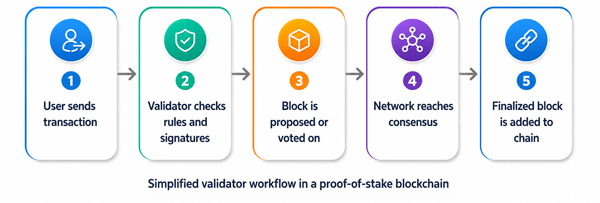
Diagram: A simplified validator workflow in a proof-of-stake blockchain.
6. What Validators Actually Check
Validators do not simply approve every transaction they see. They run software that checks whether transactions and blocks follow the rules of the network. Typical checks include:
- Does the transaction have a valid digital signature?
- Does the sender have enough balance to pay the amount and fees?
- Is the transaction formatted correctly?
- Does the block follow the chain’s size, timing, and ordering rules?
- Does the block conflict with another block or attempt to spend the same funds twice?
- Is the validator or block producer authorized for that slot, round, or height?
This rule-checking is what makes validators different from a simple payment processor. Validators must enforce the protocol even when a transaction would be profitable to include but invalid under the network’s rules.
7. Staking and Delegation Explained
7.1 What is staking?
Staking means locking or bonding cryptocurrency to participate in network security. In many proof-of-stake networks, validators must have stake behind them before they can validate. Stake acts as collateral. It gives validators something to lose if they try to harm the network.
7.2 What is delegation?
Delegation lets token holders support a validator without running validator hardware themselves. A delegator keeps ownership of their tokens but assigns their staking power to a validator. The validator does the technical work, and rewards are usually shared after the validator takes a commission.
| Option | Who operates the validator? | Best for | Pros | Cons |
|---|---|---|---|---|
| Solo validating | You or your organization | Technical users with enough capital and operational skill | Maximum control, no third-party operator fee, direct participation | Requires setup, monitoring, key security, uptime, and protocol knowledge |
| Delegating | A third-party validator | Beginners and token holders who do not want to run infrastructure | Simpler, lower technical burden, can choose from many validators | Validator performance and commission matter; slashing risk may affect delegators on some chains |
| Liquid staking or pooled staking | A protocol or service provider | Users who want easier access or liquidity | Convenient, may lower capital barrier, sometimes provides a liquid receipt token | Smart contract risk, provider risk, liquidity risk, centralization concerns |
8. Examples of Validators in Real Blockchains
8.1 Ethereum validators
Ethereum uses proof of stake. A validator must deposit 32 ETH and run the required software. Validators propose blocks when selected and make attestations about blocks they believe are valid. Ethereum also uses rewards and penalties, including slashing for serious rule violations and inactivity leak penalties if the chain cannot finalize because too many validators are offline or not participating correctly.
8.2 Solana validators
Solana validators help replay the ledger, vote on forks, and participate in consensus. Solana uses a leader schedule that assigns validators to produce blocks during specific slots. Stake-weighted votes help the cluster choose the valid chain when forks appear.
8.3 Cosmos-style validators
In Cosmos SDK and CometBFT-based chains, validators typically sign blocks and can receive delegated stake from token holders. Delegators share rewards but can also share some validator-related risks, such as slashing in networks where slashing applies to delegated stake.
| Network example | Validator role | Beginner takeaway |
|---|---|---|
| Ethereum | Proposes blocks and attests to valid blocks; requires 32 ETH for a native validator | Strong example of proof-of-stake with clear reward and penalty rules |
| Solana | Votes on forks and may be scheduled as a leader to produce blocks | Performance, hardware, and network connectivity are especially important |
| Cosmos-based chains | Signs blocks and often receives delegated stake from token holders | Validator choice matters because delegators can be affected by validator behavior |
9. Benefits of Validators
9.1 For the network
- Security: Validators make it costly to attack the chain because dishonest behavior can result in financial loss.
- Decentralization: A broad validator set can reduce reliance on one central operator.
- Availability: Many independent validators can keep the network running even when some nodes fail.
- Governance participation: In many networks, validators and delegators help vote on protocol proposals.
9.2 For token holders
- Potential staking rewards for helping secure the network.
- A way to participate without mining hardware.
- Delegation options for users who do not want to operate infrastructure.
- A clearer connection between long-term token holding and network security.
10. Risks and Limitations of Validators
Validators can be useful, but they are not risk-free. Beginners should understand both technical and financial risks before staking or delegating.
| Risk | What it means | Practical example | How to reduce it |
|---|---|---|---|
| Slashing | A penalty that removes part of stake for serious violations on some networks | A validator signs conflicting blocks or breaks consensus rules | Use reliable software, avoid duplicate validator keys, choose reputable operators |
| Downtime | Validator misses duties because it is offline or poorly connected | Server outage causes missed votes and lower rewards | Use monitoring, backups, and realistic uptime practices |
| Missed rewards | Poor performance reduces earnings even without severe penalties | Validator regularly misses attestations or votes | Track performance history before delegating |
| Token price volatility | Rewards are paid in a token whose market price can fall | A 5% token reward does not help if token price falls 40% | Do not treat staking yield as guaranteed profit |
| Lock-up and exit delays | Staked funds may not be instantly withdrawable | Unstaking takes time during a market drop | Know unbonding and withdrawal rules before staking |
| Centralization | Too much stake gathers around a few validators or providers | A large exchange controls a major share of stake | Delegate to reliable but not overly dominant validators |
| Smart contract/provider risk | Liquid staking or pooled services can introduce extra trust assumptions | A staking pool contract has a bug | Understand custody, contract audits, and provider terms |
11. What Is Slashing?
Slashing is a punishment used by some proof-of-stake networks to discourage behavior that could harm consensus. It usually applies to serious faults, such as signing two conflicting messages, attempting to validate contradictory chains, or otherwise violating consensus rules. The penalty can include losing part of the staked tokens and being removed or jailed from active validation, depending on the blockchain.
Not every mistake causes slashing. Many networks distinguish between minor missed duties, which may simply reduce rewards, and severe violations, which may be slashable. The exact rules are chain-specific, so users should read the documentation for the network they are using.
12. How Validators Earn Rewards
Validators can earn rewards for performing duties correctly. Reward sources vary by chain, but may include newly issued tokens, transaction fees, priority fees, or other protocol incentives. Delegators may receive a share of those rewards after the validator takes commission.
| Reward factor | Why it matters |
|---|---|
| Validator uptime | Frequent downtime usually lowers rewards. |
| Commission rate | A validator with very high commission may leave less for delegators. |
| Total stake | More stake can increase selection probability or voting weight, depending on the chain. |
| Network inflation and fees | Rewards depend on protocol design and network usage. |
| Slashing and penalties | Poor behavior can reduce or eliminate returns. |
| Token price | The fiat value of rewards changes with market price. |
A common beginner mistake is looking only at annual percentage yield. A high advertised staking yield can still be a bad deal if the validator is unreliable, the token price is falling, the commission is high, or the staking method adds custody or smart contract risk.
13. How to Choose a Validator for Delegation
Choosing a validator is not just about picking the highest reward number. A sensible validator choice balances reliability, security, decentralization, transparency, and cost.
- Check uptime and performance history. Look for consistent participation, not just short-term high rewards.
- Review commission. Very low commission can be attractive, but it may be unsustainable if the operator cannot cover infrastructure costs.
- Avoid excessive concentration. Delegating to the largest validator may be convenient, but it can increase centralization.
- Look for transparency. Good validators usually publish operator information, infrastructure approach, support channels, governance votes, or community updates.
- Understand slashing rules. On some chains, delegators can lose a portion of stake if their validator is slashed.
- Start small if you are new. Test the process before staking a large amount.
- Keep records. Note validator name, commission, unbonding period, wallet used, and transaction IDs.
14. Running Your Own Validator: Practical Considerations
Running a validator can be rewarding, but it is an operational responsibility. It is closer to running reliable infrastructure than simply holding a token. Before becoming a validator operator, consider the following:
- Capital requirements: Some networks require a minimum self-stake or fixed deposit.
- Hardware and bandwidth: Requirements differ greatly between chains.
- Key management: Validator signing keys must be protected from theft and accidental duplication.
- Monitoring: You need alerts for downtime, missed duties, disk space, client issues, and network upgrades.
- Software updates: Validators often need timely upgrades to stay compatible with the network.
- Security: Firewalls, access control, backups, and operational discipline matter.
- Legal and tax considerations: Staking rewards and validator income may have reporting obligations depending on location.
15. Common Validator Mistakes Beginners Make
- Assuming staking rewards are guaranteed income.
- Choosing a validator only because it offers the highest displayed yield.
- Ignoring unstaking periods and liquidity limitations.
- Not understanding whether delegated stake can be slashed.
- Using a custodial platform without understanding custody risk.
- Running duplicate validator keys, which can cause severe penalties on some networks.
- Forgetting that token price changes can outweigh staking rewards.
- Failing to update validator software before a network upgrade.
16. Validator Best Practices
16.1 For delegators
- Use official wallets, documentation, and block explorers when possible.
- Check validator performance over time, not just today’s yield.
- Diversify across more than one validator when the network and wallet support it.
- Understand commission, unbonding period, reward claim rules, and slashing exposure.
- Avoid sending tokens to someone who asks for them in a private message. Delegation should happen through the wallet or protocol interface.
- Keep your seed phrase offline and never share it with a validator operator.
16.2 For validator operators
- Use secure key management and avoid running the same signing key in two active places.
- Set up monitoring and alerts before going live.
- Test updates and understand chain-specific upgrade procedures.
- Maintain documentation for backups, disaster recovery, and incident response.
- Communicate clearly with delegators about commission changes and outages.
- Stay active in governance and network upgrade discussions.
17. Are Validators Safe?
Validators make blockchains safer when the validator set is reliable, decentralized, and economically aligned with the network. But staking through validators does not remove all risk. The main safety question is not “Are validators safe?” but “Which validator, on which network, using which staking method, with what rules and what custody model?”
For many beginners, delegating through an official wallet to a reputable validator is simpler than running a validator. However, users should still understand lock-ups, fees, slashing rules, and market volatility before staking.
18. Validators and Decentralization
A blockchain can have many validators but still become centralized if most stake is controlled by a few entities. Centralization can happen when users delegate to the biggest validators, when exchanges hold large amounts of staked assets, or when infrastructure depends heavily on a small number of cloud providers.
Healthy decentralization usually means a broad distribution of stake, independent operators, geographic diversity, client diversity where applicable, and active community oversight. Delegators can support decentralization by choosing reliable validators that are not already too dominant.
19. Validator Checklist for Beginners
| Question | Why it matters |
|---|---|
| What blockchain am I staking on? | Rules, rewards, lock-ups, and penalties differ by network. |
| Am I validating, delegating, or using a staking pool? | Each method has different technical and custody risks. |
| Can my stake be slashed? | Some networks expose delegators to validator penalties. |
| How long is the unbonding or withdrawal period? | You may not be able to exit instantly. |
| What is the validator commission? | Commission reduces delegator rewards. |
| How reliable is the validator? | Poor uptime can reduce rewards. |
| Who controls the keys? | Custody risk is one of the biggest practical differences between methods. |
| What happens during upgrades or outages? | Operators need strong maintenance and communication practices. |
20. FAQs About Validators
20.1 What is a validator in simple words?
A validator is a blockchain participant that helps check transactions and agree on new blocks. In proof-of-stake networks, validators usually have cryptocurrency staked behind them and can earn rewards for honest participation.
20.2 Do validators create new coins?
Sometimes validators receive newly issued tokens as rewards, depending on the network. They do not usually create coins freely; rewards are controlled by protocol rules.
20.3 Can anyone become a validator?
It depends on the blockchain. Some networks require a fixed deposit, minimum self-stake, specialized hardware, technical knowledge, or a place in an active validator set.
20.4 What is the difference between staking and validating?
Staking means locking or bonding tokens. Validating means operating the software that participates in consensus. You can stake without running a validator by delegating to a validator, if the network supports delegation.
20.5 Can I lose money by staking with a validator?
Yes. You can lose money through token price declines, fees, lock-up periods, missed rewards, provider problems, smart contract risk, and slashing on networks where slashing applies.
20.6 Is the validator with the highest APY always best?
No. High APY can come with higher risk, temporary conditions, poor sustainability, or hidden trade-offs. Reliability, commission, decentralization, and security matter too.
20.7 What is validator commission?
Commission is the percentage of staking rewards a validator keeps for operating the infrastructure. The remaining rewards are distributed to delegators according to network rules.
20.8 Do validators control my tokens when I delegate?
In many non-custodial delegation systems, you keep ownership of your tokens while assigning staking power to a validator. However, custodial exchanges and some pooled products may control the keys, so always check the method used.
20.9 What happens if a validator goes offline?
Usually the validator misses rewards and may face downtime penalties. In severe or prolonged network conditions, some chains may apply additional penalties. Exact rules vary by network.
20.10 Are validators better than miners?
They are different. Validators secure proof-of-stake networks using stake and consensus voting, while miners secure proof-of-work networks using computing power. Each model has trade-offs in energy use, hardware needs, decentralization, and security assumptions.
21. Final Thoughts
Validators are a core part of many modern blockchains. They help verify transactions, propose or vote on blocks, and keep the ledger trustworthy without a central authority. For users, validators create opportunities to participate in staking and earn rewards, but they also introduce important risks such as slashing, downtime, lock-ups, provider risk, and token volatility.
The practical lesson is simple: understand the network rules before staking, choose validators carefully, avoid chasing yield blindly, and treat staking as a risk-bearing activity rather than guaranteed passive income. A good validator setup can support blockchain security. A poor validator choice can reduce rewards, increase risk, and weaken decentralization.
Sources Consulted and Checked
The following sources were consulted and checked while preparing this article for context and accuracy.
- Ethereum.org, “Proof-of-stake (PoS)” and “Proof-of-stake rewards and penalties.”
- Solana.com, “Validators: Help Secure the Network and Earn SOL.”
- Anza documentation, “Solana Leader Rotation.”
- Cosmos SDK documentation, “x/slashing.”
- Cosmos Hub documentation, staking and delegation introduction.
Reader Advice
This article is provided for educational and informational purposes only and is not personalized legal, tax, financial, investment, or technical advice or a recommendation to stake, delegate, or operate a validator. Blockchain rules, reward rates, penalties, platform policies, laws, tax treatment, and statistics can change over time and vary by network and region, so verify current details through official network documentation and relevant local authorities before acting. Staking and validator activity involve risks, including token-price losses, slashing, downtime, lock-ups, custody or smart-contract failures, and possible loss of funds; consider your circumstances and seek qualified professional advice where appropriate.