Proof of Work vs Proof of Stake: Key Differences, Pros, Cons, Risks and Best Use Cases
Proof of Work and Proof of Stake are two of the most important ideas in cryptocurrency. They are consensus mechanisms, which means they help a blockchain agree on which transactions are valid without needing a bank, company or central authority to approve every payment.
The simplest way to understand the difference is this: Proof of Work makes attackers spend real-world computing power and electricity, while Proof of Stake makes validators lock up cryptocurrency that can be penalized if they behave dishonestly. Both systems try to solve the same problem: how can thousands of strangers maintain one shared ledger and trust its history?
This guide explains Proof of Work vs Proof of Stake in plain English. You will learn how each system works, why Bitcoin still uses Proof of Work, why Ethereum moved to Proof of Stake, what the trade-offs are, and which model makes more sense for different blockchain use cases.
1. Proof of Work vs Proof of Stake: Quick Answer
Proof of Work (PoW) is a blockchain security system where miners compete with computing power to add new blocks. Proof of Stake (PoS) is a blockchain security system where validators lock up coins and are chosen to propose or verify blocks. PoW is known for battle-tested security and high energy use. PoS is known for energy efficiency, easier participation and faster finality, but it has its own risks such as validator centralization, staking-service concentration and slashing penalties.
| Feature | Proof of Work | Proof of Stake |
|---|---|---|
| Main resource used | Computing power, specialized hardware and electricity | Staked cryptocurrency locked as collateral |
| Network participants | Miners and full nodes | Validators and full nodes |
| Block creation | Miners solve hash puzzles; the winner proposes a block | Validators are selected by protocol rules to propose and attest blocks |
| Security cost | External cost: energy and hardware | Internal cost: locked stake that can be penalized |
| Energy use | Usually high, especially at large scale | Usually much lower than PoW |
| Common examples | Bitcoin, Litecoin, Dogecoin | Ethereum, Cardano, Solana, Polkadot, Tezos |
| Best known strength | Long track record and simple attack-cost model | Energy efficiency, faster finality and no mining hardware race |
| Main concern | Energy use, mining centralization and hardware cost | Stake concentration, governance capture and slashing/custody risk |
2. What a Consensus Mechanism Does
A blockchain is a database shared across many computers. Anyone can copy it, verify it and, in many public networks, try to participate in securing it. The challenge is that open networks also attract attackers. Someone may try to spend the same coin twice, rewrite history, censor transactions or create thousands of fake identities.
A consensus mechanism creates rules for agreeing on the next valid block. It answers three practical questions:
- Who gets to propose the next block?
- How does the network check that the block follows the rules?
- What makes cheating expensive enough that rational participants avoid it?
Proof of Work and Proof of Stake answer these questions differently, but both are designed to protect a decentralized ledger from dishonest behavior.
3. What Is Proof of Work?
Proof of Work is a consensus mechanism where miners use machines to perform repeated calculations until one miner finds a valid result. In Bitcoin, this process is based on hashing. A miner collects transactions into a candidate block, changes a small value called a nonce, hashes the block data and checks whether the result meets the network difficulty target.
The work is hard to perform but easy for other nodes to verify. That asymmetry is the core idea. A miner may need to try a huge number of guesses, but once a valid block is found, other computers can quickly confirm that the block follows the rules.
Ethereum’s developer documentation describes Proof of Work as the algorithm that sets the difficulty and rules for the mining work performed by miners, with mining being the act of adding valid blocks to the chain [1]. Bitcoin popularized this model for open, permissionless digital money.
3.1 How Proof of Work Works Step by Step
- Users broadcast transactions to the network.
- Miners collect valid transactions into a candidate block.
- Miners repeatedly hash the block data while changing the nonce and other values.
- The first miner to find a hash below the difficulty target broadcasts the block.
- Full nodes independently verify the block, the transactions and the proof of work.
- If the block is valid, it becomes part of the chain and the miner receives block rewards and transaction fees.
Bitcoin adjusts mining difficulty about every 2,016 blocks to keep block production near its target pace. This difficulty adjustment is one reason Bitcoin can continue operating even as total mining power rises or falls.
3.2 Proof of Work Example: Bitcoin
Bitcoin is the best-known Proof of Work blockchain. Miners compete to produce blocks, but full nodes still enforce the rules. This distinction matters: miners propose blocks, but nodes reject blocks that break consensus rules, such as creating too many coins or spending coins without a valid signature.
In practice, Bitcoin mining is no longer something most beginners can do profitably at home. Competitive mining usually requires ASIC machines, cheap electricity, cooling, technical management and often participation in mining pools. This does not mean Bitcoin itself is centralized, but it does mean the mining industry has high barriers to entry.
4. What Is Proof of Stake?
Proof of Stake is a consensus mechanism where validators lock up cryptocurrency as collateral and help propose or verify blocks. Instead of proving they spent electricity, validators prove they have something valuable at risk. If they follow the rules, they can earn rewards. If they break important rules, part of their stake can be destroyed or they can be removed from the validator set.
Ethereum’s Proof of Stake documentation explains that validators stake ETH into a smart contract and are responsible for checking new blocks and sometimes creating and broadcasting new blocks themselves [2]. Ethereum completed its transition from Proof of Work to Proof of Stake on September 15, 2022, an upgrade known as The Merge [3].
4.1 How Proof of Stake Works Step by Step
- A participant locks coins in the protocol or delegates coins to a validator, depending on the network design.
- The protocol selects validators to propose or attest to blocks.
- Validators check that proposed blocks follow the network rules.
- Honest validators earn rewards from issuance, fees or both.
- Validators that go offline may lose small rewards or face penalties.
- Validators that sign conflicting blocks or attack consensus can be slashed, meaning part of their stake is burned or confiscated.
4.2 Proof of Stake Example: Ethereum
Ethereum is the most important real-world Proof of Stake example because it moved from Proof of Work to Proof of Stake while already running a large public blockchain. Ethereum says The Merge reduced the network’s energy consumption by about 99.95% [3]. This did not automatically make Ethereum fees disappear, but it changed the way the chain is secured and prepared the network for later scalability upgrades.
On Ethereum, solo validators need 32 ETH to activate a validator. Many users do not have that much ETH or do not want to run infrastructure, so they use staking pools, liquid staking tokens or centralized exchanges. These options improve access but add custody, smart contract, concentration and regulatory risks.
5. Simple Diagram: How PoW and PoS Make Attacks Expensive
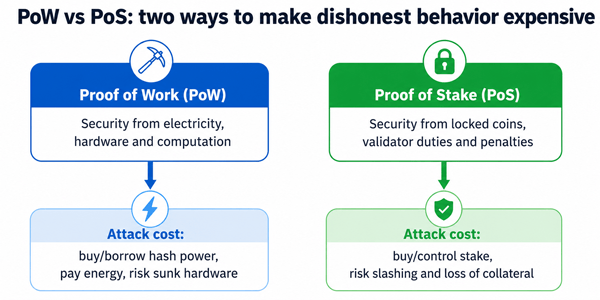
The key difference is not that one system has risk and the other does not. The difference is where the security cost comes from. PoW relies on external physical costs, while PoS relies on internal economic collateral.
6. Key Differences Between Proof of Work and Proof of Stake
| Category | Proof of Work | Proof of Stake | Why it matters |
|---|---|---|---|
| Security resource | Hash power backed by machines and electricity | Locked coins backed by penalties and rewards | This determines what an attacker must acquire or risk. |
| Energy profile | High energy demand at scale | Much lower energy demand | This affects environmental impact, public perception and regulatory pressure. |
| Hardware requirements | Often specialized mining hardware | Usually standard servers or cloud/bare-metal infrastructure | PoS may be easier to join technically, though capital and skill still matter. |
| Finality | Can be probabilistic; users wait for confirmations | Often supports stronger economic finality | Finality affects exchanges, bridges, merchants and large transfers. |
| Centralization pressure | Cheap power, ASIC supply chains and mining pools | Large token holders, staking pools and exchanges | Both systems can centralize, but the pressure points are different. |
| Penalty model | Miners lose operating costs if they mine invalid blocks that nodes reject | Validators can lose stake for slashable behavior | PoS has explicit penalties; PoW has opportunity and energy costs. |
| Environmental criticism | Common and significant for large PoW networks | Usually much lower | This matters for institutions, policymakers and ESG-sensitive users. |
| Maturity | Bitcoin PoW has the longest production history | Modern PoS is younger but widely used | Track record matters when choosing a settlement layer. |
7. Proof of Work: Pros and Cons
7.1 Benefits of Proof of Work
- Long track record: Bitcoin has operated with PoW since 2009, making it the most battle-tested consensus model in crypto.
- Simple security story: attacking the chain requires large amounts of hash power, electricity, logistics and operational capability.
- External cost: PoW security is tied to real-world resources outside the blockchain’s own token economy.
- Open verification: anyone can run a full node and verify whether miners followed the rules.
- Strong fit for digital money: PoW is especially valued by people who want a conservative, hard-to-change monetary network.
7.2 Drawbacks and Risks of Proof of Work
- High energy consumption: large PoW networks can consume significant electricity, which creates environmental and political controversy.
- Hardware arms race: profitable mining often requires specialized ASIC hardware and industrial-scale operations.
- Mining pool concentration: miners often join pools for steadier income, which can concentrate block-production influence.
- Geographic dependence: miners move toward cheap electricity and favorable regulation, which can create regional concentration.
- E-waste and cooling needs: mining equipment becomes obsolete and large farms require cooling and maintenance.
- Profitability risk: miners can become unprofitable when coin prices fall, electricity prices rise or difficulty increases.
8. Proof of Stake: Pros and Cons
8.1 Benefits of Proof of Stake
- Energy efficiency: PoS does not require miners to run massive hash calculations. Ethereum reports that The Merge reduced energy consumption by about 99.95% [3].
- Lower hardware barrier: validators usually do not need ASIC miners, though they still need reliable infrastructure.
- Economic finality: many PoS chains can finalize blocks in a way that makes reversal extremely costly under protocol rules.
- Flexible participation: users may run validators, delegate stake or use staking services, depending on the network.
- No mining hardware race: security comes from stake and penalties rather than constant competition for faster machines.
8.2 Drawbacks and Risks of Proof of Stake
- Stake concentration: wealthy holders, exchanges or staking pools can gain significant influence if stake becomes concentrated.
- Slashing risk: validators can lose funds for serious mistakes or malicious behavior. Ethereum documentation notes slashable behavior can result in ETH being burned and validator removal [4].
- Custody risk: users who stake through an exchange or custodian depend on that service to manage keys, withdrawals and operations safely.
- Smart contract risk: liquid staking and pooled staking protocols may contain bugs, oracle failures or governance vulnerabilities.
- Governance concerns: if voting power and validator power overlap heavily, large token holders may influence both consensus and protocol decisions.
- Regulatory uncertainty: staking services may face different legal treatment across countries, especially when rewards are marketed like yield products.
9. Which Is More Secure: Proof of Work or Proof of Stake?
There is no universal answer. Security depends on the chain design, value secured, decentralization, client diversity, validator or miner distribution, governance, software quality and user behavior.
Proof of Work has a very long track record in Bitcoin. Its security model is easier for many beginners to understand because attackers need to control physical mining capacity and pay ongoing energy costs. However, PoW can still face mining-pool concentration, state-level pressure, selfish mining concerns, equipment supply-chain risks and censorship risks.
Proof of Stake can be highly secure when stake is well distributed, clients are diverse and slashing rules are well designed. Its advantage is that attacks can be punished directly by destroying stake. Its weakness is that the security resource is the native asset itself, so token distribution, liquid staking concentration and governance design become especially important.
10. Best Use Cases for Proof of Work
Proof of Work is usually best suited to systems that prioritize conservative security, monetary neutrality and long-term settlement over energy efficiency or fast upgrades.
- Hard-money digital assets: Bitcoin is the main example. Its community values predictability, censorship resistance and resistance to frequent protocol changes.
- High-value base settlement: PoW may appeal when users want a settlement layer with a long operational history.
- Networks that want security tied to external costs: PoW connects chain security to energy, machines and real-world logistics.
- Simple monetary protocols: PoW often fits simpler chains better than complex application platforms that need frequent upgrades.
11. Best Use Cases for Proof of Stake
Proof of Stake is usually best suited to smart-contract platforms, app ecosystems and networks that need lower energy use, faster finality and more flexible validator participation.
- Smart contract platforms: Ethereum, Solana, Cardano and similar platforms use PoS or PoS-like designs to support application ecosystems.
- Energy-sensitive networks: PoS is better suited when environmental impact is a major concern.
- Fast-finality applications: exchanges, bridges, payments and DeFi apps can benefit from quicker economic finality.
- Communities that want on-chain participation: many PoS systems allow delegation, validator voting or other forms of token-holder participation.
- Networks that want to avoid mining hardware dependence: PoS removes the need for specialized mining equipment.
12. Real-World Examples and Scenarios
12.1 Scenario 1: A Beginner Wants to Earn Crypto Rewards
PoW mining may sound attractive, but home mining is often unprofitable after electricity, hardware, noise, heat and maintenance. A beginner may find staking easier, but staking is not risk-free. The safer approach is to understand lockup periods, withdrawal rules, validator reliability, slashing coverage, fees and custody risk before committing funds.
12.2 Scenario 2: A Business Wants to Accept Crypto Payments
For high-value Bitcoin payments, the business may wait for multiple confirmations because PoW finality is probabilistic. For PoS networks with finality, the business may use finalization rules instead of simply counting blocks. In both cases, the practical choice depends on the chain, transaction size and risk tolerance.
12.3 Scenario 3: A Developer Wants to Build a DeFi App
The developer usually cares about ecosystem tools, liquidity, smart contract support, security history, transaction costs, finality and user base. Consensus matters, but it is only one factor. A PoS smart-contract platform may be a better fit for many DeFi apps, while a PoW chain may be more attractive for monetary settlement or Bitcoin-focused applications.
13. Common Misconceptions About PoW and PoS
| Misconception | Reality |
|---|---|
| Proof of Stake is automatically centralized. | Not automatically. It can centralize through large holders, exchanges or staking pools, but design choices and user behavior matter. |
| Proof of Work is automatically decentralized. | Not automatically. Mining can concentrate around cheap energy, ASIC manufacturers and pools. |
| Proof of Stake has no costs. | PoS uses far less energy, but validators still face infrastructure, capital, opportunity, slashing and liquidity costs. |
| Proof of Work wastes all energy. | Supporters argue the energy buys censorship resistance and settlement security. Critics argue the same security goals can be met with less energy. |
| Ethereum’s Merge reduced gas fees. | The Merge changed Ethereum’s consensus mechanism and energy use. It did not directly eliminate high gas fees. |
| Staking is the same as a bank savings account. | Staking rewards come with protocol, market, liquidity, custody, smart contract and regulatory risks. |
14. How to Choose Between PoW and PoS as a User or Investor
Beginners should not choose a crypto asset only because it uses Proof of Work or Proof of Stake. Consensus is important, but it does not guarantee investment quality, decentralization, safety or long-term adoption. Use the checklist below before making decisions.
14.1 Practical Checklist
- What problem does the network solve, and does it need a blockchain at all?
- How long has the network operated without major consensus failures?
- How decentralized are miners, validators, full nodes and developers?
- Who controls upgrades, governance decisions and emergency responses?
- For PoW: how concentrated are mining pools, ASIC supply and energy sources?
- For PoS: how concentrated is stake among validators, exchanges and liquid staking protocols?
- What are the real costs of participation, including hardware, custody, fees, lockups and taxes?
- What risks could cause loss of funds: slashing, bridge hacks, smart contract bugs, exchange failure or market volatility?
- Does the network have strong documentation, transparent metrics and an active security culture?
15. Best Practices for Beginners
15.1 If You Are Considering Mining
- Calculate profitability using your actual electricity cost, hardware price, pool fees, downtime and expected difficulty changes.
- Plan for heat, noise, ventilation, repairs and hardware depreciation.
- Understand local rules. Some regions restrict or tax mining activity.
- Do not assume past mining profits will continue. Mining margins can disappear quickly.
- Join reputable mining pools only after checking payout method, fees, history and transparency.
15.2 If You Are Considering Staking
- Understand whether you are solo staking, delegated staking, pooled staking or staking through a centralized exchange.
- Check lockup periods, withdrawal delays, validator fees and reward variability.
- Avoid giving private keys or seed phrases to any staking website or support agent.
- Review slashing terms and whether the provider has protection or insurance.
- Be cautious with liquid staking tokens because they add smart contract and market depeg risk.
- Remember that staking rewards can be outweighed by token price declines.
16. PoW vs PoS Summary: Which One Is Better?
Proof of Work is not simply old and bad, and Proof of Stake is not simply new and perfect. They are different security models with different trade-offs.
Choose Proof of Work when the priority is a conservative, battle-tested monetary network with security tied to external real-world costs. Choose Proof of Stake when the priority is energy efficiency, flexible validator participation, faster finality and smart-contract ecosystem growth. The best choice depends on the network’s purpose, design and decentralization in practice.
17. FAQs About Proof of Work vs Proof of Stake
17.1 What is the main difference between Proof of Work and Proof of Stake?
Proof of Work uses mining power and electricity to secure the chain. Proof of Stake uses locked cryptocurrency and validator penalties to secure the chain.
17.2 Is Proof of Stake better than Proof of Work?
It depends on the goal. PoS is usually more energy efficient and can offer faster finality. PoW has the longest track record through Bitcoin and ties security to external physical costs.
17.3 Why does Bitcoin use Proof of Work?
Bitcoin uses PoW because it was designed as decentralized digital money secured by computational work, full-node verification and predictable issuance. Its community generally prefers stability over major consensus changes.
17.4 Why did Ethereum switch to Proof of Stake?
Ethereum moved to PoS through The Merge to reduce energy use and support its long-term roadmap. Ethereum says the change reduced energy consumption by about 99.95% [3].
17.5 Can Proof of Stake validators lose money?
Yes. Validators can lose rewards for downtime and can be slashed for serious rule violations. Users can also lose money through token price declines, custody failures or smart contract bugs.
17.6 Can Proof of Work miners lose money?
Yes. Miners can lose money if electricity, hardware and maintenance costs exceed mining rewards. Falling coin prices and rising difficulty can quickly reduce profitability.
17.7 Is staking passive income?
Staking can generate rewards, but calling it passive income can be misleading. It involves market risk, operational risk, lockup risk, custody risk and sometimes slashing risk.
17.8 Does Proof of Stake make a blockchain centralized?
Not by itself. However, stake concentration, exchange staking and liquid staking dominance can create centralization pressure.
17.9 Does Proof of Work always waste energy?
Critics argue PoW uses too much electricity. Supporters argue the energy is the cost of censorship resistance and secure settlement. The debate depends on energy sources, social value and available alternatives.
17.10 Which consensus model is safer for beginners?
For beginners, the safer approach is not to rely on consensus type alone. Study the specific network, custody model, wallet security, fees, liquidity, lockups and regulatory risks.
18. Final Thoughts
Proof of Work and Proof of Stake are two different answers to the same problem: how to keep a public blockchain honest without a central authority. PoW says, “prove you spent computing work.” PoS says, “prove you have value at risk.”
For beginners, the most important lesson is that neither model removes risk. PoW can be energy-intensive and mining can centralize. PoS can be efficient and flexible, but stake can concentrate and validators can be penalized. A trustworthy blockchain depends not only on its consensus mechanism, but also on its node culture, software quality, economic incentives, governance, security history and user behavior.
Use consensus as one part of your research, not the whole decision. The best blockchain design is the one that fits the job it is trying to do and remains secure, transparent and usable in real-world conditions.
Sources Consulted and Checked
The following sources were consulted and checked while preparing this article and reviewing its accuracy:
- [1] Ethereum.org — Proof-of-Work (PoW)
- [2] Ethereum.org — Proof-of-Stake (PoS)
- [3] Ethereum.org — The Merge
- [4] Ethereum.org — Proof-of-Stake Rewards and Penalties
- [5] Bitcoin White Paper — Bitcoin: A Peer-to-Peer Electronic Cash System
- [6] Investopedia — How Does Bitcoin Mining Work? A Beginner’s Guide
Reader Advice
This article is provided for educational and informational purposes only. It is not personalized legal, financial, investment, tax, technical or regulatory advice, and it should not be treated as a recommendation to mine, stake, buy, sell or hold any cryptocurrency. Blockchain participation can involve market volatility, loss of funds, slashing, custody, smart-contract, hardware, operational, cybersecurity and regulatory risks. Rules, policies, laws, tax treatment, network parameters and statistics can change over time and may vary by country or region, so readers should verify important information through current official sources and consider qualified professional advice before making decisions.