Crypto Mining Explained: Meaning, How It Works, Examples, Benefits and Risks
Crypto mining is one of the most talked-about parts of the cryptocurrency world, but it is also one of the most misunderstood. Many beginners hear that miners “create coins” or “solve puzzles” and imagine something mysterious happening inside a computer. In reality, crypto mining is a practical process used by some blockchains to confirm transactions, protect the network, and issue new coins according to rules written into the protocol.
The most famous example is Bitcoin mining. Bitcoin uses a system called proof of work, where miners run specialized machines that compete to find a valid cryptographic result. The winning miner adds the next block of transactions to the blockchain and receives a reward. This reward is not free money. It comes with hardware costs, electricity costs, maintenance, regulatory risks, and heavy competition.
This guide explains crypto mining from the ground up. You will learn what mining means, how it works, why it matters, how miners make money, what can go wrong, and how beginners should think about mining before spending money on equipment or cloud-mining offers.
1. What Is Crypto Mining?
Crypto mining is the process of using computing power to help maintain a proof-of-work blockchain. Miners collect pending transactions, organize them into a block, and compete to produce a valid hash for that block. A hash is a fixed-length digital fingerprint created by a cryptographic function. In Bitcoin, miners repeatedly change a small part of the block data and run it through SHA-256 until the result is below a target set by the network.
A simple definition: Crypto mining is a competitive process where miners use computing power to validate transactions and add new blocks to a proof-of-work blockchain in exchange for rewards.
Mining has three main jobs:
- Confirming transactions so they can become part of the permanent blockchain record.
- Securing the network by making it expensive to rewrite transaction history.
- Distributing new coins, such as Bitcoin’s block subsidy, according to the protocol schedule.
Not every cryptocurrency uses mining. Bitcoin, Litecoin, Dogecoin, Monero, and some other networks use proof-of-work mining. Ethereum used mining in the past, but it moved to proof of stake in 2022, so ETH is no longer mined.
2. Crypto Mining in One Simple Example
Imagine a public notebook that thousands of people use to record payments. Everyone needs to agree on which page comes next. Miners compete to earn the right to add the next page. To win, they must find a special number that makes the page’s digital fingerprint meet the network’s rules. Other participants can check the result quickly. If the result is valid, the page is accepted and added to the notebook.
The work is hard to produce but easy to verify. This is the core idea behind proof-of-work mining.
3. How Crypto Mining Works Step by Step
The exact details vary by blockchain, but Bitcoin mining gives the clearest example because it is the largest proof-of-work network.
Step 1: Users Send Transactions
When someone sends Bitcoin, the transaction is broadcast to the network. It waits with other unconfirmed transactions in a waiting area often called the mempool. Miners usually choose transactions that pay higher fees, because fees are part of the miner’s reward.
Step 2: Miners Build a Candidate Block
A miner or mining pool selects transactions and creates a candidate block. The block includes transaction data, a reference to the previous block, a timestamp, and other technical fields. This link to the previous block is why changing old data becomes difficult: changing one block would also change the blocks after it.
Step 3: Mining Machines Search for a Valid Hash
The miner’s machines repeatedly hash the block header while changing a value called the nonce and other adjustable data. The goal is to find a hash below the target. This does not require human problem solving. It is a high-speed trial-and-error process.
Step 4: The Winning Block Is Broadcast
When a miner finds a valid hash, the miner broadcasts the block. Other nodes check that the proof of work is valid, the transactions follow the rules, and the block does not spend coins that were already spent.
Step 5: The Miner Earns a Reward
If the network accepts the block, the miner receives the block subsidy plus transaction fees. Since Bitcoin’s April 2024 halving, the block subsidy is 3.125 BTC per block. This subsidy halves roughly every 210,000 blocks until new issuance eventually approaches zero. Transaction fees are expected to become more important over time.
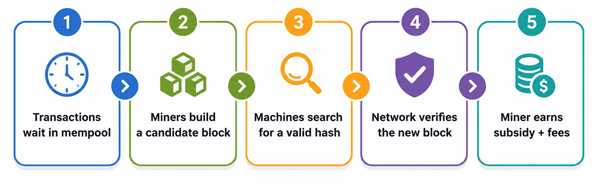
Figure: Basic proof-of-work mining flow from pending transactions to miner reward.
4. Key Mining Terms Beginners Should Know
| Term | Beginner-friendly meaning |
|---|---|
| Hash | A digital fingerprint created from data. A tiny change in the data creates a completely different hash. |
| Hash rate | The number of hash attempts a miner or network can perform per second. Higher hash rate means more attempts. |
| Proof of work | A consensus method where miners prove they spent computing power to create a valid block. |
| Block reward | The miner’s total reward: new coins from the subsidy plus transaction fees. |
| Mining difficulty | A measure of how hard it is to find a valid block. Bitcoin adjusts it every 2,016 blocks. |
| Mining pool | A group of miners combining hash power and sharing rewards based on contributed work. |
| ASIC miner | A specialized machine built for one mining algorithm, such as Bitcoin’s SHA-256. |
| Nonce | A value miners change while searching for a valid block hash. |
5. Proof of Work vs Proof of Stake
Mining belongs to proof-of-work blockchains. Proof of stake is different. In proof of stake, validators lock coins as collateral and are chosen to propose or verify blocks according to the network’s rules. They do not compete by running energy-intensive mining hardware.
| Feature | Proof of Work Mining | Proof of Stake Validation |
|---|---|---|
| Main resource | Computing power and electricity | Staked coins and validator software |
| Example networks | Bitcoin, Litecoin, Dogecoin, Monero | Ethereum, Solana, Cardano, Polkadot |
| How blocks are produced | Miners compete to find a valid hash | Validators are selected by protocol rules |
| Energy use | Can be high, especially for large networks | Usually much lower |
| Main risk to attacker | Cost of hardware and electricity | Risk of losing staked coins or rewards |
| Beginner entry | Hardware, power, cooling, pool setup | Wallet, stake, validator or staking service |
6. How Miners Make Money
A miner’s revenue usually comes from two sources: block subsidies and transaction fees. A miner’s profit is revenue minus costs. The biggest costs are normally electricity, hardware, cooling, facility rent, repairs, internet, pool fees, and sometimes taxes or regulatory costs.
6.1 Simple profitability formula
Mining profit = mining revenue - electricity cost - hardware cost - other operating costs
For a beginner, the key lesson is simple: mining is not profitable just because the coin price is high. Profit depends on your share of network hash rate, your electricity price, your hardware efficiency, the coin price, network difficulty, pool fees, and downtime.
6.2 A practical example
Suppose someone buys an ASIC miner for Bitcoin. The miner produces a certain hash rate and consumes electricity all day. If electricity is expensive, the machine may lose money even if it earns Bitcoin. If Bitcoin’s price falls or difficulty rises, revenue can drop. If the machine becomes outdated, newer miners may produce more hashes per watt and push older machines out of profitability.
7. Types of Crypto Mining
| Type | How it works | Best for | Main warning |
|---|---|---|---|
| Solo mining | You mine alone and keep the full reward if you find a block. | Large operators or hobbyists who accept lottery-like odds. | Most small miners have extremely low chances of finding a block. |
| Pool mining | You join a pool and receive smaller, steadier payouts. | Most practical miners. | Pool fees, payout rules, and pool centralization matter. |
| Cloud mining | You rent hash power from a company. | People who do not want to manage hardware. | Many offers are overpriced, unclear, or outright scams. |
| Hosted mining | You own machines but place them in a professional facility. | Miners who want professional power and cooling. | Contract terms, uptime, custody, and repair responsibilities are critical. |
| Merged mining | One mining process helps secure more than one compatible chain. | Advanced miners or pools. | Not available for every coin; setup can be technical. |
8. Common Mineable Cryptocurrencies
Mining is not limited to Bitcoin, although Bitcoin is the best-known example. Different mineable coins use different algorithms, hardware, communities, and risk profiles.
| Cryptocurrency | Mining algorithm / method | Typical hardware | Notes for beginners |
|---|---|---|---|
| Bitcoin (BTC) | SHA-256 proof of work | ASIC miners | Highly competitive and industrialized; home mining is usually difficult unless power is cheap. |
| Litecoin (LTC) | Scrypt proof of work | Scrypt ASIC miners | Often discussed with Dogecoin because of merged-mining relationships. |
| Dogecoin (DOGE) | Scrypt proof of work | Scrypt ASIC miners | Commonly mined alongside Litecoin through merged mining. |
| Monero (XMR) | RandomX proof of work | CPUs | Designed to be more CPU-friendly than ASIC-dominated networks. |
| Ethereum (ETH) | No longer mined | Not applicable | Ethereum moved from proof of work to proof of stake in 2022. |
9. Benefits of Crypto Mining
9.1. Network security
In proof-of-work systems, mining makes attacks expensive. To rewrite recent history, an attacker would need to control enough hash power and pay the cost of running it. This cost is one reason Bitcoin’s proof-of-work model is considered robust.
9.2. Transaction confirmation
Mining helps turn pending transactions into confirmed transactions. Once a transaction is included in a block and more blocks are added after it, reversing it becomes harder.
9.3. Decentralized coin issuance
Mining distributes new coins through a protocol-defined process rather than through a central issuer. In Bitcoin, issuance is predictable and decreases over time through halving events.
9.4. Incentives for infrastructure
Mining can encourage investment in data centers, energy management, cooling systems, and specialized hardware. In some regions, miners also use energy that may otherwise be curtailed or stranded, though this depends heavily on local facts and should not be assumed in every case.
9.5. Educational and technical value
Small-scale mining can teach users about blockchains, wallets, electricity costs, hardware efficiency, network difficulty, and operational risk. Even when it is not profitable, it can be useful as a learning project if the costs are controlled.
10. Risks and Limitations of Crypto Mining
10.1. High electricity costs
Electricity is usually the largest ongoing cost. A miner that looks profitable at one power rate may lose money at another. Always calculate cost per kilowatt-hour before buying equipment.
10.2. Hardware becomes outdated
Mining hardware improves over time. Newer machines may be more efficient, which can make older machines unprofitable. Resale value can also fall quickly during bear markets.
10.3. Mining difficulty can rise
Bitcoin adjusts mining difficulty every 2,016 blocks, roughly every two weeks, to keep blocks arriving near a 10-minute average. If more hash power joins the network, difficulty usually rises, making each miner’s share of rewards smaller unless they add more hash power.
10.4. Coin price volatility
Mining revenue is often paid in cryptocurrency, while many costs are paid in local currency. If the coin price falls, revenue can shrink quickly while electricity bills remain the same.
10.5. Heat, noise, and maintenance
ASIC miners can be loud and hot. They may require ventilation, dust control, stable power, firmware updates, and repairs. Home miners often underestimate noise and cooling problems.
10.6. Legal and regulatory risk
Mining rules vary by country, state, province, city, power provider, and building type. Some areas restrict mining because of electricity demand, noise, fire risk, or grid stress. Always check local rules before installing equipment.
10.7. Cloud-mining scams
Cloud mining is risky because the customer often cannot verify the real machines, real hash rate, true operating costs, or company solvency. Unrealistic guaranteed returns are a major warning sign.
10.8. Environmental concerns
Proof-of-work mining can consume large amounts of electricity. The environmental impact depends on how much power is used, the energy source, hardware efficiency, local grid conditions, cooling needs, and e-waste practices.
11. Crypto Mining Costs: What Beginners Often Forget
| Cost item | Why it matters |
|---|---|
| Hardware purchase | ASICs and other mining machines can be expensive and may lose value quickly. |
| Electricity | The largest recurring cost for most miners. |
| Cooling and ventilation | Heat can damage equipment and reduce uptime. |
| Noise control | Some machines are too loud for normal living spaces. |
| Internet and networking | Mining needs stable connectivity to reduce rejected shares and downtime. |
| Pool fees | Pools usually charge a percentage of payouts. |
| Repairs and parts | Fans, power supplies, control boards, and cables may fail. |
| Taxes and accounting | Mining income may be taxable; rules depend on jurisdiction. |
| Regulatory compliance | Permits, power agreements, and business registration may be required. |
12. How to Evaluate Mining Profitability Before You Start
Before buying a miner, treat mining like a business calculation rather than a shortcut to passive income.
- Identify the coin and algorithm you want to mine.
- Research the exact hardware model, hash rate, power consumption, price, warranty, and resale value.
- Calculate your real electricity price, including taxes, delivery charges, and demand charges if applicable.
- Estimate revenue using a reputable mining calculator, but remember that estimates change quickly.
- Include pool fees, downtime, cooling costs, repairs, and internet costs.
- Stress-test your numbers with lower coin prices and higher difficulty.
- Check local laws, power-provider rules, building safety, noise limits, and tax obligations.
- Avoid assuming that past returns will continue.
13. Best Practices for Beginners
- Start with education before hardware. Learn how wallets, pools, block explorers, and mining calculators work.
- Do not buy equipment based only on social media profit screenshots.
- Use realistic electricity prices, not national averages that do not match your actual bill.
- Prefer reputable manufacturers, verified sellers, and clear warranty terms.
- Test with a small setup before scaling.
- Keep mining wallets secure and back up seed phrases offline.
- Separate personal living space from loud, hot mining equipment.
- Track income, expenses, machine uptime, pool payouts, and tax records from day one.
- Be careful with cloud-mining contracts, especially guaranteed-return claims.
- Plan an exit strategy: know when to shut down, sell hardware, or switch strategies.
14. Common Mistakes and Misconceptions
14.1 Misconception 1: Mining means solving math problems manually
Mining is not like solving school math. Machines repeatedly hash data at high speed until one result meets the target.
14.2 Misconception 2: Any computer can profitably mine Bitcoin
In Bitcoin’s early years, ordinary computers could mine. Today, Bitcoin mining is dominated by specialized ASIC hardware and large-scale operations. A normal laptop is not a realistic Bitcoin mining tool and may be damaged by heat.
14.3 Misconception 3: Mining rewards are guaranteed
Mining rewards are probabilistic. Pool mining smooths payouts, but revenue still changes with price, difficulty, fees, machine performance, and pool rules.
14.4 Misconception 4: Cloud mining is the easy safe option
Cloud mining removes hardware management, but it adds counterparty risk. You must trust the provider, contract terms, payout accounting, and continued operation of the business.
14.5 Misconception 5: Mining is always bad or always good for energy systems
The energy debate is more complex. Mining can increase demand on stressed grids, but in some cases miners may use surplus, stranded, or curtailed energy. The real impact depends on location, energy source, timing, regulation, and grid conditions.
15. Crypto Mining vs Buying Crypto
| Question | Mining | Buying crypto directly |
|---|---|---|
| Upfront complexity | High: hardware, electricity, setup, cooling, pools | Lower: exchange or wallet setup |
| Main cost | Equipment and electricity | Purchase price and fees |
| Ongoing work | Maintenance, monitoring, repairs, accounting | Portfolio management and security |
| Main risk | Unprofitability, hardware depreciation, regulation | Price volatility, custody, exchange risk |
| Who it suits | Technically comfortable users with cheap power and risk tolerance | Users who want exposure without operating machines |
16. Is Crypto Mining Still Worth It?
Crypto mining can be worth it for some people, but it is not automatically profitable. It may make sense for people or businesses with very low electricity costs, reliable infrastructure, technical skill, good equipment sourcing, and a clear risk plan. It is often not worth it for beginners who have expensive residential power, no cooling plan, limited technical experience, or unrealistic expectations.
For many beginners, learning about mining, testing a tiny setup, or studying mining economics may be more valuable than immediately buying expensive hardware. If your goal is investment exposure, directly buying crypto may be simpler than running a mining operation. If your goal is technical learning, a small experimental setup may be enough.
17. Quick Beginner Checklist Before Mining
- Do I know my exact electricity cost per kWh?
- Have I checked local rules and power-provider restrictions?
- Can I handle the heat and noise?
- Do I understand mining pool payout methods?
- Have I calculated break-even under conservative assumptions?
- Can I afford to lose money if the coin price falls?
- Do I have secure wallet storage and backups?
- Do I understand tax reporting requirements in my country?
- Do I have a plan for repairs, downtime, and hardware resale?
18. FAQs About Crypto Mining
18.1 What does crypto mining mean?
Crypto mining means using computing power to help validate transactions and add new blocks to a proof-of-work blockchain. Miners compete to find a valid cryptographic hash and may earn block rewards and transaction fees.
18.2 Can I mine Bitcoin on my laptop?
Technically, a laptop can run mining software, but it is not practical for Bitcoin mining today. Bitcoin mining is dominated by specialized ASIC machines. Laptop mining may earn almost nothing while creating heat, noise, wear, and electricity costs.
18.3 What is a mining pool?
A mining pool is a group of miners who combine hash power. When the pool earns rewards, participants receive payouts based on their contributed work. Pools make income more predictable than solo mining, but they charge fees and require trust in pool operations.
18.4 What is mining difficulty?
Mining difficulty measures how hard it is to find a valid block. In Bitcoin, difficulty adjusts every 2,016 blocks so that blocks arrive roughly every 10 minutes on average.
18.5 How do miners get paid?
Miners are paid through the block reward, which includes newly issued coins and transaction fees. Pool miners receive smaller payouts according to the pool’s payout system.
18.6 Is crypto mining legal?
It depends on where you live and how you mine. Some places allow mining, some restrict it, and some regulate electricity use, business permits, noise, taxes, or data-center operations. Always check local rules before mining.
18.7 Is cloud mining safe?
Cloud mining can be risky. Some providers are legitimate, but many contracts are unprofitable or unclear, and some are scams. Be skeptical of guaranteed returns, hidden fees, vague company details, and pressure to deposit quickly.
18.8 Does mining damage the environment?
Mining can have environmental impact because proof-of-work systems use electricity and hardware. The impact depends on energy source, efficiency, location, cooling, e-waste handling, and whether the power would otherwise be unused.
18.9 What happens when all Bitcoin is mined?
Bitcoin’s new-coin subsidy decreases over time and is expected to approach zero around 2140. Miners would then rely mainly on transaction fees, assuming Bitcoin continues to operate and users keep paying fees for block space.
18.10 Is mining better than staking?
Neither is automatically better. Mining requires hardware and electricity. Staking requires holding and locking crypto under proof-of-stake rules. The right choice depends on the network, risk tolerance, technical skill, capital, and local regulations.
19. Conclusion
Crypto mining is the engine behind proof-of-work blockchains such as Bitcoin. It confirms transactions, secures the network, and distributes new coins according to protocol rules. The basic idea is simple: miners compete to find a valid hash, the network verifies the work, and the successful miner earns a reward.
The practical reality is more complex. Mining involves electricity costs, specialized hardware, heat, noise, maintenance, market volatility, regulatory questions, and environmental debate. For beginners, the safest approach is to learn the mechanics first, run conservative profitability calculations, avoid guaranteed-return promises, and treat mining as a technical business decision rather than easy passive income.
Crypto mining can be useful, educational, and profitable in the right conditions. It can also be expensive and risky when approached casually. The best miners understand both sides before they plug in a machine.
Sources Consulted and Checked
These sources were consulted and checked while preparing this document to support clarity and accuracy:
- Bitcoin.org, “How does Bitcoin work?” for a plain-language explanation of mining as distributed consensus.
- Satoshi Nakamoto, “Bitcoin: A Peer-to-Peer Electronic Cash System,” for the original proof-of-work design.
- Bitcoin Developer Guide, “Block Chain,” for difficulty adjustment and block-validation mechanics.
- Cambridge Centre for Alternative Finance, Cambridge Bitcoin Electricity Consumption Index methodology, for energy-estimation context.
- U.S. Energy Information Administration, February 2024 analysis of U.S. cryptocurrency mining electricity use.
- Investopedia, Bitcoin mining and Bitcoin halving explainers, for beginner-friendly framing and current block subsidy context.
Reader Advice
This article is provided for general educational and informational purposes. It is not personalized legal, financial, tax, investment, technical, or regulatory advice, and it does not recommend any particular cryptocurrency, mining equipment, service, or transaction. Crypto mining involves significant risks, including possible financial loss, price volatility, changing mining difficulty, hardware failure or obsolescence, electricity and cooling costs, scams, cybersecurity threats, environmental impacts, and legal or tax consequences. Rules, policies, laws, fees, technical conditions, and statistics can change over time and vary by country, region, utility provider, and building type. Before making a decision or spending money, verify current information through official sources and, where appropriate, consult qualified local professionals.