MPC Crypto Wallets Explained: Meaning, How It Works, Examples, Benefits and Risks
An MPC crypto wallet is a digital asset wallet that uses multi-party computation to protect the private key needed to move cryptocurrency. Instead of keeping one complete private key or one seed phrase in a single place, an MPC wallet splits control across multiple cryptographic key shares. A transaction is signed only when enough of those shares cooperate.
For beginners, the easiest way to understand MPC is this: a normal crypto wallet often has one master secret. If that secret is stolen, leaked or lost, the assets may be gone. An MPC wallet is designed so there is no single complete secret sitting on one phone, laptop, server or piece of paper. This can make wallet security stronger, especially for businesses, funds, exchanges and users who want better recovery options.
MPC wallets are not magic, and they are not risk-free. They reduce some major key-management risks, but users still need to understand recovery, phishing, device security, transaction approvals, provider trust and operational controls. This guide explains MPC wallets in plain English, with examples and practical advice.
1. What Is an MPC Crypto Wallet?
MPC stands for multi-party computation, a branch of cryptography that lets multiple parties jointly compute a result without revealing their private inputs to each other. In crypto wallets, the result is usually a valid transaction signature. The private inputs are the key shares used to approve that signature.
An MPC crypto wallet is therefore a wallet where signing authority is divided among two or more parties, devices or systems. These parties may include a user’s phone, a cloud server, a hardware security module, an enterprise co-signer, an internal approval system or a trusted wallet provider.
In many MPC designs, the blockchain does not know that MPC was used. It simply sees a normal signature from a normal wallet address. The complex cooperation happens off-chain before the transaction is sent to the blockchain.
1.1 Simple example
Imagine a company treasury wallet holding stablecoins. Instead of one finance manager controlling one seed phrase, the company uses an MPC wallet with three key shares: one in a secure cloud environment, one controlled by the finance team, and one controlled by an executive approval system. The wallet might require two of the three shares to approve a transaction. If one laptop is compromised, the attacker still cannot move the funds alone.
2. Why MPC Wallets Exist
Crypto ownership depends on private keys. Whoever can produce a valid signature for a wallet can usually move the assets. Traditional wallets often create a seed phrase, such as 12 or 24 words, that can restore the wallet. This model is powerful because it gives users direct control, but it also creates serious problems.
- A seed phrase can be stolen through phishing, malware, screenshots, cloud backups or fake support scams.
- A seed phrase can be lost, destroyed or forgotten.
- One employee with one key can become a single point of failure for a business.
- Large organizations need approvals, limits, audit trails and separation of duties, not just one secret phrase.
- Businesses often need recovery without giving one provider full unilateral control over funds.
MPC wallets were developed to solve these key-management problems. They aim to combine stronger security with a smoother user experience.
3. How MPC Wallets Work
The exact cryptography can be complex, but the basic workflow is easy to understand.
- Key generation: The wallet creates separate key shares across different devices, systems or parties. The full private key is not stored in one location.
- Address creation: The shares cooperate mathematically to create a public key and wallet address. The public address can receive crypto like any other wallet.
- Transaction request: A user or business starts a transaction, such as sending USDC to a vendor or moving ETH to cold storage.
- Policy and approval checks: The wallet checks rules such as transaction limits, allowed addresses, user roles, two-factor authentication, device status and required approvers.
- Distributed signing: Enough key shares participate in a cryptographic signing protocol. The shares do not reveal themselves, and the full private key is not assembled.
- Broadcast: The completed signature is sent to the blockchain. The blockchain validates it like a normal transaction.
The key idea is that the wallet creates a valid signature without exposing a complete private key. Some MPC systems also support key-share refresh, meaning old shares can be replaced with new shares while keeping the same wallet address. This is useful if a device is replaced or a company wants to rotate security material.
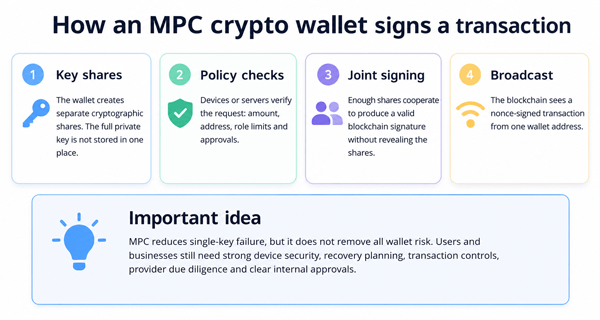
Figure: MPC wallet signing flow
4. MPC Wallet vs Traditional Seed Phrase Wallet
| Feature | Traditional seed phrase wallet | MPC crypto wallet |
|---|---|---|
| Main secret | One seed phrase can restore the wallet. | Control is split into separate key shares. |
| Single point of failure | Yes, if the seed phrase is stolen or lost. | Reduced, because one share alone is usually not enough. |
| Recovery | User must protect and restore the seed phrase. | Recovery depends on the wallet design, provider and backup setup. |
| User experience | Simple for experienced crypto users, intimidating for beginners. | Can feel more like a modern app with account recovery. |
| Business controls | Limited unless combined with other systems. | Can support policies, approvals, roles and transaction limits. |
| Best fit | Users who want maximum direct control and can secure their seed phrase. | Users and organizations that want distributed signing and stronger operational controls. |
5. MPC Wallet vs Multisig Wallet
MPC wallets and multisig wallets both try to avoid one-person, one-key risk. However, they work differently.
A multisig wallet requires multiple signatures, often through a smart contract or chain-level feature. For example, a 2-of-3 multisig wallet may require two approved wallet addresses to sign before funds can move. MPC, by contrast, produces one signature using multiple hidden key shares.
| Comparison point | MPC wallet | Multisig wallet |
|---|---|---|
| How approval works | Key shares cooperate off-chain to create one valid signature. | Multiple wallet addresses or keys approve on-chain or through a smart contract. |
| Blockchain visibility | Usually appears as a normal single-signature transaction. | Often reveals multisig structure on-chain, depending on the chain and design. |
| Chain support | Can work across many chains if the cryptography supports the signing algorithm. | Depends on blockchain or smart-contract support. |
| Gas/fees | Often similar to a normal transaction. | Can cost more on some chains because multiple approvals or smart-contract calls are needed. |
| Transparency | Internal approval setup may be private. | Approval setup may be visible and auditable on-chain. |
| Complexity | Cryptographically complex; depends heavily on provider implementation. | Operationally understandable, but chain-specific and sometimes less flexible. |
Neither is automatically better in every case. Multisig can be excellent for transparent DAO treasuries and teams that want on-chain approval records. MPC can be attractive for institutions, wallet apps and businesses that need multi-chain support, off-chain policy controls and a smoother signing experience.
6. Real-World Examples of MPC Wallets and MPC Custody
The MPC wallet market includes consumer wallets, business wallets and institutional custody platforms. Exact features change over time, so businesses should always verify current product documentation, supported chains, pricing, custody model and legal terms before choosing a provider.
| Example | Common use case | Beginner-friendly explanation |
|---|---|---|
| Zengo | Consumer self-custody wallet | Uses MPC to remove the traditional seed phrase experience and split signing between the user device and Zengo infrastructure. |
| Coinbase MPC wallets / Wallet-as-a-Service | Consumer and developer wallet infrastructure | Coinbase has described MPC wallets with two key shares: one on the user device and one managed by Coinbase, both needed for signing. |
| Fireblocks | Institutional custody and digital asset operations | Enterprise platform using MPC-based signing with governance, approvals, policy controls and operational security layers. |
| Qredo and similar institutional platforms | Institutional trading and custody workflows | Designed for organizations that need secure approvals, settlement workflows and distributed custody controls. |
| Custom MPC infrastructure | Exchanges, fintech apps and enterprises | Organizations may embed MPC signing into payment, exchange or Web3 products. |
Important note: “MPC wallet” is not one standard product type. A consumer MPC wallet, an exchange MPC custody system and an enterprise treasury platform may all use MPC, but they can differ greatly in custody model, recovery process, compliance features, insurance, support and control over key shares.
7. Benefits of MPC Crypto Wallets
7.1 Reduced single point of failure
The biggest benefit is that one stolen key share is usually not enough to move funds. This helps protect against device theft, insider risk, cloud compromise and accidental key exposure.
7.2 No traditional seed phrase in some designs
Some MPC wallets remove the need for users to write down a seed phrase. This can reduce seed phrase phishing and loss, two common causes of crypto loss. However, recovery then depends on the wallet’s specific recovery design.
7.3 Better business approvals
Companies can set rules such as “two finance approvers for payments above $10,000” or “executive approval required for withdrawals to new addresses.” This is much safer than letting one employee control a treasury wallet.
7.4 Multi-chain flexibility
Because MPC signing often works at the cryptographic signature layer, one MPC system may support many blockchains that use compatible signature schemes. This can be useful for businesses managing assets across multiple networks.
7.5 Improved recovery and key rotation
MPC can support share refresh, device replacement and recovery workflows without exposing a full private key. For businesses, this can make employee turnover and disaster recovery easier to manage.
7.6 Cleaner user experience
For consumer wallets, MPC can make crypto feel closer to a normal app. Users may be able to recover access through approved recovery steps instead of relying only on a seed phrase stored offline.
8. Risks and Limitations of MPC Wallets
MPC reduces certain risks, but it also introduces new considerations. A trustworthy article should be clear about both sides.
| Risk or limitation | What it means | How to reduce it |
|---|---|---|
| Provider dependency | Some MPC wallets require a provider server or recovery service to sign or recover. | Understand the custody model, export options, recovery process and what happens if the provider is unavailable. |
| Complex implementation | MPC cryptography is difficult to build correctly. | Choose audited, reputable providers with clear security documentation and incident response processes. |
| Phishing still works | A user can still be tricked into approving a malicious transaction. | Use transaction simulation, allowlists, spending limits and careful address verification. |
| Device compromise | A hacked phone or laptop may approve bad transactions or expose a key share. | Use strong device security, biometrics, hardware security modules, endpoint protection and approval separation. |
| Recovery confusion | Users may not understand how to recover access or what backups are required. | Document recovery steps and test them before storing large funds. |
| No universal standard | Different MPC wallets use different protocols and custody models. | Compare architecture, audits, chain support, key control and legal terms before choosing. |
| Operational mistakes | A company can approve the wrong address, set weak policies or fail to remove old employees. | Use role-based access, approval workflows, address books, periodic reviews and separation of duties. |
9. Common Misconceptions About MPC Wallets
9.1 Misconception 1: MPC means the wallet cannot be hacked
No wallet is impossible to hack. MPC protects key material, but attackers may still target users, devices, approvals, software updates, browser extensions, support channels and transaction workflows.
9.2 Misconception 2: MPC is always self-custody
Not always. Some MPC wallets are self-custodial, some are custodial, and some are hybrid. The important question is who controls the key shares and whether any single provider can move funds without the user or organization.
9.3 Misconception 3: MPC removes the need for security habits
MPC does not replace careful behavior. Users still need to check addresses, avoid phishing, secure devices and understand recovery.
9.4 Misconception 4: MPC and multisig are the same
They solve similar problems but use different methods. Multisig usually requires multiple on-chain signatures or smart-contract approvals. MPC creates one signature through off-chain cooperation among key shares.
10. Who Should Consider an MPC Wallet?
10.1 Individual crypto users
An MPC wallet may suit users who are worried about losing a seed phrase, want a simpler recovery experience or prefer a mobile-first wallet with modern security features. However, users who want maximum independence from any provider may prefer a hardware wallet or a carefully managed seed phrase setup.
10.2 Businesses and startups
Businesses receiving crypto payments, paying contractors, holding stablecoins or building Web3 apps may benefit from MPC wallets because they can add approvals, spending limits and recovery procedures.
10.3 Funds, exchanges and institutions
Institutions often need stronger controls than a basic wallet can provide. MPC custody platforms can support role-based access, transaction policies, audit logs, compliance workflows and operational resilience.
10.4 DAOs and protocol treasuries
DAOs may prefer multisig when public on-chain transparency is important. However, MPC can be useful for operational wallets, market-making wallets or treasury workflows that need privacy, speed and multi-chain support.
11. When an MPC Wallet May Not Be the Best Choice
- You want a fully offline cold-storage setup with no provider dependency.
- You need public on-chain transparency for every approval step, as many DAOs do.
- You cannot evaluate or trust the MPC provider’s security model.
- You are holding a very small amount of crypto and a simple wallet is enough.
- You do not have a clear recovery plan or do not understand who controls the key shares.
12. How to Choose an MPC Wallet Provider
Before choosing an MPC wallet, compare the actual security and custody model, not just the marketing page. Use these questions as a practical checklist.
12.1 Security and architecture questions
- How many key shares are created, and where are they stored?
- What signing threshold is required, such as 2-of-2, 2-of-3 or 3-of-5?
- Can the provider ever move funds without the user or business?
- Are key shares generated through distributed key generation, or is a key generated first and then split?
- Can key shares be refreshed or rotated?
- Are audits, security papers or open-source components available?
12.2 Operational questions
- Does the wallet support transaction limits, address allowlists and approval workflows?
- Can you remove employees, replace devices and handle emergencies?
- What happens if the provider has downtime?
- Can you export or migrate assets if you leave the provider?
- Does it support the chains, tokens and DeFi protocols you actually use?
12.3 Legal and business questions
- Is the product custodial, non-custodial or hybrid?
- What are the terms of service, liability limits and support commitments?
- Is insurance available, and what does it actually cover?
- Does the provider meet your compliance needs, such as audit logs and reporting?
13. Best Practices for Using MPC Wallets Safely
13.1 For individual users
- Understand the recovery process before depositing large amounts.
- Use strong device security, including biometric lock, updated operating systems and phishing-resistant authentication where available.
- Test with a small transaction before moving serious funds.
- Verify recipient addresses carefully, especially for first-time transfers.
- Do not approve transactions you do not understand, even if the wallet itself is secure.
- Keep wallet app, phone and browser software updated.
13.2 For businesses
- Separate duties. The person creating a payment should not be the only person approving it.
- Use transaction policies. Set limits by amount, token, destination address and user role.
- Create an address book or allowlist for vendors, exchanges and treasury wallets.
- Require multiple approvers for large transfers and new withdrawal addresses.
- Remove access immediately when employees leave or change roles.
- Run recovery drills before an emergency happens.
- Keep written procedures for signing, recovery, incident response and vendor escalation.
- Review audit logs regularly and investigate unusual behavior quickly.
14. Practical MPC Wallet Scenarios
14.1 Scenario 1: A freelancer using a consumer MPC wallet
A freelancer receives USDC payments and worries about losing a seed phrase. A consumer MPC wallet can make recovery easier while reducing seed phrase risk. The freelancer should still test recovery, secure the phone and avoid signing unknown dApp permissions.
14.2 Scenario 2: A startup holding stablecoin reserves
A startup keeps part of its operating funds in stablecoins. It uses an MPC business wallet requiring approval from the CFO and CEO for transfers above a set amount. Vendor addresses are allowlisted, and new addresses require a waiting period. This reduces the chance of one compromised employee draining the wallet.
14.3 Scenario 3: A crypto fund with active trading wallets
A fund needs faster access than deep cold storage but cannot rely on one trader’s key. An institutional MPC platform can combine policy controls, co-signers, withdrawal limits and audit logs. The fund may still keep long-term reserves in separate cold storage.
15. MPC Wallet Setup Checklist
| Step | What to do | Why it matters |
|---|---|---|
| 1 | Start with a small amount. | Confirms the wallet works before real value is at risk. |
| 2 | Document recovery steps. | Prevents panic if a device is lost or an employee leaves. |
| 3 | Enable strong authentication. | Reduces account takeover risk. |
| 4 | Set spending limits and approvals. | Limits damage from mistakes or compromised accounts. |
| 5 | Use trusted addresses. | Reduces wrong-address and phishing risk. |
| 6 | Test device replacement. | Confirms that recovery works in real life. |
| 7 | Review access regularly. | Keeps old users, devices and permissions from becoming risk points. |
16. MPC Wallets and Compliance
For businesses, security is only one part of the decision. Compliance, accounting and governance also matter. An MPC wallet platform may help by providing audit logs, approval records, user roles, reporting exports and policy enforcement. However, the wallet does not automatically make a business compliant with tax, securities, anti-money-laundering or consumer protection rules.
Businesses should work with legal, tax and compliance professionals before using MPC wallets for customer funds, tokenized assets, cross-border payments or regulated financial activity.
17. Are MPC Wallets Safe?
MPC wallets can be safer than traditional single-key wallets for many users and businesses because they reduce dependence on one complete private key or seed phrase. They are especially useful when multiple people or systems should approve transactions.
However, safety depends on implementation and behavior. A poorly designed MPC wallet, weak recovery process, compromised device or careless approval workflow can still lead to loss. The best approach is to treat MPC as one layer in a broader security system, not as a complete security solution by itself.
18. FAQs About MPC Crypto Wallets
18.1 What does MPC mean in crypto?
MPC means multi-party computation. In crypto wallets, it allows multiple parties or devices to jointly create a transaction signature without putting the full private key in one place.
18.2 Does an MPC wallet have a private key?
The wallet has signing authority linked to a public address, but the complete private key is not stored as one normal secret in many MPC designs. Instead, separate key shares cooperate to sign transactions.
18.3 Is an MPC wallet the same as a multisig wallet?
No. Multisig usually uses multiple on-chain signatures or smart-contract approvals. MPC usually creates one valid signature through off-chain cooperation among key shares.
18.4 Can an MPC wallet be recovered if I lose my phone?
It depends on the wallet. Some MPC wallets are designed for easier recovery. Others require strict enterprise recovery procedures. Always understand and test recovery before storing meaningful funds.
18.5 Can the MPC wallet provider steal my crypto?
That depends on the custody model and key-share setup. In a well-designed self-custodial MPC wallet, the provider should not be able to move funds alone. But users must verify the specific architecture, terms and recovery design.
18.6 Are MPC wallets good for beginners?
They can be, especially if the wallet removes seed phrase management and provides clear recovery. Beginners should still learn basic crypto safety, because phishing and malicious approvals remain major risks.
18.7 Are MPC wallets good for businesses?
Yes, often. Businesses can benefit from approvals, role-based permissions, spending limits, audit logs and distributed signing. The right setup depends on business size, transaction volume, asset value and compliance needs.
18.8 Do MPC wallets support Bitcoin and Ethereum?
Many MPC wallets support Bitcoin, Ethereum and other major networks, but support varies by provider. Always check the current list of supported chains and assets before choosing a wallet.
18.9 Can I use DeFi with an MPC wallet?
Some MPC wallets support DeFi and dApp connections, while others focus on custody or institutional transfers. Users should be extra careful with smart-contract approvals and permissions.
18.10 What is the biggest risk of using an MPC wallet?
The biggest risks are misunderstanding the custody model, relying blindly on a provider, approving malicious transactions and failing to plan recovery. MPC protects keys, but it does not protect users from every mistake.
19. Conclusion
MPC crypto wallets are an important evolution in wallet security. By splitting signing authority across multiple key shares, they reduce the danger of one stolen private key, one lost seed phrase or one compromised employee. They can also make wallet recovery and business approvals more practical.
Still, MPC is not a shortcut around good security. The safest users and businesses combine MPC with clear recovery plans, strong authentication, transaction policies, trusted addresses, careful provider due diligence and regular access reviews.
For beginners, the main takeaway is simple: MPC wallets are designed to remove the single point of failure found in many traditional wallets. They can be very useful, but only when you understand who controls the key shares, how recovery works and what risks remain.
Sources Consulted and Checked
These sources were consulted and checked while preparing this article to support accuracy and clarity.
- Fireblocks, “What is MPC (Multi-Party Computation)? MPC 101”
- AWS Web3 Blog, “Build secure multi-party computation (MPC) wallets using AWS Nitro Enclaves”
- Coinbase Learn, “What is a Multi-Party Computation (MPC) wallet?”
- Coinbase Blog, “Building user-focused web3 wallets at Coinbase”
- Coinbase Blog, “Digital Asset Management with MPC (Whitepaper)”
- Zengo, “MPC Wallet - What is MPC?”
- Zengo Security Model
- Blockdaemon, “What are MPC Wallets and Why Should Every Institution Have One”
- LlamaRisk, “MPCs in a Protocol Treasury and Operational Context”
Reader Advice
This article is provided for educational and informational purposes only and is not personalized financial, legal, tax, investment, compliance, or security advice or a recommendation to use any wallet, provider, or custody model. Crypto assets and wallet operations involve risks, including loss of funds, phishing, device compromise, provider failure, transaction errors, smart-contract vulnerabilities, and changing market conditions. Laws, regulations, policies, product features, fees, supported networks, and statistics can change over time and may vary by country or region. Before making a decision or transferring meaningful value, verify current information through official sources, review the provider’s custody and recovery terms, test the setup with a small amount, and seek qualified professional advice where appropriate.