Crypto Custody Explained: Meaning, How It Works, Examples, Benefits and Risks
1. Introduction: Why Crypto Custody Matters
Crypto custody is one of the most important topics in digital assets because crypto ownership works differently from traditional bank accounts or brokerage accounts. In crypto, control usually depends on private keys: secret cryptographic credentials that allow someone to move assets on a blockchain. If those keys are lost, stolen, exposed, or mismanaged, the assets may be impossible to recover.
This is why crypto custody is not just a technical detail. It affects personal investors, exchanges, funds, fintech companies, family offices, and businesses that accept or hold crypto. A beginner may think custody simply means 'where my coins are stored.' A more accurate explanation is: custody is the system used to protect access to crypto assets and control who can authorize transactions.
This guide explains crypto custody in simple language, including how it works, the main custody models, practical examples, benefits, risks, and best practices for choosing a custody setup.
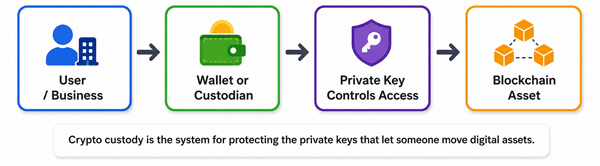
Diagram: A simplified view of crypto custody and private-key control.
2. What Is Crypto Custody?
Crypto custody means the safekeeping and management of the private keys or signing permissions that control digital assets such as Bitcoin, Ether, stablecoins, tokenized assets, and other blockchain-based tokens.
In traditional finance, a custodian may hold securities, cash, or records on behalf of a client. In crypto, the asset itself is recorded on a blockchain, but the power to move it depends on cryptographic keys. Therefore, crypto custody focuses on protecting those keys and creating secure rules for using them.
A crypto custodian may be a person, a hardware wallet, a software wallet, an exchange, a regulated trust company, a bank, or an institutional custody provider. The right option depends on the user's knowledge, asset size, legal obligations, risk tolerance, and need for convenience.
2.1 The Core Idea: Not Your Coins, Not Your Keys?
The phrase 'not your keys, not your coins' is common in crypto. It means that if another party controls the private keys, that party has practical control over whether and how the crypto can be moved. The phrase is useful, but it can also be oversimplified.
Self-custody gives users direct control, but it also gives them direct responsibility. Third-party custody reduces the burden of key management, but it introduces trust, counterparty, legal, and platform risks. Good custody is not only about who has the key. It is also about controls, recovery plans, access rules, audits, insurance, segregation, compliance, and operational discipline.
3. How Crypto Custody Works Step by Step
- A wallet or custody system generates or controls private keys. These keys are linked to blockchain addresses.
- Crypto assets are received at an address on the blockchain. The assets are not physically stored inside the wallet; the wallet controls access to them.
- When a transaction is needed, the private key or signing system authorizes it.
- The blockchain network verifies the signature and records the transaction if valid.
- Custody controls determine who can sign, when signatures are allowed, how approvals are logged, and how keys are protected from theft or loss.
For a simple individual wallet, this process may involve one person and one seed phrase. For an institution, it may involve hardware security modules, multi-signature wallets, role-based approvals, cold storage, transaction policies, insurance, legal agreements, and audits.
4. Private Keys, Seed Phrases, Wallets, and Addresses
| Term | Simple meaning | Why it matters for custody |
|---|---|---|
| Private key | A secret cryptographic key that can authorize transactions. | Whoever controls it can usually move the crypto tied to that address. |
| Seed phrase | A human-readable backup phrase that can restore a wallet. | If stolen, it may let an attacker recreate the wallet and drain funds. |
| Public address | A blockchain address used to receive assets. | It can be shared, but it does not give spending power. |
| Wallet | Software, hardware, or infrastructure that manages keys and transactions. | Wallets are tools for custody, not the place where assets physically exist. |
| Signature | A cryptographic approval proving the transaction was authorized. | Secure custody controls when and how signatures are created. |
5. Main Types of Crypto Custody
5.1 Self-Custody
Self-custody means you control your own private keys. This can be done through a hardware wallet, mobile wallet, desktop wallet, paper backup, or more advanced setup such as multi-signature storage. Self-custody is popular among people who want maximum control and do not want to rely on exchanges or custodians.
- Best for: knowledgeable users who can protect backups and avoid scams.
- Main benefit: direct control over assets.
- Main risk: losing the seed phrase, making a wrong transfer, or being hacked can cause permanent loss.
5.2 Third-Party Custody
Third-party custody means another organization holds or manages the keys for you. This may be a crypto exchange, broker, fintech app, qualified custodian, trust company, or bank-like digital asset institution. Users usually access their assets through a login, dashboard, or account agreement rather than directly managing private keys.
- Best for: beginners, active traders, businesses, and institutions that need operational support.
- Main benefit: convenience, recovery support, reporting, and professional controls.
- Main risk: platform failure, withdrawal freezes, poor asset segregation, hacks, or misuse of customer assets.
5.3 Hybrid or Collaborative Custody
Hybrid custody sits between self-custody and full third-party custody. In some setups, the user controls one key, the provider controls another key, and a recovery service or co-signer controls a backup key. This model can reduce single-point-of-failure risk while still offering support.
- Best for: users who want more control than an exchange but more recovery help than pure self-custody.
- Main benefit: shared responsibility and better recovery options.
- Main risk: complexity, unclear responsibilities, and dependence on provider design.
| Custody model | Who controls the keys? | Convenience | Control | Typical users | Main risk |
|---|---|---|---|---|---|
| Self-custody | The user | Low to medium | High | Individuals, crypto-native teams | User error, theft, lost seed phrase |
| Exchange custody | Exchange or trading platform | High | Low | Beginners, traders | Platform failure, hacks, withdrawal limits |
| Qualified/regulated custodian | Specialized regulated provider | Medium to high | Medium | Funds, institutions, businesses | Fees, onboarding, custodian risk |
| Collaborative custody | Shared between user and provider | Medium | Medium to high | High-net-worth users, small businesses | Complex recovery and policy design |
6. Hot Wallets vs Cold Wallets
A major custody concept is whether keys are connected to the internet. Hot wallets are online or readily connected, which makes them convenient for fast transactions. Cold wallets keep keys offline or in highly restricted environments, which reduces exposure to online attacks.
| Feature | Hot wallet | Cold wallet |
|---|---|---|
| Connection | Online or easily connected | Offline or strongly isolated |
| Speed | Fast for frequent transactions | Slower; often requires extra approval steps |
| Security profile | Higher exposure to phishing, malware, and online attacks | Lower online exposure but still needs strong physical and procedural controls |
| Best use | Small operational balances, trading, payments | Long-term holdings, treasury, institutional reserves |
| Common mistake | Keeping too much value online | Making recovery so difficult that assets become inaccessible |
7. Multi-Signature and MPC Custody
7.1 Multi-Signature Wallets
A multi-signature wallet requires more than one key to approve a transaction. For example, a 2-of-3 setup may require any two of three authorized keys. This reduces the risk that one stolen key can drain all assets. It is useful for teams, DAOs, businesses, family offices, and serious long-term holders.
7.2 MPC Wallets
Multi-party computation, or MPC, is a custody method where the signing process is split across multiple parties or devices. Instead of one complete private key existing in one place, separate key shares cooperate to create a valid signature. MPC is common in institutional custody because it can support policy controls, approvals, and flexible operations.
| Approach | How it works | Strength | Trade-off |
|---|---|---|---|
| Single-key wallet | One private key or seed phrase controls funds. | Simple and low cost. | One mistake or theft can be catastrophic. |
| Multi-signature | Several keys exist; a threshold is needed to sign. | Transparent and good for shared control. | Can be harder to configure and use across chains. |
| MPC | Signing is split across key shares. | Flexible for institutions and policy-based access. | More technical and provider-dependent. |
8. Real-World Examples of Crypto Custody
| Scenario | Likely custody setup | Why |
|---|---|---|
| A beginner buys $100 of Bitcoin on an exchange. | Exchange custody. | Convenient, simple login, no seed phrase management. |
| A long-term holder stores Bitcoin for several years. | Hardware wallet or multi-signature self-custody. | Reduces exchange risk and supports long-term control. |
| A crypto trading firm moves assets daily. | Combination of hot wallets, cold wallets, and policy approvals. | Needs both speed and risk limits. |
| A public company holds Bitcoin as treasury. | Institutional custodian with cold storage, reporting, and controls. | Needs governance, auditability, and board-level oversight. |
| A Web3 startup manages protocol funds. | Multi-signature or MPC wallet with role-based approvals. | Prevents one founder or employee from moving all funds alone. |
9. Benefits of Good Crypto Custody
- Stronger asset protection through key security, cold storage, access controls, and approval workflows.
- Lower operational risk because responsibilities are documented and transactions are reviewed before signing.
- Better recovery planning through backups, inheritance procedures, disaster recovery, or institutional support.
- More trust for businesses and funds because custody can support reporting, audits, compliance, and client due diligence.
- Reduced single-person risk when multi-signature, MPC, or role-based approvals are used.
- Improved separation between trading balances, long-term reserves, customer assets, and operational wallets.
10. Major Risks of Crypto Custody
Every custody model has risks. The key is to understand which risks you are accepting and which controls reduce them.
| Risk | What it means | How to reduce it |
|---|---|---|
| Private-key loss | The key or seed phrase is lost, destroyed, or forgotten. | Use secure backups, test recovery, and document inheritance or business continuity procedures. |
| Theft or hacking | Attackers steal keys, login access, or signing authority. | Use hardware wallets, multi-factor authentication, cold storage, allowlists, and transaction approvals. |
| Phishing and social engineering | Users are tricked into revealing seed phrases or approving malicious transactions. | Never type seed phrases online; verify addresses, URLs, and wallet prompts. |
| Custodian failure | A third party becomes insolvent, hacked, frozen, or dishonest. | Use reputable custodians, understand legal terms, asset segregation, audits, and withdrawal policies. |
| Smart contract risk | Assets are locked in DeFi contracts that may contain bugs or admin risks. | Separate custody risk from protocol risk; review contracts and avoid unknown protocols. |
| Operational mistakes | Wrong address, wrong chain, excessive approvals, or weak internal controls. | Use test transactions, address books, withdrawal limits, and clear approval policies. |
| Regulatory and legal risk | Rules may affect custody, reporting, or access depending on jurisdiction. | Use legal and tax professionals for businesses, funds, and large holdings. |
11. Crypto Custody vs Crypto Wallet: What Is the Difference?
A crypto wallet is a tool that creates, stores, or uses private keys. Crypto custody is the broader security, governance, and operational system around those keys. A wallet can be part of custody, but custody also includes policies, people, backups, audits, legal agreements, transaction approvals, and recovery plans.
| Question | Wallet | Custody |
|---|---|---|
| What is it? | A tool for managing keys and transactions. | A full system for protecting and controlling crypto access. |
| Who uses it? | Individuals and organizations. | Individuals, businesses, funds, exchanges, custodians. |
| What does it include? | App, hardware device, seed phrase, address. | Wallets plus security policies, approvals, backups, audits, controls. |
| Main focus | Signing and receiving transactions. | Safe ownership, governance, risk management, and recoverability. |
12. How to Choose a Crypto Custody Solution
The best custody option depends on your situation. A beginner with a small amount of crypto does not need the same setup as a business managing payroll, treasury, or customer assets. Use the following questions before choosing.
- How much value are you protecting? A small learning balance and a company treasury need different controls.
- How often do you need to move funds? Frequent transactions may require a hot wallet or operational wallet with limits.
- Who needs access? Solo users, families, founders, finance teams, and funds all need different approval structures.
- Can you safely manage a seed phrase? If not, pure self-custody may be risky.
- Do you need reporting, audit trails, statements, or compliance support? Institutions usually do.
- What happens if the main signer dies, leaves the company, loses a device, or is unavailable?
- Are assets segregated from the custodian or platform balance sheet? Read the terms carefully.
- What insurance exists, what does it cover, and what exclusions apply?
- Can withdrawals be delayed, frozen, limited, or blocked by the provider?
- Has the provider undergone credible security audits, SOC reports, penetration testing, or regulatory oversight?
13. Best Practices for Self-Custody
- Use a reputable hardware wallet for meaningful long-term holdings.
- Buy hardware wallets from trusted sources and check for tampering.
- Write down the seed phrase offline. Do not store it in email, cloud notes, screenshots, or messaging apps.
- Create more than one backup and store backups in separate secure locations.
- Test wallet recovery with a small amount before storing large value.
- Use a small hot wallet for everyday activity and a separate cold wallet for savings.
- Do not sign transactions you do not understand. Be especially careful with unlimited token approvals.
- Use address allowlists and test transactions when sending large amounts.
- Plan for inheritance or emergency access without exposing the seed phrase unnecessarily.
- For large balances, consider multi-signature or collaborative custody instead of one seed phrase.
14. Best Practices for Businesses and Institutions
- Separate duties so no single employee can move all funds alone.
- Use multi-signature, MPC, or custodian policy controls for treasury wallets.
- Define who can request, approve, and execute transactions.
- Use withdrawal limits, destination allowlists, and cooling-off periods for large transfers.
- Keep long-term reserves in cold storage and only small operational balances in hot wallets.
- Maintain written custody policies approved by leadership or the board.
- Review custodian agreements for asset segregation, insurance, insolvency treatment, audit rights, fees, and withdrawal procedures.
- Keep transaction records for accounting, tax, and audit purposes.
- Run incident-response drills for compromised devices, phishing attacks, key loss, and employee departures.
- Have legal, compliance, and tax advisors review custody arrangements when customer funds or investor assets are involved.
15. Common Crypto Custody Mistakes
- Keeping all crypto on one exchange because it feels easier.
- Taking self-custody without learning how seed phrases, backups, and recovery work.
- Storing seed phrases in screenshots, cloud storage, or password managers without understanding the risk.
- Using one person as the only signer for a business wallet.
- Assuming insurance covers every possible loss. Most policies have exclusions.
- Ignoring withdrawal terms, rehypothecation, asset segregation, and bankruptcy risk.
- Sending assets on the wrong blockchain network.
- Approving malicious smart contracts or unlimited token allowances.
- Failing to update custody plans as balances grow.
- Confusing proof of reserves with full protection. It may show assets exist, but it does not always prove legal ownership, liabilities, or operational safety.
16. Crypto Custody and Regulation: What Beginners Should Know
Crypto custody regulation depends on the country, asset type, customer type, and service provider. Some custodians operate as trust companies, banks, broker-dealers, or regulated digital asset firms. Others may be ordinary exchanges or offshore platforms with limited protections.
Regulation can improve accountability, but it does not remove all risk. A regulated custodian can still have fees, operational limits, policy restrictions, technology risk, or insurance exclusions. Beginners should not assume that a platform is safe simply because it is well known or says it uses cold storage.
In the United States, the SEC has issued investor education explaining the difference between self-custody and third-party custody and warning that losing access to keys can mean permanent loss of assets. The SEC also rescinded Staff Accounting Bulletin No. 121 in 2025, a change that affected how some firms account for safeguarding crypto assets for others. These details show why custody rules continue to evolve.
17. Custody Checklist Before You Store Crypto
| Checklist item | Why it matters |
|---|---|
| Know who controls the private keys. | This determines who can move the assets. |
| Understand recovery options. | Lost keys or accounts can mean permanent loss. |
| Separate hot and cold storage. | Reduces the amount exposed to online threats. |
| Use multi-factor authentication. | Protects accounts from password theft. |
| Confirm withdrawal rules. | Platforms may impose limits, delays, or freezes. |
| Read legal terms. | Terms may explain asset ownership, commingling, fees, and insolvency treatment. |
| Check audits and security reports. | Independent reviews can improve confidence, though they are not guarantees. |
| Review insurance carefully. | Coverage may exclude phishing, insider actions, user mistakes, or certain assets. |
| Document responsibilities. | Businesses need clear approval, backup, and incident-response procedures. |
| Start small and test. | Small test transactions reduce costly mistakes. |
18. When Self-Custody Makes Sense
Self-custody may make sense when you value direct control, understand wallet security, can protect backups, and do not want to rely fully on a third party. It is often suitable for long-term holders who are willing to learn and practice safe key management.
However, self-custody is not automatically safer. A person who loses a seed phrase, falls for a phishing attack, or signs a malicious transaction may have less protection than someone using a reputable custodian with strong controls. The safest option is the one you can actually manage correctly.
19. When Third-Party Custody Makes Sense
Third-party custody may make sense when convenience, compliance, reporting, recovery support, or institutional controls are more important than direct key control. Businesses, investment funds, public companies, and users who are not comfortable managing private keys may prefer a professional custodian.
The trade-off is trust. You must trust the provider's security, financial health, legal structure, internal controls, and honesty. For meaningful balances, do due diligence instead of choosing only by brand recognition or low fees.
20. A Practical Custody Strategy for Beginners
A simple beginner strategy is to match custody complexity to the amount at risk.
| Level | Example amount or use | Practical custody approach |
|---|---|---|
| Learning stage | Small amount used to learn crypto basics. | A reputable exchange or simple wallet may be enough, with strong login security. |
| Growing holdings | Meaningful savings or long-term investment. | Move long-term assets to a hardware wallet or carefully chosen custodian. |
| Large personal holdings | Funds you cannot afford to lose. | Consider multi-signature, collaborative custody, separate backups, and inheritance planning. |
| Business or institutional funds | Treasury, client assets, investor capital, or payroll. | Use formal policies, multi-approval controls, professional custody, legal review, and audit records. |
21. Frequently Asked Questions
21.1 What does crypto custody mean in simple words?
Crypto custody means protecting the private keys or signing permissions that control crypto assets. It is the system that decides who can access, move, recover, and secure digital assets.
21.2 Is crypto stored inside a wallet?
Not exactly. Crypto balances are recorded on a blockchain. A wallet stores or uses the private keys that allow the owner to control those blockchain assets.
21.3 Is self-custody safer than an exchange?
It can be safer if you manage keys correctly, but it can be more dangerous if you lose your seed phrase, use insecure backups, or fall for scams. Self-custody gives control and responsibility together.
21.4 What is a crypto custodian?
A crypto custodian is a person or organization that safeguards the keys or signing controls for crypto assets. Institutional custodians may also provide cold storage, reporting, insurance, compliance support, and approval workflows.
21.5 What is cold storage in crypto custody?
Cold storage means keeping private keys offline or in a highly isolated environment. It is commonly used for long-term holdings and large balances because it reduces exposure to online attacks.
21.6 Can a crypto custodian lose my assets?
Yes, custody reduces some risks but does not eliminate all risks. A custodian may face hacks, operational failures, insolvency, legal restrictions, or policy limitations. Always review terms, controls, insurance, and reputation.
21.7 What is the biggest risk in self-custody?
The biggest risks are losing the seed phrase, exposing it to attackers, signing malicious transactions, or sending assets to the wrong address or network.
21.8 Do I need a hardware wallet?
A hardware wallet is often useful for meaningful long-term holdings because it keeps signing keys away from everyday internet-connected devices. For very small learning balances, it may not be necessary at first.
21.9 What is qualified custody?
Qualified custody generally refers to custody by an entity that meets specific regulatory standards for holding client assets, depending on jurisdiction and client type. The exact meaning can vary, so investors and businesses should verify the provider’s legal status.
21.10 What should I check before using a crypto custody provider?
Check who controls keys, whether assets are segregated, withdrawal rules, fees, insurance coverage, audits, security controls, regulatory status, recovery process, and what happens if the provider fails.
22. Conclusion: Crypto Custody Is About Control, Security, and Responsibility
Crypto custody is the foundation of safe digital asset ownership. The main question is not only where the crypto is held, but who controls the private keys, how transactions are approved, how assets can be recovered, and what protections exist if something goes wrong.
Self-custody offers maximum control but requires strong personal security habits. Third-party custody offers convenience and professional infrastructure but introduces trust and counterparty risk. Hybrid models can balance both, but they require careful design.
For beginners, the best approach is to start simple, learn how custody works, avoid storing large amounts in weak setups, and upgrade security as the value and complexity of holdings grow. For businesses and institutions, custody should be treated as a formal risk-management system, not just a wallet choice.
Sources Consulted and Checked
These sources were consulted and checked while preparing this article to support its accuracy and reliability.
- U.S. SEC Investor.gov: Crypto Asset Custody Basics for Retail Investors, 2025.
- Reuters: SEC revoked Staff Accounting Bulletin No. 121 in January 2025.
- BitGo: Qualified custody and institutional custody resources, 2025-2026.
- Anchorage Digital: Institutional crypto custody platform information.
- Cobo: Crypto custody solutions guide, 2026.
Reader Advice
This article is provided for educational and informational purposes only and is not personalized financial, investment, legal, tax, accounting, or security advice or a recommendation to use any wallet, exchange, custodian, or strategy. Crypto assets and custody arrangements involve risks, including theft, loss of private keys, scams, technology failures, provider insolvency, restricted access, regulatory changes, and possible permanent loss. Rules, policies, laws, product features, and statistics can change over time and vary by country or region, so verify important details through current official sources and seek qualified professional advice where appropriate before making decisions or committing funds.