Tokenization for Businesses: Complete Guide, Examples, Risks and Best Practices
1. What Is Tokenization for Businesses?
Tokenization for businesses means turning something of value, or sensitive information about something of value, into a digital token that can be stored, transferred, tracked, or used in software systems. In business, the word tokenization is used in two main ways.
| Meaning | Simple explanation | Common business goal |
|---|---|---|
| Asset tokenization | A real-world asset or right is represented by a digital token, often on a blockchain or distributed ledger. | Make ownership, transfers, settlement, financing, or access easier to manage. |
| Data/payment tokenization | Sensitive data, such as a card number or customer identifier, is replaced with a non-sensitive token. | Reduce exposure to fraud, data breaches, and compliance scope. |
This guide focuses mainly on asset and business-process tokenization, while also explaining data tokenization because many companies confuse the two. A real business tokenization project often involves both: a token may represent an asset, while sensitive customer and payment data are also tokenized for security.
1.1 A beginner-friendly example
Imagine a company owns a commercial property worth $10 million. Instead of selling the entire property to one buyer, the company could create digital tokens that represent certain economic rights, such as a share of rental income or a claim on a fund that owns the building. Investors can buy smaller units, and the business can manage ownership records digitally. This is asset tokenization.
Now imagine the same company accepts customer card payments. It may replace each card number with a token in its systems so employees and internal applications do not store the actual card number. That is payment or data tokenization.
2. What Tokenization Does and Does Not Do
| Tokenization can help with | Tokenization does not automatically solve |
|---|---|
| Digital records of ownership or entitlement | Unclear legal rights or poor asset documentation |
| Faster transfer and settlement workflows | Regulatory approval, investor protection, or tax compliance |
| Fractional access to expensive assets | Asset quality, cash flow, or market demand |
| Programmable rules through smart contracts | Bad governance, weak cybersecurity, or poor internal controls |
| Audit trails and better operational visibility | The need for trusted off-chain data and real-world enforcement |
The most important beginner lesson is this: tokenization changes the technology layer, not the economic reality of the asset. A tokenized bond is still a bond. A tokenized share is still connected to securities law. A tokenized invoice is only useful if the invoice is real, enforceable, and collectable.
3. How Tokenization Works for a Business
A tokenization project usually follows a sequence. The details differ by asset type, jurisdiction, and technology stack, but the basic workflow is similar.
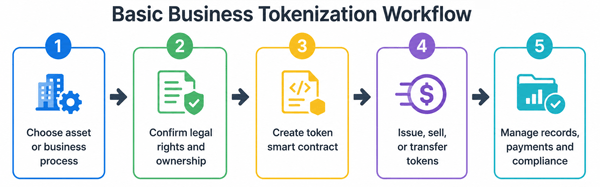
Figure: A simplified business tokenization workflow. In practice, legal, accounting, cybersecurity, custody, and compliance work should run alongside the technical build.
3.1 Choose the asset, right, or process
A business first decides what it wants to tokenize. This could be property, private credit, invoices, loyalty points, carbon credits, intellectual property rights, event tickets, supply chain documents, or access rights. The asset must be clearly defined before any token is created.
3.2 Define what the token actually represents
This is where many projects fail. A token is not valuable simply because it exists. It must represent a clear right or function. For example, a token may represent ownership, a revenue share, membership access, a claim on an asset held by a custodian, voting rights, a discount, a license, or a redeemable unit.
3.3 Create the legal and operational structure
The company may need contracts, custody arrangements, transfer restrictions, investor onboarding, tax analysis, accounting treatment, disclosures, data protection controls, and governance rules. For securities or investment products, regulation is central. The U.S. SEC has emphasized that tokenized securities remain securities when they meet the legal definition of a security, even if represented on a distributed ledger. IOSCO has also highlighted that tokenization does not remove the need for investor protection, market integrity, and risk controls in financial markets.
3.4 Build or select the technology
A business can build directly on a public blockchain, use a permissioned blockchain, work with a tokenization platform, or use a traditional database with token-like records. The right choice depends on privacy, regulatory, interoperability, cost, and control requirements.
3.5 Issue tokens and manage the lifecycle
Issuing tokens is only the start. The business must manage transfers, identity checks, reporting, customer support, audits, redemptions, corporate actions, upgrades, incident response, and ongoing compliance. The long-term operating model matters more than the launch announcement.
4. Main Types of Tokenization Businesses Should Know
| Type | What it represents | Example | Key concern |
|---|---|---|---|
| Real-world asset tokenization | Rights linked to a physical or financial asset | A tokenized real estate fund, private credit pool, or money market fund unit | Legal enforceability and regulation |
| Security tokenization | Shares, bonds, fund interests, or other regulated securities represented digitally | A bond issued and settled on distributed ledger technology | Securities law, disclosures, transfer restrictions |
| Utility or access tokenization | Access to a product, service, network, or benefit | Token-gated software features or membership access | Avoiding misleading investment-like claims |
| Loyalty tokenization | Reward points or benefits in a digital form | Retail points that can be redeemed across partners | Consumer protection, breakage, fraud, accounting |
| Supply chain tokenization | Digital records tied to goods, certificates, or documents | Tokenized warehouse receipts or product provenance records | Data accuracy and trusted verification |
| Payment/data tokenization | A substitute value that replaces sensitive data | Replacing card numbers with network tokens | Security architecture and data governance |
5. Tokenization vs Traditional Digitization
Many businesses already digitize documents and records. Tokenization is different because the token is designed to be a transferable or programmable representation of a right, asset, or data element.
| Feature | Traditional digitization | Tokenization |
|---|---|---|
| Record format | PDFs, spreadsheets, databases, ERP entries | Digital tokens with rules and ownership logic |
| Transfer process | Manual approvals, bank settlement, registry updates | Potentially automated transfer and settlement |
| Programmability | Limited; usually depends on business software | Rules can be built into smart contracts and workflows |
| Interoperability | Often siloed inside one company | Can interact with wallets, marketplaces, and other systems if standards align |
| Legal dependency | Depends on contracts and existing law | Still depends on contracts and existing law; technology alone is not enough |
6. Business Use Cases and Practical Examples
Tokenization is not useful for every company. It tends to be most useful where assets are expensive, ownership records are complex, settlement is slow, access is limited, or several parties need a trusted shared record.
6.1 Real estate tokenization
A property owner or fund manager can tokenize economic interests in a real estate project. Investors may buy smaller units than they could in a traditional property deal. The business may benefit from broader investor access, faster recordkeeping, and easier secondary transfers if legally permitted.
Practical example: A real estate sponsor creates a regulated fund that owns rental properties. Tokens represent fund interests, not direct ownership of each apartment. Investors are onboarded through KYC and suitability checks. Rental income distributions are calculated off-chain and paid according to the fund documents.
Main risks: securities compliance, valuation disputes, illiquidity, property management risk, tax reporting, and confusion between owning a token and owning the building itself.
6.2 Private credit and invoice financing
A company with receivables or loans can tokenize claims on cash flows. This may help investors fund small pieces of a credit portfolio. It can also make reporting more transparent if loan performance data is reliable.
Practical example: A lender tokenizes participation interests in a pool of small business loans. Investors receive tokens representing exposure to the pool. Smart contracts may automate distribution calculations, while legal agreements define what investors actually own.
Main risks: borrower default, poor underwriting, inaccurate data, legal enforceability, servicing failures, and conflicts between token holders and the loan originator.
6.3 Tokenized funds and financial products
Financial institutions are exploring tokenized money market funds, bonds, and other investment products. McKinsey reported in 2024 that tokenized money market funds had already attracted more than $1 billion in assets under management, and Citi projected in 2026 that tokenized financial assets could reach several trillion dollars by 2030, while also noting that forecasts vary widely. These estimates show growing interest, but they should not be treated as guaranteed adoption.
Main risks: regulation, settlement integration, custody, secondary market depth, investor eligibility, and operational readiness.
6.4 Supply chain and product provenance
Tokenization can help businesses track goods, certificates, or documents across multiple parties. A token may represent a batch of goods, a warehouse receipt, a certificate of origin, or a quality inspection record.
Practical example: A food exporter tokenizes shipment records so buyers, insurers, and logistics partners can verify origin, inspection status, and custody changes. The token does not prove the food is safe by itself; it only reflects data entered by trusted participants.
Main risks: bad data at the source, weak verification, privacy concerns, integration with logistics systems, and overpromising traceability.
6.5 Loyalty, membership, and customer engagement
Businesses can tokenize loyalty points, memberships, event access, or digital benefits. This can make rewards more portable and programmable. However, it can also create consumer protection, accounting, and fraud risks if not designed carefully.
Practical example: A hotel group issues tokenized loyalty rewards that customers can redeem with partner restaurants. The tokens are not marketed as investments. Terms clearly explain expiration, transferability, redemption limits, and customer support procedures.
6.6 Intellectual property and royalties
Creators and businesses can tokenize rights to royalties, licenses, or access to intellectual property. This can improve transparency in revenue sharing, but IP rights are legally complex and vary by contract and jurisdiction.
Practical example: A music catalog owner tokenizes a contractual right to receive a share of future royalty income. The token holder does not necessarily own the copyright. The legal documents must clearly explain the difference.
7. Benefits of Tokenization for Businesses
| Benefit | What it can mean in practice | Reality check |
|---|---|---|
| Fractional access | Smaller investors or partners may access assets that were previously too expensive. | Fractional access may trigger securities, consumer, or licensing rules. |
| Faster settlement | Transfers can settle faster when payment, ownership, and compliance workflows are integrated. | Real-world settlement still depends on banks, custodians, legal rules, and counterparties. |
| Lower administrative burden | Automated records, distributions, and restrictions may reduce manual work. | Automation requires strong setup, testing, controls, and maintenance. |
| Transparency and auditability | Shared ledgers can improve visibility across participants. | Private data, trade secrets, and personal information must be protected. |
| New business models | Companies can create programmable memberships, marketplaces, or asset-backed products. | A token is not a business model by itself; demand and trust still matter. |
| Improved liquidity potential | Tokens may make transfers easier and create secondary market options. | Liquidity is not guaranteed and may be legally restricted. |
8. Risks and Limitations of Business Tokenization
Tokenization can create new opportunities, but it also introduces risks that a traditional digital project may not have. The biggest mistake is treating tokenization as a technology project only.
8.1 Legal and regulatory risk
If a token represents an investment, debt, equity, fund interest, derivative, payment instrument, or financial entitlement, it may be regulated. Deloitte has identified regulatory compliance as one of the largest obstacles for regulated financial institutions exploring tokenization. Businesses should not assume that calling something a utility token, membership token, or digital collectible avoids regulation.
8.2 Custody and control risk
Who controls the underlying asset? Who controls the private keys? What happens if the issuer, platform, custodian, or wallet provider fails? Synthetic or entitlement-style tokens can expose holders to issuer or intermediary risk, which may differ from owning the underlying asset directly.
8.3 Smart contract and cybersecurity risk
Smart contracts can contain bugs. Wallets can be compromised. Admin keys can be abused. Bridges and integrations can fail. Tokenization systems need code audits, access controls, incident response plans, and careful change management.
8.4 Data and oracle risk
Many tokenized assets depend on off-chain information. Examples include property valuations, shipment status, invoice payment, carbon data, or royalty statements. If the data source is wrong or manipulated, the tokenized record may be wrong too.
8.5 Market and liquidity risk
Businesses often promote tokenization as a way to improve liquidity. That may happen, but only if there are qualified buyers, compliant marketplaces, clear pricing, and enough market demand. A token can be technically transferable but commercially illiquid.
8.6 Reputation and customer trust risk
Customers, investors, and regulators may react badly if tokenization is marketed with hype, unclear rights, unrealistic returns, or confusing disclosures. A conservative, transparent launch is usually safer than a flashy one.
9. Common Mistakes Businesses Make
- Starting with blockchain technology before defining the business problem.
- Assuming tokenization automatically creates liquidity.
- Failing to define what token holders actually own or can redeem.
- Ignoring securities, tax, consumer protection, privacy, and AML obligations.
- Using public blockchains without considering confidential business data.
- Treating smart contracts as a replacement for legal contracts.
- Launching without custody, key management, and incident response plans.
- Choosing vendors based on hype rather than controls, references, and compliance readiness.
- Making investor or customer claims that the business cannot support with evidence.
10. Tokenization Implementation Roadmap
A practical roadmap helps a business avoid expensive rework. The goal is not to tokenize as fast as possible. The goal is to tokenize the right thing, for the right reason, with the right controls.
10.1 Business case and suitability test
- Identify the asset, process, or customer experience problem.
- Define why a token is better than a normal database, contract, or payment system.
- Estimate demand from customers, investors, partners, or internal users.
- Decide whether the benefit is revenue growth, cost reduction, faster settlement, transparency, or risk reduction.
- Create a stop/go decision before spending heavily on technology.
10.2 Legal, tax, accounting, and compliance review
- Classify the token and the rights it represents.
- Confirm ownership, transferability, redemption rules, and restrictions.
- Assess securities, commodities, payments, AML/KYC, sanctions, data protection, consumer protection, and licensing obligations.
- Review tax treatment and accounting recognition.
- Prepare clear customer or investor disclosures.
10.3 Technology and vendor design
- Choose public blockchain, permissioned blockchain, tokenization platform, or non-blockchain tokenization system.
- Define wallet, custody, identity, transfer, compliance, and reporting workflows.
- Choose token standards and integration points.
- Plan cybersecurity controls, audits, monitoring, and backups.
- Design a process for upgrades, freezes, burns, recoveries, and dispute handling.
10.4 Pilot and controlled rollout
- Start with a limited asset, user group, or geography.
- Test onboarding, transfers, redemptions, reporting, support, and incident scenarios.
- Measure operational efficiency, user experience, costs, and compliance performance.
- Fix issues before opening to a broader market.
- Document lessons learned and update governance policies.
11. Best Practices for Business Tokenization
| Best practice | Why it matters | Practical action |
|---|---|---|
| Start with a real business problem | Tokenization should solve a measurable pain point. | Write a one-page business case comparing tokenization against simpler alternatives. |
| Define token holder rights clearly | Confusion creates legal, reputational, and customer support risk. | Use plain-language terms explaining ownership, redemption, voting, income, and limits. |
| Use qualified legal and compliance review early | Regulatory mistakes can be expensive to fix later. | Run a classification review before building or marketing the token. |
| Separate marketing from legal reality | Overpromising can mislead users and attract enforcement risk. | Avoid guaranteed liquidity, guaranteed returns, or vague ownership claims. |
| Design for privacy | Public ledgers can expose sensitive patterns even when names are hidden. | Minimize on-chain personal and commercial data; use permissioning where needed. |
| Invest in custody and key management | Lost or stolen keys can create major losses. | Use multi-signature controls, hardware security, role separation, and recovery procedures. |
| Audit smart contracts and integrations | Code bugs can become financial losses. | Use independent reviews, testing, monitoring, and staged releases. |
| Plan lifecycle operations | Tokens need ongoing administration. | Document issuance, transfer, freeze, redemption, upgrade, support, and wind-down processes. |
| Measure success honestly | A token launch is not success by itself. | Track adoption, cost savings, settlement time, error reduction, revenue, and customer satisfaction. |
12. Choosing the Right Tokenization Technology
| Option | Best for | Strengths | Trade-offs |
|---|---|---|---|
| Public blockchain | Open ecosystems, broad interoperability, digital asset users | Transparency, composability, large developer ecosystem | Privacy, fees, regulation, and governance challenges |
| Permissioned blockchain | Banks, supply chains, consortia, regulated workflows | More control over access, privacy, and governance | Less open liquidity and interoperability |
| Tokenization platform/vendor | Businesses that want faster implementation | Prebuilt issuance, compliance, custody, and reporting features | Vendor dependency, fees, integration limits |
| Traditional database with tokenized records | Internal use cases and data tokenization | Lower complexity and easier control | Less interoperability and weaker public settlement benefits |
13. Vendor Selection Checklist
Before choosing a tokenization vendor, ask specific questions. A vendor that cannot answer clearly may not be ready for a regulated or business-critical deployment.
- What asset classes and jurisdictions has the vendor supported before?
- Does the vendor provide legal structuring, compliance tools, custody, wallet support, or only software?
- How are KYC, AML, sanctions screening, transfer restrictions, and investor eligibility handled?
- What smart contract standards are used, and are the contracts audited?
- Who can pause, upgrade, freeze, or recover tokens, and under what policy?
- How are private keys stored and protected?
- What happens if the vendor goes out of business?
- Can the business export data and migrate to another provider?
- What reports are available for finance, tax, audit, and regulators?
- What are the full costs: setup, issuance, custody, transactions, support, audits, and ongoing compliance?
14. Costs to Consider
Tokenization costs vary widely. The technology build is only one part of the budget. Businesses should budget for the full lifecycle.
| Cost category | Examples |
|---|---|
| Legal and structuring | Entity setup, contracts, disclosures, regulatory analysis, licensing review |
| Compliance operations | KYC, AML, sanctions screening, investor suitability, monitoring, reporting |
| Technology | Smart contracts, platform fees, integrations, wallets, APIs, hosting, blockchain transaction fees |
| Security | Code audits, penetration testing, custody, key management, incident response |
| Operations | Customer support, accounting, reconciliation, tax reporting, governance, audits |
| Marketing and education | User guides, onboarding materials, risk disclosures, partner training |
15. KPIs: How to Measure Whether Tokenization Is Working
| Goal | Possible KPI |
|---|---|
| Reduce operational friction | Settlement time, reconciliation time, manual processing hours, error rate |
| Improve capital access | Number of qualified investors, average ticket size, fundraising time, cost of capital |
| Improve liquidity | Compliant secondary transfers, bid-ask spread, trading volume, time to exit |
| Improve customer engagement | Redemption rate, repeat usage, active wallets, churn, customer satisfaction |
| Improve transparency | Audit exceptions, reporting time, data accuracy, dispute frequency |
| Manage risk | Failed KYC checks, suspicious activity alerts, security incidents, unresolved support cases |
16. When Tokenization Makes Sense - and When It Does Not
| Tokenization may make sense when... | Tokenization may not make sense when... |
|---|---|
| The asset has clear legal ownership and transfer rules. | The asset rights are unclear or disputed. |
| Multiple parties need a shared, tamper-resistant record. | A simple internal database solves the problem. |
| Fractional access creates real demand. | There is no customer, investor, or partner demand. |
| Transfers, settlement, or reconciliation are slow and costly. | Existing processes are already fast and inexpensive. |
| The business can support ongoing compliance and operations. | The company only wants a short-term marketing story. |
| Privacy, cybersecurity, and governance can be designed properly. | Sensitive data would be exposed or controls are weak. |
17. A Practical Example: Tokenizing a Small Business Revenue Share
Suppose a growing company wants to raise capital for a new product line. It considers issuing tokens that give holders a percentage of revenue from that product line for five years.
A responsible process would look like this:
- The company defines the economic right: a contractual revenue share, not equity ownership.
- Lawyers review whether the token is a security and what offering rules apply.
- The finance team defines how revenue will be calculated, audited, and distributed.
- The company creates investor disclosures covering business risk, liquidity risk, tax treatment, and conflicts of interest.
- KYC and eligibility checks are built into onboarding.
- Smart contracts are tested and audited before launch.
- The company starts with a limited pilot and reports performance transparently.
This example shows why tokenization is not just minting a token. It is a full business, legal, financial, and operational design problem.
18. Myths and Misconceptions
| Myth | Reality |
|---|---|
| Tokenization automatically makes any asset liquid. | Liquidity requires buyers, sellers, compliant markets, pricing, and trust. |
| A token replaces legal contracts. | Legal contracts define rights; tokens help record and automate them. |
| Blockchain data is always accurate. | Blockchain can preserve bad data just as permanently as good data. |
| Tokenization avoids regulation. | If the underlying product is regulated, tokenization usually does not remove that regulation. |
| Only large financial institutions can tokenize assets. | Smaller businesses can use tokenization too, but they still need a strong use case and controls. |
| Tokenization is always cheaper. | It can reduce some costs but adds legal, security, compliance, and operational costs. |
19. Future Outlook for Business Tokenization
Business tokenization is moving from experiments toward more practical adoption, especially in financial assets, funds, private credit, collateral, settlement, and institutional workflows. However, adoption is uneven. Forecasts vary widely because the market depends on regulation, infrastructure, trusted custody, demand, accounting treatment, and integration with existing financial systems. Businesses should treat tokenization as a strategic capability, not a guaranteed shortcut to growth.
20. FAQs About Tokenization for Businesses
20.1 What is tokenization in simple business terms?
Tokenization means creating a digital token that represents an asset, right, access benefit, or sensitive data substitute. For businesses, it can be used to manage ownership records, automate transfers, reduce data exposure, or create new digital products.
20.2 Is tokenization the same as cryptocurrency?
No. Cryptocurrency is one use of blockchain technology. Tokenization can represent real estate, securities, invoices, loyalty points, supply chain documents, memberships, or payment data. Some tokenization uses blockchain, and some data tokenization does not.
20.3 Do tokens give legal ownership?
Only if the legal structure says they do. A token might represent ownership, a contractual claim, access rights, or nothing more than a record. The legal documents determine the real rights.
20.4 Can a small business use tokenization?
Yes, but it should start with a narrow use case. Examples include tokenized loyalty rewards, membership access, invoices, or digital certificates. Regulated investment-style tokens require much more legal and compliance work.
20.5 Is asset tokenization legal?
It can be legal when structured correctly, but the rules depend on the asset, jurisdiction, buyers, marketing, transferability, and rights attached to the token. Securities, payments, commodities, consumer, tax, and privacy laws may apply.
20.6 Does tokenization reduce costs?
It can reduce some administrative, settlement, and reconciliation costs, but it can also add costs for compliance, technology, security, audits, custody, and support. Businesses should compare total cost, not just transaction cost.
20.7 What is the biggest risk of tokenization?
The biggest risk is unclear rights and poor governance. If users do not understand what the token represents, or if the issuer cannot enforce and operate the structure, the project can fail even if the technology works.
20.8 Should a business use a public or private blockchain?
Public blockchains can offer openness and interoperability. Private or permissioned systems can offer more control and privacy. The right choice depends on regulation, data sensitivity, users, cost, and integration needs.
20.9 What teams should be involved in a tokenization project?
At minimum: business leadership, legal, compliance, finance, tax, cybersecurity, IT, operations, customer support, and marketing. For regulated products, external legal and audit support is usually necessary.
20.10 What is a good first tokenization project?
A good first project has clear rights, limited regulatory complexity, measurable operational pain, and a small controlled user group. Internal document/token tracking or loyalty/access tokenization may be easier than launching an investment product.
21. Conclusion
Tokenization for businesses can be powerful when it is used to solve a real problem: making ownership records easier to manage, improving settlement, enabling fractional access, reducing data exposure, or creating programmable customer experiences. But tokenization is not magic. It does not fix weak assets, unclear legal rights, poor data, bad security, or lack of market demand.
The safest approach is practical and disciplined: define the business problem, clarify the legal rights, choose the right technology, build strong controls, start small, measure results, and communicate honestly. Businesses that treat tokenization as a full operating model, not just a digital token launch, are far more likely to create lasting value.
Sources Consulted and Checked
The following sources were consulted and checked while preparing this article to support accuracy and context.
- McKinsey & Company, “Tokenized financial assets: From pilot to scale,” June 2024.
- Deloitte, “Tokenization in financial services: Embracing a new ecosystem.”
- U.S. Securities and Exchange Commission, “Statement on Tokenized Securities,” January 2026.
- IOSCO, “Tokenization of Financial Assets,” Final Report FR/17/2025, November 2025.
- Citi Institute, “Tokenization 2030,” June 2026.
Reader Advice
This article is provided for educational and informational purposes only. It is not personalized legal, tax, accounting, investment, financial, regulatory, or cybersecurity advice or a recommendation to launch, buy, sell, or use any tokenized product. Tokenization can involve financial loss, illiquidity, fraud, technology failure, cybersecurity incidents, custody problems, inaccurate data, and legal or regulatory consequences. Rules, policies, laws, market practices, and statistics can change over time and vary by country, state, and region. Before making a decision, verify current information through official sources and consult appropriately qualified legal, tax, accounting, compliance, financial, and cybersecurity professionals for your circumstances.