Crypto Proof of Reserves Explained: Meaning, How It Works, Examples, Benefits and Risks
Crypto proof of reserves, often shortened to PoR, is a transparency method used by some crypto exchanges, custodians, and platforms to show that they hold enough assets to cover customer balances. In simple terms, it is a way for a platform to say: 'We have the crypto we claim to hold for users.'
The idea became much more important after several crypto platform failures made users ask a basic question: if a company says your Bitcoin, Ether, or stablecoins are safe, how can you know the assets are actually there? Proof of reserves tries to answer that question using blockchain transparency, cryptographic proofs, wallet ownership checks, and sometimes third-party reviews.
However, proof of reserves is not a magic safety guarantee. A good PoR process can improve transparency, but a weak or incomplete PoR report can give users a false sense of security. The most useful approach is to understand what PoR proves, what it does not prove, and what questions to ask before trusting any crypto platform.
1. What Is Crypto Proof of Reserves?
Crypto proof of reserves is a process that attempts to prove a crypto company has enough assets in reserve to match the customer balances it owes. It is most commonly discussed for centralized crypto exchanges, but the idea can also apply to custodians, lending platforms, stablecoin issuers, wrapped-token issuers, and other businesses that hold assets for customers.
A simple proof of reserves report usually has two sides:
- Assets: the crypto held by the platform, often shown through public blockchain wallet addresses or signed messages proving wallet control.
- Liabilities: the total amount the platform owes to customers, often calculated from a snapshot of customer balances.
The basic test is: are verified reserves equal to or greater than customer liabilities? If the answer is yes, the platform may be fully backed for the assets included in that report. If the answer is no, the platform does not appear to have enough reserves for the reported customer balances.
| Term | Beginner-friendly meaning |
|---|---|
| Reserve | Assets the platform holds, such as BTC, ETH, USDT, USDC, or other crypto. |
| Liability | What the platform owes customers. If users collectively have 10,000 BTC credited to their accounts, that is a customer liability. |
| Proof of reserves | A method for showing that reserves exist and are sufficient for included liabilities. |
| Merkle tree | A cryptographic data structure that lets users verify their balance was included without exposing everyone else’s balances. |
| Attestation | A limited report or statement by a third party about specific information at a specific time. |
| Audit | A broader financial statement examination. A PoR report is not automatically the same as a full audit. |
2. Why Proof of Reserves Matters in Crypto
In traditional finance, customers usually rely on regulation, audits, deposit insurance, bank supervision, and legal protections. Crypto is different. Many crypto platforms are global, lightly regulated compared with banks, and often combine exchange, custody, lending, market-making, and brokerage-like activities under one roof. That makes transparency especially important.
Proof of reserves matters because users want to know whether a platform is holding customer assets one-to-one or whether it is using, lending, pledging, or otherwise risking those assets. A platform that publishes a strong proof of reserves process gives users more information than a platform that simply says 'trust us.'
Still, proof of reserves should be treated as one signal, not the whole answer. The PCAOB, the U.S. audit oversight body, warned in 2023 that proof-of-reserve reports are inherently limited and that customers should use extreme caution when relying on them to conclude a crypto company has enough assets to meet customer liabilities. The SEC has also warned that these reports should not be confused with audited financial statements.
3. How Crypto Proof of Reserves Works
Different platforms use different PoR methods, but most versions follow a similar pattern.
- The platform takes a snapshot of customer balances at a specific date and time.
- Customer balances are anonymized and organized into a cryptographic structure such as a Merkle tree.
- The platform proves it controls certain crypto wallets, usually by signing messages or moving small amounts from public addresses.
- The reserves in those wallets are compared with the customer liabilities included in the snapshot.
- Users may receive a way to verify that their own balance was included in the liability calculation.
- The platform publishes the report, reserve ratios, wallet information, proof files, or third-party attestation details.
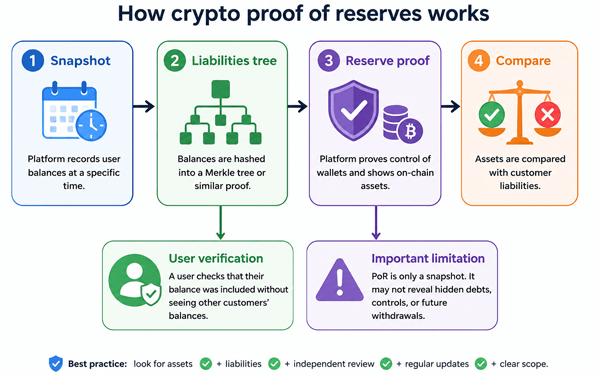
Diagram: A simplified proof-of-reserves workflow showing customer balance snapshots, Merkle tree liability proofs, reserve wallet checks, and user verification.
4. The Two Core Parts: Proof of Assets and Proof of Liabilities
A proof of reserves system is only meaningful if it deals with both assets and liabilities. Showing a wallet full of crypto is not enough. A platform also needs to show what it owes customers.
| Component | What it should answer | Weak version | Stronger version |
|---|---|---|---|
| Proof of assets | Does the platform control enough crypto assets? | Shows large wallets but does not prove ownership or scope. | Publishes wallet addresses, signs messages, and explains which assets and entities are included. |
| Proof of liabilities | How much does the platform owe users? | Gives only a total number with little detail. | Uses a verifiable customer balance snapshot, Merkle tree, or zero-knowledge proof so users can check inclusion. |
| Comparison | Are reserves greater than or equal to liabilities? | Reports a reserve ratio without explaining methodology. | Shows asset-by-asset ratios, date/time, exclusions, and independent review details. |
| Ongoing monitoring | Is this still true after the snapshot? | One-time report only. | Regular updates, transparent historical reports, and clear wallet monitoring. |
5. What Is a Merkle Tree in Proof of Reserves?
A Merkle tree is a way to combine many pieces of data into one cryptographic fingerprint called a Merkle root. In a proof of reserves system, each customer’s balance information can be converted into a hashed entry. Those entries are paired and hashed again, then repeated until one final root is produced.
The benefit is privacy and verifiability. A user can check whether their account balance was included in the tree without seeing all other users’ balances. If even one piece of data changes, the Merkle root changes, which makes tampering easier to detect.
For beginners, think of a Merkle tree like a sealed class attendance list. You can prove your name was included in the list, but you do not need to reveal everyone else’s names.
6. What About Zero-Knowledge Proofs and zk-SNARKs?
Some platforms have added zero-knowledge proofs, such as zk-SNARKs, to improve proof of reserves. A zero-knowledge proof can help prove that a calculation is correct without revealing all the underlying private information.
For example, Binance says its proof-of-reserves system uses zk-SNARKs so users can verify that account balances are included in the total calculation while preserving privacy. This type of approach can also help address weaknesses in basic Merkle tree systems, such as the risk of negative balances being used to distort liabilities.
Zero-knowledge proofs can improve the technical quality of PoR, but they still do not solve every problem. They do not automatically reveal hidden debts, poor governance, weak internal controls, or whether assets were borrowed temporarily for the snapshot.
7. Simple Example of Proof of Reserves
Imagine a crypto exchange called ClearBlock. Its customers hold the following balances on the exchange:
| Customer | BTC balance shown in account |
|---|---|
| Aisha | 1.0 BTC |
| Ben | 0.5 BTC |
| Carlos | 2.0 BTC |
| Dina | 1.5 BTC |
ClearBlock owes customers a total of 5.0 BTC. To prove reserves, it must show that it controls at least 5.0 BTC in reserve wallets for the BTC liabilities included in the report.
| Item | Amount |
|---|---|
| Total customer BTC liabilities | 5.0 BTC |
| BTC in wallets controlled by ClearBlock | 5.4 BTC |
| Reserve ratio | 108% |
In this simple example, ClearBlock appears to have more BTC than it owes customers for the included BTC balances. But users should still ask: Are all customer liabilities included? Are any reserves borrowed? Are there loans, liens, or legal claims against those assets? Is this only a one-day snapshot? Is an independent reviewer involved?
8. Real-World Examples of Crypto Proof of Reserves
Proof of reserves is used in different ways across the crypto industry. The exact methods vary, so users should compare scope, frequency, verification options, and third-party involvement rather than assuming all PoR reports are equal.
| Example | How it is commonly used | What users should check |
|---|---|---|
| Centralized exchanges | Exchanges publish asset reserves, reserve ratios, user verification tools, and sometimes Merkle tree or zero-knowledge proof systems. | Which assets are included, whether liabilities are included, whether user verification is possible, and how often reports are updated. |
| Kraken | Kraken has offered client verification for proof-of-reserves reviews and describes PoR as a way for clients to verify that in-scope balances are backed by real assets. | Check which services and assets are included in the latest review and whether your balance is in scope. |
| Binance | Binance publishes a proof-of-reserves page and has described using Merkle tree data with zk-SNARK proofs for user-balance verification. | Check reserve ratios, supported assets, methodology, code availability, exclusions, and update date. |
| Stablecoin issuers | Some issuers publish reserve attestations showing assets backing issued tokens, often involving cash, Treasury bills, or other instruments rather than only on-chain crypto. | Look at asset quality, custodian names, maturity, liquidity, auditor or attestation provider, and legal redemption rights. |
| Wrapped assets | A wrapped Bitcoin or cross-chain token issuer may show that tokens issued on one chain are backed by assets held on another chain. | Check whether circulating wrapped tokens match backing assets and whether custody arrangements are transparent. |
9. Benefits of Proof of Reserves
- Better transparency: Users can see more than marketing claims and may be able to verify wallet balances on-chain.
- User confidence: A clear report can reduce uncertainty about whether customer assets are actually held.
- Early warning signals: Falling reserve ratios, missing reports, vague methodology, or sudden exclusions can alert users to ask harder questions.
- Industry accountability: Exchanges that publish meaningful PoR can pressure competitors to improve transparency.
- Privacy-preserving verification: Merkle trees and zero-knowledge proofs can let users verify inclusion without revealing everyone’s balances.
- Asset-by-asset clarity: A good PoR report can show whether BTC liabilities are backed by BTC, ETH by ETH, stablecoins by the correct assets, and so on.
10. Risks and Limitations of Proof of Reserves
The biggest mistake is treating proof of reserves as proof that a company is safe. PoR can be useful, but it is limited. Here are the main risks beginners should understand.
| Risk or limitation | Why it matters | Practical question to ask |
|---|---|---|
| Snapshot risk | A report may only show reserves at one moment in time. Assets can move after the snapshot. | How often is PoR updated, and is wallet activity visible? |
| Hidden liabilities | The company may have loans, legal claims, off-balance-sheet obligations, or debts not included in the PoR scope. | Does the report include all customer liabilities and other obligations? |
| Borrowed reserves | A platform could temporarily borrow assets before a snapshot, then return them later. | Does the methodology address asset ownership, liens, and temporary transfers? |
| Incomplete asset coverage | Only selected tokens, chains, subsidiaries, or services may be included. | Which assets and products are excluded? |
| No internal-control assurance | PoR does not necessarily test governance, cybersecurity, segregation of duties, or operational controls. | Is there a broader audit or control report? |
| Valuation issues | Crypto prices move quickly; backing in one asset may not safely cover liabilities in another asset. | Are liabilities backed asset-by-asset or by volatile mixed assets? |
| Auditor or reviewer limitations | Some reports are attestations or agreed-upon procedures, not full audits. | Who performed the work, under what standard, and what exactly did they verify? |
| Privacy trade-offs | Publishing too much wallet information can create security or privacy risks. | Does the platform balance transparency with customer privacy and security? |
11. Proof of Reserves vs Full Financial Audit
Proof of reserves and a financial statement audit are not the same thing. A PoR report is usually narrower. It focuses on whether specific assets appear to support specific customer balances at a specific time. A full audit looks more broadly at financial statements, accounting policies, internal controls, liabilities, revenue, expenses, related-party transactions, and other financial risks.
| Feature | Proof of reserves | Full financial statement audit |
|---|---|---|
| Main purpose | Show that certain reserves match certain customer balances. | Give assurance on financial statements as a whole. |
| Scope | Usually limited to selected assets, wallets, and liabilities. | Broader company-wide financial reporting scope. |
| Timing | Often a point-in-time snapshot. | Covers a reporting period and balance sheet date. |
| Hidden liabilities | May not detect all debts or obligations. | Designed to assess recorded liabilities and financial statement presentation, though audits also have limits. |
| Internal controls | Usually limited or not covered. | May include control testing depending on the audit type and entity. |
| User takeaway | Useful transparency signal, but incomplete. | Stronger assurance, but still not a guarantee of future safety. |
12. How to Check a Crypto Proof of Reserves Report
A beginner does not need to understand every cryptographic detail to use PoR more wisely. Start with practical questions.
1. Find the official proof-of-reserves page. Avoid links from social media ads or random posts; use the platform’s official website or app.
2. Check the date and frequency. A report from many months ago may be less useful than a regularly updated report.
3. Look for asset-by-asset reserve ratios. A combined dollar value can hide weak backing for specific tokens.
4. Read the scope. Confirm which assets, chains, products, subsidiaries, and customer balances are included or excluded.
5. Check whether liabilities are included. A wallet list without customer liability proof is incomplete.
6. Use the personal verification tool if offered. Confirm that your balance was included in the snapshot.
7. Review the third-party report, if available. Look for the reviewer’s name, methodology, standards, limitations, and disclaimers.
8. Watch for red flags: vague language, no liabilities, no update date, unexplained exclusions, broken verification tools, or reserve ratios below 100%.
13. Best Practices for Users
- Do not keep more crypto on an exchange than you need for trading or short-term use.
- Use self-custody for long-term holdings if you understand private key security and can manage backups safely.
- Prefer platforms that explain PoR methodology clearly and include both assets and liabilities.
- Look for regular updates rather than one-time marketing announcements.
- Check whether the platform separates customer assets from company assets.
- Do not assume a 100% reserve ratio means the company has no other financial problems.
- Compare PoR with other trust signals, such as regulation, security history, insurance details, corporate governance, public financial disclosures, and customer withdrawal reliability.
14. Best Practices for Crypto Platforms Publishing Proof of Reserves
A strong proof of reserves program should be designed for users, not just public relations. Platforms should aim for clarity, completeness, and repeatability.
- Publish the exact snapshot time, included assets, included entities, and excluded products.
- Show both proof of assets and proof of liabilities.
- Use asset-by-asset reserve ratios instead of relying only on a total dollar figure.
- Prove wallet control with signed messages or other verifiable methods.
- Give every user a private way to verify their own inclusion.
- Use independent third-party review where appropriate and publish the limitations of that work.
- Avoid using vague labels such as 'audited' if the work is only an attestation or agreed-upon procedure.
- Update reports regularly and keep historical reports accessible.
- Disclose whether any reserves are pledged, borrowed, rehypothecated, locked, or subject to legal claims.
15. Common Misconceptions About Proof of Reserves
| Misconception | Reality |
|---|---|
| Proof of reserves means the exchange is completely safe. | No. It only provides limited evidence about included reserves and liabilities. |
| A wallet balance alone is proof of solvency. | No. You also need to know what the platform owes customers and other creditors. |
| All PoR reports are the same. | No. Methods, scope, frequency, and reviewer quality vary widely. |
| A 100% reserve ratio guarantees withdrawals forever. | No. Future losses, hacks, legal freezes, liquidity issues, or hidden obligations can still create problems. |
| Merkle trees reveal everyone’s balances. | Not necessarily. They are often used because they can allow private inclusion checks. |
| PoR replaces regulation and audits. | No. It can complement them, but it does not replace broader legal, financial, and operational oversight. |
16. Proof of Reserves Checklist Before Trusting a Platform
| Question | Good sign | Warning sign |
|---|---|---|
| Is there a recent PoR report? | Updated regularly with clear dates. | Old report or no date. |
| Are liabilities included? | Customer balances are included in a verifiable way. | Only wallet balances are shown. |
| Can users verify their own balance? | Merkle proof or similar user tool is available. | Users cannot check inclusion. |
| Is the scope clear? | Included and excluded assets are listed. | Scope is vague or buried. |
| Is there independent review? | Reviewer, method, and limitations are disclosed. | Anonymous or unclear third-party claims. |
| Are reserve assets high quality? | Assets match liabilities asset-by-asset. | Risky tokens or mixed assets used as backing. |
| Are reports consistent over time? | Historical reports remain available. | Reports disappear or methodology changes without explanation. |
17. Should You Rely on Proof of Reserves?
You can use proof of reserves as one helpful piece of information, but you should not rely on it alone. A transparent PoR process is better than no transparency, especially when it includes assets, liabilities, user verification, clear scope, and independent review. But it still cannot answer every question about a company’s financial health, risk management, legal obligations, cybersecurity, or future behavior.
For most users, the safest mindset is practical: proof of reserves can reduce uncertainty, but it does not eliminate counterparty risk. If you leave assets on a centralized platform, you are still trusting that platform to operate honestly, securely, and legally after the snapshot date.
18. FAQs About Crypto Proof of Reserves
18.1 What does proof of reserves mean in crypto?
Proof of reserves means a crypto platform provides evidence that it holds enough assets to cover customer balances included in the report. It usually involves proof of assets, proof of liabilities, and a comparison between the two.
18.2 Is proof of reserves the same as an audit?
No. A proof of reserves report is usually narrower than a full financial statement audit. It may only cover selected assets and customer balances at a specific point in time.
18.3 What is a Merkle tree proof of reserves?
It is a method that organizes customer balances into a cryptographic tree so users can verify their balance was included without revealing all customer data.
18.4 Can proof of reserves prove an exchange is solvent?
It can support a solvency claim for the assets and liabilities included in the report, but it does not automatically prove full company solvency. Hidden debts, excluded liabilities, borrowed assets, and operational risks may remain.
18.5 Why do crypto exchanges publish proof of reserves?
They publish PoR to build trust, improve transparency, respond to user concerns, and show that customer balances are backed by reserves.
18.6 What is a good reserve ratio?
A reserve ratio above 100% means the reported reserves exceed the reported liabilities for the included asset. However, users should also check scope, asset quality, and whether liabilities are complete.
18.7 Can a platform fake proof of reserves?
A weak PoR process can be misleading. For example, a platform might omit liabilities, borrow assets temporarily, or publish vague wallet information. Strong methodology and independent review reduce these risks but do not remove them completely.
18.8 Do decentralized exchanges need proof of reserves?
Usually not in the same way as centralized custodians, because users often keep control of their own assets and smart contracts hold funds transparently on-chain. However, bridges, wrapped assets, and custodial DeFi services may still need reserve transparency.
18.9 What should I do if my exchange has no proof of reserves?
Treat the lack of PoR as a transparency weakness. Consider reducing funds held there, using self-custody for long-term holdings, and comparing the platform with alternatives that provide clearer reserve information.
18.10 Is proof of reserves useful for stablecoins?
Yes, but stablecoin reserve reports can be different because backing may include cash, Treasury bills, repo agreements, or other financial assets. Users should check asset quality, liquidity, custodian details, and redemption rights.
19. Final Thoughts
Crypto proof of reserves is an important transparency tool, especially for centralized platforms that hold customer assets. It can help users see whether a platform appears to hold enough reserves for the customer balances included in a report. Merkle trees, signed wallet proofs, third-party reviews, and zero-knowledge proofs can make the process more private and verifiable.
But proof of reserves is not the same as complete safety. It is usually a limited snapshot, not a full audit of the business. It may not reveal hidden liabilities, poor controls, legal risks, borrowed reserves, or future liquidity problems. The best approach is to use PoR as one part of a broader risk checklist, not as a reason to stop asking questions.
For beginners, the practical rule is simple: prefer platforms that publish clear, regular, verifiable proof of reserves - but never assume that proof of reserves removes the need for caution, diversification, and responsible custody habits.
Sources Consulted and Checked
These sources were consulted and checked while preparing this article to support accuracy and clarity.
- PCAOB Investor Advisory - Exercise Caution With Third-Party Verification/Proof of Reserve Reports
- SEC Investor Alert - Exercise Caution with Crypto Asset Securities
- Coinbase - How crypto companies can provide proof of reserves
- Kraken - Proof of Reserves
- Binance - Proof of Reserves
- Binance Academy - Improving Crypto Transparency With Zero-Knowledge Proof
Reader Advice
This article is provided for educational and informational purposes only and is not personalized financial, investment, legal, tax, or security advice. Crypto assets, exchanges, custodial services, and self-custody methods involve significant risks, including price volatility, hacking, fraud, loss of access, platform failure, liquidity problems, and possible loss of funds. Proof of reserves is a limited transparency tool and does not guarantee solvency, safety, regulatory compliance, or future withdrawals. Rules, policies, laws, market practices, and statistics can change over time and vary by country or region, so readers should verify current information through official regulators, platform disclosures, and qualified professionals before making decisions. Never risk funds you cannot afford to lose.