Crypto Payment Gateways in the US: Complete Guide to Features, Fees & Risks
Executive Summary
A crypto payment gateway lets a business quote an invoice in dollars, allow the buyer to pay from a cryptocurrency wallet, verify the blockchain payment and deliver settlement to the merchant, often in U.S. dollars or a dollar-denominated stablecoin. It is the crypto equivalent of a payment service provider, but the underlying payment rail is a blockchain rather than a card network or ACH.
For most U.S. merchants, the key decision is not simply “Should we accept Bitcoin?” It is whether crypto acceptance solves a real customer or cross-border problem after accounting for integration, fraud controls, refunds, accounting, tax records, sanctions screening, volatility and provider concentration. Stablecoin-first products have become the practical center of the market because they reduce price volatility and can settle around the clock.
| Question | Practical answer |
|---|---|
| Best fit | Businesses with measurable demand from crypto users, international customers, digital-native buyers, high average order values or costly cross-border settlement. |
| Usually easiest model | Use a regulated third-party gateway that handles wallet compatibility, payment detection, compliance checks and automatic fiat settlement. |
| Main advantage | Potentially broader global reach, faster availability of funds and no card-network chargebacks after final settlement. |
| Main trade-off | Blockchain transfers are usually irreversible; refunds, customer mistakes, sanctions exposure, wallet security and accounting require deliberate controls. |
| Tax baseline | The merchant generally recognizes ordinary business revenue at the U.S.-dollar fair market value when received. If the merchant keeps crypto, later price movement can create a separate gain or loss. |
| Regulatory baseline | A merchant accepting crypto solely for its own goods or services is generally treated differently from a gateway that accepts and transmits value for others. Payment processors may be money transmitters under FinCEN rules and may also need state licenses. |
| 2026 market direction | Stablecoin checkout, fiat settlement and embedded payment APIs are replacing older “accept any coin and hold it” models. |
Bottom line
Crypto payments should be an additional payment method, not a substitute for basic payment controls. Start with a limited pilot, settle to dollars unless treasury policy says otherwise, accept a narrow asset/network list and measure conversion, support burden, refund rates and total cost.
1. What Is a Crypto Payment Gateway?
A crypto payment gateway is software and financial infrastructure that helps a merchant accept blockchain-based payments. It normally creates a time-limited payment request, shows the customer an amount and wallet address or QR code, monitors the correct blockchain, determines when the payment is sufficiently confirmed, notifies the merchant’s order system and settles the proceeds according to the merchant’s instructions.
1.1 Gateway, processor and wallet: the difference
| Term | What it does | Merchant implication |
|---|---|---|
| Crypto payment gateway | Connects checkout, wallet payment, blockchain monitoring and merchant settlement. | The most complete option for ecommerce or invoicing. |
| Payment processor | Accepts/transmits value and may convert crypto to fiat. | Often bears licensing, AML and sanctions duties; confirm its regulatory status. |
| Wallet | Stores or controls private keys and sends/receives digital assets. | Direct wallet acceptance gives control but shifts security, accounting and compliance work to the merchant. |
| Exchange or business crypto account | Converts, stores or transfers crypto and may offer payment links/APIs. | Useful for treasury and off-ramping, but not every exchange product is a full checkout solution. |
| Stablecoin payment method | Accepts a token designed to track a fiat currency, usually the U.S. dollar. | Reduces—but does not eliminate—volatility, issuer, depegging and network risks. |
1.2 What the gateway does behind the scenes
- Price conversion: locks or calculates a crypto amount from a dollar invoice.
- Address generation: creates a unique address, payment intent or smart-contract instruction.
- Blockchain monitoring: checks for the correct token, network, amount and confirmation status.
- Risk screening: may screen wallets, sanctions indicators and transaction patterns.
- Settlement: pays the merchant in USD, stablecoin, cryptocurrency or a chosen mix.
- Integration: returns webhooks or API responses to mark an order paid, expired, underpaid or overpaid.
- Reporting: provides transaction IDs, exchange rates, fees and settlement data for reconciliation.
Important distinction
“No chargebacks” does not mean “no disputes.” A confirmed blockchain payment may be irreversible, but merchants still face refund duties, product claims, fraud complaints, contractual obligations and consumer-protection laws.
2. How Crypto Payments Work: Step by Step
- A customer selects “Pay with crypto” at checkout. The merchant still prices the product in U.S. dollars unless it intentionally uses crypto-denominated pricing.
- The gateway creates a payment intent and displays supported assets, networks, a wallet address or QR code, the exact amount and an expiration time.
- The customer approves the transfer in a compatible wallet or exchange account. Network fees may be paid by the buyer, included in the quote or subsidized by the provider.
- The transaction is broadcast to the blockchain. The gateway checks the token contract, network, destination address and amount.
- The gateway waits for its required level of confirmation or uses an off-chain/internal transfer method where available.
- The merchant receives an authorization or “paid” webhook. The order should only be fulfilled when the gateway’s final status, not a customer screenshot, meets the merchant’s policy.
- The provider settles funds. With fiat settlement, it converts the crypto and sends USD to the merchant’s bank or platform balance. With crypto settlement, the merchant receives the selected digital asset.
- The merchant records gross revenue, gateway fees, refunds, settlement and any subsequent gain or loss on retained digital assets.
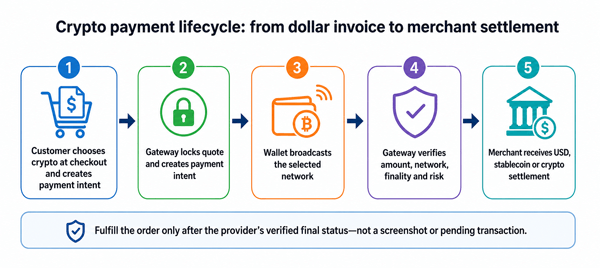
Figure 1. A typical crypto payment gateway converts a dollar-denominated order into a verified blockchain payment and merchant settlement.
2.1 Why confirmations matter
A blockchain transaction can appear before it is economically final. Gateways use network-specific rules to decide when a payment is sufficiently settled. Faster confirmation improves checkout experience but can increase exposure to chain reorganizations, replacement transactions or operational errors. The right threshold depends on the network, payment amount and product risk.
2.2 Underpayments, overpayments and wrong-network payments
These are common exceptions. A customer may omit a network fee, use a stale quote, send the right token on the wrong network or send from a smart contract that behaves unexpectedly. A mature gateway provides exception statuses and recovery procedures. Merchants should publish a clear policy for payment expirations, partial payments and recovery fees.
3. Gateway Models and Settlement Choices
| Model | How it works | Advantages | Risks / workload |
|---|---|---|---|
| Hosted gateway with fiat settlement | Provider receives crypto and settles USD. | Lowest treasury volatility; simpler books and banking. | Provider fees, onboarding, reserves/holds and dependency. |
| Hosted gateway with stablecoin settlement | Provider settles in USDC, PYUSD or another supported stablecoin. | 24/7 onchain liquidity and easier cross-border payouts. | Issuer, depegging, wallet, network and conversion risk. |
| Hosted gateway with volatile-crypto settlement | Merchant keeps BTC, ETH or another asset. | Direct treasury exposure and no immediate conversion. | Price risk, tax lots, custody and governance burden. |
| Direct wallet acceptance | Customer pays merchant-controlled addresses. | Maximum control and potentially fewer processor fees. | Highest security, compliance, support and reconciliation burden. |
| Embedded/API payment acceptance | Checkout and payment lifecycle are built into the merchant or platform. | Custom experience, marketplace features and automation. | Engineering, monitoring and provider/API concentration risk. |
| Payment link/invoice | Provider-hosted page or link used without a full cart integration. | Fast pilot for services, B2B invoices and donations. | Less checkout control; manual workflow may not scale. |
3.1 Fiat settlement vs. crypto settlement
Automatic USD settlement is usually the safest starting point for a U.S. operating company. It aligns the payment asset with payroll, suppliers and taxes. Crypto settlement may make sense when the business has approved onchain expenses, international payouts, customer refunds in the same asset or a board-approved treasury allocation. Keeping crypto merely because it arrived as payment turns a payment decision into an investment and custody decision.
3.2 Stablecoins are not cash deposits
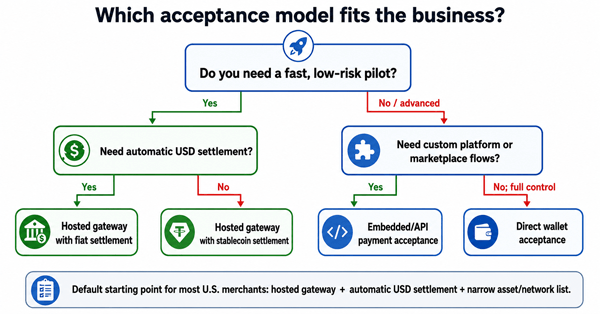
Figure 2. A practical model-selection path. Most first-time merchants should avoid direct custody unless they already have security, compliance and reconciliation capabilities.
A dollar stablecoin is designed to maintain a $1 value, but it is not automatically the same as an insured bank deposit. Risk depends on the issuer, reserve quality, redemption rights, legal structure, supported network, smart contracts, custodians and market liquidity. The 2025 GENIUS Act created a U.S. framework for permitted payment stablecoin issuers, and Treasury proposed implementing AML and sanctions rules in April 2026, but merchants still need asset-level due diligence and current legal advice.
4. Benefits, Drawbacks and Realistic Expectations
4.1 Potential benefits
- Access to crypto-native and international customers who prefer wallet payments.
- Around-the-clock transaction and settlement capability on supported networks.
- Potentially lower acceptance cost for some ticket sizes, corridors and providers.
- Reduced exposure to card chargebacks once a valid blockchain payment is final.
- Faster cross-border value transfer than some correspondent banking routes.
- Programmable payment links, APIs, split settlement and automated payouts.
- A marketing and customer-choice benefit when genuine demand exists.
4.2 Limitations and disadvantages
- Customer adoption remains uneven; adding the option may not materially increase conversion.
- Refunds are not native reversals and may require a new transfer, a refund address and network fees.
- User mistakes can be irreversible, including wrong addresses, networks and tokens.
- Provider, banking and regulatory eligibility can change.
- Volatile coins create treasury and tax complexity unless immediately converted.
- Stablecoins add issuer, redemption, reserve, smart-contract and depegging risk.
- Blockchain transparency can expose business payment flows unless privacy is designed carefully.
- Accounting systems may not map cleanly to transaction hashes, wallet addresses and multiple settlement events.
Avoid the wrong business case
“Crypto is popular” is not a sufficient reason. A defensible business case connects the payment method to measurable customer demand, lower total cost, faster settlement, improved cross-border reach or a strategic onchain workflow.
5. Fees, Costs and Hidden Expenses
The advertised gateway fee is only one part of total cost. Compare the all-in economics for the same transaction profile, settlement method and refund rate.
| Cost category | What to examine |
|---|---|
| Gateway transaction fee | Percentage, fixed fee, volume tiers, high-risk surcharge and minimums. |
| Conversion spread | Difference between the reference market rate and the rate used for customer quote or merchant settlement. |
| Network fee | Who pays gas/miner fees for customer payment, sweep, refund and payout transactions. |
| Fiat settlement fee | ACH/wire cost, minimum payout, timing, failed-transfer fee and currency conversion. |
| Stablecoin conversion/off-ramp | Fee to convert USDC/PYUSD/other token to USD and withdraw to a bank. |
| Refund expense | New network fee, exchange-rate movement and customer-support labor. |
| Integration cost | Developer time, plugins, API maintenance, monitoring and checkout testing. |
| Compliance cost | Legal review, sanctions procedures, recordkeeping and vendor due diligence. |
| Custody/security cost | Wallet infrastructure, hardware security, multisignature approvals, insurance and incident response. |
| Accounting/tax cost | Subledger, cost-basis records, reconciliation and professional review. |
| Working-capital cost | Settlement delay, reserves, holds and provider failure exposure. |
5.1 Current public fee examples
Verification note Public prices and product availability were checked against official provider pages on August 2, 2026. Account-specific pricing, underwriting and geographic eligibility may differ.
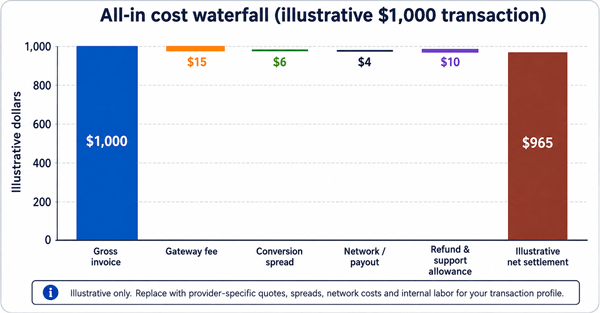
Figure 3. Headline processing fees do not show the full cost. The amounts above are illustrative, not provider quotes.
Public prices change and are not directly comparable. As reviewed August 2, 2026, PayPal lists a 1.5% Pay with Crypto merchant rate on or after August 1, 2026. BitPay publishes volume-tiered acceptance pricing of 2% + $0.25 below $500,000 monthly volume, 1.5% + $0.25 from $500,000 to $999,999, and 1% + $0.25 at $1 million or more, with possible higher fees for high-risk industries. Coinbase Business states that payment and auto-conversion fees apply but directs account holders to the current in-product rate. Stripe’s stablecoin documentation emphasizes local-currency settlement; merchants should obtain current account-specific pricing and eligibility.
Comparison rule
Do not compare a gateway’s headline percentage with a card processor’s percentage alone. Include interchange, fixed fees, cross-border/FX fees, chargeback losses, fraud tools, refunds, conversion spreads, network fees and internal labor.
6. U.S. Regulation and Compliance
Crypto payments sit across payments law, money transmission, sanctions, consumer protection, tax, privacy, cybersecurity and contract law. The exact obligations depend on what the business does—not just what it calls itself.
6.1 Merchant versus money transmitter
FinCEN guidance distinguishes a user spending or receiving convertible virtual currency for its own account from a business accepting and transmitting value for others. A merchant that receives crypto as payment for its own goods or services generally presents a different Bank Secrecy Act profile from a gateway that receives crypto from a customer and transmits value to the merchant. FinCEN’s 2019 guidance states that CVC payment processors generally fall within the money-transmitter definition unless a specific exemption applies.
That distinction can change if a merchant holds funds for third parties, operates a marketplace wallet, converts assets for customers, provides custodial balances, routes payments among users or offers payout/remittance services. Businesses designing those functions should obtain specialized legal analysis before launch.
6.2 State money-transmitter and virtual-currency licensing
Federal MSB registration does not replace state licensing. Requirements differ by state and may include money-transmitter licenses, virtual-currency licenses, surety bonds, permissible-investment rules, examinations, cybersecurity requirements and consumer disclosures. A merchant using a third-party provider should verify where the provider is licensed or otherwise authorized and whether the merchant’s own activities remain outside licensable transmission.
6.3 Sanctions compliance
OFAC rules apply to U.S. persons and transactions involving blocked persons or prohibited jurisdictions, including digital-asset activity. A processor may screen wallet addresses, IP/geolocation signals and transaction history, but the merchant remains responsible for its own compliance program where applicable. Controls should include customer and counterparty screening, escalation procedures, blocked-property handling, documentation and current sanctions-list updates.
6.4 AML, KYC and transaction monitoring
A regulated processor may perform customer identification, wallet screening, suspicious-activity monitoring, recordkeeping and reporting. Merchants should understand exactly what the provider covers. Provider screening does not automatically satisfy obligations associated with the merchant’s own customer relationship, restricted products, marketplace sellers, refunds or off-platform transfers.
6.5 Consumer protection and commercial law
- Describe prices, expiration times, exchange rates, network fees and refund terms clearly.
- Do not imply that crypto payment removes statutory warranty, refund or deceptive-practice obligations.
- Use truthful marketing; avoid claims that payments are “risk-free,” “instant” or “guaranteed.”
- Maintain a complaint and error-resolution process even where the blockchain transfer cannot be reversed.
- For recurring charges, obtain clear authorization and explain how stablecoin subscription payments operate.
- Evaluate privacy notices and data-sharing across wallet analytics, identity providers and processors.
6.6 Stablecoin regulation in 2026
The GENIUS Act became law on July 18, 2025 and established a federal framework for payment stablecoins. Among other elements, it focuses on permitted issuers, reserves, redemption and compliance. In April 2026, Treasury announced a joint FinCEN/OFAC proposed rule to implement anti-money-laundering and sanctions requirements for permitted payment stablecoin issuers. Because implementation remains rule-dependent, merchants should verify the current status rather than assume every dollar-pegged token is compliant or equivalent.
7. Federal and State Tax Treatment
7.1 Income recognition for the merchant
For federal income-tax purposes, digital assets are generally treated as property. When a business receives crypto for goods or services, it generally includes the U.S.-dollar fair market value of the asset in gross income at the time of receipt under its accounting method. The sales transaction is still business revenue; accepting crypto does not make it tax-free.
7.2 What happens if the merchant keeps the crypto
The dollar value recognized when received generally becomes the merchant’s tax basis in the digital asset, adjusted for applicable costs. A later sale, exchange or use of that asset can create a separate gain or loss measured against that basis. This is why automatic conversion to USD can materially simplify tax-lot accounting.
7.3 Sales tax
Payment in crypto does not normally change whether a sale is subject to state or local sales tax. The merchant generally calculates tax from the taxable dollar sales price under the applicable jurisdiction’s rules, collects it through checkout and remits it in dollars. Multi-state nexus, marketplace-facilitator rules, digital-product classifications and local rates still apply.
7.4 Information reporting and records
Digital-asset broker reporting rules have evolved, including Form 1099-DA. Whether or not a form is received, businesses must maintain their own complete records. Retain order ID, timestamp, customer invoice amount, asset and network, quantity received, fair-market-value source, transaction hash, gateway fee, conversion rate, settlement amount, refund transaction and wallet/custodian statements.
| Event | Typical accounting/tax record |
|---|---|
| Customer pays $1,000 invoice in USDC | Record $1,000 gross revenue and sales tax as applicable; record processor fee separately. |
| Provider converts immediately and settles $985 | Record gross revenue at the sale amount, not merely the net bank deposit; record $15 processing/conversion cost. |
| Merchant keeps BTC worth $1,000 | Record $1,000 revenue and establish a $1,000 tax basis, subject to specific facts and costs. |
| BTC later sold for $1,150 | Record a separate $150 gain, subject to holding period and tax rules. |
| Refund issued after asset price changes | Record the customer refund and any separate gain/loss or fee consequences of acquiring/sending the refund asset. |
Tax control
Choose and document a consistent fair-market-value source and timestamp policy. Reconcile gateway reports to the order system, wallet/custodian, bank and general ledger every month.
8. Security, Fraud and Operational Risks
| Risk | How it occurs | Controls |
|---|---|---|
| Wrong address/network | Customer sends to an unsupported chain or mistypes address. | Use provider-generated payment intents, network labels, QR codes, address validation and warnings. |
| Invoice tampering | Malware or compromised checkout replaces the payment address. | Content-security controls, signed payment requests, monitoring, code review and domain protection. |
| Private-key theft | Merchant-managed wallet credentials are stolen. | Avoid direct custody initially; use hardware security, multisig, least privilege and withdrawal allowlists. |
| Webhook spoofing | Attacker sends a fake “paid” event. | Verify signatures, fetch transaction status server-to-server, use idempotency and log events. |
| Double-spend/reorg | Order is fulfilled before sufficient finality. | Use provider final status, risk-based confirmations and delayed fulfillment for high-value goods. |
| Sanctions/illicit funds | Funds originate from or pass through risky addresses. | Use compliant provider screening, escalation and documented OFAC procedures. |
| Stablecoin depeg/freeze | Token loses parity or issuer freezes addresses. | Limit exposure, use approved assets, prompt fiat conversion and concentration limits. |
| Provider failure | Outage, insolvency, cyberattack or bank disruption delays funds. | Set exposure limits, frequent settlement, backup payment method and data export. |
| Refund fraud | Customer requests refund to a different wallet or claims non-receipt. | Refund to verified original source where supported, authenticate customer and document approval. |
| Privacy leakage | Public ledger reveals revenue or counterparties. | Use unique addresses, provider-managed flows, data minimization and wallet-privacy review. |
8.1 Security standards for an API integration
- Never treat a browser redirect or screenshot as proof of payment.
- Verify webhook signatures and replay protection.
- Use idempotency keys when creating charges and processing events.
- Restrict API keys by environment, role and IP where available; rotate secrets.
- Keep testnet and production addresses, tokens and credentials separate.
- Model every payment state: created, pending, confirmed, expired, underpaid, overpaid, failed, refunded and manually reviewed.
- Alert on webhook failures, settlement delays, unusual refund volume and address changes.
- Retain transaction hashes and gateway event logs for audit and support.
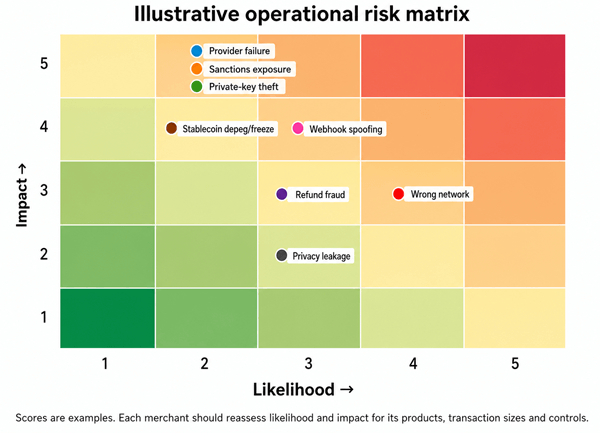
Figure 4. An illustrative risk matrix helps prioritize controls. The merchant should score risks using its own transaction profile.
8.2 Fraud realities
Crypto eliminates certain card fraud patterns but introduces others. The FTC warns that scammers frequently demand cryptocurrency because transfers can be difficult to reverse. Merchants should train support staff not to instruct customers to buy crypto at an ATM, share seed phrases or send “verification” payments. No legitimate payment-support process requires a customer’s recovery phrase.
9. Examples of Crypto Payment Gateways and Platforms in the US (2026)
The following examples illustrate different models. They are not endorsements, and availability depends on business type, location, underwriting and integration. Confirm current contracts, supported assets, fees, settlement, reserve rights and licenses.
| Provider / model | Current positioning | Settlement / notable points | Best suited to |
|---|---|---|---|
| BitPay | Established crypto payment processor with online, invoice, retail and payout tools. | Supports fiat or crypto settlement; published volume tiers; broad wallet/asset support; compliance onboarding. | Merchants wanting a dedicated crypto processor and multiple acceptance formats. |
| PayPal Pay with Crypto | Crypto payment option within PayPal’s merchant ecosystem. | Global buyers can use supported crypto/wallet sources; merchant receives local-currency settlement; published U.S. rate is 1.5% from Aug. 1, 2026. | Existing PayPal merchants seeking a familiar checkout path. |
| Stripe stablecoin payments | Stablecoin payment method integrated with Stripe’s payments stack. | Customers choose supported wallet/token/network; completed payments settle to the Stripe balance in local currency. | Online businesses already using Stripe and prioritizing fiat settlement. |
| Coinbase Business / Coinbase Payments | Business account, payment links/APIs and stablecoin commerce infrastructure. | USDC-centric payments, business account settlement and bank withdrawal options; Coinbase Commerce portal ended after Mar. 31, 2026. | Crypto-native firms, platforms, marketplaces and USDC workflows. |
| Direct wallet + accounting stack | Merchant accepts to self-controlled addresses and uses separate analytics/accounting. | No automatic fiat conversion unless added separately; maximum control and responsibility. | Experienced organizations with custody, compliance and engineering capabilities. |
9.1 How these examples differ
BitPay represents the traditional specialist processor. PayPal and Stripe embed crypto or stablecoin acceptance into broader payment platforms. Coinbase increasingly focuses on USDC business payments and infrastructure rather than the old standalone Commerce portal. Direct wallet acceptance is not a gateway at all; it is a do-it-yourself operating model and should not be treated as the default merely to avoid fees.
10. How to Choose a Crypto Payment Gateway
| Criterion | Questions to ask | Red flags |
|---|---|---|
| Regulatory status | Where is the provider registered or licensed? Which entity contracts with us? | Vague legal entity, no licensing explanation, unsupported “fully compliant” claims. |
| Settlement | USD, stablecoin or crypto? Timing, minimums, reserves and failed payouts? | Long or unclear holding periods, forced asset exposure. |
| Assets/networks | Which exact token contracts and chains are supported? | Too many obscure tokens, no wrong-network policy. |
| Pricing | Fee, fixed charge, spread, network cost, refund cost, FX and withdrawal fee? | Only a headline percentage; spread not disclosed. |
| Security | Custody model, SOC reports, incident history, key controls and webhook verification? | No security documentation or weak account controls. |
| Compliance controls | KYC/KYB, wallet screening, sanctions, suspicious activity and blocked funds? | Claims that blockchain payments require no compliance. |
| Refunds/support | Can refunds return through the API? How is recipient verified? | Manual wallet requests without authentication. |
| Integration | Plugin/API quality, webhooks, sandbox, uptime, idempotency and status model? | No test environment or incomplete event documentation. |
| Reporting | Gross sale, fee, rate, tx hash, settlement and tax exports? | Only net deposits; no auditable transaction export. |
| Contract risk | Termination, reserves, data portability, liability, indemnity and dispute forum? | Provider may freeze indefinitely without process or export access. |
10.1 Weighted decision matrix
Score each provider from 1 (poor) to 5 (excellent), multiply by the weight and compare totals. Adjust weights to your business.
| Factor | Suggested weight | Why it matters |
|---|---|---|
| Compliance and licensing | 20% | A low fee does not compensate for regulatory or banking risk. |
| Settlement and treasury fit | 15% | Determines volatility, liquidity and reconciliation burden. |
| Security and custody | 15% | Protects funds, data and customer trust. |
| Total cost | 15% | Includes fees, spread, network and internal operations. |
| Customer experience | 10% | Wallet compatibility, mobile flow and payment success. |
| Integration reliability | 10% | APIs, webhooks, uptime and exception handling. |
| Reporting/accounting | 10% | Supports audit, tax and month-end close. |
| Support and contract terms | 5% | Critical during frozen payments, outages and refunds. |
11. Implementation Playbook
11.1 Phase 1: Validate the business case
- Measure customer requests, abandoned checkouts by geography and cross-border payment pain.
- Define the target use case: ecommerce checkout, B2B invoice, donation, marketplace or payout.
- Estimate monthly volume, average ticket, countries, refund rate and supported products.
- Compare total cost with cards, ACH, wires and alternative payment methods.
- Set a pilot success threshold before integration begins.
11.2 Phase 2: Define policy and risk appetite
- Start with USD settlement unless treasury approves crypto holdings.
- Choose an approved asset/network list; stablecoin-only is often simpler.
- Set maximum transaction size and enhanced-review thresholds.
- Decide when an order is final and when high-value goods can be released.
- Document refund asset, exchange-rate and network-fee treatment.
- Define prohibited countries, products and customer types.
- Set provider exposure and settlement-frequency limits.
11.3 Phase 3: Vendor diligence and contracting
- Verify legal entity, licenses, regulatory disclosures and banking relationships.
- Review security reports, insurance, custody model and incident notifications.
- Model all charges and settlement economics with sample transactions.
- Review reserve, freeze, termination, data ownership, indemnity and liability clauses.
- Confirm data exports and transition assistance if the service ends.
11.4 Phase 4: Technical integration
- Use a sandbox and scripted test cases for every payment state.
- Display the invoice currency, crypto amount, network and timer clearly.
- Verify server-side status before fulfillment.
- Make webhook processing idempotent and observable.
- Store provider payment ID, order ID, tx hash, exchange rate, fee and settlement ID.
- Test mobile wallets, exchange wallets, expired quotes, underpayments and refunds.
11.5 Phase 5: Controlled launch
- Launch to a small segment, geography or transaction limit.
- Keep cards/ACH available; do not force customers into crypto.
- Monitor authorization-to-payment conversion, payment completion time and support tickets.
- Reconcile daily during the pilot and review sanctions/exception cases.
- Expand only after accounting, support and refunds work end to end.
12. Accounting, Refunds and Reconciliation
12.1 Build a four-way reconciliation
Each period, match (1) the commerce order, (2) gateway payment record, (3) blockchain or custodial record and (4) bank or stablecoin settlement. The gross sale, tax, discount, gateway fee, conversion spread, refund and net deposit should be separately identifiable.
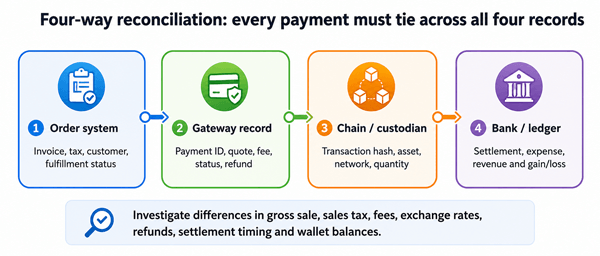
Figure 5. Four-way reconciliation prevents net-settlement deposits from obscuring gross revenue, fees, refunds or missing transactions.
12.2 Refund policy design
- State whether refunds are denominated in the original dollar purchase price or the original crypto quantity. Dollar-denominated refunds are usually clearer for retail sales.
- Authenticate the customer before collecting a refund address. Prefer returning to the original verified source where the provider supports it.
- State who bears network fees and how dust/minimum amounts are handled.
- Use dual approval for high-value manual refunds.
- Do not send a refund merely because a person presents a transaction hash; verify the linked order and customer.
- Record the refund transaction hash, asset quantity, dollar value, approver and reason.
12.3 Revenue presentation
A processor’s net deposit is not usually the gross sale. For example, if a $500 order produces a $490 bank settlement after a $10 gateway fee, the books generally need $500 revenue (plus or minus sales tax presentation under applicable accounting policy) and $10 payment-processing expense, not $490 revenue. Obtain accountant guidance for your reporting framework and facts.
13. Use Cases and Worked Examples
Example 1: U.S. ecommerce store with automatic fiat settlement
A customer buys a $250 product and pays from a wallet. The gateway locks the quote, confirms payment and settles $246.00 after a $4.00 fee. The merchant records the $250 sale, applicable sales tax and $4 payment expense. Because the provider converted before merchant settlement, the merchant avoids holding the volatile asset, although contract and tax details still matter.
Example 2: B2B invoice paid in USDC
A U.S. software company invoices an overseas client $20,000. The client pays USDC on an approved network. The gateway settles USD the next business day. The benefit is 24/7 payment initiation and potentially simpler cross-border collection. The company still screens the customer, documents the source and purpose of funds, records $20,000 revenue and reconciles the conversion and bank receipt.
Example 3: Merchant keeps Bitcoin
A consulting firm receives BTC worth $5,000 for services and keeps it. It generally recognizes $5,000 of service revenue when received and establishes a tax basis in the BTC. If it later sells for $4,200, the $800 decline is analyzed separately from the original service income. The firm also needs custody controls, valuation policy and board/owner-approved treasury limits.
Example 4: Customer uses the wrong network
A customer sends a supported stablecoin to an address on an unsupported chain. The order system never receives a valid payment. Recovery may be impossible or may require a provider review and fee. The merchant should not mark the order paid based solely on the token name; token contract and network must match the payment intent.
14. Common Mistakes to Avoid
| Mistake | Why it is costly | Better approach |
|---|---|---|
| Accepting every coin and network | Increases support, liquidity, sanctions and wrong-network risk. | Begin with one or two well-supported assets/networks. |
| Keeping crypto by default | Creates accidental investment, tax-lot and custody exposure. | Settle to USD unless treasury policy approves otherwise. |
| Trusting screenshots | Screenshots can be edited and pending transactions can fail. | Fulfill only after verified provider final status. |
| Ignoring refunds | Irreversibility does not erase customer obligations. | Design and test authenticated refund workflows. |
| Comparing only headline fees | Misses spread, network, settlement and labor. | Calculate all-in cost for representative transactions. |
| Assuming provider compliance covers everything | Merchant obligations can remain. | Map responsibilities in writing with legal/compliance review. |
| Poor reconciliation | Causes understated revenue, tax errors and missing funds. | Reconcile order, gateway, chain/custodian and bank. |
| No exit plan | Provider access or product can change. | Export data, maintain alternatives and cap unsettled exposure. |
| Using one shared address | Makes reconciliation and privacy harder. | Use unique payment intents or addresses. |
| Marketing “no risk” or “instant” | Misleading and operationally false. | Describe finality, fees and settlement accurately. |
15. Decision Framework and Launch Checklist
15.1 Should your business accept crypto?
| Answer “yes” when… | Pause or decline when… |
|---|---|
| Customers are asking for it and the demand is measurable. | The project is driven only by publicity or executive enthusiasm. |
| Cross-border collection is slow or expensive. | Most sales are domestic low-ticket purchases with no wallet demand. |
| A provider can settle in USD with acceptable total cost. | The only workable model requires holding volatile assets. |
| Accounting, refunds, sanctions and support have owners. | No team owns exceptions, reconciliation or customer complaints. |
| The gateway is licensed/authorized for the relevant activity and geography. | Provider status, legal entity or terms are unclear. |
| A small, reversible operational pilot is possible. | Launch requires replacing reliable existing payment methods. |
15.2 Pre-launch checklist
- ☐ Business case and pilot metrics approved
- ☐ Legal entity and provider diligence completed
- ☐ Licensing and responsibility map reviewed
- ☐ Approved assets and networks documented
- ☐ USD/stablecoin/crypto settlement policy approved
- ☐ Transaction and exposure limits configured
- ☐ Refund and wrong-network policies published
- ☐ Webhook signatures and server-side verification tested
- ☐ Sanctions escalation and blocked-funds process documented
- ☐ Accounting and tax data fields validated
- ☐ Four-way reconciliation tested
- ☐ Support scripts and scam warnings trained
- ☐ Incident response and provider outage plan tested
- ☐ Data export and exit plan confirmed
16. Frequently Asked Questions
16.1 Is it legal for a U.S. business to accept cryptocurrency?
Generally, a U.S. merchant may accept cryptocurrency for lawful goods or services, but the business must comply with applicable tax, sanctions, consumer-protection, licensing, privacy and industry-specific laws. Activities beyond accepting payment for the merchant’s own goods, such as transmitting funds for others or operating custodial balances, can create additional licensing and BSA obligations.
16.2 Does a merchant need a money-transmitter license?
A merchant merely accepting crypto for its own goods or services is generally different from a business accepting and transmitting value for others. The answer is activity- and state-specific. Marketplaces, custodial wallets, exchanges, payment routing and payout services require specialized analysis.
16.3 Are crypto payments taxable?
Yes. Business income received in digital assets is generally taxable at its U.S.-dollar fair market value. Holding the asset afterward can create a separate gain or loss when it is sold, exchanged or spent.
16.4 Do customers pay sales tax when using crypto?
Crypto does not normally remove sales-tax obligations. The merchant calculates and remits tax under the same state and local rules that apply to the underlying product or service.
16.5 Can crypto payments be charged back?
A confirmed onchain transfer generally cannot be reversed through a card-network chargeback. However, customers can still seek refunds, assert contract or consumer claims, or dispute delivery. Some provider-managed/off-chain systems may have their own rules.
16.6 Which cryptocurrency is best for payments?
For many merchants, a reputable dollar stablecoin on a low-cost, well-supported network is operationally simpler than a volatile coin. The choice still requires issuer, network, liquidity, regulatory and customer-demand review.
16.7 Is a stablecoin the same as a dollar in a bank?
No. A stablecoin is a token designed to track a dollar. It has issuer, reserve, redemption, smart-contract, network and custody risks and is not automatically an FDIC-insured bank deposit.
16.8 Can a business accept Bitcoin and receive dollars?
Yes. Many gateways quote the customer in Bitcoin or another asset and automatically convert and settle the merchant in USD, subject to availability, fees, underwriting and settlement terms.
16.9 What happens if a customer sends the wrong amount?
The gateway may label the payment underpaid or overpaid. The merchant should not fulfill automatically unless its policy permits it. Recovery or supplemental payment procedures should be documented.
16.10 What if a customer sends the right token on the wrong blockchain?
The payment may be unrecoverable because the provider may not control or support that network. Clear network labeling and warnings are essential.
16.11 How should refunds work?
Most merchants should define refunds in the original dollar purchase amount, authenticate the customer, use a provider refund API where possible and document exchange-rate and network-fee treatment.
16.12 Are crypto gateway fees lower than credit-card fees?
Sometimes, but not always. Compare all-in cost, including fixed fees, spread, network fees, settlement, refunds, support, compliance and engineering. The answer depends heavily on ticket size and customer geography.
16.13 Do crypto gateways prevent fraud?
They can reduce card chargebacks and use wallet screening, but they do not eliminate fraud, scams, account takeover, invoice tampering or customer mistakes.
16.14 Can a nonprofit accept crypto donations?
Many can, but they need gift-acceptance policies, donor acknowledgment, sanctions controls, valuation and tax/accounting procedures. Donation-specific legal and tax advice may be required.
16.15 Can crypto be used for subscriptions?
Some providers support stablecoin recurring or subscription models, but the customer experience differs from stored card credentials. Merchants need clear authorization, payment-failure handling and refund terms.
16.16 Should a small business accept crypto directly to its own wallet?
Usually not as the first step. Direct acceptance can reduce processor dependency but transfers custody, security, monitoring, valuation, refund and reconciliation duties to the business.
16.17 What records should a merchant keep?
Keep invoice/order ID, timestamp, dollar value, asset, network, quantity, valuation source, wallet/payment ID, transaction hash, fee, conversion, settlement, refund and customer-support records.
16.18 What is the safest way to start?
Use a reputable provider, limit the pilot to stablecoin or a narrow asset list, settle to USD, cap transaction sizes, maintain existing payment methods and reconcile frequently.
16.19 Is Coinbase Commerce still available?
Coinbase announced that Commerce was unified with Coinbase Business and that the Commerce portal would become inaccessible after March 31, 2026. Businesses should evaluate current Coinbase Business or Coinbase Payments products instead of relying on older Commerce instructions.
16.20 Can the rules change?
Yes. Stablecoin implementation, tax reporting, state licensing, sanctions and provider terms can change. Review policies and vendors at least annually and before adding new assets, networks or business models.
17. Final Recommendations
A crypto payment gateway can be useful when it solves a real payment problem: serving crypto-native customers, improving international collection, enabling stablecoin settlement or reducing friction in an onchain business model. It is not automatically cheaper, safer or simpler than cards and bank payments.
- Use customer demand and total-cost data—not hype—to justify the project.
- Prefer a regulated, transparent provider and automatic USD settlement for the first pilot.
- Keep the asset and network list narrow.
- Treat refunds, sanctions, accounting and wrong-network payments as core product requirements.
- Verify payment server-side and secure every webhook and API key.
- Set limits on unsettled funds and provider concentration.
- Reassess fees, licenses, stablecoin rules and product availability regularly.
Practical conclusion
For a typical U.S. merchant, the strongest 2026 starting design is: optional stablecoin/crypto checkout through an established provider, automatic local-currency settlement, verified webhooks, a dollar-denominated refund policy, daily reconciliation during the pilot and a documented compliance responsibility map.
17.1 Reader Advice
This article is provided for educational and informational purposes only. It is not personalized legal, tax, accounting, investment, financial, compliance or business advice, and it does not recommend any particular cryptocurrency, stablecoin, payment gateway or provider. Crypto payments can involve volatility, irreversible transfers, fraud, custody, cybersecurity, sanctions, licensing, tax, liquidity, provider and operational risks. Laws, regulations, policies, statistics, fees, product eligibility and supported features can change over time and vary by jurisdiction, business model and provider. Verify current information through official government, regulatory and provider sources, assess the risks for your circumstances, and consult appropriately qualified professionals before making legal, compliance, tax, financial or implementation decisions.
17.2 Sources Consulted and Checked
The following sources were consulted and checked while preparing this article and reviewing its accuracy. This guide prioritizes primary U.S. government and regulator materials for tax, money transmission, sanctions and stablecoin policy. Provider descriptions and fee examples come from current official product and pricing pages reviewed on August 2, 2026. Product pages are commercial sources and should be independently verified before purchasing or integration.
- Internal Revenue Service — Frequently Asked Questions on Digital Asset Transactions — Official source
- Internal Revenue Service — Digital Assets — Official source
- Internal Revenue Service — Understanding Form 1099-DA — Official source
- FinCEN — 2019 Guidance on Convertible Virtual Currency Business Models — Official source
- FinCEN — 2013 Virtual Currency Guidance — Official source
- OFAC — Sanctions Compliance Guidance for the Virtual Currency Industry — Official source
- U.S. Treasury — April 8, 2026 GENIUS Act Proposed Rule Announcement — Official source
- White House — GENIUS Act Fact Sheet, July 18, 2025 — Official source
- Federal Trade Commission — What to Know About Cryptocurrency and Scams — Official source
- BitPay — Business Pricing — Official source
- PayPal — U.S. Merchant Fees, Pay With Crypto — Official source
- PayPal Developer — Pay with Crypto Overview — Official source
- Stripe — Stablecoin Payments Documentation — Official source
- Coinbase — Transitioning from Coinbase Commerce to Coinbase Business — Official source
- Coinbase Business — Crypto Payments for Businesses — Official source
- Coinbase Developer Documentation — Payment Acceptance — Official source