Crypto Treasury Management: Complete Guide, Examples, Risks and Best Practices
Crypto treasury management is the way an organization plans, stores, uses, protects, and reports its digital assets. A crypto treasury may include Bitcoin, Ether, stablecoins, tokenized assets, governance tokens, rewards, or other on-chain funds. For a business, DAO, protocol, investment fund, or nonprofit, these assets are not just coins in a wallet. They are part of the organization’s financial resources, so they need policies, controls, records, and risk management.
Good crypto treasury management answers practical questions: Who can move funds? Which assets should the organization hold? How much should stay in stablecoins? Which wallets and custodians are allowed? How are approvals recorded? What happens if a signer leaves? How are taxes, audits, and compliance handled? Without clear answers, a crypto treasury can quickly become risky, confusing, and expensive to manage.
1. What Is Crypto Treasury Management?
Crypto treasury management is the structured management of an organization’s crypto assets. It combines finance, security, operations, accounting, legal compliance, and governance.
- Protect assets from theft, loss, internal misuse, and operational mistakes.
- Maintain enough liquidity for payments, payroll, grants, taxes, and operating expenses.
- Decide how much exposure the organization should have to volatile crypto assets.
- Track transactions, valuations, realized gains or losses, fees, and wallet balances.
- Set approval rules so no single person can move important funds alone.
- Prepare reliable records for management, boards, auditors, tax advisers, and regulators.
In simple terms, crypto treasury management is the financial operating system for digital assets.
| Area | What it means in practice |
|---|---|
| Asset strategy | Choosing the mix of cash, stablecoins, Bitcoin, Ether, native tokens, or other assets. |
| Custody | Deciding where private keys are stored and who can authorize transactions. |
| Liquidity | Keeping enough spendable funds available without overexposing the treasury to risk. |
| Governance | Creating approval workflows, spending limits, signer rules, and emergency procedures. |
| Accounting and tax | Recording transactions, valuations, gains/losses, income, expenses, and fees. |
| Compliance | Managing KYC/KYB, sanctions screening, reporting duties, and jurisdiction-specific rules. |
| Risk management | Reducing market, counterparty, smart contract, operational, and security risks. |
2. Why Crypto Treasury Management Matters
A traditional treasury usually deals with bank accounts, cash, foreign exchange, short-term investments, and payment rails. A crypto treasury adds new challenges: assets can move 24/7, blockchain transactions are usually irreversible, private keys can be lost, prices can change sharply, and the regulatory environment is still developing.
- A single mistaken wallet address can permanently send funds to the wrong place.
- A compromised signer can drain funds before a bank-style recall is possible.
- A stablecoin can lose its peg or become restricted on certain platforms.
- A volatile token can drop sharply before payroll, tax, or vendor payments are due.
- Poor records can make audits, tax filings, investor reporting, and board reporting painful.
This is why serious crypto treasury management is not only about choosing coins. It is about building repeatable systems that reduce avoidable risk.
3. How Crypto Treasury Management Works
A practical crypto treasury process usually follows six stages.
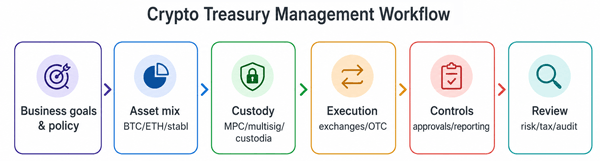
Crypto Treasury Management Workflow
3.1 Define treasury goals
The organization decides why it holds crypto. Goals may include operating liquidity, long-term investment, customer payments, protocol reserves, market-making, grants, staking, or ecosystem incentives.
3.2 Set an asset allocation policy
The team defines target ranges. For example: 50-70% stablecoins for operations, 10-30% BTC or ETH for long-term reserves, and 0-20% native tokens for ecosystem needs.
3.3 Choose custody and wallet controls
The organization selects self-custody, institutional custody, multisig wallets, MPC wallets, hardware wallets, or a hybrid model. It defines who can initiate, approve, and execute transactions.
3.4 Manage liquidity and execution
The treasury team decides how funds move between wallets, exchanges, OTC desks, payment providers, and bank accounts. It also manages slippage, fees, withdrawal limits, and timing.
3.5 Record, reconcile, and report
Every transaction should be categorized and matched to a business purpose. Wallet balances, exchange balances, bank movements, fees, and valuations must be reconciled regularly.
3.6 Review risk and update policy
Market conditions, regulations, counterparties, and business needs change. A treasury policy should be reviewed at least quarterly, and after major incidents or strategic changes.
4. Common Types of Crypto Treasury Assets
| Asset type | Typical use | Main risks |
|---|---|---|
| Stablecoins | Payments, working capital, settlements, exchange liquidity, DeFi operations. | Issuer risk, depeg risk, chain risk, regulatory restrictions, reserve transparency concerns. |
| Bitcoin (BTC) | Long-term reserve, inflation hedge thesis, treasury diversification. | High price volatility, accounting/tax complexity, custody risk, liquidity timing risk. |
| Ether (ETH) | Reserve asset, gas fees, staking, ecosystem participation. | Volatility, staking lockups or slashing risk, protocol and execution risk. |
| Native or governance tokens | Protocol ownership, incentives, voting, ecosystem grants. | Concentration risk, liquidity risk, governance attacks, securities-law uncertainty. |
| Tokenized treasury bills or funds | On-chain access to yield-like cash management products. | Issuer, legal, redemption, custody, smart contract, and jurisdiction risk. |
| DeFi positions | Yield, liquidity provision, borrowing/lending, protocol operations. | Smart contract exploits, oracle failures, liquidation, impermanent loss, governance risk. |
5. Examples of Crypto Treasury Management in Practice
5.1 Example: Startup accepting stablecoin payments
A software company accepts USDC from international customers. Its policy says customer payments are swept daily into a multisig wallet, 80% is converted to bank cash every week for payroll and taxes, and 20% remains in stablecoins for vendor payments. Transfers above $10,000 need two approvals; transfers above $100,000 need CFO and founder approval.
5.2 Example: DAO managing protocol reserves
A DAO holds its native token, stablecoins, ETH, and liquidity positions. The DAO creates a treasury committee, uses an on-chain multisig, publishes monthly reports, keeps 18 months of operating expenses in stablecoins, and limits DeFi exposure to a defined percentage of treasury value.
5.3 Example: Business holding Bitcoin as a long-term reserve
A company decides to hold part of its excess cash in Bitcoin. It sets a maximum allocation, uses an institutional custodian, separates trading authority from withdrawal authority, and reviews liquidity needs before buying. It does not use operating cash needed for payroll, taxes, or debt payments.
5.4 Example: Crypto fund or market maker
A digital asset fund needs assets available across exchanges and custodians. It uses whitelisted addresses, withdrawal delays, risk limits by counterparty, daily reconciliation, and incident playbooks. It avoids keeping more funds on any exchange than needed for near-term trading.
6. Crypto Treasury Management vs Traditional Treasury
| Topic | Traditional treasury | Crypto treasury |
|---|---|---|
| Asset movement | Bank transfers, cards, wires, payment processors. | Blockchain transfers, exchanges, OTC desks, wallets, bridges, smart contracts. |
| Operating hours | Often limited by banking rails and business days. | Markets and transfers operate 24/7. |
| Transaction reversibility | Some payments can be recalled, disputed, or reversed. | Most blockchain transfers are final once confirmed. |
| Security model | Bank controls, account permissions, fraud monitoring. | Private keys, wallet policies, multisig/MPC, address whitelists. |
| Valuation | Cash is stable; investments have established reporting systems. | Crypto prices can be highly volatile and require frequent valuation. |
| Compliance | Mature banking, AML, tax, and reporting frameworks. | Rapidly evolving rules by jurisdiction and asset type. |
7. Benefits of Crypto Treasury Management
- Better control over private keys, approvals, and spending authority.
- Improved liquidity planning for crypto-native revenue and expenses.
- Lower risk of lost funds due to accidental transfers or compromised accounts.
- Cleaner records for audits, tax filings, management reporting, and investor updates.
- More disciplined asset allocation instead of emotional buying, selling, or yield chasing.
- Ability to use crypto payment rails while still maintaining business-grade controls.
8. Major Risks and Limitations
| Risk | What can go wrong | Practical control |
|---|---|---|
| Market volatility | Treasury value falls before expenses are due. | Keep operating runway in cash or high-quality stable assets; set allocation limits. |
| Custody failure | Keys are lost, stolen, or controlled by the wrong person. | Use multisig/MPC, role separation, backups, and tested recovery procedures. |
| Counterparty risk | Exchange, custodian, issuer, or OTC desk fails or freezes funds. | Diversify providers, conduct due diligence, set exposure limits, withdraw idle funds. |
| Stablecoin depeg | A stablecoin trades below its intended value. | Diversify stablecoins carefully, monitor reserves and liquidity, maintain bank cash. |
| Smart contract risk | A DeFi protocol, bridge, or contract is exploited. | Use audited protocols cautiously, cap exposure, avoid unnecessary complexity. |
| Compliance risk | Transfers involve sanctioned addresses, weak KYB/KYC, or restricted assets. | Use screening tools, approved providers, documented controls, and legal review. |
| Accounting and tax risk | Incomplete records lead to errors, penalties, or delayed audits. | Reconcile wallets regularly and use crypto accounting software with human review. |
| Governance risk | Insiders approve bad transfers or unclear proposals. | Require quorum, spending limits, conflict rules, and transparent reporting. |
9. Custody Options for a Crypto Treasury
Custody is one of the most important decisions because whoever controls the private keys can usually control the assets. Most organizations use one of three models.
| Custody model | Best for | Advantages | Trade-offs |
|---|---|---|---|
| Self-custody | Small teams with strong technical skills or crypto-native DAOs. | Direct control, no custodian dependency, flexible on-chain access. | Higher operational burden; mistakes can be irreversible. |
| Institutional custodian | Companies, funds, and regulated entities needing insurance, reporting, and controls. | Professional security, audit support, governance features. | Fees, onboarding requirements, withdrawal processes, provider dependency. |
| Hybrid custody | Organizations needing both secure storage and active on-chain operations. | Balances cold storage, operational wallets, and third-party controls. | Requires clear architecture and disciplined reconciliation. |
9.1 MPC, Multisig, and Hardware Wallets
- Multisig wallets require multiple signatures before funds move. They are transparent and popular with DAOs, but depend on smart contract wallet security and signer discipline.
- MPC wallets split signing authority into separate key shares. They can support business workflows and reduce single-key risk, but users must understand provider design and recovery rules.
- Hardware wallets store keys offline and are useful for smaller treasuries or individual signers, but they still need secure backups and governance controls.
10. How to Create a Crypto Treasury Policy
A crypto treasury policy does not need to be complicated at the start. A clear one-page policy is better than a long document nobody follows. It should answer these questions:
- What assets are allowed and prohibited?
- What is the target allocation and maximum exposure for each asset type?
- Which wallets, custodians, exchanges, and chains are approved?
- Who can initiate, approve, and execute transactions?
- What are the approval thresholds for different transaction sizes?
- How are wallet addresses verified and whitelisted?
- How often are balances reconciled and reported?
- What happens during a security incident, signer departure, depeg, or market crash?
- Who reviews the policy and how often?
| Policy item | Example rule |
|---|---|
| Operating runway | Maintain at least 12 months of expected operating expenses in bank cash or approved stable assets. |
| Single asset limit | No volatile crypto asset may exceed 25% of treasury value without board or DAO approval. |
| Exchange exposure | Do not leave more than 10% of treasury value on any exchange unless needed for active execution. |
| Transfer approval | Transfers above $25,000 require at least two authorized approvers. |
| Address whitelisting | All new withdrawal addresses require out-of-band verification and a 24-hour waiting period. |
| Reporting | Treasury report prepared monthly, including balances, asset allocation, realized gains/losses, and risk exceptions. |
11. Best Practices for Crypto Treasury Management
11.1 Separate operating funds from investment funds
Do not expose payroll, taxes, rent, debt payments, or essential vendor payments to unnecessary volatility. Keep operating funds in the most reliable and liquid form available for your jurisdiction and business model.
11.2 Use role-based approvals
Separate the person who requests a transaction from the people who approve it. Large transfers should require more than one approver. No single employee, founder, contractor, or community member should be able to move material treasury funds alone.
11.3 Whitelist addresses and test transfers
For large transfers, use address whitelisting, out-of-band confirmation, and small test transfers. Verify the network as well as the address. Sending a token on the wrong chain can create costly recovery problems or permanent loss.
11.4 Limit exchange and bridge exposure
Exchanges and bridges are useful tools, not long-term vaults. Keep only the amount needed for near-term trading, conversion, or settlement. Withdraw idle balances to approved treasury wallets or custodians.
11.5 Reconcile frequently
At minimum, reconcile monthly. Active treasuries may need daily reconciliation. Match wallet balances, exchange balances, bank transfers, invoices, payroll, grants, gas fees, staking rewards, and realized gains or losses.
11.6 Document every business purpose
A blockchain transaction hash proves that a transfer happened. It does not explain why it happened. Each material transaction should have a business reason, approver record, counterparty, invoice or proposal reference, and accounting category.
11.7 Stress-test the treasury
Ask uncomfortable but realistic questions: What if Bitcoin falls 40%? What if a stablecoin depegs? What if an exchange freezes withdrawals? What if two signers are unavailable? What if a signer’s laptop is compromised? A good treasury plan survives bad days.
12. Accounting, Tax, and Regulatory Considerations
Crypto accounting rules vary by jurisdiction and asset type, so organizations should work with qualified advisers. In the United States, FASB ASU 2023-08 requires certain crypto assets within its scope to be measured at fair value, with changes recognized in net income for each reporting period. The SEC also issued Staff Accounting Bulletin No. 122 in January 2025, rescinding prior SAB 121 guidance related to safeguarding crypto assets for platform users. In the European Union, MiCA creates a harmonized framework covering many crypto-assets and service providers, including transparency, authorization, and supervision requirements. Stablecoin rules are also changing in several jurisdictions.
- Do not assume all tokens have the same accounting treatment.
- Track cost basis, fair value, transaction fees, rewards, airdrops, conversions, and realized gains/losses.
- Document whether assets are held for operations, investment, customer custody, staking, liquidity provision, or another purpose.
- Understand local rules for stablecoins, payment activity, custody, securities, commodities, AML, sanctions, and tax reporting.
- Keep records that an independent auditor or tax professional can understand without relying only on wallet screenshots.
13. Tools Used in Crypto Treasury Management
| Tool category | Purpose | Examples of features to look for |
|---|---|---|
| Wallet infrastructure | Secure storage and transaction approvals. | Multisig, MPC, role permissions, policies, whitelists, recovery workflows. |
| Custodian | Professional safekeeping and institutional controls. | Insurance details, SOC reports, reporting, withdrawal rules, segregation. |
| Crypto accounting software | Bookkeeping, tax lots, transaction classification, reporting. | Wallet/exchange imports, cost basis, DeFi support, audit trails. |
| Portfolio dashboard | Treasury visibility and monitoring. | Balances by wallet, chain, asset, custodian, exposure limits, alerts. |
| Compliance tools | Screening and monitoring. | Sanctions screening, KYT, counterparty risk scores, alerts. |
| Execution providers | Buying, selling, and converting assets. | OTC access, exchange integrations, slippage controls, settlement options. |
14. Common Mistakes to Avoid
- Using one founder wallet as the company treasury.
- Keeping all funds on one exchange for convenience.
- Chasing DeFi yield without understanding smart contract and liquidity risks.
- Holding operating runway in highly volatile assets.
- Failing to document approvals and business reasons for transfers.
- Ignoring tax and accounting until year-end.
- Treating all stablecoins as equally safe.
- Not having a signer offboarding and key rotation process.
- Using the wrong blockchain network for a transfer.
- Confusing an on-chain balance with a complete financial statement.
15. Crypto Treasury Checklist
| Checklist question | Done? |
|---|---|
| Do we have a written crypto treasury policy? | Yes / No |
| Are asset allocation limits clearly defined? | Yes / No |
| Are all wallets, custodians, exchanges, and chains approved? | Yes / No |
| Do material transfers require multiple approvals? | Yes / No |
| Are withdrawal addresses whitelisted and verified? | Yes / No |
| Do we reconcile wallet and exchange balances regularly? | Yes / No |
| Do we track cost basis, fair value, fees, and business purpose? | Yes / No |
| Do we have an incident response plan? | Yes / No |
| Do we review stablecoin, custody, and counterparty risk? | Yes / No |
| Have accounting, tax, and legal advisers reviewed the setup? | Yes / No |
16. When Should a Business Use Crypto Treasury Management?
Any organization should use crypto treasury management if it holds meaningful digital assets, accepts crypto payments, pays vendors or contributors in crypto, issues tokens, manages DAO reserves, stakes assets, uses DeFi, or keeps funds across wallets and exchanges. The more assets, signers, chains, counterparties, or reporting duties involved, the more formal the treasury process should be.
17. FAQs About Crypto Treasury Management
17.1 What is crypto treasury management in simple terms?
It is the process of managing an organization’s digital assets safely and responsibly. It covers custody, approvals, liquidity, asset allocation, accounting, reporting, tax, and risk controls.
17.2 Is crypto treasury management only for large companies?
No. Small startups, DAOs, creators, nonprofits, and crypto-native teams also need it if they hold or move meaningful crypto funds. The controls can be simpler for smaller treasuries, but they should still exist.
17.3 Should a company keep its treasury in Bitcoin?
That depends on risk tolerance, cash needs, accounting treatment, and board or owner approval. Bitcoin may be used as a long-term reserve by some companies, but operating cash should generally not be exposed to severe volatility.
17.4 Are stablecoins safe for treasury management?
Stablecoins can be useful for payments and liquidity, but they are not risk-free. Consider issuer reserves, redemption rights, liquidity, chain support, regulatory status, and depeg history.
17.5 What is the safest custody method?
There is no universal safest method. Institutional custody may suit regulated companies, multisig may suit DAOs, MPC may suit teams needing flexible approvals, and hybrid models may suit active treasuries. The best setup depends on size, activity, expertise, and risk tolerance.
17.6 How often should a crypto treasury be reconciled?
Monthly may be enough for a small, low-activity treasury. Active businesses, funds, and DAOs may need daily or weekly reconciliation.
17.7 What is the biggest risk in crypto treasury management?
The biggest risks are usually custody failure, poor internal controls, market volatility, counterparty failure, and incomplete records. Many losses come from operational mistakes rather than complex market events.
17.8 Do crypto treasuries need legal and tax advice?
Yes. Rules differ by jurisdiction and asset type. Tax, accounting, AML, securities, custody, and payment laws can all matter.
17.9 Can a DAO have professional treasury management?
Yes. Many DAOs use treasury committees, multisig wallets, public reporting, spending proposals, stablecoin runway policies, and external service providers.
17.10 What should be included in a monthly crypto treasury report?
A useful report includes opening and closing balances, allocation by asset and wallet, major inflows and outflows, realized gains/losses, fees, counterparty exposure, policy exceptions, and upcoming liquidity needs.
18. Final Thoughts
Crypto treasury management turns digital assets from a risky pile of wallets into a controlled financial system. The goal is not to remove every risk, because crypto markets, technology, and regulations will always carry uncertainty. The goal is to make risks visible, limit avoidable losses, preserve liquidity, and create clear accountability.
For beginners, the best starting point is simple: write a treasury policy, separate operating funds from risky assets, use multi-person approvals, track every transaction, reconcile regularly, and get professional help for tax, accounting, and legal questions. A disciplined treasury process may feel boring, but in crypto, boring controls are often what keep organizations alive.
Sources Consulted and Checked
The following sources were consulted and checked while preparing this document and reviewing its accuracy.
- Financial Accounting Standards Board (FASB), ASU 2023-08 and related updates on accounting for certain crypto assets at fair value.
- U.S. Securities and Exchange Commission, Staff Accounting Bulletin No. 122, effective January 30, 2025, rescinding prior SAB 121 safeguarding guidance.
- European Securities and Markets Authority (ESMA), Markets in Crypto-Assets Regulation (MiCA) overview and regulatory framework.
- Reuters, Bank of England stablecoin policy update, June 22, 2026.
- Deloitte and PwC public guidance on crypto accounting and implementation considerations.
- Industry treasury management resources from digital asset custody and stablecoin infrastructure providers, reviewed for practical operational patterns.
Reader Advice
This article is provided for educational and informational purposes only. It is not personalized financial, investment, tax, accounting, regulatory, or legal advice, and it should not be treated as a recommendation to buy, sell, hold, custody, or use any digital asset, service, or strategy. Crypto assets and treasury activities involve significant risks, including price volatility, loss of private keys, fraud, cyberattacks, smart-contract failures, stablecoin depegging, counterparty insolvency, liquidity constraints, irreversible transactions, and possible loss of some or all funds. Rules, policies, laws, accounting treatments, tax requirements, and market statistics can change over time and vary by country or region. Readers should verify current information through official sources and consult appropriately qualified professional advisers before making decisions.