Corporate Bitcoin Treasuries: Complete Guide, Examples, Risks and Best Practices
A corporate Bitcoin treasury is a company strategy for holding Bitcoin on its balance sheet, usually as part of treasury reserves, long-term investment policy, or a broader Bitcoin-focused business model. In simple terms, it means a business owns Bitcoin in the same way it might hold cash, short-term investments, marketable securities, or other treasury assets.
The idea became widely known after MicroStrategy, now Strategy, began buying Bitcoin in 2020 and turned Bitcoin accumulation into a central part of its corporate identity. Since then, other public companies, miners, financial firms, technology companies, healthcare companies, and international businesses have experimented with Bitcoin treasury strategies. Some hold a small allocation. Others make Bitcoin the core of their balance sheet strategy.
This guide explains what corporate Bitcoin treasuries are, how they work, why companies use them, where the risks are, and what best practices a serious company should follow before adding Bitcoin to treasury reserves.
1. What Is a Corporate Bitcoin Treasury?
A corporate Bitcoin treasury is a formal company approach to buying, holding, safeguarding, accounting for, and reporting Bitcoin as a treasury asset.
It is important to separate three ideas:
| Term | Meaning | Example |
|---|---|---|
| Bitcoin payment acceptance | The company accepts Bitcoin from customers, often converts it to local currency, and may not hold much BTC. | An online retailer accepts BTC through a payment processor and settles into dollars. |
| Bitcoin investment | The company buys Bitcoin as a financial asset but it is not central to the business model. | A company puts 1% of excess cash into BTC as a long-term investment. |
| Bitcoin treasury strategy | The company has a defined policy for holding Bitcoin as part of treasury reserves or as a core balance sheet strategy. | A public company regularly raises capital or uses excess cash to accumulate BTC. |
A true Bitcoin treasury strategy should include governance, risk limits, custody controls, accounting treatment, liquidity planning, and disclosure standards. Without those pieces, it is not a treasury strategy; it is simply a speculative purchase.
2. Why Do Companies Hold Bitcoin in Treasury?
Companies consider Bitcoin for different reasons. The strongest cases usually connect Bitcoin to a clear business or treasury objective rather than hype.
| Reason | What the company is trying to achieve | Important caution |
|---|---|---|
| Inflation and currency hedge | Protect part of reserves from long-term currency debasement or weakening fiat purchasing power. | Bitcoin can fall sharply in the short and medium term, so it is not a stable hedge. |
| Long-term store of value thesis | Hold an asset with fixed supply and global liquidity. | The thesis depends on continued market adoption and liquidity. |
| Brand and shareholder positioning | Signal alignment with Bitcoin investors or a digital-asset strategy. | Brand benefits can reverse if the market turns or governance looks weak. |
| Capital markets strategy | Use equity, debt, convertibles, or preferred stock to increase Bitcoin per share. | This adds leverage, dilution, refinancing, and market-confidence risk. |
| Operational alignment | Support a business already connected to payments, mining, fintech, or Bitcoin services. | Treasury exposure should not distract from the operating business. |
3. How a Corporate Bitcoin Treasury Works
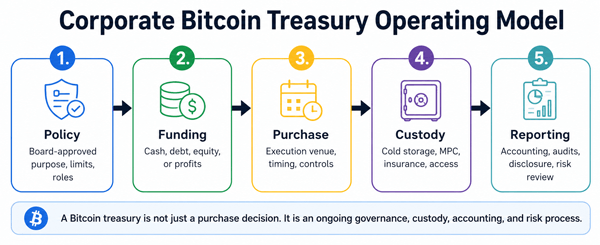
A responsible Bitcoin treasury program usually follows a structured process, not a single impulse buy.
3.1 Treasury Policy and Board Approval
The company first defines why Bitcoin is being considered. The board and management team should approve a written policy that explains the purpose, maximum exposure, funding source, custody model, permitted counterparties, reporting cadence, and conditions for buying or selling.
3.2 Capital Allocation Decision
The company decides how much Bitcoin exposure is appropriate. A conservative company may use a small percentage of excess cash. A Bitcoin-first company may use a much larger allocation and may raise capital specifically to buy Bitcoin. The bigger the allocation, the more important liquidity planning becomes.
3.3 Purchase Execution
Large purchases are normally executed through institutional exchanges, OTC desks, or prime brokers to reduce market impact and improve execution controls. Companies should document trade approvals, counterparties, fees, settlement procedures, and who is authorized to place orders.
3.4 Custody and Security
Bitcoin custody is one of the most important parts of the strategy. A company can self-custody, use a qualified custodian, use multi-signature wallets, use MPC wallet technology, or combine these approaches. The goal is to avoid both theft and accidental loss.
3.5 Accounting, Disclosure, and Ongoing Monitoring
After purchase, Bitcoin must be recorded, valued, audited, and disclosed properly. Under U.S. GAAP, FASB ASU 2023-08 introduced fair value accounting for certain crypto assets, including Bitcoin-like assets within the standard's scope, with changes recognized in net income for reporting periods after adoption. Companies also need risk-factor disclosures when crypto exposure is material.
4. Real-World Examples of Corporate Bitcoin Treasuries
The examples below show that there is no single Bitcoin treasury model. Some companies are Bitcoin-first. Others hold Bitcoin as a smaller reserve or strategic investment. Holdings change frequently, so readers should verify the latest figures from company filings or reputable treasury trackers before relying on exact numbers.
| Company | Approach | What beginners can learn |
|---|---|---|
| Strategy (formerly MicroStrategy) | The best-known Bitcoin treasury company. It has repeatedly raised capital and used proceeds to buy Bitcoin, making BTC central to its corporate identity. | This is the aggressive model: it can create strong Bitcoin exposure, but also adds stock volatility, financing, dilution, and debt/preferred-equity risk. |
| Tesla | Tesla bought Bitcoin in 2021, later sold a large portion, and has continued reporting digital assets in financial statements. | This shows a corporate treasury can buy, sell, and reduce exposure when management priorities change. |
| Block | Block has held Bitcoin as part of a broader fintech and Bitcoin-related strategy. Its investor materials have shown Bitcoin remeasurement gains and losses under fair value accounting. | This is an example of Bitcoin fitting alongside an operating business that already has crypto-related products and customers. |
| Semler Scientific | Semler announced in 2024 that it adopted Bitcoin as its primary treasury reserve asset. | This shows Bitcoin treasury strategies are not limited to software or crypto-native companies. |
| Metaplanet | A Japan-listed company that pivoted toward a Bitcoin treasury strategy and became one of the more visible non-U.S. examples. | This shows that the treasury model has spread internationally, but local regulation, tax, and capital markets matter. |
5. Corporate Bitcoin Treasury Models
| Model | Typical allocation | Suitable for | Main risk |
|---|---|---|---|
| Small strategic allocation | 1%-5% of excess cash or investable reserves | Companies testing Bitcoin exposure without changing the business model | Price volatility may still affect earnings and investor perception. |
| Moderate reserve allocation | 5%-25% of treasury assets | Companies with high risk tolerance and long time horizons | Liquidity and accounting swings become more important. |
| Bitcoin-first treasury | Large share of balance sheet; may raise capital to buy BTC | Companies intentionally repositioning around Bitcoin exposure | High dependence on Bitcoin price, capital markets access, and shareholder confidence. |
| Operating-business aligned holding | Varies based on business model | Miners, exchanges, payment firms, fintech companies | Operational and treasury risks can become correlated during crypto downturns. |
6. Benefits of Corporate Bitcoin Treasuries
- Potential long-term upside if Bitcoin adoption and liquidity continue to grow.
- Diversification away from purely fiat cash and short-term instruments, although Bitcoin is not a low-risk asset.
- A clear strategic identity for companies that want exposure to Bitcoin or serve Bitcoin-focused customers.
- Potential shareholder appeal among investors seeking public-equity Bitcoin exposure.
- More transparent treasury policy when the company explains its holdings, custody, and risk controls clearly.
7. Risks and Limitations of Corporate Bitcoin Treasuries
The risks are not theoretical. Bitcoin can be highly volatile, accounting results can swing, custody mistakes can be permanent, and capital markets can become less friendly exactly when a company needs liquidity.
| Risk | What it means | Practical control |
|---|---|---|
| Price volatility | Bitcoin can decline sharply, reducing asset value and potentially hurting the share price. | Use exposure limits, stress tests, liquidity buffers, and clear investor disclosure. |
| Liquidity mismatch | A company may need cash for payroll, debt, taxes, or operations during a Bitcoin downturn. | Do not use operating cash that may be needed within 12-24 months. |
| Custody failure | Private keys can be stolen, lost, mismanaged, or accessed by unauthorized people. | Use qualified custody, multi-approval controls, key backups, insurance review, and independent audits. |
| Accounting volatility | Fair value gains and losses can affect reported net income. | Educate investors and management about earnings volatility before adoption. |
| Regulatory and disclosure risk | Public companies may need detailed risk disclosures and controls. | Coordinate legal, finance, audit, tax, and investor-relations teams early. |
| Financing and dilution risk | Issuing stock, debt, convertibles, or preferred shares to buy BTC can magnify outcomes. | Model downside scenarios and avoid structures that force selling in a downturn. |
| Reputation risk | Stakeholders may see the strategy as speculation rather than treasury management. | Explain the purpose, limits, governance, and risk management in plain language. |
8. Accounting and Reporting Considerations
Accounting rules are one reason companies should involve finance and audit teams before buying Bitcoin. Under the previous U.S. GAAP approach, many companies treated crypto assets as indefinite-lived intangible assets, which created impairment issues. FASB ASU 2023-08 changed the treatment for in-scope crypto assets by requiring fair value measurement and recognition of changes in net income after adoption.
For beginners, the key point is simple: Bitcoin on a corporate balance sheet can affect reported earnings even when the company does not sell. If Bitcoin rises, the company may report gains. If Bitcoin falls, it may report losses. Those movements can make earnings look more volatile than the operating business alone.
Public companies also need to think about disclosure. The SEC staff has previously asked companies to disclose material crypto-market developments, price volatility, custody risks, financing risks, and other crypto-related exposures when relevant to the company's business, financial condition, or share price.
9. Bitcoin Custody Options for Companies
| Custody option | How it works | Pros | Cons |
|---|---|---|---|
| Qualified custodian | A regulated or institutional custodian holds the Bitcoin for the company. | Professional controls, audit support, insurance options, easier governance. | Fees, counterparty risk, less direct control. |
| Self-custody | The company controls its own private keys. | Maximum control and no custodian counterparty. | High operational burden; mistakes can be irreversible. |
| Multi-signature wallet | Several keys are required to move funds. Keys can be split across executives, custodians, or service providers. | Reduces single-person failure and improves approval controls. | More complex setup and recovery planning. |
| MPC wallet | Private key control is split into cryptographic shares rather than traditional key fragments. | Useful for institutions needing flexible approval workflows. | Vendor risk and technical complexity. |
| Hybrid model | A company combines custodian, multi-sig, cold storage, and internal controls. | Can balance security, liquidity, and governance. | Requires careful policy design. |
10. Best Practices for Corporate Bitcoin Treasury Management
- Start with a written investment thesis. The company should explain why Bitcoin belongs in treasury, what problem it solves, and why the chosen allocation is appropriate.
- Separate operating cash from investment reserves. Money needed for payroll, suppliers, taxes, debt service, or working capital should not be exposed to Bitcoin volatility.
- Set board-approved limits. Define maximum allocation, purchase authority, rebalancing rules, sale conditions, counterparty limits, and reporting frequency.
- Run downside stress tests. Model Bitcoin price drops of 30%, 50%, and 80%, plus financing stress, revenue decline, and liquidity needs occurring at the same time.
- Use institutional-grade custody. Require multi-person approvals, segregation of duties, transaction whitelists, cold-storage procedures, recovery plans, and independent control reviews.
- Document every transaction. Keep records of approvals, trade tickets, counterparties, fees, wallet addresses, confirmations, tax lots, and reconciliation reports.
- Coordinate legal, tax, audit, and investor relations before buying. The strategy affects disclosures, tax reporting, financial statements, and shareholder messaging.
- Avoid over-leverage. Debt or preferred equity used to buy Bitcoin can magnify gains, but it can also create forced-selling or refinancing pressure during a downturn.
- Communicate honestly. Investors should understand the purpose, risks, time horizon, accounting effects, custody model, and liquidity plan.
- Review the policy regularly. Bitcoin markets, accounting rules, regulations, and company liquidity needs can change quickly.
11. Corporate Bitcoin Treasury Policy Checklist
| Policy area | Questions to answer before buying |
|---|---|
| Purpose | Is the goal inflation protection, long-term reserve growth, brand positioning, Bitcoin exposure, or operating-business alignment? |
| Allocation | What percentage of cash, reserves, or total assets may be held in Bitcoin? What is the maximum limit? |
| Funding | Will purchases come from excess cash, operating cash flow, debt, equity, convertibles, or preferred shares? |
| Liquidity | How much cash must remain available for 12-24 months of expected obligations? |
| Execution | Who can approve purchases? Which exchanges, brokers, or OTC desks are permitted? |
| Custody | Who controls keys? What approvals are needed to move funds? What happens if an authorized person leaves? |
| Accounting | How will fair value, gains, losses, tax lots, and reconciliations be handled? |
| Disclosure | What will be disclosed to shareholders, lenders, auditors, regulators, employees, and customers? |
| Risk review | How often will the board review exposure, performance, controls, and market conditions? |
| Exit rules | Under what conditions would the company sell, reduce exposure, or pause purchases? |
12. Common Mistakes Companies Make
- Buying Bitcoin before creating a treasury policy.
- Using cash that may be needed for operations.
- Treating custody as an IT task instead of a board-level financial control issue.
- Ignoring accounting volatility and then surprising investors later.
- Assuming Bitcoin is automatically a hedge in every market environment.
- Relying on one executive or one vendor without recovery and succession planning.
- Using leverage without modeling a severe Bitcoin bear market.
- Copying another company’s strategy without matching it to the company’s own liquidity, industry, shareholders, and risk tolerance.
13. Should Small and Medium-Sized Businesses Hold Bitcoin?
For most small and medium-sized businesses, a Bitcoin treasury should be approached cautiously. A business that struggles with cash-flow forecasting, tax planning, bookkeeping, or basic internal controls is usually not ready to manage Bitcoin treasury risk.
A small business considering Bitcoin should start with a limited policy, use only surplus funds, avoid leverage, use reputable custody, and speak with a qualified accountant and tax adviser. The goal should be survival first, optional upside second.
14. When a Bitcoin Treasury Strategy May Not Make Sense
- The company has thin cash reserves or unpredictable cash flow.
- Debt covenants or lender expectations limit risky asset holdings.
- Management cannot clearly explain why Bitcoin fits the company’s treasury policy.
- The board is uncomfortable with large mark-to-market earnings swings.
- The company lacks strong custody, audit, and internal-control capabilities.
- Shareholders expect a conservative cash-management strategy.
15. FAQs About Corporate Bitcoin Treasuries
15.1 What is a corporate Bitcoin treasury?
It is a company program for holding Bitcoin as a treasury or balance sheet asset, supported by policies for governance, custody, accounting, disclosure, liquidity, and risk management.
15.2 Why would a company buy Bitcoin?
Common reasons include long-term store-of-value beliefs, diversification away from fiat cash, shareholder positioning, alignment with a Bitcoin-related business model, or an aggressive capital markets strategy.
15.3 Is Bitcoin a cash equivalent for companies?
No. Bitcoin is not cash or a cash equivalent. It is a volatile crypto asset and should be treated differently from bank deposits, money market funds, or Treasury bills.
15.4 Can a company lose money with a Bitcoin treasury?
Yes. Bitcoin can fall sharply, and companies may report losses under fair value accounting. If the company uses leverage, the downside can be much larger.
15.5 Do companies need special custody for Bitcoin?
Yes. Corporate Bitcoin custody should involve institutional controls such as multi-person approvals, secure key management, recovery procedures, segregation of duties, and regular reconciliation.
15.6 Are corporate Bitcoin treasuries only for public companies?
No. Private companies can hold Bitcoin too, but public companies face more disclosure, investor-relations, audit, and regulatory scrutiny.
15.7 What is the biggest risk?
The biggest risk depends on the company, but the most common are price volatility, liquidity mismatch, custody failure, accounting volatility, regulatory disclosure risk, and over-leverage.
15.8 How much Bitcoin should a company hold?
There is no universal answer. A company should base the allocation on cash needs, risk tolerance, board policy, debt obligations, shareholder expectations, and downside stress tests.
15.9 Can Bitcoin treasury holdings improve shareholder value?
They can if Bitcoin appreciates and the strategy is well governed, but they can also hurt shareholder value if Bitcoin falls, financing becomes expensive, or investors lose confidence.
15.10 What is the safest way for a company to start?
The safest approach is usually a small allocation from true excess reserves, board-approved limits, institutional custody, no leverage, strong accounting processes, and transparent disclosure.
16. Final Thoughts
Corporate Bitcoin treasuries can be powerful, but they are not simple. For some companies, Bitcoin may be a strategic reserve asset, a shareholder-positioning tool, or a natural extension of a Bitcoin-related business model. For others, it may create unnecessary volatility, governance problems, liquidity risk, and reputational pressure.
The best Bitcoin treasury strategies are not built on excitement alone. They are built on clear purpose, conservative liquidity planning, strong custody, careful accounting, honest disclosure, and disciplined risk management. A company should be able to explain not only why it wants Bitcoin, but also what it will do if Bitcoin falls sharply, if financing conditions worsen, or if stakeholders question the strategy.
In short: Bitcoin can be a treasury asset, but it should be managed like a serious corporate risk program, not like a casual trade.
Sources Consulted and Checked
These sources were consulted and checked while preparing this document and reviewing its accuracy.
- FASB Accounting Standards Update 2023-08, Accounting for and Disclosure of Crypto Assets
- Financial Accounting Standards Board news release on fair value accounting for certain crypto assets
- U.S. Securities and Exchange Commission sample letter on crypto-asset market developments and company disclosures
- Strategy corporate Bitcoin purchases information
- BitcoinTreasuries.net public-company treasury tracker
- Semler Scientific Bitcoin treasury information
- Tesla first-quarter 2026 investor update discussing digital-asset accounting treatment
- Block first-quarter 2026 investor presentation discussing Bitcoin remeasurement effects
- CoinGecko Bitcoin treasuries tracker
Reader Advice
This article is provided for educational and informational purposes only and is not personalized legal, financial, accounting, tax, investment, or risk-management advice or a recommendation to buy, hold, sell, or finance Bitcoin. Corporate treasury decisions can involve substantial price, liquidity, custody, cybersecurity, financing, disclosure, regulatory, tax, and reputational risks, including the possible loss of invested funds. Rules, policies, laws, accounting standards, market data, and statistics may change over time and may vary by country, state, industry, and company circumstances. Readers should verify current information through official sources and consult appropriately qualified professional advisers before making or implementing any decision.