Enterprise Blockchain Use Cases: Complete Guide, Examples, Risks and Best Practices
Enterprise blockchain is the use of blockchain or distributed ledger technology by businesses, banks, governments, and industry networks to share trusted data, automate multi-party workflows, and improve traceability across organizations.
Unlike public cryptocurrency networks that anyone can join, most enterprise blockchain systems are permissioned. That means participants are known, access is controlled, and business rules are agreed in advance. The goal is not speculation. The goal is usually better coordination between companies that do not fully trust each other but still need to work from the same records.
This guide explains enterprise blockchain use cases in plain English. It covers how the technology works, where it makes sense, real-world examples, benefits, risks, mistakes to avoid, and practical best practices for planning an enterprise blockchain project.
1. What Is Enterprise Blockchain?
Enterprise blockchain is a shared digital record used by multiple approved organizations. It stores transactions, events, documents, or asset records in a way that is difficult to secretly change after the fact.
Think of it as a shared business notebook. Instead of each company keeping a separate version of the same process, the approved parties write updates to one agreed record. Everyone sees the version they are allowed to see, and the system keeps a time-stamped history of what happened.
Enterprise blockchain is often called distributed ledger technology, or DLT. In business settings, the term DLT is sometimes used more broadly because the system may not look exactly like public blockchains such as Bitcoin or Ethereum.
1.1 Enterprise Blockchain vs Public Blockchain
| Feature | Public blockchain | Enterprise blockchain |
|---|---|---|
| Access | Open to anyone | Usually limited to approved participants |
| Identity | Users can be pseudonymous | Participants are normally known businesses or institutions |
| Main purpose | Open value transfer, decentralized applications, crypto assets | Shared records, settlement, traceability, compliance, workflow automation |
| Governance | Community, protocol developers, validators, miners, token holders | Consortium, company, bank, regulator, or industry group |
| Privacy | Data is often visible publicly, though privacy tools exist | Privacy controls are usually built into the network design |
| Typical examples | Bitcoin, Ethereum, Solana | Hyperledger Fabric networks, Corda networks, Quorum/Besu-based systems, bank-led tokenization platforms |
2. How Enterprise Blockchain Works
The basic process is easier to understand when you follow a business event from start to finish.
- A business event happens, such as a shipment leaving a factory, an invoice being approved, a bond being issued, or a product batch being scanned.
- The event is submitted to the blockchain network by an approved participant or connected system.
- The network checks rules, permissions, signatures, and data format.
- Once validated, the event is added to the shared ledger.
- Other approved participants can view or act on the record, depending on their permissions.
- Smart contracts or workflow rules can trigger actions such as payment, alerts, settlement, reporting, or compliance checks.
In practice, enterprise blockchain is usually not a standalone system. It connects with existing ERP systems, banking systems, identity tools, IoT sensors, document platforms, and analytics dashboards.
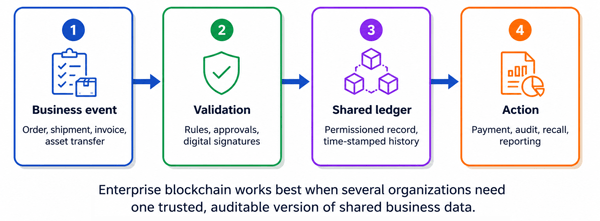
Diagram: A simplified enterprise blockchain workflow.
3. Why Enterprises Use Blockchain
Enterprises do not need blockchain for every database problem. A normal database is often cheaper, faster, and simpler when one company controls the data. Enterprise blockchain becomes more useful when several independent parties need to coordinate around shared data, shared assets, or shared obligations.
- Shared source of truth: Different organizations can work from the same verified record instead of reconciling separate spreadsheets and databases.
- Traceability: A product, document, payment, or asset can be tracked across its life cycle.
- Auditability: The system can preserve a record of who submitted what and when.
- Automation: Smart contracts can reduce manual handoffs, delays, and duplicate checks.
- Lower reconciliation effort: Participants may spend less time matching records across systems.
- Programmable assets: Digital tokens can represent cash, securities, invoices, loyalty points, carbon credits, or other rights.
4. When Enterprise Blockchain Makes Sense
A blockchain project is more likely to be useful when the business problem has several of these conditions:
- Multiple organizations need to write to or verify the same record.
- No single party is trusted enough to control the entire system alone.
- Audit history matters, such as for compliance, disputes, recalls, or settlement.
- The current process relies on manual reconciliation, duplicate data entry, or slow document exchange.
- Participants can agree on common data standards and governance rules.
- There is a strong business reason for participants to join and keep using the network.
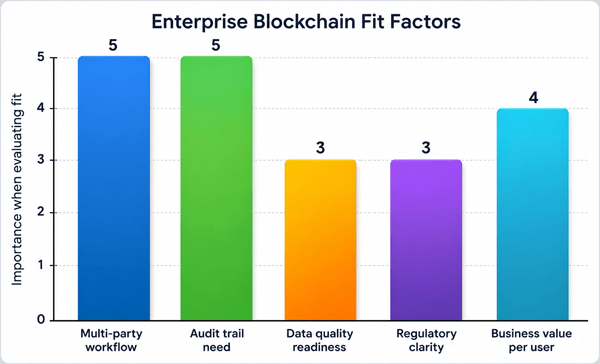
Chart: The strongest enterprise blockchain candidates usually combine multi-party workflows, audit needs, and clear business value.
4.1 When Blockchain Is Probably Not the Right Fit
- Only one company controls the process and does not need outside verification.
- The main issue is poor internal data quality rather than lack of trust between parties.
- The system needs very high-speed internal transactions that a normal database can handle better.
- The participants cannot agree on governance, standards, fees, or liability.
- The use case requires private data to be widely shared without a strong privacy design.
- There is no clear return on investment beyond saying the company is using blockchain.
5. Major Enterprise Blockchain Use Cases
The strongest use cases usually involve shared records, cross-company workflows, digital assets, and compliance-heavy industries. Below are the most important categories.
5.1 Supply Chain Traceability
Supply chain traceability is one of the most common enterprise blockchain use cases. It helps companies record product movements from raw materials to manufacturing, shipping, distribution, retail, and sometimes the end customer.
For example, a food company might record farm origin, processing dates, shipping temperature, inspection records, and store delivery. If a contamination issue occurs, the company can narrow down affected batches more quickly instead of recalling more products than necessary.
IBM Food Trust is a well-known example of a blockchain-based food supply chain network. IBM describes it as a SaaS food-safety solution powered by the IBM Blockchain Platform that helps supply chain participants securely share data to improve traceability and safety. Walmart, Carrefour, and other food industry participants have been associated with food traceability blockchain initiatives in different periods. The important lesson is not that every food supply chain needs blockchain, but that shared, permissioned records can help when many organizations need trusted traceability.
| Practical use | How blockchain helps | Business value |
|---|---|---|
| Food traceability | Records farm, batch, processing, and distribution events | Faster recalls, better transparency, improved supplier accountability |
| Pharmaceutical tracking | Tracks medicine batches and handoffs | Helps fight counterfeits and supports compliance |
| Luxury goods provenance | Stores product origin and ownership history | Helps verify authenticity and reduce fraud |
| Automotive parts | Tracks parts across suppliers and factories | Improves recall precision and supplier quality monitoring |
5.2 Trade Finance and Letters of Credit
Trade finance is paperwork-heavy. A cross-border shipment can involve buyers, sellers, banks, insurers, freight forwarders, customs agents, and inspection companies. Each party may hold a different version of documents such as invoices, bills of lading, insurance certificates, and letters of credit.
Enterprise blockchain can create a shared workflow where approved parties submit and verify trade documents. Smart contracts can release payment when conditions are met, such as proof that goods were shipped and documents were accepted.
The benefit is not simply making documents digital. The bigger benefit is reducing delays, disputes, duplicate checks, and fraud risk across parties that do not share one internal system.
5.3 Cross-Border Payments and Settlement
Traditional cross-border payments often move through several correspondent banks. This can create delays, fees, cut-off times, and limited transparency. Enterprise blockchain can support near-real-time settlement, 24/7 operations, tokenized deposits, and programmable payment flows.
Kinexys by J.P. Morgan, formerly associated with Onyx, is an example of a bank-led blockchain platform focused on programmable payments, asset tokenization, and near-real-time settlement across global markets. Large financial institutions are also testing tokenized commercial bank deposits and central bank money for cross-border settlement through industry initiatives such as Project Agorá.
For businesses, the practical value may include faster supplier payments, better treasury visibility, automated conditional payments, and lower reconciliation work. However, these systems must meet strict rules for identity, sanctions screening, liquidity, privacy, and legal finality.
5.4 Asset Tokenization
Asset tokenization means representing ownership rights or claims to an asset as digital tokens on a blockchain or distributed ledger. The asset might be financial, such as bonds, money market fund shares, deposits, or private funds. It can also be non-financial, such as real estate interests, carbon credits, or invoices.
Tokenization can make assets easier to transfer, settle, divide, or use as collateral. In capital markets, blockchain can support faster settlement and more automated post-trade processes. In private markets, tokenization may reduce some administrative friction, though legal, custody, and investor protection rules remain critical.
| Tokenized asset | Enterprise use case | Key caution |
|---|---|---|
| Bonds | Digital issuance, coupon payments, settlement | Legal enforceability and market liquidity matter |
| Money market funds | On-chain share records and settlement options | Investor eligibility and custody controls are essential |
| Invoices | Supply chain finance and invoice discounting | Fraud checks and real receivable validation are still needed |
| Carbon credits | Traceability, retirement records, marketplace settlement | Quality of the underlying credit is more important than the token |
| Real estate interests | Fractional ownership records and investor administration | Securities laws and ownership rights must be clear |
5.5 Digital Identity and Access Management
Enterprise blockchain can support decentralized identity, verifiable credentials, and reusable digital proofs. Instead of repeatedly sending sensitive documents to many organizations, a person or company can present cryptographic proof that a trusted issuer verified something.
For example, a supplier could prove it has a valid certification, a customer could prove age or residency, or an employee could prove a professional credential. The verifier checks the credential without needing to call the issuer every time.
This can reduce onboarding friction, improve privacy, and lower verification costs. But identity systems need strong governance, recovery processes, and privacy protections. A bad identity design can create surveillance risks or lock users out of important services.
5.6 Healthcare Data Sharing and Clinical Records
Healthcare organizations often struggle with fragmented data. Hospitals, labs, insurers, pharmacies, and patients may all hold different pieces of the record. Enterprise blockchain can help manage consent, audit data access, and verify records across organizations.
A practical healthcare blockchain system should not put sensitive medical records directly on-chain. Instead, it may store hashes, permissions, consent records, and access logs while the actual clinical data remains in secure health systems. This approach helps prove data integrity without exposing private information.
- Patient consent management for data sharing.
- Audit logs for who accessed a record and when.
- Verification of clinical trial data integrity.
- Drug traceability and anti-counterfeit tracking.
5.7 Insurance Claims and Parametric Insurance
Insurance involves verification, documents, claims assessment, and payments. Blockchain can help when several parties need the same claim record, such as insurers, reinsurers, brokers, repair networks, and customers.
Parametric insurance is a useful example. A policy pays automatically when an agreed event happens, such as rainfall below a certain level, a flight delay, or a shipping temperature breach. The smart contract can use trusted external data, called an oracle, to trigger payment.
The risk is that smart contracts are only as good as the policy terms, data source, and dispute process. A wrong oracle reading can create wrong payouts. Good governance and human escalation paths are still necessary.
5.8 Real Estate and Land Registries
Property transactions require trusted records of ownership, liens, inspections, taxes, and transfers. Blockchain can support land registry modernization, title history, escrow automation, and document verification.
In some countries, land registry blockchain pilots have explored ways to reduce fraud and improve record transparency. However, real estate is heavily tied to law, courts, notaries, and government authority. A blockchain record is not useful unless the legal system recognizes it and the off-chain data is accurate.
5.9 Government Records and Public Services
Governments can use permissioned blockchain for public records, licenses, procurement, grants, identity credentials, and inter-agency data sharing. The goal is usually integrity, transparency, and reduced paperwork.
- Business license verification.
- Public procurement audit trails.
- Digital credentials for education or professional licensing.
- Benefits distribution tracking.
- Inter-agency records where multiple departments need trusted updates.
The public sector must be especially careful with privacy, accessibility, vendor lock-in, legal authority, and long-term maintenance. A public service should not become harder to use because the technology behind it is fashionable.
5.10 Energy Trading and Grid Management
Energy markets involve producers, distributors, grid operators, businesses, households, regulators, and renewable energy certificate systems. Blockchain can help record energy production, peer-to-peer energy trading, renewable certificate issuance, and settlement between parties.
For example, a company buying renewable energy certificates may want stronger proof that certificates were issued once, transferred properly, and retired after use. Blockchain can improve the audit trail, but it cannot guarantee the physical electricity came from a renewable source unless the measurement and certification systems are trustworthy.
5.11 Manufacturing, IoT, and Maintenance Records
Manufacturers can use enterprise blockchain to track components, machine maintenance, quality inspections, warranties, and supplier certifications. When IoT sensors are involved, sensor data can be hashed or linked to blockchain records to prove that data was not changed later.
Common examples include aircraft parts, automotive components, industrial machinery, and high-value equipment. A shared ledger can help manufacturers, suppliers, maintenance providers, and regulators verify the history of a part or machine.
5.12 Media, Intellectual Property, and Royalties
Media and intellectual property workflows often involve creators, publishers, platforms, distributors, advertisers, and rights holders. Blockchain can record ownership claims, licenses, usage events, and royalty splits.
The main benefit is clearer rights management and automated royalty distribution. The main limitation is that the blockchain cannot decide who truly owns a song, image, patent, or script if the original rights information is wrong or disputed. Legal contracts and industry standards remain essential.
6. Best Enterprise Blockchain Use Cases by Industry
| Industry | Strong use cases | Why it fits |
|---|---|---|
| Banking and capital markets | Cross-border settlement, tokenized deposits, tokenized securities, collateral management | Many parties, high reconciliation costs, strong audit requirements |
| Supply chain and logistics | Traceability, document sharing, customs workflows, cold-chain records | Many handoffs across companies and borders |
| Healthcare and pharma | Consent logs, drug traceability, clinical trial data integrity | Sensitive records, compliance needs, anti-counterfeit concerns |
| Insurance | Claims workflows, parametric insurance, reinsurance records | Multi-party verification and payment conditions |
| Government | Licenses, credentials, procurement, land records | Public trust, auditability, inter-agency coordination |
| Energy | Renewable certificates, peer-to-peer energy trading, settlement | Distributed producers and certificate verification |
| Manufacturing | Parts provenance, maintenance records, supplier certification | Complex supplier networks and safety requirements |
| Retail and consumer goods | Product authenticity, loyalty points, recall tracking | Brand trust, counterfeit prevention, customer transparency |
7. Benefits of Enterprise Blockchain
7.1 Better Transparency Between Parties
A shared ledger can reduce disputes about what happened, when it happened, and who approved it. This is useful in supply chains, finance, insurance, and regulated workflows.
7.2 Faster Reconciliation
Many enterprise processes are slow because companies spend time comparing separate records. A shared ledger can reduce matching work and manual follow-up.
7.3 Improved Audit Trails
Blockchain records are time-stamped and difficult to alter quietly. This can help with compliance, internal audits, dispute resolution, and fraud investigation.
7.4 Automation Through Smart Contracts
Smart contracts can apply agreed rules automatically. For example, payment can be released when shipment data, inspection approval, and invoice acceptance are all recorded.
7.5 New Business Models
Tokenization, programmable payments, digital credentials, and shared industry networks can create services that were difficult with older systems.
8. Risks and Limitations of Enterprise Blockchain
Enterprise blockchain has real potential, but it also has important risks. Many failed projects did not fail because the technology was impossible. They failed because the business model, governance, adoption plan, or data quality was weak.
| Risk | What it means | How to reduce it |
|---|---|---|
| Poor data quality | Bad data on-chain still creates bad decisions | Validate data before writing it; use trusted integrations and audits |
| Weak governance | Participants disagree over rules, costs, access, or upgrades | Create a governance charter before launch |
| Privacy exposure | Sensitive data may be visible to the wrong parties | Use permissioning, encryption, private channels, and off-chain storage |
| Legal uncertainty | A token or smart contract may not be legally enforceable | Get legal review early and define dispute processes |
| Vendor lock-in | The network depends too heavily on one vendor or platform | Use open standards where possible and plan exit options |
| Integration complexity | Legacy systems are hard to connect | Start with a narrow workflow and build APIs carefully |
| Cybersecurity risk | Keys, smart contracts, and nodes can be attacked | Use key management, audits, monitoring, and incident response |
| Low adoption | Participants do not join or do not keep data updated | Make the value clear for every participant, not just the sponsor |
9. Common Misconceptions About Enterprise Blockchain
9.1 Misconception 1: Blockchain automatically creates trust
Blockchain can improve trust in records, but it does not automatically make people honest. If someone enters false data, the blockchain may preserve the false data. Strong onboarding, validation, audits, and accountability are still needed.
9.2 Misconception 2: Everything should be stored on-chain
Most enterprise systems should not store large files or sensitive personal data directly on-chain. A better design is often to store data off-chain and keep hashes, proofs, permissions, or transaction references on-chain.
9.3 Misconception 3: Blockchain removes the need for legal agreements
Smart contracts can automate rules, but business contracts define rights, responsibilities, liability, and dispute resolution. Legal agreements are still needed.
9.4 Misconception 4: A private blockchain is always better than a database
A private blockchain can be useful for cross-company trust. But if a single company controls the process, a normal database is usually simpler and cheaper.
9.5 Misconception 5: Tokenization makes any asset liquid
Tokenization can make transfers easier, but it does not magically create buyers. Liquidity depends on legal clarity, market demand, investor access, custody, and trading infrastructure.
10. Enterprise Blockchain Platforms and Technologies
Different enterprise blockchain platforms serve different needs. The best choice depends on privacy, governance, interoperability, smart contract requirements, developer skills, and regulatory needs.
| Platform or approach | Common enterprise use | Notes |
|---|---|---|
| Hyperledger Fabric | Supply chain, identity, private consortium networks | Permissioned architecture with channels and modular components |
| R3 Corda | Financial services, trade finance, regulated workflows | Designed for privacy-focused business agreements between known parties |
| Quorum / Hyperledger Besu | Enterprise Ethereum networks, tokenization, financial workflows | Useful when Ethereum compatibility matters |
| Public Ethereum with enterprise controls | Tokenization, settlement, digital assets, proofs | Can provide broad interoperability, but privacy and compliance must be designed carefully |
| Bank-led blockchain platforms | Payments, deposits, settlement, tokenized assets | Often built around regulated participants and institutional workflows |
11. How to Choose the Right Enterprise Blockchain Use Case
Before choosing a platform, choose the right problem. A useful enterprise blockchain project begins with a business workflow, not a technology preference.
- Map the current process. Identify every party, document, approval, system, delay, and reconciliation step.
- Define the business pain. Is the problem fraud, delay, manual work, lack of transparency, compliance cost, or settlement risk?
- Confirm that multiple parties need shared records. If not, use a normal database or workflow tool.
- Estimate the value for each participant. A network fails if only the sponsor benefits.
- Check legal and privacy constraints. Decide what can be shared, what must remain private, and what needs regulatory approval.
- Start small with one high-value workflow. Avoid launching a broad industry network before proving the first use case.
- Set measurable success metrics. Examples include days saved, disputes reduced, recall time improved, settlement speed, or reconciliation cost reduction.
12. Enterprise Blockchain Implementation Roadmap
| Phase | Goal | Key outputs |
|---|---|---|
| 1. Discovery | Decide whether blockchain is the right fit | Problem statement, stakeholder map, ROI hypothesis |
| 2. Use case design | Define the workflow and data model | Process map, permissions, data fields, privacy requirements |
| 3. Governance design | Agree how the network will run | Participant roles, voting rights, fees, onboarding, upgrade rules |
| 4. Prototype | Test technical feasibility | Small working model, integration plan, user feedback |
| 5. Pilot | Run with limited real users or real records | Measured results, compliance review, operational lessons |
| 6. Production | Launch controlled operations | Security controls, monitoring, SLAs, support model |
| 7. Scale | Add participants and use cases | Interoperability, automation, analytics, network growth plan |
13. Best Practices for Enterprise Blockchain Projects
13.1 Start With Business Value, Not the Word Blockchain
Write down the business outcome in plain language. For example: reduce invoice disputes by 40%, cut settlement time from two days to same day, or trace affected product batches within minutes. If the outcome is vague, the project is not ready.
13.2 Use Blockchain Only for Shared Trust Problems
The best use cases involve multiple parties, shared records, audit needs, and limited trust. Do not use blockchain to replace a simple internal database.
13.3 Design Governance Before Technology
Decide who can join, who can write data, who pays, who operates nodes, who handles errors, and how upgrades are approved. Governance failures can kill a technically strong project.
13.4 Do Not Put Sensitive Data Directly On-Chain
Use off-chain storage for sensitive documents and personal data. Put hashes, references, permissions, or proofs on-chain. This is especially important for privacy laws and data deletion requirements.
13.5 Plan for Integration With Existing Systems
Most value comes when blockchain connects to ERP, warehouse, payment, identity, and reporting systems. Manual blockchain portals often fail because users do not want another system to update.
13.6 Build Strong Key Management
Private keys control access and signing. Use enterprise-grade key management, hardware security modules where appropriate, role-based access, recovery processes, and employee offboarding controls.
13.7 Audit Smart Contracts and Business Rules
Smart contracts can create costly mistakes if rules are wrong. Test edge cases, run security reviews, and create emergency controls for severe incidents.
13.8 Measure Adoption, Not Just Launch
A blockchain network only works if participants use it. Track active participants, data completeness, transaction volume, error rates, and business outcomes.
14. Enterprise Blockchain KPI Examples
| Use case | Useful KPIs |
|---|---|
| Supply chain traceability | Recall time, batch visibility, supplier data completeness, counterfeit incidents |
| Trade finance | Document processing time, discrepancy rate, payment release time, fraud incidents |
| Payments and settlement | Settlement time, failed transactions, reconciliation breaks, liquidity usage |
| Tokenization | Settlement speed, investor onboarding time, transfer cost, secondary market activity |
| Identity credentials | Verification time, onboarding completion rate, fraud rate, user consent errors |
| Insurance claims | Claim cycle time, dispute rate, automated payout rate, customer satisfaction |
15. Enterprise Blockchain Example Scenario
Imagine a food retailer wants to improve traceability for fresh mangoes. Today, the retailer receives supplier spreadsheets, transport records, warehouse updates, and inspection reports in separate systems. When a safety issue occurs, staff must email suppliers and manually compare records.
With an enterprise blockchain network, approved farms, packers, transport companies, warehouses, and retailers record key events: harvest date, batch ID, inspection status, temperature logs, shipment handoff, and store delivery. Sensitive commercial details stay private, but authorized parties can verify the batch history.
If a contamination concern appears, the retailer can search the affected batch and see the supply path quickly. It can recall specific lots instead of removing every mango shipment. The benefit is practical: faster response, lower waste, better supplier accountability, and clearer audit evidence.
16. Enterprise Blockchain Pros and Cons
| Pros | Cons |
|---|---|
| Improves shared visibility across organizations | Can be expensive and complex to govern |
| Reduces reconciliation and duplicate records | Does not fix bad data at the source |
| Creates strong audit trails | Privacy design can be difficult |
| Supports automation through smart contracts | Smart contract errors can be costly |
| Enables tokenization and programmable assets | Legal and regulatory clarity may be required |
| Can reduce fraud in certain workflows | Network adoption is hard if incentives are weak |
17. How Enterprise Blockchain Relates to AI, IoT, and Cloud
Enterprise blockchain is often more useful when combined with other technologies.
- IoT: Sensors can provide shipment temperature, machine status, energy production, or location data. Blockchain can preserve a tamper-evident record of selected events.
- AI: AI can analyze blockchain-linked data for fraud patterns, risk scoring, demand forecasting, or supplier performance. Blockchain can also help verify data provenance for AI systems.
- Cloud: Most enterprise blockchain deployments rely on cloud infrastructure, managed nodes, APIs, monitoring, and integration services.
- Digital identity: Identity and credential systems help verify who is allowed to participate and what they are authorized to do.
18. Security and Compliance Checklist
- Define participant identity and onboarding checks.
- Use role-based permissions and least-privilege access.
- Keep sensitive personal or commercial data off-chain where possible.
- Encrypt data in transit and at rest.
- Use secure key custody and recovery procedures.
- Audit smart contracts, integrations, and APIs.
- Monitor nodes, transaction failures, and suspicious activity.
- Document legal responsibilities and dispute resolution processes.
- Check sanctions, AML, KYC, securities, data protection, and industry-specific rules.
- Create an incident response plan before production launch.
19. Beginner-Friendly Glossary
| Term | Simple meaning |
|---|---|
| Blockchain | A shared digital record that stores transactions or events in linked records that are hard to secretly change |
| Distributed ledger | A shared database maintained across multiple systems or organizations |
| Permissioned blockchain | A blockchain where participants need approval to join or perform actions |
| Node | A computer or service that participates in the blockchain network |
| Smart contract | Code or business logic that runs agreed rules automatically |
| Tokenization | Representing an asset, claim, or right as a digital token |
| Oracle | A trusted data source that brings external information into a blockchain system |
| Hash | A digital fingerprint used to verify that data has not changed |
| Consensus | The method the network uses to agree on valid records |
| Interoperability | The ability of different systems or networks to work together |
20. FAQs About Enterprise Blockchain Use Cases
20.1 What is the best enterprise blockchain use case?
The best use case is usually one where multiple organizations need a shared, auditable record. Strong examples include supply chain traceability, cross-border settlement, trade finance, digital identity, and asset tokenization.
20.2 Is enterprise blockchain the same as cryptocurrency?
No. Cryptocurrency is one application of blockchain. Enterprise blockchain usually focuses on business records, payments, settlement, traceability, identity, and automation. Some enterprise systems use tokens, but many do not involve public cryptocurrencies.
20.3 Do companies need a public blockchain or a private blockchain?
It depends on the use case. A private or permissioned blockchain can be better for controlled business networks. A public blockchain can offer broader interoperability and transparency, but privacy, fees, compliance, and scalability must be carefully managed.
20.4 Can blockchain fix supply chain problems?
Blockchain can improve traceability and shared records, but it cannot fix bad supplier behavior, inaccurate data entry, poor logistics, or weak quality controls by itself. It works best with good data standards, audits, IoT, and strong supplier governance.
20.5 Are smart contracts legally binding?
Sometimes, but not automatically. Legal enforceability depends on jurisdiction, contract wording, parties, evidence, and the legal framework. Businesses should use legal agreements alongside smart contract code.
20.6 What is the biggest risk in enterprise blockchain?
The biggest risk is often not the technology. It is poor governance, weak participant incentives, unclear ROI, bad data quality, or legal uncertainty.
20.7 How much does enterprise blockchain cost?
Costs vary widely based on network size, platform, integrations, security, compliance, and support. A small prototype may be relatively modest, while a regulated multi-party production network can require significant investment.
20.8 Can small businesses use enterprise blockchain?
Yes, but small businesses usually participate in a network built by a larger company, bank, logistics provider, or industry group. Building a full network from scratch is often too expensive for a small business.
20.9 What should be stored on-chain?
Usually only transaction records, hashes, permissions, proofs, and essential state changes. Large files, sensitive personal data, and confidential business documents are usually better stored off-chain with blockchain references.
20.10 Will enterprise blockchain replace ERP systems?
No. Enterprise blockchain usually complements ERP systems. ERP manages internal company processes, while blockchain can help coordinate shared records across organizations.
21. Conclusion
Enterprise blockchain is most useful when businesses need trusted coordination across organizational boundaries. It can improve traceability, settlement, auditability, identity verification, and multi-party workflow automation. But it is not a magic replacement for databases, contracts, governance, or good data management.
The best enterprise blockchain projects start with a clear business problem, measurable value, strong governance, careful privacy design, and realistic adoption planning. If several parties need one trusted record and the current process is slow, costly, or hard to audit, blockchain may be worth exploring. If the problem is internal, simple, or mainly caused by poor data quality, a traditional database or workflow system may be the better choice.
Sources Consulted and Checked
The following sources were consulted and checked while preparing this article and reviewing its accuracy:
- IBM Think: Blockchain for supply chain and IBM Food Trust example
- IBM Documentation: IBM Food Trust with App Connect Enterprise
- J.P. Morgan Kinexys: Enterprise bank-led blockchain solutions
- J.P. Morgan: Introducing Kinexys, rebrand from Onyx
- Deloitte: Using blockchain to drive supply chain transparency
- Deloitte: Blockchain security risks for financial organizations
- Deutsche Bank Flow: Trade finance and blockchain case studies
- BIS Project Agorá information and updates
- Consensys: Blockchain use cases and applications by industry
Reader Advice
This article is for general educational and informational purposes and is not personalized legal, financial, investment, cybersecurity, compliance, or technical advice. It does not recommend any particular platform, token, vendor, or business model. Laws, policies, standards, costs, statistics, and technology capabilities change and vary by region and industry. Verify current information through official sources and seek suitable professional advice before acting. Enterprise blockchain may involve financial, privacy, cybersecurity, operational, vendor, legal, and adoption risks, so assess governance, security, benefits, limitations, and exit options carefully.